Sun’s up!

September 13th, 2022

Mike the Musicologist asked for a ruling on this one: which, frankly, I wasn’t even aware of until he asked, because I’d been busy with Godard and work and stuff.

Robert Sarver, majority owner of the Phoenix Suns and Phoenix Mercury franchises, will be suspended from any activities involving both teams for one year and fined $10 million for ”workplace misconduct and organizational deficiencies” found during an NBA investigation into allegations made against him, the league announced Tuesday.

The ruling here is: no, this does not count as a firing. Generally, I consider a defined length suspension to not be a firing by itself. If someone gets a one-year suspension and the team then announces they’re letting the guy go, that’s probably a firing. An “indefinite” suspension to me, counts as a firing. But in this case: not a firing, but still newsworthy.

The NBA statement said the firm’s investigation concluded that Sarver “engaged in conduct that clearly violated common workplace standards, as reflected in team and League rules and policies. This conduct included the use of racially insensitive language; unequal treatment of female employees; sex-related statements and conduct; and harsh treatment of employees that on occasion constituted bullying.”
Among the key findings:
• Sarver, on at least five occasions during his tenure with the Suns/Mercury organization, repeated the N-word when recounting the statements of others.
• Sarver engaged in instances of inequitable conduct toward female employees, made many sex-related comments in the workplace, made inappropriate comments about the physical appearance of female employees and other women, and on several occasions engaged in inappropriate physical conduct toward male employees.
• Sarver engaged in demeaning and harsh treatment of employees, including by yelling and cursing at them.

More from the Entertainment and Sports Programming Network:

As part of the suspension, Sarver is not allowed to be around any NBA or WNBA facility, including offices and practice facilities. He is also not allowed to be a part of any NBA or WNBA event or activity, or represent the Suns or Mercury in any public or private way.

Obit watch: September 13, 2022.

September 13th, 2022

An era has ended. Jean-Luc Godard has died at 91: per his legal advisor, he chose assisted suicide in a Swiss clinic due to “multiple disabling pathologies”. Alt link. THR. Variety.

As a young critic in the 1950s, Mr. Godard was one of several iconoclastic writers who helped turn a new publication called Cahiers du Cinéma into a critical force that swept away the old guard of the European art cinema and replaced it with new heroes largely drawn from the ranks of the American commercial cinema — directors like Alfred Hitchcock and Howard Hawks.
When his first feature-length film as a director, “Breathless” (“À Bout de Souffle”), was released in 1960, Mr. Godard joined several of his Cahiers colleagues in a movement that the French press soon labeled La Nouvelle Vague — the New Wave.
For Mr. Godard, as well as for New Wave friends and associates like François Truffaut, Claude Chabrol, Jacques Rivette and Eric Rohmer, the “tradition of quality” represented by the established French cinema was an aesthetic dead end. To them it was strangled by literary influences and empty displays of craftsmanship that had to be vanquished to make room for a new cinema, one that sprang from the personality and predilections of the director.
Although “Breathless” was not the first New Wave film (both Mr. Chabrol’s 1958 “Beau Serge” and Mr. Truffaut’s 1959 “400 Blows” preceded it), it became representative of the movement. Mr. Godard unapologetically juxtaposed plot devices and characters inherited from genre films and emotional material dredged up, in almost diarylike form, from the filmmaker’s personal life.

In 2010, Mr. Godard, long at odds with Hollywood, was awarded an honorary Oscar for lifetime achievement, but not without controversy. The award brought into focus long-simmering accusations that Mr. Godard held antisemitic views. He did not attend the ceremony at which the Academy of Motion Picture Arts and Sciences bestowed the honor, and when an interviewer afterward asked him what the award meant to him, he was blunt.
“Nothing,” he said. “If the academy likes to do it, let them do it.”

When his parents refused to support him financially, hoping that he would take more responsibility for himself, Mr. Godard began stealing money — from his family members and their friends and even from the office of Cahiers du Cinema. This went on for five years.
He distributed some of the proceeds to fellow filmmakers, lending Rivette enough money to make his film debut with “Paris Belongs to Us.”
“I pinched money to be able to see films and to make films,” he told The Guardian in 2007.
After his mother secured a job for him with a Swiss television outfit, he stole from his employer and, in 1952, landed in jail in Zurich. His father obtained his quick release, but only after Mr. Godard agreed to spend several months in a mental hospital.

As the 1960s unfolded, Mr. Godard continued to work at a breakneck pace, turning out sketches for compilation films — including “RoGoPaG” (1963) and “Paris vu Par ” (1965) — alongside features like “Band of Outsiders” (1964), “Une Femme Mariée” (1964), “Pierrot le Fou” (1965) and “Masculin Féminin” (1966).
In “Alphaville” (1965), Mr. Godard plucked a character from the French popular cinema, the private detective and secret agent Lemmy Caution, along with the expatriate American actor Eddie Constantine, who had played Caution (or variations on the character) in many films, and dropped him down in a dystopian future ruled by a giant computer.

As he grew older, Mr. Godard seemed more intolerant of other film directors. He quarreled bitterly with Truffaut, once his closest friends among the New Wave directors. He was especially scathing toward Steven Spielberg. In the 2001 film “In Praise of Love,” he portrays Spielberg representatives trying to buy the film rights to the memories of a Jewish couple who fought in the French Resistance. Commenting on the film’s sourness, the Times critic A. O. Scott wrote in 2002 that it “completes Mr. Godard’s journey from one of the cinema’s great radicals to one of its crankiest reactionaries.”
Mr. Godard’s personality was as difficult to warm to as many of his films were. Biographers filled paged after page with details of his feuds and schisms. He and his friend Truffaut got into a spat after the release of Truffaut’s “Day for Night” in 1973 and never reconciled before Truffaut died of a brain tumor in 1984. When a talk show interviewer reunited Mr. Godard and Ms. Karina in 1987, Mr. Godard’s indifferent response to a question about their romance caused Ms. Karina to leave the set.

This goes unmentioned in the obits, but I have to bring it up: “Made In U.S.A.”, about which I have written before. In brief: Goddard adapting a Westlake Parker novel, except he changed it around considerably and didn’t actually pay Westlake, leading to legal action. Pay the writer, you clown!

Lance Mackey. He won the Iditarod four times.

After receiving a diagnosis of throat cancer in 2001 and undergoing major health problems, Lance emerged to dominate the race, winning an unprecedented four straight Iditarod championships, from 2007 through 2010. During that run he also twice won the 1,000-mile (1,609-kilometer) Yukon Quest International Sled Dog Race between Canada and Alaska with only two weeks’ rest between races.

But after his string of wins, he was burdened by personal problems, health scares and drug issues that prevented him from ever again reaching the top of the sport.
The treatment for his throat cancer cost him his saliva glands and ultimately disintegrated his teeth. He was then diagnosed with Raynaud’s syndrome, which limits circulation to the hands and feet and is exacerbated by the cold weather that every musher must contend with in the wilds of Alaska.
In the 2015 race, he couldn’t manipulate his fingers to do simple tasks, like putting bootees on his dogs’ paws to protect them from the snow, ice and cold. His brother and fellow competitor Jason Mackey agreed to stay with him at the back of the pack to help him care for the dogs.

Mackey and his wife divorced after splitting up in 2011. She had earlier had three children who Mackey embraced as his own, Outside reported. During Mackey’s last Iditarod, in 2020, he raced with his mother’s ashes. He was later disqualified after testing positive for methamphetamine, and he entered rehab on the East Coast.
Months after the 2020 race finished, his partner, Jenne Smith, died in an all-terrain vehicle accident. They had two children.

He was 52. Cancer got him.

Javier Marías, prominent Spanish novelist. I’d never heard of the guy, though his name got mentioned a lot as a Nobel Prize candidate. But he sounds like someone I would have enjoyed drinking with.

Mr. Marías occupied a reputational perch in Spanish culture that would be almost inconceivable for an American author. His novels were greeted like blockbuster summer films, he received practically every prize available to a Spanish writer, and he was regularly considered a favorite to win the Nobel Prize in Literature, one of the few awards to elude his grasp. Most critics considered him the greatest living Spanish writer; some said the greatest since Miguel de Cervantes.
He was more than just a famous novelist. Mr. Marías wrote a widely read weekly column in El País, Spain’s leading newspaper, where he set down his thoughts on everything from bike lanes (he hated them) to the Spanish government (which he also detested, regardless of the party in power).
He cultivated a public image as a curmudgeon, but in person he was generous and witty, inviting interviewers for long conversations in his dimly lit study, his fingers tweezering an ever-present cigarette. (One column he wrote in 2006, for The New York Times, castigated Madrid’s antismoking laws as “far more befitting of Franco than a democracy.”)

He wore his fame lightly, and joked that such comparisons said less about his talents than they did about a general decline in literary achievement. When “The Infatuations” won the state-run National Novel Prize, one of Spain’s highest literary awards, he rejected the $20,000 in prize money, saying he did not want to be indebted to a government of any kind.
He did maintain one such relationship, though: In 1997 he became king of Redonda, an uninhabited island in the Caribbean. The fictional Kingdom of Redonda is something of a running in-joke among European artists, who occupy the throne and make up most of its peerage. After his predecessor, the author Jon Wynne-Tyson, abdicated in his favor, Mr. Marías took the royal name Xavier I.
Like most modern monarchs, his role was largely ceremonial, his primary duty being to dispense noble titles to other artistic worthies — he named the director Pedro Almodóvar the Duke of Trémula and Mr. Ashbery the Duke of Convexo.
As of press time, a successor to King Xavier I had not been named, though several pretenders claim the throne as theirs.

Your loser update: week 1, 2022.

September 13th, 2022

NFL teams that still have a chance to go 0-17:

New England
Jets
Cincinnati
Jacksonville
Tennessee
Denver
Las Vegas
Dallas
Detroit
Green Bay
Atlanta
Carolina
San Francisco
Arizona
Rams

I happened to be out at lunch with my mother on Sunday, sitting directly across from a TV playing the Houston-Indianapolis game. When we sat down, it was 20-3 Houston and the Texas seemed to be playing well. When we got up to leave, it was 20-6 and Indy was in scoring position after a Houston fumble.

Houston teams will always disappoint you.

Coverage of Denver’s WTF field goal attempt.

Obit watch: September 12, 2022.

September 12th, 2022

Marsha Hunt. She was 104.

Credits include “Harry O”, the 1940 “Pride and Prejudice”, “Run for Your Life”, and one of the spinoffs of a minor 1960s SF TV series.

Bo Brundin. Other credits include “The A-Team”, “Raise the Titanic”, the good “Hawaii Five-O”, and “The Day the Clown Cried”.

Jack Ging. Credits include “Wings”, “The A-Team”, “B.J. and the Bear”, “The Misadventures of Sheriff Lobo”, “The Six Million Dollar Man”…

…and eight appearances on “Mannix”. (“The End of the Rainbow”, season 2, episode 5. “Medal for a Hero”, season 3, episode 14. “The Sound of Murder”, season 5, episode 17. “Lifeline”, season 5, episode 21. “A Puzzle for One”, season 6, episode 11. “A Game of Shadows”, season 6, episode 15. “A Night Full of Darkness”, season 7, episode 17. “A Choice of Victims”, season 8, episode 12. It looks like he was “Lt. Dan Ives” in all but “The End of the Rainbow”, in which he played “James Spencer”.)

(Hattip: Lawrence.)

Edited to add: better obit for Mr. Ging from THR.

Frost bitten.

September 12th, 2022

We’re only two (or three, depending on schedules) games into the college football season, and we already have our first firing. (As far as I know: at least this is the first major school firing.)

Scott Frost out at Nebraska. Rather unceremoniously: they fired him now, three games in, rather than waiting until October 1st. On the first, his buyout amount would have been halved.

Frost was pretty well regarded: as a quarterback, he led Nebraska to the national championship in 1997. Nebraska hasn’t won a championship since. As a coach, he led Central Florida to a 13-0 season in 2017.

Then he came to Nebraska. His record in four and a quarter seasons was 16-31, “worse than any of the previous four Husker head coaches who had been fired this century”. His record in “one-score” games was 5-22.

The final straw seems to have been Saturday’s game against Georgia Southern, a cupcake team that Nebraska paid $1.423 million to play in Lincoln. Nebraska lost 45-42, at home, after being a a three touchdown favorite. They’re now 1-2 this season.

More from ESPN.

Brief historical note, suitable for use in schools.

September 10th, 2022

The first two doctorates in computer science in the United States were awarded on June 7, 1965.

One of them was awarded to Irving C. Tang. I can’t find a lot of information online about him, though I think this might be his obituary.

The other one was awarded to Sister Mary Kenneth Keller, of the Sisters of Charity of the Blessed Virgin Mary.

Yes, that’s right: one of the first computer science PhDs in the United States wasn’t just a woman, but a nun. And a good Cleveland girl.

Sister Kenneth’s life took an interesting turn when, as a high school math teacher on the west side of Chicago in her mid-40s, she “read the signs of the times andas early as 1961 responded by enrolling at Dartmouth College in Hanover, New Hampshire for her first workshop in computer education.” As Sister Kenneth told it, “I just went out to look at a computer one day, and I never came back. … It looked to me as if the computer would be the most revolutionary tool for doing math that I could get.”

This is a recent biographical paper about Sister Keller, who passed away in 1985. She sounds like a very interesting person: she had a long career teaching (at one point, she sat down with Buckminster Fuller to discuss “how computers could augment his work”) and as an administrator who pioneered the use of computers in administration. She was also an early advocate for microcoputers in education.

Sister Kenneth had a keen sense of humor. She was often recruited by phone to job openings around the country, and she would politely listen to the pitch. When the topic of salary came up, she would surprise the recruiter by saying, “You know, I couldn’t accept a salary since I’ve taken the vow of poverty.”

The struggle continues.

September 10th, 2022

For those of you who are people of the gun, and especially those interested in holsters:

My fellow book collecting friend in the Association just tipped me off to the fact that there’s a second edition of Holstory. I wrote about the fist edition here: according to the website, the second edition adds three new chapters.

I really enjoyed the first edition (which I read cover to cover as soon as I could after that post), and have no qualms about recommending that you order the second edition if you didn’t order the first. I’ve already ordered my personal copy. (And no, I do not get any kickbacks or free books from the authors: I just happen to think this is a swell book.)

Tweet(s) of the day.

September 9th, 2022

Bonus:

Norts spews.

September 9th, 2022

Stolen by me from my beloved and indulgent aunt:

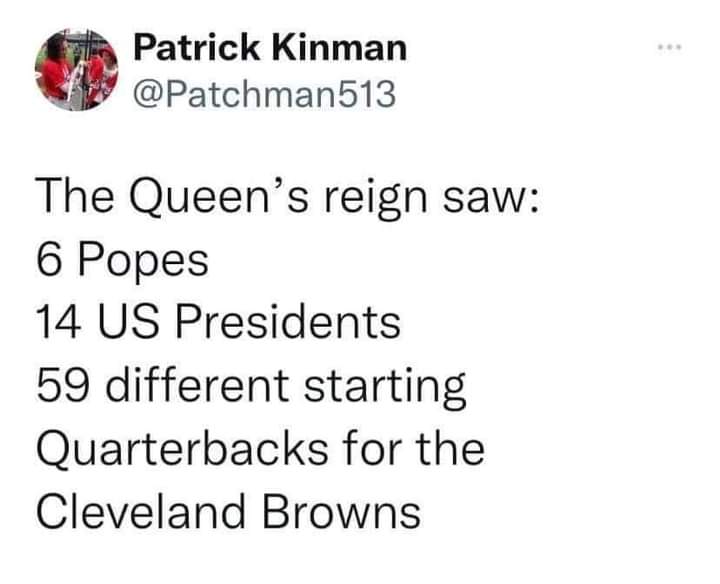
Edited to add: I went through this list of Cleveland Browns starting quarterbacks and tried to come up with a count. I may be off, but I didn’t come up with 59.

I came up with 64.

Obit watch: September 9, 2022.

September 9th, 2022

Joseph Hazelwood, captain of the Exxon Valdez. Alt link.

The Exxon Valdez (pronounced val-DEEZ) ran aground on Alaska’s Bligh Reef a few minutes after midnight on March 24, 1989. “Evidently we’re leaking some oil and we’re going to be here for quite a while,” Captain Hazelwood radioed the Coast Guard in what turned out to be a vast understatement.
Captain Hazelwood had not been on the bridge when the accident occurred. The National Transportation Safety Board found that the ship’s third mate had failed to properly maneuver the vessel because of fatigue and excessive workload, and that Captain Hazelwood had failed to provide a proper navigation watch because he was impaired by alcohol. The Exxon Shipping Company and its Exxon Corporation subsidiary were found to have failed to provide a fit master and a rested and sufficient crew.

The Exxon Valdez spill blackened 1,500 miles of the Gulf of Alaska coastline, home to rich fishing grounds and wildlife. It contributed to the passage by Congress of the Oil Pollution Act of 1990, which streamlined and strengthened the United States Environmental Protection Agency’s ability to prevent and respond to catastrophic oil spills.
The spill killed 250,000 seabirds, 2,800 sea otters, 300 harbor seals, 250 bald eagles and as many as 22 killer whales, according to the Exxon Valdez Oil Spill Trustee Council, a joint federal-state monitoring agency.
A jury acquitted Captain Hazelwood of a felony charge of operating a vessel while intoxicated but convicted him on a misdemeanor charge of negligently discharging oil, resulting in a $50,000 fine and 1,000 hours of community service. The Coast Guard suspended his license for some nine months. He never returned to the seas.

In June 1999, as the legal case dragged on, Mr. Hazelwood was taking time off from his job at a New York law firm and heading to Alaska to begin his community service, picking up trash in the city of Anchorage’s parks, when he told The New York Times in an interview, “As master of the vessel, I accept responsibility for the vessel and the actions of my subordinates.” He added: “I’ve never tried to avoid that. I’m not some remorseless oaf.”
“But,” he continued, “the crime I was convicted of is a B misdemeanor. There’s no lower crime in the State of Alaska. The judge had to come up with a sentence. I can understand it. I don’t have to agree with it.”

In an interview for the book “The Spill: Personal Stories From the Exxon Valdez Disaster,” by Sharon Bushell and Stan Jones (2009), Mr. Hazelwood offered a “heartfelt apology” to the people of Alaska while suggesting that his notoriety was not deserved.
As he put it, “The true story is out there for anybody who wants to look at the facts, but that’s not the sexy story and that’s not the easy story.”

Random gun-related crankery.

September 8th, 2022

I like watches.

But not in the way other people do. I’m not so much into the expensive high-end mechanical watches (I think they’re cool, but not $180,000 cool) but weird digital watches. I’ve actually worn two Casio Triple Sensors and am on my second moon phase and tide watch.

Yes, I do find it increasingly hard to justify watches when my phone pretty much does every possible function I could want. But I digress. Trust me, I’m going somewhere.

Did you know Garmin makes a watch with Applied Ballistics software built-in? Yeah, really. It’s $1,600.

“So?”

The Apple Watch Ultra is $800. Apple claims that they already have a full-blown recreational dive computer on it. I’m wondering: what will the Garmin watch do that the Apple Ultra won’t? Other than battery life: the Garmin has a solar cell which boosts battery life before recharging.

How long do you think it’s going to be before we start seeing advanced ballistic apps that run well on the Ultra? My guess is not too long. You’ll probably need a smartphone to set up and load cartridge profiles and such, but if I’m reading Garmin’s marketing right the same thing applies.

I’ve said before: I like Apple stuff in my personal life because it just works. My work computer is a Mac (full-time employees have a choice between Mac and PC), but the machines I work on are UNIX boxes with a thick layer of Python slathered all over them. I’ve worked professionally with PCs and Windows servers before, and would do it again for money. When it comes to the platform wars, I am a conscientious objector.

I’m just thinking: I haven’t bought an Apple Watch before now because the value proposition hasn’t quite been there for me. But it is getting closer to being there, especially looking at the new Ultra.

(If I don’t buy one before that time: continuous blood glucose monitoring is the one thing that absolutely would push me over the edge. Unfortunately, it feels like that’s one of those things that’s been five years away for the past 20 years.)

Obit watch: September 8, 2022.

September 8th, 2022

I started preparing the obit watch this morning, before things happened. Mike the Musicologist sent this over:

I’m reminded of C.S. Lewis’s passing…on November 22, 1963.

Bernard Shaw, former CNN anchor.

Shaw was CNN’s first chief anchor and was with the network when it launched on June 1, 1980. He retired from CNN after more than 20 years on February 28, 2001.
During his storied career, Shaw reported on some of the biggest stories of that time — including the student revolt in Tiananmen Square in May 1989, the First Gulf war live from Baghdad in 1991, and the 2000 presidential election.

NYT.

Anne Garrels, NPR correspondent.

As much as Anne Garrels loved Russia, she is probably best known for her reporting during the 2003 Iraq war. She was one of a handful of foreign reporters who remained in Bagdhad as the war began. As she told Susan Stamberg, she used a satellite phone for her reports and went to great lengths to conceal it from Iraqi authorities.
“And then I decided it would be very smart if I broadcast naked, so if that, god forbid, the secret police were coming through the rooms, that would give me maybe five minutes to answer the phone, pretend I’d been asleep and sort of go ‘I don’t have any clothes on!’ And maybe it would maybe give me five seconds to hide the phone,” she said.

NYT:

Her most acclaimed reporting came during the 2003 Iraq war. More than 500 journalists, including more than 100 Americans, covered the run-up to the war. But once the United States began the all-out bombing campaign known as “shock and awe,” she was one of 16 American correspondents not embedded with U.S. troops who stayed — and for a time was the only U.S. network reporter to continue broadcasting from the heart of Baghdad…
Once she was home, other reporters interviewed her about her ordeal. She told of subsisting on Kit Kat chocolate bars and Marlboro Lights, bathing by gathering water in huge trash cans, and powering her equipment by attaching jumper cables to a car battery, which she lugged up to her hotel room every night.

She was 71. Lung cancer got her.

Don Gehrmann. Hadn’t heard of him before, but he had an interesting story. He was a runner. In the “1950 Wanamaker Mile”, he ran the race in four minutes and 9.3 seconds.

It took him 314 days to win the race.

In the 1950 Wanamaker Mile, on Jan. 28, Gehrmann seemed to catch Fred Wilt at the tape, or did he? Both first-place judges said Wilt had won. Both second-place judges said Wilt had finished second. The finish-line picture from the phototimer was inadvertently blocked by a judge. And so it was left to the chief judge, Asa Bushnell, who was at the finish line, to make the call. He declared Gehrmann the winner, with a time of 4 minutes, 9.3. seconds.
But that did not settle the matter. Wilt, an F.B.I. agent when not competing and a future inductee of the National Track & Field Hall of Fame, protested, and 13 days later the Metropolitan Amateur Athletic Union’s registration committee, reversing Bushnell, declared him the winner.
Then Gehrmann protested that decision, and the matter carried over almost a year later to the A.A.U.’s national convention in Washington. By a vote of 314 to 108 — 314 days after the race — that ruling body’s board of governors upheld the chief judge’s decision and declared Gehrmann, forevermore, the victor.
Some were skeptical. As Howard Schmertz, the Millrose Games’ assistant meet director in 1950, told The New York Times in 2011, “The final decision was made by maybe a dozen people who saw the race and a few hundred who didn’t.”

In a 1976 interview with United Press International, Gehrmann described how the sport, by then having gone professional, had changed. He recalled that for his workouts he had usually run just 2 ¼ miles, that his pre-meet meal had usually consisted of a hamburger, French fries and soda pop, and that the cinder tracks he had run on stole a lot of energy.

God Save the Queen.

September 8th, 2022

Queen Elizabeth II dead at 96. BBC.

Edited to add: Formal NYT obit. Archive version. Borepatch.

Personal indulgence (possibly noteworthy for others).

September 8th, 2022

I’ve been listening to the Hornady Podcast.

They cover a wide variety of topics. They’ve talked about various hunting opportunities (including Africa). They do interviews with prominent individuals in the industry like Jerry Miculek. (And, on a side note, I really enjoyed their interview with Kristy Titus. Not in the “oooh, a girl in the gun industry”, or the “I want to marry this woman” sense, but: here’s a person who seems to have their head screwed on straight, knows what they know and what they don’t know, and is actively working to fill in the gaps on what they don’t know. I find that admirable. I hadn’t heard of Ms. Titus before this: now I’m a fan.)

And they’ve done several podcasts on interior (what happens to the bullet inside the gun) and exterior (what happens to the bullet in flight) ballistics. Those podcasts are really deep dives into the way things work. If you’re a gun person with a techy bent at all, I encourage you to listen.

Episode 35 is a listener Q&A session. If you listen to the first few minutes of it, you might hear a name you recognize. You can listen to the whole thing if you’d like (I’d encourage that) but the “relevant” (for some value of “relevant”) part comes early.

A couple of quick points:

  • Remember this post? Yeah, this is what I was talking about. Preston from Hornady had told me they were doing a Q&A at some point, and asked if he could use my questions on the show. Of course I said yes.
  • There’s a bit more to the questions I asked than what made it on to the show. What’s on the show is a very good summary of one of the questions I asked. Preston and I had a long conversation about both of my questions. I’m not kidding: Preston actually called me on the phone and we talked through this stuff. I can’t tell you how impressed I am with their support for some random murder hobo. (I don’t think anybody at Hornady even knows I blog.)
  • They didn’t really go into my second question on this podcast, but that’s okay. They did kind of briefly touch on it, and, from what they said, they plan a much deeper dive into that question in some future podcast. Which is awesome.
  • Never read the YouTube comments. Seriously. I know I’m taking this personal-like, but Preston and the rest of the gang was so nice to me, I can’t imagine how people could treat them like crap in the YouTube comments. I guess a lot of people have trouble remembering there are real people behind the screen.

And, actually, some other things are coming together. My project for the Smith and Wesson Collector’s Association came to fruition and is active now. I’ve even received some nice feedback. (You can’t access it unless you’re a member. Which you should be if you’re interested in Smith and Wessons.)

The government finally mailed my tax refund. I haven’t gotten official word yet, but I’ve gotten “unofficial” word on my corporate bonus and pay for the next two quarters (at least) and been reassured there won’t be any layoffs on my team.

And I’ve been talking to a fellow collector, and there’s some more hoplobibilophilia coming soon-ish.

In the meantime, as we often say, look for the smiling face of Archduke Franz Ferdinand on every bottle!
You’re going down in flames, you tax-fattened hyena! (#97 in a series)

September 8th, 2022

Jeff German was a reporter for the Las Vegas Review Journal. He specialized in investigative reporting, and was apparently quite well regarded by his peers.

I say “was” because Mr. German was stabbed to death on Friday. Mike the Musicologist sent me a tweet from some Twitter rando claiming that Mr. German’s latest investigative reporting was on the Oathkeepers.

Robert Telles is the “public administrator” for Clark County. According to the Clark County webpage:

Rob’s primary focus is to ensure that the CCPA serves the community as best as possible. Under the current administration, safeguarding and customer service performance have been increased significantly according to the statistical data provided on the CCPA website. Further, the CCPA now objects to many probate court matters where families are at risk.

It isn’t exactly clear to me what the “public administrator” does, but it is an elected position. Mr. Telles (who is a Democrat) lost the primary election for the position in June. He apparently blamed his loss on Mr. German, who had done a series of investigative pieces on Mr. Telles’s management of the office:

Reporting from May included allegations from former employees that Telles created a hostile work environment and had an “inappropriate relationship” with a staffer. There were also accusations of bullying and favoritism.

Yesterday, the police searched Mr. Telles’s home. Shortly afterwards, Mr. Telles was arrested and charged with “suspicion of murder”.

Not really sure what I can say here. Seems tragic that a reporter got stabbed for doing his job, especially when it was apparently a politician who’d already lost his own job. What did he think he was going to get out of killing a reporter? His old job back? Or was he just a bully who thought he could get away with killing someone who crossed him?

Considered innocent until proven guilty, yadda yadda, but it’ll be interesting to see this one play out.

Edited to add: More from Reason. I haven’t quoted from the Review-Journal at all because that outlet is totally unreadable without a subscription, even in incognito mode.