Archive for the ‘Planes’ Category

NRA annual meeting: a collection of random photos of varying quality.

Monday, April 20th, 2026

You can’t buy firearms at the NRA annual meeting, so I had to leave the gun.

But: I did take the cannoli.

(Yes, I do realize that was a long way to go for a joke. But the setup was right in front of me, and I had to take advantage of it.)
It is Jerry‘s world. I just live in it.

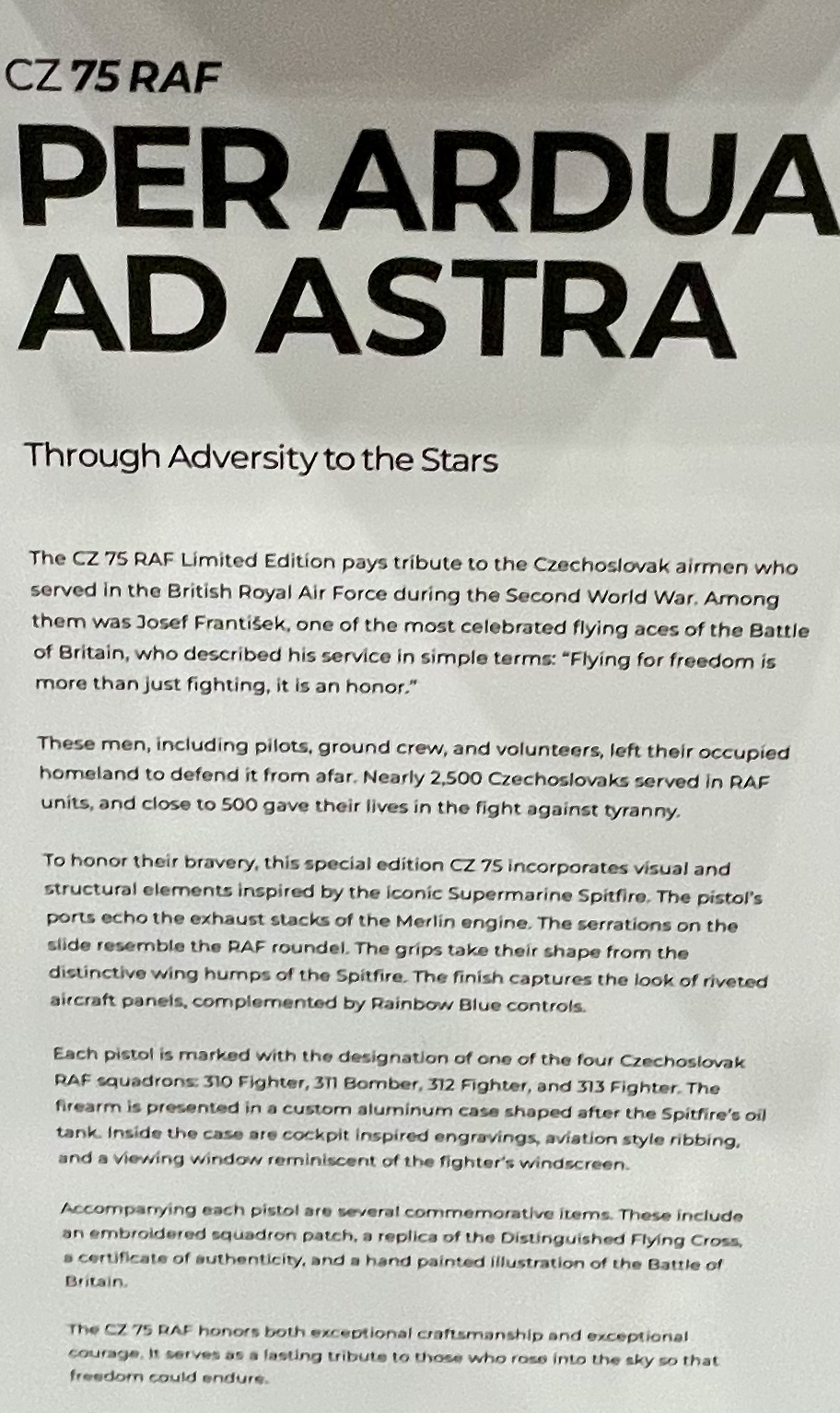
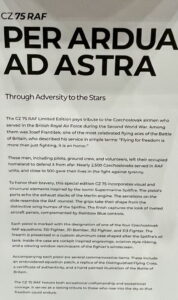
I thought this was quite interesting. It is a CZ-75, but it is part of a special edition CZ is doing to honor the Czech fighter squadrons that fought alongside the RAF in WWII. The styling is “influenced” by the Spitfire. Below is a photo of the explanation from CZ’s display, which covers it in more detail: click to embiggen, and I hope you can read it.
I have no idea how much they will sell for, but I admit to being mildly tempted.

Edited to add 4/21: CZ’s page on the CZ 75 RAF, with many much better photos.

Staplerfahrer Klaus, call your office, please.

I guess if you need this, you need it.

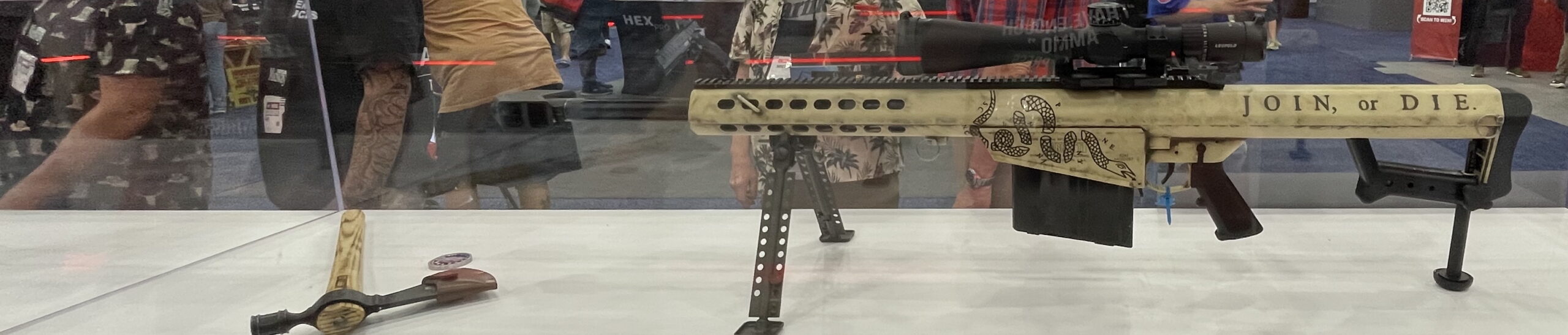
This commemorative Barrett is actually much more tasteful than I expected. I’m sorry I don’t have a photo of the other America 250 commemorative, but there was a huge clot of people in front of it, and I wasn’t about shoving people out of the way.
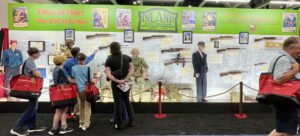
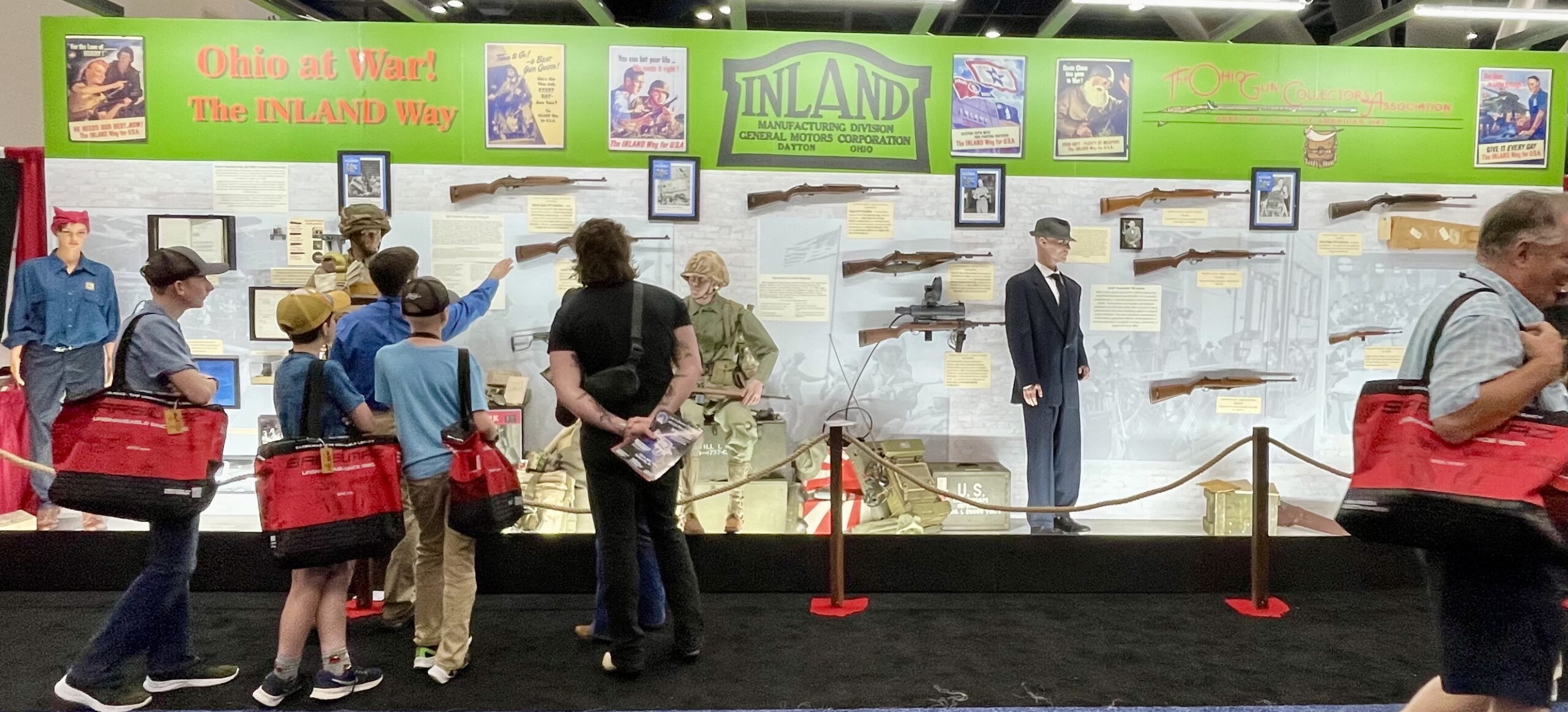
This didn’t come out as well as I would have liked, but I wanted to immortalize it for “Ohio At War!”.

Total distance walked yesterday: 3.3 miles.

I plan to post more, but I’m going to be busy tonight and tomorrow night. It may be Wednesday before I’m able to do a more comprehensive post. Which will include some gun book blogging. Yes, I got a deal in Houston, though not at the show.

Obit watch: March 3, 2026.

Tuesday, March 3rd, 2026

The 1940 Air Terminal Museum in Houston. Chron (feels short and incomplete). KHOU. Houston Chronicle (archived, but I think this is a longer better article).

I never visited the Museum. I wanted to, some weekend when I was in Houston with nothing else to do. But that never happens.

FotB RoadRich, who informed me of this, was an active volunteer at the Museum, and brought me all sorts of tchotchkes from the Museum shop, some from defunct airlines. I don’t have his permission to quote the email he sent me, but he filled all sorts of volunteer roles at the Museum and was down there at least one weekend every month.

This is sad and awful and stinks. There’s talk about maybe reopening the Museum if they can line up some more permanent funding, so maybe there’s hope. But today is a sad day for aircraft and history buffs.

Edited to add 3/4: FotB RoadRich granted me permission to quote his eloquent obit.

The Museum sent out an e-mail to its volunteers at exactly midnight on March 2 declaring its independence from, sadly, existence.

I for one remain optimistic that there is a chance this is a first step toward a new future for the iconic art deco terminal building from aviation’s pioneering era, and its many and unique artifacts, some of which are us volunteers. I’ve given many years to support the Museum as an attendee, volunteer, senior volunteer, pilot, marshaller, docent, mop jockey, yammering aviation enthusiast, event staffer, security badged ramp guide, fly-in coordinator, chair stacker, tug operator, graphic designer, photographer, Model AA driver, museum blog contributor, mechanic, and collector of airport FOD. I’ve also driven thousands of miles to do this because there simply is nothing like the place, and I hope the unique collection of architectural history, aviation history, Houston history, and darned amusing volunteers get to be enjoyed by many more people as soon as possible.

The Houston Chronicle article linked here (wants to activate my DRMs does it??? Hands off my DRMs please) calls today’s announcement a “pause”, which gives me hope for the Museum’s future.

(See above for the link – DB)

Obit watch: December 19, 2025.

Friday, December 19th, 2025

Peter Arnett, noted war correspondent.

From Vietnam’s jungles to Iraq, where he interviewed President Saddam Hussein, Mr. Arnett broke news and rules, infuriated national leaders and inspired generations of journalists. He was twice among the last Western TV broadcasters in Baghdad — as the Persian Gulf War began in 1991 and as an American-led coalition invaded in 2003.
Over 45 years, by his own account, he covered 17 wars in Asia, the Middle East, Europe and Latin America, first for The Associated Press and later for CNN and other television and print organizations. He made television documentaries, wrote two books, lectured widely and in 1997 interviewed Osama bin Laden, the leader of the Al Qaeda terrorist organization, somewhere in Afghanistan.

Late in his career, he ran into trouble for crossing journalistic lines of propriety. He left CNN in 1999 after reporting a Vietnam War atrocity that apparently never happened, and was fired by NBC in 2003 for claiming on Iraqi state television that the war plan of the American-led coalition against Iraq was failing.

Mr. Arnett left CNN in 1999 after anchoring “Operation Tailwind,” a documentary broadcast that claimed that the United States used poison sarin gas in a Laotian village in 1970 in an attempt to kill American defectors in the Vietnam War. After denials and protests by Washington, a CNN investigation found the allegations to be largely unsupported. CNN issued a retraction and fired nearly everyone involved in the program.

Sue Bender, author.

In Ms. Bender’s 1989 book, “Plain and Simple: A Woman’s Journey to the Amish,” she recounted how she learned from her hosts to recognize the beauty in the everyday, the peace that comes from slowing down and the dignity of ordinary work. The book became a best seller and one of the go-to texts of an anti-materialist movement of the 1990s known as voluntary simplicity.

Greg Biffle, former NASCAR driver. He, his wife and two children, and three other passengers were killed yesterday when their small plane crashed on approach to Statesville Regional Airport.

The Spirit of Christmas 3.

Friday, December 19th, 2025

Another good Christmas story, this one from Dr. Dabbs. And I’m not just saying that because the story features a F-4 Phantom II jet.

Also, LawDog is still writing about the Flickerfoxes.

Historical note. Parental guidance suggested.

Saturday, November 1st, 2025

70 years ago today, United Flight 629 (a DC-6B) disintegrated near Longmont, Colorado. There were no survivors among the 44 passengers and crew.

(more…)

Obit watch: October 2, 2025.

Thursday, October 2nd, 2025

Lt. Colonel George Hardy (USAF – ret.). He was 100.

Colonel Hardy, a Philadelphia native, was 19 and had never even driven a car when he began aviation cadet training in September 1944 at Tuskegee Army Air Field in Alabama. By early the next year, in the closing months of the war in Europe, then-Second Lieutenant Hardy was assigned to an Army Air Forces base in Italy, from which he flew 21 missions accompanying bombers to their targets over southern Germany in early 1945.
In addition to those high-altitude missions in P-51 Mustang aircraft, he made strafing runs on German trains, trucks or river barges and was once struck by small-arms fire. He knew he was hit, he recalled to the National World War II Museum in New Orleans, when he saw a flash of light coming through the cockpit floor, which was usually dark.

He also flew 45 missions during the Korean War, and 70 during the Vietnam War.

Colonel Hardy spent years in supervisory roles involving the maintenance of electronic equipment before his final tour of duty, in Vietnam, where he piloted an AC-119K gunship. His decorations included the Distinguished Flying Cross and 12 Air Medal awards, recognizing single acts of extraordinary achievement or heroism.

Wikipedia says he was the last surviving member of the Tuskegee Airmen who saw combat during WWII.

Updated NYT obit for Jane Goodall. This includes corrections that were added today.

Marilyn Knowlden, child actress. She was 99. IMDB.

…Ms. Knowlden’s parents did not even take her to see her own films, fearful that she would develop a titanic ego. Her father, who managed her career, refused to let her be bound by a studio contract.
As a result, “I was always a freelance actor, so I had complete freedom to choose my roles,” she told Mr. Thomas. “If you were under contract like Judy Garland or Shirley Temple, you went to a studio school and really lost your ordinary life. I went to public school, had a very normal life, and then occasionally would go off and make a film.”

Obit watch: August 30, 2025.

Saturday, August 30th, 2025

It never fails. As soon as I say I can’t find an obit, the paper of record publishes one.

NYT obit for Randall “Duke” Cunningham.

I feel very conflicted about this. On the one hand, I have a lot of respect for people who served honorably in the military. Especially fighter pilots, and especially fighter aces.

On the other hand, Mr. Cunningham’s crimes were sleazy and stupid.

He pleaded guilty in federal court in 2005 to tax evasion and conspiracy to commit bribery. Among the favors he accepted from defense contractors were a Rolls-Royce, free rent on a live-aboard yacht, the Duke-Stir, moored on the Potomac River, and a sweetheart sale of his San Diego County home for nearly $1 million above market value.

On the gripping hand, it seems like this was a pattern for him. Wikipedia cites sources that say he was nearly court-martialed for breaking into his CO’s office. And it seems like the whole “Colonel Toon”/”Colonel Tomb” story was fabricated by Cunningham.

Floyd Levine, actor. Other credits include “Manimal”, “The Master”, “Mrs. Columbo” and “Columbo: Murder in Malibu”, “Braddock: Missing in Action III”, and “Angel III: The Final Chapter”.

Frank Price, movie executive. He was in charge at Columbia twice, and also at different times ran Universal’s television and movie divisions.

During Mr. Price’s five years there, Columbia released hits like the comedies “Stir Crazy” (1980), starring Gene Wilder and Richard Pryor; “Tootsie” (1982), with Dustin Hoffman as an out-of-work actor who finds success only by impersonating a woman; and “Ghostbusters” (1984), with Bill Murray and Dan Aykroyd. Another major film under his watch was “Gandhi” (1982), with Ben Kingsley as the Indian leader Mahatma Gandhi; it won eight Oscars, including for best picture and best actor.
But Mr. Price was said to have refused to make “E.T. the Extraterrestrial,” Steven Spielberg’s science fiction story about a fragile alien lost on Earth, because of studio research saying that it would appeal only to children. The decision proved to be one of the biggest blunders in Hollywood history: “E.T.” went on to break box-office records.

“It’s hard for someone like Price to confront the fact that ‘Tootsie’ doesn’t make up for six bad films,” Mr. [Fay] Vincent told Kim Masters and Nancy Griffin for their 1996 book, “Hit and Run: How Jon Peters and Peter Guber Took Sony for a Ride in Hollywood.”

I don’t know. I personally think that one big hit can make up for six bad films: if you keep costs under control, which is something Hollywood seems to be bad at. Then again, as William Goldman used to say about Hollywood, “Nobody knows anything…… Not one person in the entire motion picture field knows for a certainty what’s going to work. Every time out it’s a guess and, if you’re lucky, an educated one.”

Obit watch: August 29, 2025.

Friday, August 29th, 2025

I know I’m drawing heavily from the NYT, but that’s where the interesting obits are today.

Jim Murray. He was the general manager of the Philadelphia Eagles from 1974 until 1983, including during their Super Bowl run in 1981. But that’s not what I think is notable.

The first facility opened in Philadelphia in 1974, the year Mr. Murray became, at 36, the National Football League’s youngest general manager. The daughter of Fred Hill, a tight end with the Eagles, had been diagnosed with leukemia. The team raised money for her; Mr. Murray was delegated to prolong the giving by looking for a related charitable cause.
He found a local pediatric oncologist, Dr. Audrey Evans, who told him that the most pressing need was to provide accommodation for families who brought their sick children to a hospital and often had to sleep in the corridor or in their cars.
Mr. Murray understood immediately. “He saw the way they were struggling and said, ‘We have to figure something out,’” his godson, the Philadelphia sports broadcaster Rob Ellis, said in an interview. “Then the idea bloomed and progressed. It started with the motivation to help his player.”

Know your stuff. Be a man. Look after your people.

Mr. Murray reached out to a Philadelphia advertising executive who handled the region’s McDonald’s account. Local McDonald’s restaurants agreed to donate money from a promotional drink — the Shamrock Shake — as long as the house could be named after the company’s emblematic clown.
The first Ronald McDonald House opened on Oct. 15, 1974, at 4032 Spruce Street in Philadelphia. There was room for seven families. Mr. Murray took to calling it the “McMiracle.”

Joan Mellen, biographer. She wrote 25 books about all sorts of subjects (Japanese film, the JFK assassination) but I wanted to highlight her because…one of her biographies was about Bobby Knight.

In early 1987, the irascible and authoritarian college basketball coach Bobby Knight called Temple University looking for Joan Mellen…
Mr. Knight was fuming about “A Season on the Brink,” a recent best-selling biography by the sportswriter John Feinstein that portrayed him as vulgar, sexist and out of control. Professor Mellen had just reviewed the book for The St. Petersburg Times, faulting it for misunderstanding its subject.
“Knight is, above all, a teacher,” she wrote. “Aggressively he gives his all. In this he is no different from the dedicated English or math teacher. The basketball players, like all students, are recalcitrant. They fight against learning. Knight’s advantage over other teachers lies in his access and control.”
On the phone, Mr. Knight was charming.
“You’re a professor of literature?” Professor Mellen later recalled him asking her. “I just wanted to tell you I really liked what you wrote.”
Professor Mellen began compulsively watching his games. She arranged to write a profile of him for The New York Times, which she later expanded into a best seller of her own: “Bob Knight: His Own Man.”

Bob Knight: His Own Man was negatively reviewed by many people, some of whom saw it as a shot across the bow of Mr. Feinstein. One of those people was Rick Telander in the New York Times Book Review.

Professor Mellen’s response was vintage Professor Mellen.
She castigated The Times in a letter to the editor, saying that Mr. Telander should not have reviewed her book because he worked for Sports Illustrated, which had published several negative articles about Mr. Knight. He was among the writers who had criticized the coach.
“Such breaches of journalistic ethics on the part of some sportswriters are a central theme of my book,” Professor Mellen wrote. “My focus, however, was Mr. Knight as a teacher, a topic not touched upon once by Mr. Telander, who is obviously adhering to some other agenda.”
The Times published an Editors’ Note saying that Mr. Telander should not have been chosen to review the book.

A.K. Best, fly tying guy.

Mr. Best was renowned for his mastery of the meticulous art of professional fly tying. He produced nearly weightless artificial lures that mimicked the midges, caddisflies and other bugs that fish eat; his specialty was dry flies, which float on the water’s surface.

Mr. Best also wrote books and magazine articles, spoke at seminars and made instructional videos with the professorial tone of a pipe-smoking teacher, which he had been. (Pipe smoke helped keep the mosquitoes away while he fished.) Fly Fisherman magazine said, in a tribute after his death, that he “shaped the soul of modern fly fishing.”
For hours at a time, Mr. Best sat in his basement workshop in Boulder, using a vise, pliers, tweezers, a toothbrush, sprigs of feathers and other tools of the trade. He made the wings and tails of insect replicas by hand, for personal use and at a commercial pace of roughly 40 lures an hour and 36,000 a year for companies like Orvis, Umpqua Feather Merchants and Urban Angler. He was said to have attached a shoulder rest to his phone so he could keep tying while taking a call.
As he worked, he listened to classical music and jazz, accompaniment that dated to his earlier career as a music teacher and high school band director. He considered the precision required for tying flies similar to the exactitude of creating music.
“There’s no such thing as an unimportant detail in music,” Mr. Best told The Gazette of Colorado Springs in 2024. “The composer put that dot on the paper with an ink pen for a specific reason. Just like when you look at a picture of an insect, every dot is important.”

His great skill was creating flies of a size and color that appeared natural, rather than store-bought, using the knowledge that no adult aquatic insects have fuzzy bodies; that flies should appear shiny and waxy, not translucent; that hair from a white-tailed deer could be used if elk hair was not available.
“You don’t need a fly so big you’re going to scare the hell out of a fish,” he said in a 2015 interview for the Montana State University Angling Oral History Project. In the same interview, he said, “If it’s the right color and floats, it’ll catch fish.”

There’s a Montana State University Angling Oral History Project? Awesome! President Trump, I want some of my tax money going there, please.

We fished some when I was a child, by which I mean we dangled lines in the water from fishing poles. I’ve never been fly fishing, but I find myself becoming more interested in both the sport itself and the literature surrounding it as I get older. Callahan and Company has fly fishing and angling books as one of their specialties, so I see a lot of fly fishing literature advertised in their catalogs. Much of it sounds fascinating.

I am seeing reports (especially from McThag) that Randall “Duke” Cunningham, Navy ace, former Congressman, and convicted and pardoned felon, has passed away. But I don’t have anything I can link yet.

Burning in Hell watch: Tran Trong Duyet, chief warden of the Hanoi Hilton.

Obit watch: August 27th, 2025.

Wednesday, August 27th, 2025

Playing catch-up after returning from my trip:

Ens. Donald McPherson (US Navy – ret.) He was 103. National WWII Museum.

I love the NYT opening:

On April 6, 1945, during the Battle of Okinawa in the final months of World War II, a 22-year-old Navy ensign, Donald McPherson, was piloting a Hellcat fighter with “Death N’ Destruction” painted on the side.
As his squadron, the VF-83, joined an aerial assault on the island of Kikaijima, between Okinawa and mainland Japan, Mr. McPherson spotted Japanese dive-bombers rushing toward him from below. He lowered the nose of his Hellcat and fired, notching his first hit before positioning himself behind a second enemy plane.
“By using full throttle, my Hellcat responded well, and I squeezed the trigger, and it exploded,” he said, referring to the enemy plane, in an interview for Fagen Fighters WWII Museum in Granite Falls, Minn. “Then I turned and did a lot of violent maneuvering to try to get out of there without getting shot down.”

Also, I love Hellcats. Ens. McPherson shot down three kamikazes attacking the USS Ingraham in a subsequent engagement, making him an ace.

Although he never flew a plane again, Mr. McPherson was reintroduced to the F6F Hellcat when Fagen Fighters museum — which restores, displays and flies World War II-era planes — refurbished a similar one in 2021, soliciting his approval to paint it navy blue, the color of his plane, and adding the “Death N’ Destruction” motto. He reacquainted himself with the aircraft in person that year when it was flown to a ceremony at an airport in Beatrice, Neb.
At a 2022 event at the Fagen Fighters museum, Mr. McPherson said, “You people just can’t believe what all this has meant to me. That beautiful airplane.”
With a smile, he asked Evan Fagen, the museum’s chief pilot, “Can I take it home with me?”

The National WWII Museum and other reports I’ve seen refer to him as the last surviving WWII ace. The NYT obit seems to hedge that a bit by referring to him as “one of the last surviving American combat pilots from World War II recognized by the American Fighter Aces Association as combat aces”.

He received three Distinguished Flying Crosses and four Air Medals, and was awarded a Congressional Gold Medal in 2015.

Humpy Wheeler, NASCAR guy. I probably would have let this go past if it wasn’t for this:

…he transformed race day into a carnival. With his taste for Hollywood-level stunts, he might just as easily have been called the Cecil B. DeMille of motorsports. The clowns, trapeze artists, elephants and tigers he brought in to perform in the speedway’s infield in 1980 were only a start.
He once collaborated with the 82nd Airborne Division, garrisoned in Fort Bragg, N.C., to restage the U.S.-led 1983 invasion of the Caribbean nation of Grenada, complete with wood fortifications, troops and helicopters.
“The mortars were blanks,” the sportswriter Tommy Tomlinson recalled in a recent post on Substack, “but the dynamite that blew up two houses placed on the infield was very real.”

David Ketchum, actor. IMDB.

Theodore Friedman, lawyer. I think this is an interesting story. He was a personal injury specialist, and known as a zealous advocate for his clients.

Maybe a little too zealous, as he was disbarred in 1994.

Mr. Friedman’s disbarment exposed an underside to his turn-it-to-11 style of lawyering. Accused of 23 counts of professional misconduct — including intentional dishonesty, filing a false affidavit and soliciting false testimony from a witness — he lost his law license after a special referee affirmed 14 of the charges. He was disbarred by the Appellate Division of the First Department, a state court that oversees civil and criminal appeals in Manhattan and the Bronx.
His disbarment was seen by some in the legal community as unfair, by others as a comeuppance for sleaze, and by still others as a cautionary tale about the limits of overzealous advocacy.

He reapplied for his license several times, and was ultimately reinstated to the bar in 2010.

Ron Turcotte, jockey. He was most famous as the jockey who Secretariat to the Triple Crown.

Secretariat, a big coppery chestnut nicknamed Big Red who, like Riva Ridge, was owned by Penny Chenery of Meadow Stable and trained by Lucien Laurin, made up for that disappointment in spectacular fashion. He powered to victory in the Derby and the Preakness, setting track records that still stand. He then demolished the competition in the Belmont Stakes to become the first Triple Crown winner since Citation in 1948.
Secretariat’s Belmont remains one of the most celebrated performances in racing history. Under Turcotte’s supremely confident handling, he cruised by the competition on the backstretch, “moving like a tremendous machine” in the famous race call by Chic Anderson, then drew off to win by an astounding 31 lengths. He broke the track record set by Gallant Man in 1957 by just under three seconds — the equivalent of 13 lengths — and set a new world record for the mile-and-a-half distance on the dirt, one that still stands and has never been approached.

Obit watch: June 22, 2025.

Sunday, June 22nd, 2025

Frederick W. Smith, founder and former CEO of FedEx. NYPost. Nothing in the paper of record yet.

Lynn Hamilton, actress. Other credits include “Hunter”, “Quincy, M.E.”, “Lady Sings the Blues”, “The Marcus-Nelson Murders” (the pilot for “Kojak”)…

…and “Mannix”. (“Tooth of the Serpent“, season 3, episode 15. This is actually a pretty solid episode.)

Jack Betts, actor. Other credits include “The Assassination of Trotsky”, “The F.B.I.”, and “Dead Men Don’t Die”.

Obit watch: June 17, 2025.

Tuesday, June 17th, 2025

William Langewiesche, writer.

He wrote a fair amount of stuff about aviation, especially a famous piece on EgyptAir 990.

Mr. Langewiesche’s account of the EgyptAir crash in 1999, which was profoundly enriched by his own aviation background, blamed a suicidal co-pilot. Egyptian officials refused to accept that conclusion, a response, he wrote, that was rooted in political and cultural chauvinism.

I used to be an admirer of his work, especially his aviation stuff. I generally try to avoid speaking ill of the dead when I write these obits, but there are some things I think need to be said about Mr. Langewiesche’s work.

Writing about Capt. Chesley B. Sullenberger III’s famous landing of a commercial airliner in the Hudson River in 2009, Mr. Langewiesche made the case that that injury-free belly flop was a testament more to modern airplane technology than to the heroism of the pilot.
Captain Sullenberger took issue with that account, telling The New York Times that Mr. Langewiesche’s book about the episode, “Fly by Wire,” contained “misstatements of fact.”

His 2002 book, “American Ground: Unbuilding The World Trade Center,” based on a three-part series in The Atlantic, was reported over six months at ground zero as he meticulously covered the cleanup after the terrorist attacks of Sept. 11, 2001.

Unmentioned in the obit: his accusation that members of the NYFD looted stores at ground zero before the towers collapsed. I think it is fair to say that accusation has been refuted.

Mr. Black, who sent his report to Mr. Langewiesche’s publisher, included a letter in which he asserted that Mr. Langewiesche ”passed off demonstrably unfounded rumor as plain fact, with a reckless disregard for both elementary procedures of verification and the likely harm his reporting would cause.”

Also unmentioned in the obit: his involvement in the Chevron Corp. v. Donziger pollution case.

Obit watch: June 9, 2025.

Monday, June 9th, 2025

Lieutenant Commander Conrad Shinn (US Navy – ret.) died on May 15th. He was 102.

LTC Shinn was the first man to land a plane at the South Pole.

Late in Commander Shinn’s life, his daughters said, when asked about being the first pilot to land a plane at the South Pole, he began replying, “And the first to take off.”

On Oct. 31, 1956, Commander Shinn, Admiral Dufek and five other Navy men made the seven-hour flight from McMurdo Station on Antarctica to the pole aboard an R4D-5L Skytrain, a twin-engine military version of the commercial DC-3. Internal politics affected the assigned duties for the extraordinary mission.
A captain onboard, Douglas Cordiner, was so upset at not being named the co-pilot that he later stood on the deck of a ship in New Zealand and “threw his library of Antarctica into the water,” Commander Shinn said in his oral history interview.
The R4D, nicknamed Que Sera Sera — Whatever Will Be Will Be — after a popular song, had its landing gear outfitted with skis and was accompanied by a circling Air Force C-124 Globemaster cargo aircraft. Maurice Cutler, then an 18-year-old United Press correspondent from Australia who joined other reporters on the cargo plane, which had wheels but no skis, said in an interview that pallets of survival gear were to be airdropped if Commander Shinn’s plane could not lift off from the pole.
The landing, photographed from above by Mr. Cutler, was not exceptionally rough. Commander Shinn set his plane down at 8:34 p.m. during continuous sunlight across windblown ridges on a desolate ice sheet nearly 10,000 feet above sea level. The temperature was minus 58 degrees Fahrenheit.
Admiral Dufek planted an American flag, and Commander Shinn kept the engines running as the plane remained on the ground for 49 minutes. By then, the skis had become stuck to the ice.
In the thin air on the ice cap, the propeller-driven plane, weighing 28,000 pounds, did not budge with its engines at full power. “We just sat on the ice like an old mud hen,” Commander Shinn told the National Naval Aviation Museum.
To gain thrust, Commander Shinn made a jet-assisted takeoff, firing a series of small rockets housed in canisters attached to the fuselage. After all 15 rockets had been fired, the plane lifted off. “Barely,” he said in a radio interview a day or so after the flight.
Tom Henderson, who directed the 2019 documentary “Ice Eagles,” about aviation in Antarctica, said in a recent interview that Commander Shinn had told him he had lifted off at 58 miles an hour, two below the plane’s minimum designated takeoff speed.
Later, an engine oil pressure light came on, Mr. Henderson said, and Commander Shinn promptly unscrewed the bulb, telling his co-pilot that he’d rather not have Admiral Dufek “see that and get excited.”

Commander Shinn’s pioneering flight showed that remote research stations could be supported by air. Today, planes land routinely at the Amundsen-Scott South Pole Station. In his oral history interview, he said he had probably landed six miles from the actual pole. Mr. Cutler’s initial United Press dispatch said four miles.

Frederick Forsyth. The obits right now are still in the preliminary stage, but I’m going to be on the road tomorrow and don’t know when I’ll have time to write.

I wrote a long time ago about my early experience with The Day of the Jackel. I also wrote a little, not quite so long ago, about The Shepherd.

I remember thinking The Odessa File was pretty good, but I was young at the time. I’m not sure it holds up. I do think The Dogs of War does.

Oddly, I think my second favorite Forsyth (of the ones I’ve read) is the short story collection No Comebacks. A story that turns on an obscure point of libel law? Another story about a man who figures out a way to take his fortune with him when he dies…and tick off his greedy family. A group of blackmailers meet their match in a meek insurance executive.

And then there’s “The Emperor”. This seems like a typical fishing story of the kind Hemingway would have written: man gets into the fight of his life with a big fish. But the man is a henpecked bank employee…and in the struggle with the fish, he finds something inside him. This story contains another of my favorite lines in fiction:

“To hell with the bank,” he said at length. “To hell with Ponder’s End. And madam, to hell with you.”

Bill Atkinson, one of the pioneers of the Macintosh.

It was Mr. Atkinson who programmed QuickDraw, a foundational software layer used for both the Lisa and Macintosh computers; composed of a library of small programs, it made it possible to display shapes, text and images on the screen efficiently.
The QuickDraw programs were embedded in the computers’ hardware, providing a distinctive graphical user interface that presented a simulated “desktop,” displaying icons of folders, files and application programs.
Mr. Atkinson is credited with inventing many of the key aspects of graphical computing, such as “pull down” menus and the “double-click” gesture, which allows users to open files, folders and applications by clicking a mouse button twice in succession.

Mr. Atkinson’s programming feats were renowned in Silicon Valley.
“Looking at his code was like looking at the ceiling of the Sistine Chapel,” recalled Steve Perlman, who as a young Apple hardware engineer took advantage of Mr. Atkinson’s software to design the first color Macintosh. “His code was remarkable. It is what made the Macintosh possible.”

He was also the author of two of the most significant early programs written for the Macintosh. One, MacPaint, was a digital drawing program that came with the original Macintosh; it made it possible for a user to create and manipulate images on the screen, controlling everything down to the level of the individual display pixel.
Ordinary users without specialized skills could now create drawings, illustrations and designs directly on a computer screen. The program introduced the concept of a “tool palette,” a set of clickable icons to select simulated paint brushes pens, and pencils.

After the introduction of the Macintosh, while under the influence of a modest dose of LSD, Mr. Atkinson conceived of a program that would weave text, images and video seamlessly in a simple-to-use database. That experience would lead to Apple’s HyperCard software, a forerunner of the World Wide Web.

At age 10, after Bill was given a subscription to Arizona Highways magazine, he began cutting out nature photographs and placing them on his bedroom wall. That led to a lifetime passion for nature photography and eventually a second career as a commercial and artistic photographer. A 2004 book, “Within the Stone,” presented his close-up photographs of stones that had been cut and polished.

Obit watch: April 28, 2025.

Monday, April 28th, 2025

David Paton, big damn hero, died on April 3rd. He was 94.

I take blindness kind of personally. Dr. Paton was a prominent ophthalmologist. In the early 1970s, he started thinking about blindness in developing countries: there were a lot of folks, he believed, that were losing their eyesight because of things that could be prevented or treated. But how to get doctors and training to the developing world?

He considered shipping trunks of equipment — almost the way a circus would — but that presented logistical challenges. He pondered the possibility of using a medical ship like the one that the humanitarian group Project Hope sent around the world. That was too slow for him.
“Shortly after the first moon landing in 1969, thinking big was becoming a reality,” Dr. Paton wrote.
And then a moonshot idea struck him: “Could an aircraft be the answer? A large enough aircraft could be converted into an operating theater, a teaching classroom and all the necessary facilities.”

In 1980, Mr. Trippe helped persuade Edward Carlson, the chief executive of United Airlines, to donate a DC-8 jet. The United States Agency for International Development contributed $1.25 million to convert the plane into a hospital with an operating room, a recovery area and a classroom equipped with televisions, so local medical workers could watch surgeries.

This was the birth of Orbis International.

…the organization is on its third plane, an MD-10 donated by Federal Express.
From 2014 to 2023, Orbis performed more than 621,000 surgeries and procedures, according to its most recent annual report, and offered more than 424,000 training sessions to doctors, nurses and other providers.

David Thomas, of Pere Ubu and Rocket From the Tombs, and a good Cleveland boy.

Lar Park Lincoln, actress. Other credits include “Space: Above and Beyond”, “House II: The Second Story”, and “Murder, She Wrote”.

Bagatelle (#133)

Tuesday, April 22nd, 2025

My Personal Top Ten List of Wikipedia Lists

10. “List of stoffs”. How can you not like a list with a name like that? Also, as you know, Bob, I’m both a bit of a plane geek and a military history geek. And as you also know, Bob, the famous ME-163 ran on T-Stoff and Z-Stoff (in the A variant) or C-Stoff (in the B and C variants.) (At least, I think that’s the case. The Wikipedia article is a little confusing.)

(I’ve been thinking about doing a Kickstarter for another million-dollar idea: a small rocket engine that attaches to a snowboard and runs on T-Stoff and Z-Stoff, maybe about the size of an old Apollo RCS motor. Why take the lift when you can rocket up the slope and board back down? And why just board back down when you can rocketboard back down? Think of the extreme fun!)

(No, I haven’t done the math on this. Yet.)

9. “List of lists of lists”. “This is a list of articles that are lists of list articles on the English Wikipedia. In other words, each of the articles linked here is an index to multiple lists on a topic. Some of the linked articles are themselves lists of lists of lists.” So do we need a “Lists of lists of lists of lists” entry?

8. “List of animals awarded human credentials”. This one would be higher on the list if it wasn’t just cats and dogs (well, except for one chicken and one goldfish). Really, is there nobody out there who has obtained a diploma for their sloth or slow loris? (And if the answer is “No, there isn’t” I sense a great need. Senator Shoshana, I’ve never met you and this is crazy, but here’s my number, so call me, maybe, about diplomas for sloths?) Honorable mention: “Non-human electoral candidates”.

7. “List of helicopter prison escapes“. I guess this is mostly personal nostalgia. When I was (mumble mumble) years old, “Breakout” was released. I thought a movie about a prison break by helicopter was incredibly cool. I never actually it in theaters because my parents wouldn’t let me watch PG-rated movies. I still haven’t seen it, and in retrospect it was probably a mediocre Bronson action film, But: Robert Duvall! John Huston! Randy Quaid! And it’s available on blu-ray from Kino Lorber.

Setting aside my personal nostalgia, this is still a good list. I’ve written before about the crazy Garrett Brock Trapnell story, but that’s not the only good one. “I told him it was our Minister of Defence leaving.” “The 3-passenger helicopter was so overloaded with 5 occupants that it barely cleared the fence, while flying away in a hail of gunfire that injured one guard.” “One of the skids caught on the razor wire, causing the helicopter to catapult over the fence and crash into the prison grounds.” Is it just me, or do there seem to be a disproportionate number of helicopter escapes in France and Canada?

The record for most helicopter escapes goes to convicted murderer Pascal Payet, who has used helicopters to escape from prisons in 2001, 2003, and most recently 2007.

6. “List of classical music concerts with an unruly audience response“. Everyone knows about “The Rite of Spring” (or thinks they know: I would really love to find a good reliable history of what actually happened the night of the premiere). But there are other great moments in this entry. Some of them even involve artists I like. “One woman walked down the aisle and repeatedly banged her head on the front of the stage, wailing ‘Stop, stop, I confess.'”Artist Man Ray reportedly punched a man in the nose, Marcel Duchamp began hurling obscenities at a fellow audience member, and Erik Satie was heard shouting, ‘What precision! What precision!'”. “…Futurists led by Filippo Tommaso Marinetti fighting members of the audience in the stalls.” (Futurism! There’s a rabbit hole for you.)

5. “List of sausages“. As you know, Bob, I am somewhat food obsessed. There are a bunch of Wikipedia food lists I could probably pick, but I happen to be fond of sausages. I wonder how hard it would be to organize a sausage tour of Germany? (I’d include Volkswagen currywurst in that tour, but I’m not if VW would let a tourist group eat in their canteen.) Also, I’m wondering if there’s any way to get Noumboulo in the US…

4. “List of Latin phrases”. Because sometimes in business it is useful to be able to toss out a reference like “alea iacta est” or “fiat justitia ruat caelum” and see who picks up on it. Honorable mention: “Glossary of French expressions in English“. I don’t have as many opportunities to use any of these, except “pour encourager les autres“.

3. “List of winless seasons”. Yes, this does include the NFL, and yes, the 2008 Lions and the 2017 Cleveland Browns are on the list. But there’s more to it than just the NFL. Have you ever wondered if a cricket team has lost all of their matches in a season? What about rugby? Or “association football”? (“In the 2010–11 Ukrainian Second League (3rd tier on the Ukrainian pyramid), FC Veres Rivne lost all 14 out of 22 scheduled games before being expelled from the league due to failure of payment of league dues; in addition, they also did not score a single goal at home.” Now that’s a mark to strive for.)

2. “List of canceled Las Vegas casinos”. I’ve linked to this before, but it is still a favorite of mine. Honorable mention: “List of Atlantic City casinos that never opened”.

And at number one on the hit parade…

1. “List of television series canceled after one episode”. Not only is this a subject near and dear to my heart (epic failure) but I love the way this list is organized: “Canceled before the first episode finished airing”, “Canceled after two episodes, seen back-to-back on premiere night”, “Special cases”, and etc.

Obit watch: February 17, 2025.

Monday, February 17th, 2025

Eleanor Maguire passed away in early January. She was 54. Cancer got her.

I think this is a fascinating obit. She was a cognitive neuroscientist who did a lot of early and influential work using MRI scanning to study the brain, especially the hippocampus.

Her studies revealed that the hippocampus can grow, and that memory is not a replay of the past but rather an active reconstructive process that shapes how people imagine the future.
“She was absolutely one of the leading researchers of her generation in the world on memory,” Chris Frith, an emeritus professor of neuropsychology at University College London, said in an interview. “She changed our understanding of memory, and I think she also gave us important new ways of studying it.”

She was watching TV one night and came across “The Knowledge“, about London taxi drivers and their qualifying exams. (That’s a rabbit hole worth going down if you’re unfamiliar with it.)

In the first of a series of studies, Dr. Maguire and her colleagues scanned the brains of taxi drivers while quizzing them about the shortest routes between various destinations in London.
The results, published in 1997, showed that blood flow in the right hippocampus increased sharply as the drivers described their routes — meaning that specific area of the brain played a key role in spatial navigation.
But that didn’t solve the mystery of why the taxi drivers were so good at their jobs.
Dr. Maguire kept digging. Using M.R.I. machines, she measured different regions in the brains of 16 drivers, comparing their dimensions with those in the brains of people who weren’t taxi drivers.
“The posterior hippocampi of taxi drivers were significantly larger relative to those of control subjects,” she wrote in Proceedings of the National Academy of Sciences. And the size, she found, correlated with the length of a cabby’s career: The longer the cabby had driven, the bigger the hippocampus.

She followed up with other studies. One showed that the hippocampi of bus drivers — whose routes were set rather than navigated from memory — didn’t grow. Another showed that prospective taxi drivers who failed their tests did not gain any hippocampus volume in the process.
The implications were striking: The key structure in the brain governing memory and spatial navigation was malleable.
In a roundabout way, Dr. Maguire’s findings revealed the scientific underpinnings of the ancient Roman “method of loci,” a memorization trick also known as the “memory palace.”
This technique involves visualizing a large house and assigning an individual memory to a particular room. Mentally walking through the house fires up the hippocampus, eliciting the memorized information. Dr. Maguire studied memory athletes — people who train their brains to memorize vast amounts of information quickly — who used this method, and observed that its effectiveness was “reflected in its continued use over two and a half millennia in virtually unchanged form.”

In studying patients with damage to the hippocampus, including those with amnesia, Dr. Maguire found that they couldn’t visualize or navigate future scenarios. One taxi driver, for instance, struggled to make his way through busy London streets in a virtual-reality simulation. Other amnesiacs couldn’t imagine an upcoming Christmas party or a trip to the beach.
“Instead of visualizing a single scene in their mind, such as a crowded beach filled with sunbathers, the patients reported seeing just a collection of disjointed images, such as sand, water, people and beach towels,” the journal Science News reported in 2009.
The hippocampus, it turns out, binds snippets of information to construct scenes from the past — and the future.

(See also.)

Jim Guy Tucker, former governor of Arkansas. You may remember him from such hits as Whitewater.

He had been among the most promising figures in Arkansas politics and a rival to Mr. Clinton in Arkansas’s Democratic Party. But he was forced to resign as governor in July 1996, after serving less than two years of his term.
Two months earlier, he had been convicted in a federal court in Little Rock. He had been prosecuted by independent counsel, a team led by Kenneth W. Starr, for receiving a fraudulent loan from a small business development company, Capital Management Services, in the mid-1980s.
In August 1996, Judge George Howard Jr. of Federal District Court in Little Rock sentenced him to four years’ probation — Mr. Tucker avoided jail because of testimony about a serious health condition — and ordered him to pay $294,000 in restitution to the Small Business Administration. By then Mr. Tucker had already quit the governor’s mansion; he would never hold office again.

The loan — for $150,000, according to the historian Jeannie M. Whayne of the University of Arkansas — should never have gone to Mr. Tucker’s water and sewer services company. Other sources say nearly $3 million was lent to Mr. Tucker and his co-defendants, James B. and Susan McDougal, who were also convicted in May 1996.
Capital Management Services “was supposed to make loans to companies where at least half the owners were ‘disadvantaged’ in some way,” the veteran Arkansas journalist Ernie Dumas, described as the dean of the Arkansas political press corps by the Encyclopedia of Arkansas, wrote in an unpublished manuscript.
But David Hale, the banker who ran Capital Management Services and was the key witness for Mr. Starr’s prosecution team, “never told any of his borrowers that, and few, if any, of them would have qualified,” Mr. Dumas wrote. “Tucker and the McDougals learned of the special designation, for disadvantaged people, at the trial.”

At the end of 1996 he received a liver transplant, which he credited with saving his life. Two years later, Mr. Starr was after him again, and Mr. Tucker pleaded guilty to tax fraud “to avoid going to prison,” Mr. Dumas wrote.
“The Justice Department and the I.R.S. eventually acknowledged that Starr had charged Tucker with violating a section of the federal bankruptcy code that did not even exist at the time of a cable-television transaction in the 1980s,” Mr. Dumas added. “The government eventually concluded that it might owe Tucker money but could not discern how much. It sent him and his wife a check for $1.44, which he framed and put on his wall.”

Ron Travisano, noted advertising guy.

FotB RoadRich sent over an obit for Kevin Lacey, “pilot, philanthropist, businessman and Discovery Channel character”. He was part of the cast of “Airplane Repo”.

Rich met him a few times at fly-ins (and sent over a photo, which I don’t have his permission to reproduce here), and says he was a really down-to-earth guy with a lot of stories. As Rich put it, he was the kind of person you could just walk up and talk to.

Facebook.