Archive for the ‘TV’ Category

Obit watch: July 29, 2021.

Thursday, July 29th, 2021

Supplemental: NYT obit for Dusty Hill.

City Journal tribute to Jackie Mason. (Hattip: Lawrence.)

Ron Popeil.

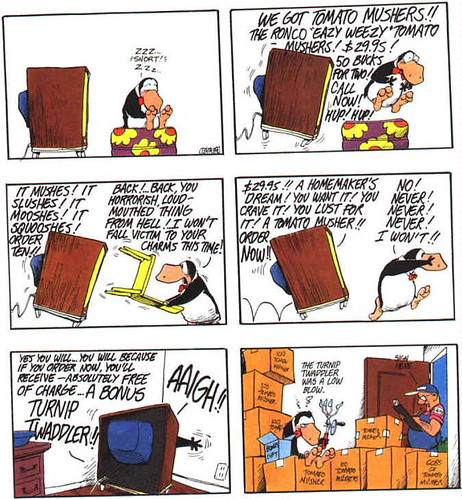
The quirky products certainly sounded like inventions Americans could live without — an Inside-the-Shell Electric Egg Scrambler, spray-on fake hair in a can, the Pocket Fisherman (“the biggest fishing invention since the hook … and still only $19.95!”), and the counter-size Showtime Rotisserie & BBQ (“Set it and forget it!”), one of his biggest successes.
His redesigned 1975 Veg-O-Matic is enshrined in the Smithsonian’s American Legacies collection alongside the Barbie doll, and comedian Dan Aykroyd vigorously parodied both salesman and machine in Bass-O-Matic skits on “Saturday Night Live” in the 1970s.

“I’ve gone by many titles: King of Hair, King of Pasta, King of Dehydration, or to use a more colloquial phrase, a pitchman or a hawker,” Mr. Popeil said in 1995. “I don’t like those phrases, but I am what I am. Pick a product, any product on your desk. Introduce the product. Tell all the problems relating to the product. Tell how the product solves all those problems. Tell the customer where he or she can buy it and how much it costs. Do this in one minute. Try it. You know what it sounds like? It comes out like this: Brrrrrrrrrrr.”

George Rhoads. I had not heard of him previously, but his work sounds really cool.

Mr. Rhoads’s colorful “audio-kinetic ball machines,” which evoked the workings of watches and roller coasters, were built of comically designed tracks and devices like loop-the-loops and helical ramps, and were usually six- to 10-feet high. Scores of the machines have been installed in children’s hospitals, malls, science museums and airports and elsewhere in a dozen countries, but mostly in the United States and Japan.
“Each pathway that the ball takes is a different drama, as I call it, because the events happen in a certain sequence, analogous to drama,” he said in an interview in 2014 with Creative Machines, which makes ball machines based on and inspired by his designs. “The ball gets into certain difficulties. It does a few things. Maybe there’s some conflict. They hit or they wander, whatever it is and then there’s some kind of dramatic conclusion.”
One of his most frequently viewed machines, “42nd Street Ballroom,” was installed in 1983 in the lobby of Manhattan’s Port Authority Bus Terminal, where it remained. Eight feet tall and eight feet wide, the sculpture shows its plates spin, its levers flip and its 24 billiard balls roll down ramps. As was typical of his machines, numerous balls move independently, letting gravity guide them and, when they reach the bottom, they are returned to the top by a motorized hoist.

Joey Jordison, drummer and founding member of Slipknot.

Rick Aiello, actor. (“Do The Right Thing”, lots of TV credits including “18 Wheels of Justice”)

For the record, he was Danny Aiello’s son.

Obit watch: July 26, 2021.

Monday, July 26th, 2021

Supplemental Steven Weinberg obits: NYT. Statesman.

Jackie Mason, comedian.

Mr. Mason regarded the world around him as a nonstop assault on common sense and an affront to his sense of dignity. Gesturing frantically, his forefinger jabbing the air, he would invite the audience to share his sense of disbelief and inhabit his very thin skin, if only for an hour.
“I used to be so self-conscious,” he once said, “that when I attended a football game, every time the players went into a huddle, I thought they were talking about me.” Recalling his early struggles as a comic, he said, “I had to sell furniture to make a living — my own.”
The idea of music in elevators sent him into a tirade: “I live on the first floor; how much music can I hear by the time I get there? The guy on the 28th floor, let him pay for it.”

After dozens of appearances on “The Ed Sullivan Show,” Mr. Mason encountered disaster on Oct. 18, 1964. A speech by President Lyndon B. Johnson pre-empted the program, which resumed as Mr. Mason was halfway through his act. Onstage but out of camera range, Sullivan indicated with two fingers, then one, how many minutes Mr. Mason had left, distracting the audience. Mr. Mason, annoyed, responded by holding up his own fingers to the audience, saying, “Here’s a finger for you, and a finger for you, and a finger for you.”
Sullivan, convinced that one of those fingers was an obscene gesture, canceled Mr. Mason’s six-show contract and refused to pay him for the performance. Mr. Mason sued, and won.
The two later reconciled, but the damage was done. Club owners and booking agents now regarded him, he said, as “crude and unpredictable.”
“People started to think I was some kind of sick maniac,” Mr. Mason told Look. “It took 20 years to overcome what happened in that one minute.”

A play he starred in and wrote (with Mike Mortman), “A Teaspoon Every Four Hours,” went through a record-breaking 97 preview performances on Broadway before opening on June 14, 1969, to terrible reviews. It closed after one night, taking with it his $100,000 investment.

For the record (and per Wikipedia), “Spider-Man: Turn Off the Dark” went through 182 preview performances.

He also invested in “The Stoolie” (1972), a film in which he played a con man and improbable Romeo. It also failed, taking even more of his money. Roles in sitcoms and films eluded him, although he did make the most of small parts in Mel Brooks’s “History of the World: Part I” (1981) — he was “Jew No. 1” in the Spanish Inquisition sequence — and “The Jerk” (1979), in which he played the gas-station owner who employs Steve Martin.

Appearances on the cartoon series “The Simpsons,” as the voice of Rabbi Hyman Krustofski, the father of Krusty the Clown, confirmed his newfound status, and earned him a second Emmy. Not even the 1988 bomb “Caddyshack II,” in which he was a last-minute replacement for Rodney Dangerfield, or the ill-fated “Chicken Soup,” a 1989 sitcom co-starring Lynn Redgrave that died quickly, could slow his improbable transformation from borscht belt relic into hot property.

Laura Foreman. She was a prominent and well-regarded reporter for the Philadelphia Inquirer in the 1970s: so much so that she got hired by the NYT.

Her focus was Philadelphia’s 1975 mayoral race, in which the brash and cocky incumbent, Frank L. Rizzo, the city’s former police commissioner, was seeking a second term.
One of Mr. Rizzo’s close allies was Mr. Cianfrani, a longtime ward boss who became chairman of the Senate Appropriations Committee and one of Pennsylvania’s most influential lawmakers. A streetwise power broker, he was a natural source and occasional subject for the new political writer.
Rumors began circulating that the two were involved romantically, but Ms. Foreman denied them, and the editors discounted them.

After she got hired by the NYT, it came out that the rumors were true: “…the politician had given her more than $20,000 worth of gifts, including jewelry, furniture and a fur coat, and helped her buy a 1964 Morgan sports car.

The Times told her she had to resign, even though the conduct in question had occurred at another paper. The Times, in fact, said initially that her work had comported with the highest ethical standards. But according to an account that Ms. Foreman wrote in The Washington Monthly in 1978, A.M. Rosenthal, The Times’s executive editor, told her that because the paper was writing tough stories at the time about conflicts of interest involving Bert Lance, a close Carter adviser, it couldn’t very well harbor a conflict of its own.
To others, Mr. Rosenthal uttered an unforgettable comment that has been rendered several different ways but in essence said that he didn’t care if his reporters were having sex with elephants — as long as they weren’t covering the circus.
In Philadelphia, Mr. Roberts, the Inquirer editor, appointed the paper’s top investigative team of Donald L. Barlett and James B. Steele to dig into the affair. They produced a 17,000-word article, published on Oct. 16, 1977, that exposed internal rivalries at the paper and found that editors had looked the other way to protect a favored reporter, Ms. Foreman. It was among the first instances of a newspaper turning its investigative artillery on itself.

She married Mr. Cianfrani, but never worked in journalism again. Ms. Foreman actually passed away over a year ago, but her death was only recently reported.

A burning in Hell watch, by way of Lawrence: Rodney Alcala, the “Dating Game” killer.

A longhaired photographer who lured women by offering to take their pictures, Mr. Alcala was convicted of killing a 12-year-old girl and four women in Orange County, Calif., and two women in New York, all between 1971 and 1979, the authorities said.
Investigators had also suspected him of, or had linked him to, other murders in Los Angeles, Seattle, Arizona, New Hampshire and Marin County, Calif., the department said.

In 1978, six years after he was convicted of molesting [removed – DB], Mr. Alcala appeared in a brown bell-bottom suit and a shirt with a butterfly collar as “Bachelor No. 1” on an episode of “The Dating Game.”
The host described him as “a successful photographer,” according to a YouTube video. “Between takes, you might find him sky-diving or motorcycling.”
Mr. Alcala won the contest, charming the bachelorette with sexual innuendo. The woman later decided not to go on a date with him because she found him disturbing, according to several news reports.

Obit watch: July 13, 2021.

Tuesday, July 13th, 2021

Charlie Robinson, actor.

We have “Night Court” on sometimes on Saturday mornings when we’re getting ready for excursions. That was a swell show, and not just because of Harry Anderson or John Larroquette: everybody is great in it. Including Mr. Robinson.

Among other credits, he was in “Gray Lady Down”. (Which, sadly, we have watched recently, so no tribute night.)

Paul “Mr. Wonderful” Orndorff, professional wrestler.

He participated in the first WrestleMania at Madison Square Garden in March 1985 in a fight with Roddy Piper against Hulk Hogan and Mr. T., according to WWE. Mr. Hogan and Mr. T won the fight. The next year, Mr. Orndorff fought against Mr. Hogan in an event that drew more than 60,000 spectators to Canadian National Exhibition Stadium in Toronto, which Mr. Hogan won by disqualification.

Lawrence sent over a more local obit for Henry Parham.

Obit watch: July 12, 2021.

Monday, July 12th, 2021

Edwin Edwards, former governor of Louisiana.

In January 2011, Mr. Edwards was released from a federal prison in Oakdale, La., after serving more than eight years of a 10-year sentence for bribery and extortion by rigging Louisiana’s riverboat casino licensing process during his last term in office.
Six months later he married. And in the fall, he rode in an open convertible through cheering crowds waving Edwards-for-governor signs at an election-day barbecue. “As you know, they sent me to prison for life,” he told them. “But I came back with a wife.”
Before Mr. Edwards, no one had ever been elected to more than two terms as governor of Louisiana. Indeed, the state constitution prohibits more than two consecutive terms. But from 1972 to 1996, with a couple of four-year furloughs to stoke up his improbable comebacks, Mr. Edwards was the undisputed king of Baton Rouge, a Scripture-quoting, nonsmoking teetotaler who once considered life as a preacher.

Henry Parham. He served in the 320th Barrage Balloon Battalion during D-Day.

Recognizing Mr. Parham’s service in remarks on the floor of the House of Representatives in June 2019, when the 75th anniversary of D-Day was commemorated, his congressman, Mike Doyle, Democrat of Pennsylvania, said, “He is believed to be the last surviving African American combat veteran from D-Day.”

His battalion hoisted large balloons to heights of up to 2,000 feet over Omaha and Utah beaches between D-Day and August 1944, carrying out the mission during the night hours so the balloons would not be spotted by incoming German planes. The balloons were tethered to the ground by cables fitted with small packets of explosive charges. German planes that became entangled in them were likely to be severely damaged or downed.
Mr. Parham’s section of the balloon battalion had reached Omaha Beach in the hours after the arrival of the first waves of infantrymen. (The other section was assigned to Utah Beach.) When the balloonists stepped off small boats, they witnessed a scene of carnage. The American forces, raked by German fire from high ground, had taken heavy casualties.
“We landed in water up to our necks,” Mr. Parham once told The Pittsburgh Post-Gazette. “Once we got there we were walking over dead Germans and Americans on the beach. Bullets were falling all around us.”
Mr. Parham told CNN in 2019: “I prayed to the Good Lord to save me. I did my duty. I did what I was supposed to do as an American.”

He was 99.

Thomas Cleary, noted translator and writer.

His books included “The Inner Teachings of Taoism” (1986), “Book of Serenity: One Hundred Zen Dialogues” (1991), “The Essential Koran: The Heart of Islam” (1993) and “The Counsels of Cormac: The Ancient Irish Guide to Leadership” (2004). Among the most popular was his version of “The Art of War” (1988), written by the Chinese military strategist Sun Tzu more than 2,000 years ago.

William Smith, prolific actor. He has 274 credits in IMDB, including the good “Hawaii 5-0”, “Rich Man, Poor Man”, “Darker Than Amber”, “Any Which Way You Can”, and “Kolchak: The Night Stalker”.

Obit watch: July 9, 2021.

Friday, July 9th, 2021

Dicky Maegle.

Maegle was an all-American as a senior in the 1954 season, when he ran for 905 yards and 11 touchdowns and finished sixth in the balloting for the Heisman Trophy, presented annually to college football’s most outstanding player. The trophy was won that year by the Wisconsin back Alan Ameche (who went on to fame with the Baltimore Colts for scoring the winning touchdown in overtime in the storied 1958 N.F.L. championship game against the New York Giants).
The San Francisco 49ers drafted Maegle in the first round of the January 1955 N.F.L. draft. He was a 49er for five seasons, playing mostly at right safety and occasionally as a running back, then concluded his pro career with the 1960 Pittsburgh Steelers and the 1961 Dallas Cowboys. He intercepted 28 passes, running one of them back for a touchdown.
He was inducted into the College Football Hall of Fame in 1979.

But he’s best remembered for something that happened in 1954 at the Cotton Bowl in Dallas:

Taking a handoff at Rice’s 5-yard line in the second quarter of its matchup with Alabama, Maegle cut to the right and raced down the sideline. When he passed the Alabama bench while crossing midfield, on his way to a virtually certain touchdown, the Crimson Tide fullback Tommy Lewis interrupted his rest period and, sans helmet, sprang onto the field and leveled Maegle with a blindside block at Alabama’s 42-yard line.
The referee ruled that Maegle was entitled to a 95-yard touchdown run. Rice, ranked No. 6 in the nation by The Associated Press, went on to a 28-6 victory over 13th-ranked Alabama.

Chick Vennera, one of those knock-around actors. Credits include “Thank God It’s Friday”, “The Milagro Beanfield War”, and a lot of TV, including “The Golden Girls” and voice work on “Animaniacs”.

James Kallstrom, FBI guy.

In his 27 years with the F.B.I., Mr. Kallstrom helped convict the bosses of New York City’s five Mafia families with cleverly concealed wiretaps and spiked meatballs. And he investigated the 1993 terrorist bombing of the World Trade Center, expanded the bureau’s surveillance purview to include cellular phones, and recovered a half-million dollars in diamond jewelry that had been stolen by a baggage handler at Kennedy International Airport in 1995 and that had belonged to Sarah, the duchess of York.
In the investigation of the crash of Flight 800, he became the face of the F.B.I. in daily briefings as he and other authorities sought to understand what caused the explosion that sent the jetliner plummeting into the waves off Long Island on July 17, 1996 — one of the deadliest aviation incidents in American history.

He may also be known to some folks as the guy who introduced episodes of “The F.B.I. Files”.

Obit watch: July 2, 2021.

Friday, July 2nd, 2021

John Erman, TV director. Credits include episodes of “Roots”, “Roots II: The Next Generation”, “The Outer Limits”, “Peyton Place”, “My Favorite Martian”, and one episode of a minor 1960s SF TV series.

NYT obit for Robert Sacchi.

Obit watch: June 30, 2021.

Wednesday, June 30th, 2021

NYT obit for John Langley, which (as usual) went up after I posted the other day.

Stuart Damon. He played “Dr. Alan Quartermaine” on “General Hospital” basically forever. He has a few other credits – mostly soaps – beyond that, including “Space: 1999” and “Star 80”.

Robert Sacchi, most famous for “The Man With Bogart’s Face”.

Obit watch: June 22, 2021.

Tuesday, June 22nd, 2021

Joanne Linville, actress.

84 credits in IMDB. She did a few 70s cop shows (“The Streets of San Francisco”, “The Blue Knight”, “Barnaby Jones”, the good “Hawaii Five-0”, “Columbo” and “Mrs. Columbo”, etc.). She also did a “Twilight Zone” (“The Passerby”), “The Invaders”, and an episode of a minor 1960s SF series.

Sang Ho Baek. He played baseball for George Mason University as a freshman this past season. After the season, he decided to have Tommy John surgery. He had the surgery on June 8th, and passed away on June 12th from complications.

He was 20 years old.

Obit watch: June 21, 2021.

Monday, June 21st, 2021

George Stranahan, colorful figure.

His family owned the Champion Spark Plug company, so he had family money. He got a PhD in physics, and spent a lot of time doing physics in the late 1950s.

Staring at a blank page one afternoon in 1959, he made a discovery: You can’t do physics alone. You need someone to talk to. Mr. Stranahan dreamed of creating a physics think tank in the Rockies.

So he did:

The Aspen Center for Physics was born. It proved pivotal in the development of the Fermi National Accelerator Laboratory, for a long time the world’s most powerful particle accelerator, and the formulation of string theory, regarded by many physicists as the most promising candidate for a “theory of everything” that would explain all the universe’s physical phenomena.
Sixty-six Nobel laureates have visited. “I’m convinced all the best physics gets done there,” Tony Leggett, one of those Nobelists, wrote on the center’s website. Another, Brian Schmidt, called the center “the place I have gone to expand my horizons for the entirety of my career.”

He cut back on his involvement in physics in 1972.

…in 1980, he opened a bar near Aspen, the Woody Creek Tavern, where he spent several years mixing drinks while also pitching in for humbler tasks like janitorial work. His daughter Molly Stranahan remembered him as a skilled cooker of soup for customers, including ranchers and cowboys.

He went on to found Stranahan’s Colorado Whiskey (which I have heard good things about, but never been able to find) and Flying Dog beer.

As of last year, Flying Dog was the 35th-biggest craft brewing company in the United States, according to the Brewers Association. In 2010, a “beer panel” convened by the New York Times food critics Eric Asimov and Florence Fabricant to rank pale ales declared Flying Dog’s Doggie Style Classic its “consensus favorite.”

He also did some ranching:

In 1990, Mr. Stranahan’s Limousin bull Turbo was declared grand champion at the 1990 National Western Stock Show, a highly regarded trade show. The price for a shot of Turbo’s semen rose to $15,000.
He quit the business not long after. Even with Turbo, Mr. Stranahan estimated that he lost $1 million during 18 years of ranching.

Going back for a minute, if the Woody Creek Tavern rings a bell with you, yes, that was Hunter S. Thompson’s hangout. Mr. Stranahan and Hunter were close friends.

Mr. Thompson either leased or bought the land he lived on from Mr. Stranahan. The details of the arrangement, intended to be easy on Mr. Thompson, appear to have been lost in a haze of friendship and misbehavior. The first time the two men met, Mr. Stranahan told Vanity Fair in 2003, they took mescaline that hit him “like a sledgehammer.”
“We talked a lot, drank a lot and dynamited a lot,” Mr. Stranahan said about their friendship in a 2008 interview with The Denver Post. “If you’re a rancher, you have access to dynamite.”

For the historical record: NYT obit for Frank Bonner.

Obit watch: June 18, 2021.

Friday, June 18th, 2021

Frank Bonner.

He was, of course, most famous as Herb Tarlek on “WKRP In Cincinnati” (and “The New WKRP in Cincinnati”, which I don’t think I ever saw an episode of).

But he had other credits.

His second credit in IMDB is “Equinox“, an odd film that we watched one Halloween season. I remember us saying, “Hey, is that Herb Tarlek? It sure looks a lot like him. Wait, it is!” (His first credit is “The Equinox: Journey into the Supernatural”, the short film that was expanded into “Equinox”.) And somewhat oddly, he has some pre “WKRP” cop show credits…

…including, believe it or not, “Mannix”. (“Catspaw”, season 5, episode 13. He’s listed in IMDB as “Hypnotized man (uncredited)”.)

Heidi Ferrer, writer for “Dawson’s Creek”. She also wrote “The Hottie & the Nottie”. According to her family, she had been fighting COVID-19 for over a year, and took her own life.

The number for the National Suicide Prevention Lifeline is 1-800-273-TALK (8255). If you live outside of the United States or are looking for other help, TVTropes has a good page of additional resources.

Janet Malcolm, who you may remember from “The Journalist and the Murderer”.

Her essay began with one of the most arresting first sentences in literary nonfiction: “Every journalist who is not too stupid or too full of himself to notice what is going on knows that what he does is morally indefensible.”
Her pronouncement enraged the journalistic firmament. Many writers insisted that this was not how they treated their subjects and accused Ms. Malcolm of tarring everyone with the same broad brush.
But what galled some journalists about the piece the most, The Times reported in 1989, “was her failure, and that of her magazine, to disclose that Miss Malcolm had been accused of the same kind of behavior, in a lawsuit filed against her by the subject of an earlier New Yorker article.”
That earlier article, a 1983 profile of the flamboyant psychoanalyst Jeffrey Masson, led to a libel suit against Ms. Malcolm that hung over her during a decade of litigation and clouded her reputation even longer.
The legal allegations were different: The MacDonald suit accused Mr. McGinniss of fraud and breach of contract; the Masson suit accused Ms. Malcolm of libel. But both suits raised serious questions about journalistic ethics — Dr. MacDonald’s about the nature of writers’ obligations to their sources, and Mr. Masson’s about what constitutes quotations and what license, if any, reporters may take with them.
The journalistic community generally judged Ms. Malcolm harshly, mostly for the finding in the Masson case that she had cobbled together 50 or 60 separate conversations with the loquacious Mr. Masson and made them appear as if he had spoken them in a single lunchtime monologue.
“This thing called speech is sloppy, redundant, repetitious, full of uhs and ahs,” Ms. Malcolm testified in her defense in 1993 during the first of two jury trials. “I needed to present it in logical, rational order so he would sound like a logical, rational person.”

In the Masson suit, the jury ruled that while two of five disputed quotations that Ms. Malcolm had attributed to Mr. Masson were false and that one of those was defamatory, none were written with reckless disregard of the truth, the standard under which libel damages would have been allowed.

Obit watch: June 14, 2021.

Monday, June 14th, 2021

Ned Beatty. THR. Variety.

Damn. 165 acting credits in IMDB. The man worked. And as far as I’m concerned, he classed up everything he was in.

I apologize, but this is the best Big Man scene I can find on the ‘Tube.

John Gabriel, long time actor on “Ryan’s Hope”. He did a decent amount of other stuff, including several appearances on “77 Sunset Strip”. Interestingly, he was also one of the (uncredited) newsreaders in “Network”.

Lawrence forwarded me an obit for Douglas S. Cramer, TV producer. I wasn’t really planning on noting this, but Lawrence pointed out that his credits do include “Mannix”…

Mudcat Grant, pitcher for the Twins and the Indians.

Grant led the American League in victories, winning percentage and shutouts in 1965 and pitched for 14 major league seasons.
He was remembered as a leading right-hander of his time, but also for his intriguing nickname, his second career singing and dancing at nightspots, and his book profiling outstanding Black pitchers.
Grant, a two-time All-Star, was a mainstay in the starting rotation for the Indians and the Twins for much of his career, then became a reliever, most notably with the Oakland A’s and Pittsburgh Pirates.
The Indians traded Grant to the Twins in June 1964. His best season came the following year, when he went 21-7, turned in a winning percentage of .750 and threw six shutouts. He pitched two complete-game victories against the Los Angeles Dodgers in the World Series, losing once, and hit a three-run homer as the Dodgers went on to win the series in seven games.
Cited by Sporting News as the A.L. pitcher of the year, Grant headed a staff that included Jim Kaat, Jim Perry and Camilo Pascual, backed by a lineup featuring Harmon Killebrew, Tony Oliva, Bob Allison and shortstop Zoilo Versalles, the league’s most valuable player.

As a youth Grant performed in a choir. Following the 1965 World Series, he founded Mudcat and the Kittens, a song and dance group that played at nightclubs and hotels during the off-seasons and that also gained international bookings.
“First his musicians — up to seven of them — begin, playing dance music and jazzier stuff, and then the Kittens, some very sexy girls in spare feline outfits, take over the stage to sing and dance and purr,” Frank Deford wrote in Sports Illustrated in 1968. “Then Mudcat comes on. He sings — everything from show tunes to rock ‘n’ roll — and tells jokes and dances.”
“I made way more money in music than I did in baseball,” Grant once said.

Planet Failure.

Sunday, June 13th, 2021

This popped up on Hacker News, and, while I have reservations about linking to Esquire for anything but drinks, it did entertain me: “The Rise and Fall of Planet Hollywood“.

I never went to a Planet Hollywood: when it first opened, it struck me as a cynical cash grab, and nothing in this article convinces me otherwise.

Some relevant quotes:

The ax Jack Nicholson wielded in The Shining, still caked in fake blood, was buried in the back of the garden shed of a guy who worked on the film.
“We asked what he wanted for it,” Todd told the Los Angeles Times in 1995, “and he said, ‘Well, I’ll need another ax.’ That was an easy deal.”

In interviews at the time, it was promised that Schwarzenegger would be in the kitchen cooking Wiener schnitzel. But when the three chiseled men did press for the restaurant, it seemed clear how much the menu was an afterthought. “The day they can reduce a meal to a pill, I’ll be happy,” Stallone said with a smirk in a 1992 interview with British talk-show host Michael Aspel. “I guess it’s from doing a great deal of training or whatever. Maybe it’s just genetic; I’m just not prone to chew a lot. It doesn’t go with my personality.”

“I don’t remember it ever having a lot of class,” says Hay. “I just remember the food got worse and worse and worse and worse until it really became inedible. And if you were going to go there for an event, you ate before, because you knew you couldn’t eat anything.”

“It was incredibly monotonous for us, because there was a hierarchy like there is at any other job,” says actress Natalie Zea, who worked as a hostess at the Manhattan Planet Hollywood in 1994. “The servers were superior to us, because they’re the ones who got to interact on the occasion when somebody [famous] would come in. There was no real behind-the-scenes. It was just so rote.”

“My only real memory of [stars coming in] is this blurry vision of a very tall man being kind of swept through as I stand behind the podium thinking, Oh, he’ll see me and be like, ‘You, hostess, there. Let me put you in a movie,’ ” Zea says. “Which, to be honest, is the only reason any of us worked there.”

(For those who don’t recognize Natalie Zea’s name, she did get discovered eventually. She was “Raylan Givens” ex-wife/current girlfriend on “Justified”, and was “Wade Felton”‘s (Walton Goggins) girlfriend on “The Unicorn” before that got cancelled.)

Copycat restaurants were popping up all around. There was Country Star with Reba McEntire, Clint Black, Vince Gill, and Wynonna Judd. Fashion Cafe, with models Naomi Campbell, Elle Macpherson, and Claudia Schiffer, opened in Rockefeller Center just down the street from the Manhattan Planet Hollywood. Steven Spielberg had Dive!, an underwater-themed restaurant with, yes, gourmet submarine sandwiches. Hulk Hogan had Pastamania! Earl launched his own spin-offs to help with growth when Planet Hollywood ran out of places to open Planet Hollywoods. There was a sports offshoot, the Official All Star Cafe, with Shaquille O’Neal, Andre Agassi, and Joe Montana. When Tiger Woods made his first public appearance after winning the Masters in 1997, it was at the opening of Myrtle Beach’s All Star Cafe. There was also an ice cream chain, Cool Planet, with Whoopi Goldberg. Any cool factor associated with Planet Hollywood was melting. The stock value plummeted, and people just weren’t going back to eat. In 1999, Los Angeles magazine reported that same-store sales—a critical factor in a restaurant’s long-term success—fell by 18 percent the previous year. And the food only seemed to be getting worse.

A rep for Stallone says, “Contrary to the assertion by Robert Earl, Mr. Stallone is no longer involved with Planet Hollywood.” (Stallone and Willis, who were effusive in their enthusiasm for Planet Hollywood throughout the nineties and during the Vegas opening in 2007, declined to be interviewed for this piece. A rep for Willis never responded to my inquiry about the actor’s current involvement with the brand. A rep for Schwarzenegger didn’t respond to multiple inquiries.)

Bonus: I was sort of on the fence about using this. But in the end, it told me something I didn’t know, and the presenter isn’t quite as grating as some of those other “abandoned thing” guys.

Did you know there was a Hard Rock theme park? It opened in Myrtle Beach, South Carolina in April of 2008. The plan was for it to be the first of a chain of Hard Rock theme parks.

It closed in September of 2008. The parent company filed for Chapter 11, and the park was sold off. It reopened in May of 2009 as “Freestyle Music Park“, with the Hard Rock branding removed. Freestyle’s parent company was sued multiple times by various entities for various reasons, and the park closed again at the end of the 2009 season. It never reopened and remains abandoned today.

(I’ve been to Myrtle Beach once or twice, but it was when we lived in Virginia, so about 50 years ago, long before Hard Rock Park. My most vivid memory of those trips was us going to some other amusement park, and being upset that I was too short for the bumper cars. I do know people in the North Carolina area, but I’m not sure if any of them ever made the trip down to Hard Rock Park.)

Obit watch: June 10, 2021.

Thursday, June 10th, 2021

Claudia Barrett. She did some Westerns and detective shows (including an appearance on “77 Sunset Strip”, making her the second person from that series to get an obit this week), but was out of acting by 1964.

She may be most famous as the female lead in “Robot Monster“.

Ernie Lively. He knocked around quite a bit (his first credit was 1975, and his last was 2020). He appeared multiple times on “The West Wing”, “Murder She Wrote” and “The Dukes of Hazzard”. However, he seems to be most famous as the father of “Bridget” in the two “Sisterhood of the Traveling Pants” movies. (“Bridget” was played by his daughter, Blake Lively.)

Robert Hollander.

Professor Hollander joined the faculty of Princeton University in 1962 and taught beloved classes on Dante for 42 years. For medievalist scholarship, the three-volume translation he produced with Ms. Hollander found a wide degree of public interest, including two admiring reviews in The New Yorker.
In one, in 2007, the New Yorker critic Joan Acocella called all three volumes of their translation “the best on the market.” (The Hollanders produced “Inferno” in 2000, “Purgatorio” in 2003 and the last volume of the epic allegorical work, “Paradiso,” in 2007.)

The couple brought complementary strengths to the project. Ms. Hollander, the author of five books of poetry, attended to the music of the language. Professor Hollander ensured the translation’s accuracy and wrote introductions to each volume, along with notes to the text.
Ms. Acocella estimated that the notes amounted to 30 times the length of “The Divine Comedy” itself. That was Professor Hollander’s style. He interpreted moralistically and theologically passages usually appreciated for their beauty. His erudition wore down fellow scholars. He reported that A.B. Giamatti, the Renaissance expert and former president of Yale University, once asked him, “Are you going to try to ruin this scene for me too, Hollander?”

One of the reasons I wanted to post this here (other than, he sounds like a really nifty guy: you should read the whole obit, especially the part about his stroke) is that I wanted to ask the huddled, wretched masses: does anybody have any experience with Dante translations, and can you recommend a good one?

Other than the Hollander one, Thomas Harris (yes, that Thomas Harris) likes the Robert Pinsky translation. Anthony Esolen (a writer I greatly admire) has also done a transalation

I could just read Rod Dreher’s book and see if he recommends one: I do want to read How Dante Can Save Your Life (and that’s actually what started me on this quest), but I’m having trouble finding a decent copy at a decent price.

(All links are Amazon affiliate links, for the record.)

Speaking of Rod Dreher, this is a beautifully written post about the death of a friend. Followup.

Obit watch: June 9, 2021.

Wednesday, June 9th, 2021

Erin O’Brien, actress. She appeared on several Western series, and in the pilot of “77 Sunset Strip” (among other credits).

NYT obit for Jim Fassel, which did not go up until late in the day yesterday.

Obit watch: June 7, 2021.

Monday, June 7th, 2021

Clarence Williams III. THR.

Although “The Mod Squad” made Mr. Williams a symbol of the Vietnam War generation, he actually served in the military just before that era. He was a paratrooper in the 101st Airborne Division in the late 1950s.

He began his acting career on Broadway, where his grandfather had appeared as early as 1908. The young Mr. Williams appeared in three plays, including “Slow Dance on the Killing Ground” (1964), for which he received a Tony Award nomination and a Theater World Award.

After the show ended, Mr. Williams dropped out of sight for a while, expressing disappointment in the kinds of roles available to Black men. He returned to Broadway, appearing as an African head of state, with Maggie Smith, in a Tom Stoppard drama, “Night and Day” (1979).
Beginning in the 1980s, he had a busy film career. He played Prince’s abusive father in “Purple Rain” (1984) and Wesley Snipes’s heroin-addicted father in “Sugar Hill” (1993). He was a crazed blackmailer in John Frankenheimer’s “52 Pick-Up” (1986) and a wild-eyed storytelling mortician in “Tales From the Hood” (1995). He had small roles in the blaxploitation parody “I’m Gonna Git You Sucka” (1988) and in Norman Mailer’s “Tough Guys Don’t Dance” (1987).
Television brought Mr. Williams new opportunities too. He was a leader of the Attica prison riots in HBO’s “Against the Wall” (1994); a segregationist governor’s manservant in the mini-series “George Wallace” (1997); Muhammad Ali’s father in “Ali: An American Hero” (2000); and a retired C.I.A. operative in 10 “Mystery Woman” movies (2003-07). He did guest appearances on close to 40 series, from “Hill Street Blues” to “Empire.”