This is kind of surprising to see in the NYT: Tom Knapp, noted exhibition shooter.
More:
I feel sure I’ve written before about the Feds and their effort to shut down the Mongols Motorcycle Club by…seizing their trademarks. Because, of course, not having a logo will deter members of the Mongols from engaging in criminal activity, and they’d never think of something like adopting a new logo, or doing without. After all, how can you make meth without a snazzy logo?
Oddly, though, I can’t find that post. But by way of Reason‘s “Hit and Run”, I have discovered a couple of updates:
So not only did the government not get what they were looking for, they have to pay out a quarter million dollars worth of taxpayer’s money and clean up the garbage.
In other news, I was considering writing an extended rant about the Statesman and their forthcoming paywall. But now I don’t have to: Lawrence has saved me the trouble, in a post with charts and graphs and words and all that good stuff. I commend it to your attention.
Jimmy Savile isn’t the only British entertainer caught up in scandal:
I don’t want to seem like I’m trivializing this. But going on:
Among the people caught up in this:
Freewheeling Bicycles, official purveyor of bicycles, accessories, and repairs to sportsfirings.com, is closing at the end of May.
This makes me sad. There are other bike shops in Austin: REI in particular isn’t a bad place to go. But the people at Freewheeling were always nice and helpful to me, and the store felt like it had a personality. That’s something lacking at REI, or Bicycle Sport Shop, or pretty much all the other shops I’ve found in Austin.
And so we come to the end of the TMQ NFL draft interregnum. What messages does TMQ have for us this week? After the jump…
Great and good friend of sportsfirings.com and valued commenter lelnet left a long comment on last night’s cellphone post. Because his comment represents a lot of work and thought (and I believe in rewarding hard work) and because I’m afraid it will get lost in the shuffle, I’m promoting it to a blog post (with his permission).
You can already buy, off the shelf at Fry’s, a “phone” that does essentially what you’re talking about, using available wi-fi networks to connect with Skype and make calls through that, without any involvement of the cell providers. (Yes, I know…Skype is a proprietary protocol and would be unacceptable to Stallman. The firmware is also closed. But since it’s provably _possible_, one could do it with open standards if one saw a market.)
The problem is that it doesn’t scale well. Getting a reliable wi-fi signal is pretty easy…in the sorts of places one is likely to have access to a _wired_ phone whenever one wants one. Building a wi-fi network that covers the places one actually needs mobile connectivity from is a massively harder problem, due to the range limitations of unlicensed spectrum.
It _might_ be possible to do it using amateur frequencies, _if_ you could get regulatory approval to open those up to use by the general public. Which, of course, would involve fighting off both the whole telco industry and at least 80% of the amateur radio community. Considering that the latter group is where you’d be trying to recruit most of your network engineers from, it seems like it’d be a bad idea to begin your plan by irrevocably pissing them off, even if you magically assume that you’ll be able to out-muscle the telcos in Washington.
The last mile is a hard problem on several different dimensions, some of them physical and some of them political. But there is something you _could_ do…
Build an Android (or, if you like, Replicant) phone, pre-configured to send all its traffic through an encrypted VPN to an anonymizing end-point. Purchase connectivity for it on an existing cell carrier’s prepaid plan. Disable the cellular voice service, and have it send and receive calls exclusively through VoIP connectivity to an Asterisk or FreeSwitch server, either run by the same entity that does your anonymizer, or run yourself on a cheap colo server stuck in a rack in some country you doubt is ever going to care enough to spy on you.
Your cell provider can easily determine that Charles Udall Farley (or whatever name you gave them when you signed up…it’s prepaid, so it’s not like the name you give has to pass a credit check) pushes a lot of data around, but they’d have no way of inspecting the content. They’d have a record of Mr. Farley’s movements around their network, but no way to associate that with you, or even with the phone number you make and receive calls on. An Open Source OS on the phone addresses the “remote bugging” fears. It doesn’t depend on you personally running any software that RMS would find objectionable. And since you can make and receive calls from anywhere that you’re able to get a data signal off a cell tower, it’s still useful if your car breaks down by the side of the road, instead of just in your home and office, like a wi-fi-only device would be.
(I came up with this plan for a team of spies in a novel my wife is writing. But although to my knowledge no such phone exists today, there’s absolutely no barrier to someone building one tomorrow. And both the technologies and the services required to support the back-end of it are already available for purchase in the real world right now, at prices comparable to or better than what people who already had cell phones in the mid-90s were paying for service then.)
The only thing I’d add to this is that I, personally, have no interest in pissing off the amateur radio operators out there; both because it is not good strategy, as lelnet notes, and because I happen to be one myself. (KF5BFL, in case anyone was wondering, but don’t look for me; I don’t have any transmitting equipment at the moment.)
Once upon a time, there was a man named James Stockwell who lived in Orange County.
Mr. Stockwell led a colorful life. He ran strip clubs on the Sunset Strip in the 1970s. He was also involved in credit card fraud and counterfeiting. Mr. Stockwell went away for a while.
When he came out of prison, he started a chain of hotdog stands called “Cowboy Hotdogs”. He raised a million dollars for his hotdog stands. But “Cowboy Hotdogs” folded; worse yet, Mr. Stockwell admitted that he stole $412,000 from his investors.
Mr. Stockwell, also known as “Jimmy Casino”, also ran the Mustang Topless Theater in Orange County. (Strippers, always with the strippers.) By 1987, he was in a bind: the IRS was going to shut down the Mustang because of “millions of dollars in unpaid taxes”, he didn’t have the money to make restitution payments to the “Cowboy Hotdogs” investors, and he owed other folks money. Serious other folks.
25 years later, a man named Richard Morris Jr. is standing trial for the murder of Jimmy Casino. The investigators in the case matched DNA from Morris to DNA recovered from Casino’s girlfriend, and arrested him in 2008.
I’m looking forward to the book about this case.
If this had happened in New York City, I’d blame Julie Taymor, Bono, and The Edge.
Dr. Kenneth I. Appel, noted mathematician.
Dr. Appel is famous, along with Dr. Wolfgang Haken, for their 1976 proof of the four-color map theorem. Their proof was significant for two reasons:
The Appel/Haken proof was rather controversial at the time:
I would have been 11 at the time, and I remember this being a big deal. I even remember trying to read the Scientific American article about the four color proof, and it being more than a little above my head. I’d love to go back and read that article now, but (of course) it doesn’t seem to be available online unless you’re willing to cough up money to Nature.
(When did Nature acquire the Scientific American archives? Did I miss that?)
Two things collided in my head last week. After I picked up the wreckage, I thought there might be a worthy blog post in the aftermath.
(Picking up the wreckage took a while, because the week was so busy. At least nobody took part of a locomotive through the eye. Anyway, I apologize if this is old news.)
Thing one: Andrew Huang’s post on the $12 Gongkai phone (by way of LWN). It doesn’t come as any great shock to me that cellphone hardware has become cheap: at last year’s DEFCON, the Ninja Networks party invitations were fully functional cellphones. (I do not know what the Ninja Networks cost per phone was: as I recall, the Ninjas stated they got substantial financial and technical support from Qualcomm. However, the fact that the phones were cheap enough to pass out as party invites is significant in and of itself, in my ever so humble opinion.)
Thing two: Dr. Richard Stallman and his position on cell phones. I don’t want to reopen the whole debate on whether Stallman is a hypocrite for not having a cell phone but being willing to use other people’s phones. Rather, I want to ask a not-so-simple simple question: is it possible to build a phone that overcomes Stallman’s objections?
Well, it looks like we can put together a cellphone computer for about $12. Maybe less. I don’t see any reason to think that someone (more likely, a small group of someones) could put together a reference hardware spec for an open cellphone, complete with schematics, PCB layouts, and a parts list. I know I don’t have the skills or equipment to do SMD soldering, and I wouldn’t ask, say, my mother to build a phone from a kit either. But it is just as easy for me to visualize a scenario where some organization (say, the FSF) contracts with a manufacturer to build phones from the reference design, with an organizational seal of approval. They could sell the phones outright, or offer them as a premium for donations: I think I’d give at least $50 to FSF for a phone like the one Huang describes. Add WiFi, GPS, a color screen and a camera and I’d go up to $100, possibly more depending on my mood, the phase of the moon, and other factors.
But we need an operating system for our cellphone computer, right? Right. Android is open source. Note well, however, that there is a difference between “free software” and “open source software”, and that these are not equivalent concepts. But it seems pretty easy to imagine (as long as were are imagining) a fork of Android that is truly “free” by the FSF definition. As a matter of fact, we don’t even have to imagine; while I was researching this post, I stumbled across Replicant, which is exactly that.
I’ll deal with the second objection first. With a truly open source and free OS, I think you can pretty much eliminate the capacity for remote bugging. As to the first objection, I don’t see a way around that. It seems pretty clear that the phone system has to know where your phone is for you to make calls and get calls. But: if the system only stores that information for the minimum necessary length of time, and discards it after the call is completed, is that good enough for Stallman?
(Even if you’re not actively engaged in a call, I think the network still has to know what cell you’re in. But could the network only store your current cell, and not the history of cells you’ve been through?)
(From this point forward, I’m going to refer to this idea as the “open” network. Calling it the “free” network carries with it the connotation that people aren’t paying for it. I’ll come back to that.)
Okay. So we expect AT&T and Sprint and Verizon and T-Mobile and the Grace L. Ferguson Cell Phone and Storm Door Company not to store this information. Right. I’ll wait for you to finish laughing.
Done? Okay. So we not only need consumer hardware, we need an entire “open” cell phone network. Is that something that could be reasonably built? Well, we need radio spectrum. It is unlikely that the carriers will give up spectrum for an “open” network. So what do we do? Could we use amateur radio frequencies, like the 2390-2450 MHz band? Is it even possible that local amateur radio groups could set up and maintain cells in their local areas? (I don’t imagine the equipment to set up a cell is cheap, but I also don’t imagine it is beyond the reach of a group of talented amateur radio operators with a GNU software radio. And if the equipment becomes widespread, the prices should go down. I hope.)
Could you even do away completely with the cell network, and just run all the communications over IP? You’d need to be associated with an access point, but aren’t most folks near one at home or at work most of the day? Would it be possible for amateur radio operators to set up networks of access points along major urban corridors? WiFi hardware is even more of a commodity item than cell hardware, and there are protocols for linking access points together or doing mesh networks.
Someone has to pay for this, right? Right. We don’t want movements and activity tracked, but I don’t see any philosophical problem with a simple lookup based on each phone’s unique identifier. All you need is one bit to indicate the customer is paid up and entitled to use the network. As for the actual cost and billing, it seems to me that can be handled by systems outside the network. If you’re giving unlimited everything for one flat fee, you don’t need to track anything except paid or unpaid. If you want to start getting into per voice minute or per KB data charges, it seems to me that you can still track usage (minutes, KB, or texts) without tracking activity and bill based on usage. The money from service fees could, in turn, be routed to the cell providers. I’m sure we could come up with a fair way of doing this; for example, X cents per call routed through an individual cell. Busier cells get more money, which they can invest in upgrading service; more remote cells probably have lower demand, and don’t need the same capacity.
(One big problem if you’re using amateur radio frequencies: FCC regulations prohibit “communications in which the operator has a pecuniary interest, including communications on behalf of an employer“. There’s a strong tradition, in addition to the FCC regulations, against using the amateur radio bands for business purposes. One could argue that this kind of network wouldn’t be a business, though; rather, it would be a maintained as a public service, and the money that comes in would go back out to local amateur organizations to cover their cost of maintaining cells. I sort of see this in the same way as I do the repeaters maintained by some amateur radio clubs for the use of their members.)
So I said this was a not-so-simple simple question. Basically, what I don’t know about cell phones and cell technology could fill books. (Indeed, it has filled books, which are located in places called “bookstores” and “libraries”. But I digress.) I think I’ve outlined a possible path to an “open” network, but I acknowledge the limits of what I know. I would welcome criticism from people who know more than I do: those who work in the industry, computer security experts, and heck, even cyberpunk writers.
I mention cyberpunk writers for a reason. Maybe I am over-romanticizing this a bit, but I have this mental image of guys in the Sprawl with “open” cellphones spread out on blankets in the street, and gangs like the Panther Moderns using those phones. A guy can dream, can’t he?
(Subject line hattip: the greatest rock song ever, by the greatest band ever. Like you needed it anyway.)
Edited to add: I knew there was something I was forgetting. How reliable would this network be? After all, AT&T spends hundreds of millions of dollars a year on their network, where what I’m talking about here is something that is, at best, a fringe network primarily used by people highly concerned with privacy, and possibly maintained by amateurs on a spare time basis. On the other hand, AT&T spends hundreds of millions of dollars a year on their network. Enough said.
My inclination is to say that you could probably build something that’s “good enough”. You might not be able to get to the same level of service as, say, Verizon, but you could probably get to a level of service where people are willing to make the tradeoff between guaranteed privacy and a small amount of inconvenience. I think this is one place where my plan is weak.
Edited to add 2: 1500 words? I haven’t written like this since I was in college. In other words, last year.
Travis County DA Rosemary Lehmberg says she’s not going to run for re-election in 2016. She also says she plans to seek “professional help and guidance” once she’s released.
It may seem that I’ve been gloating about this case. I’m not. Truthfully, I feel bad for Ms. Lehmberg. I’m not an expert in substance abuse, but if she had blown a .09, I could chalk that up as the kind of mistake anyone could make. Driving around with a .239 BAC and an open bottle of vodka in the passenger seat makes me think there’s a problem. I respect Ms. Lehmberg for standing up and taking responsibility for her actions – including entering a guilty plea right away, rather than forcing a trial and all the conflicts that would result from her office prosecuting her. I think she’s doing the right thing by seeking professional help.
But I also feel that her actions have compromised the office. And as I’ve said before, the law is the law, and says she can be removed from office for intoxication. There’s no “good person” exception.
I hope Ms. Lehmberg gets help, and I hope she remains a respected member of the Travis County legal community. I hope she uses this experience to help other people in similar situations. But I believe she needs to do so as a defense lawyer, not as an elected prosecutor.
Heading out to the gun show, and then a ceremony at the university later on. Busy day coming.
The mayor of Patton Village, Texas, is no longer the mayor of Patton Village.
She was removed from office by the judge shortly after her conviction. Ms. Munoz still faces charges of tampering with government records: she was convicted of a felony in 1979, but lied about that conviction when she ran for mayor.
(Previously. Previously.)
Obit watch: the late great George Jones. NYT. LAT. A/V Club.
Yeah, we know, we’re late. We didn’t realize until Wednesday that it was that time of year again, and it took us a while to work up the gumption to do this. Part of the problem, of course, is that this is the column where TMQ mocks the mock drafts. As we’ve said in the past, TMQ thinks this is more amusing than it actually is, and there’s really no reason to go item by item through his attempts at humor.
But we have an obligation to our reader. So we might as well get into it…
There just hasn’t been much newsworthy in the past day or so. I’m having trouble working up energy to write about TMQ’s mock draft column (further proof that Easterbrook is more funny to himself than he is to real people). I’m also having trouble with the latest Travis County DA development:
“Hey, Rosemary? Betty. How are you doing?”
“Oh, I’m so glad to hear that. Listen, Rosemary, I need a favor.”
“Well, Rosemary, I’ve got this client…”
“Look, Rosemary, when you were in jail and needed a hand, I stood up for you. Now you’re not willing to help me out with a little deal here?”
This is exactly the kind of thing I was afraid was going to happen. And, you know, I’m not sure it makes a difference. The petition to remove Lehmberg is based on the law, and the law says you can get thrown out for being intoxicated. Lehmberg’s confessed to DWI. As far as I know, the law doesn’t say you can get thrown out for being intoxicated unless you get a bunch of your friends to testify about what a great person you are.
Anyway, instead of content, have a couple of photos.
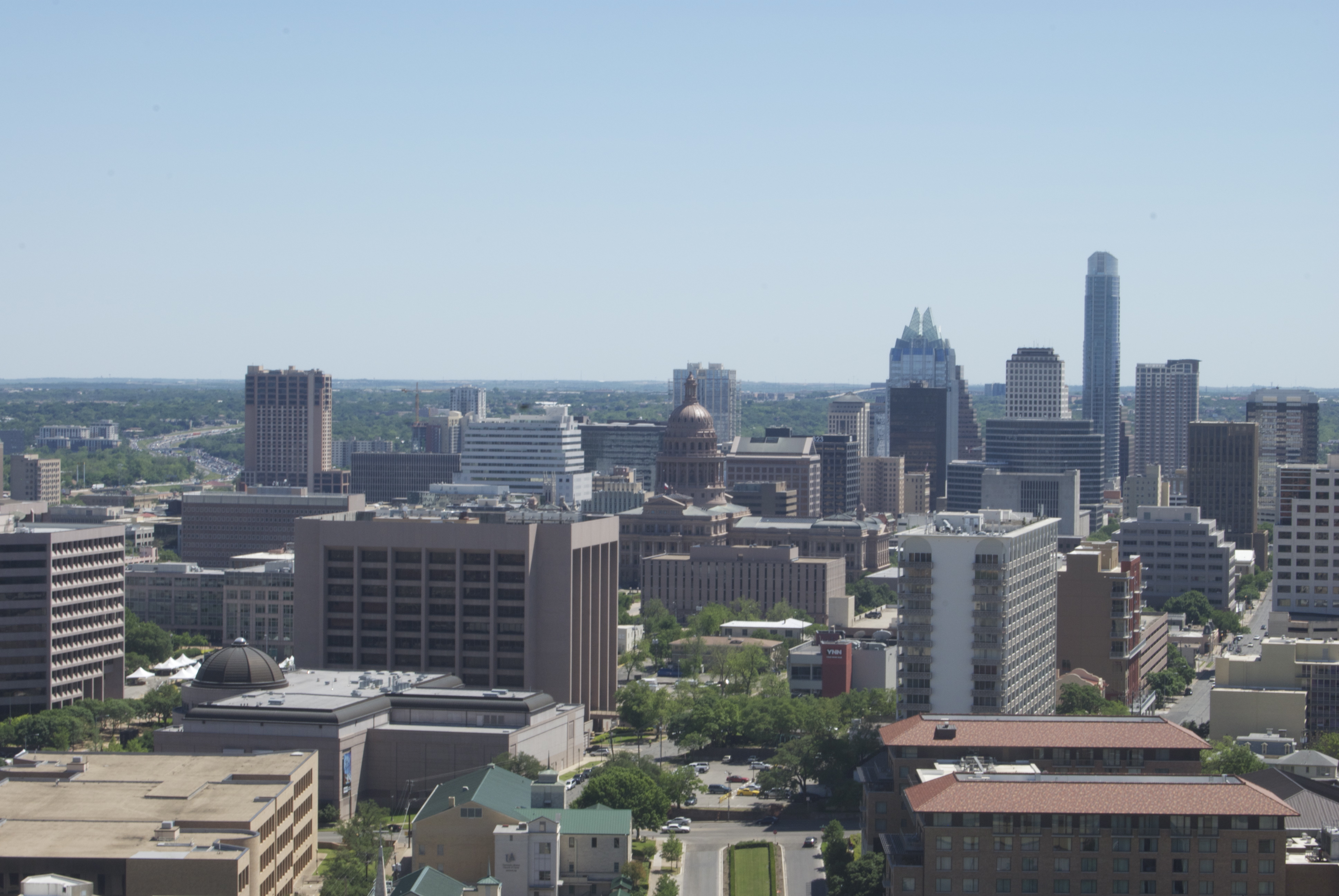
This is the Austin skyline, facing south from the 27th floor observation deck of the Main Building at the University of Texas. (Yes, that observation deck.) Taken at 1/60 and f/22, with the Nikon 55-200 VR zoom at 55mm. Just to the right of the Capitol, you can see the Frost Bank Tower, or as some of us like to call it, “the nose hair clippers”.
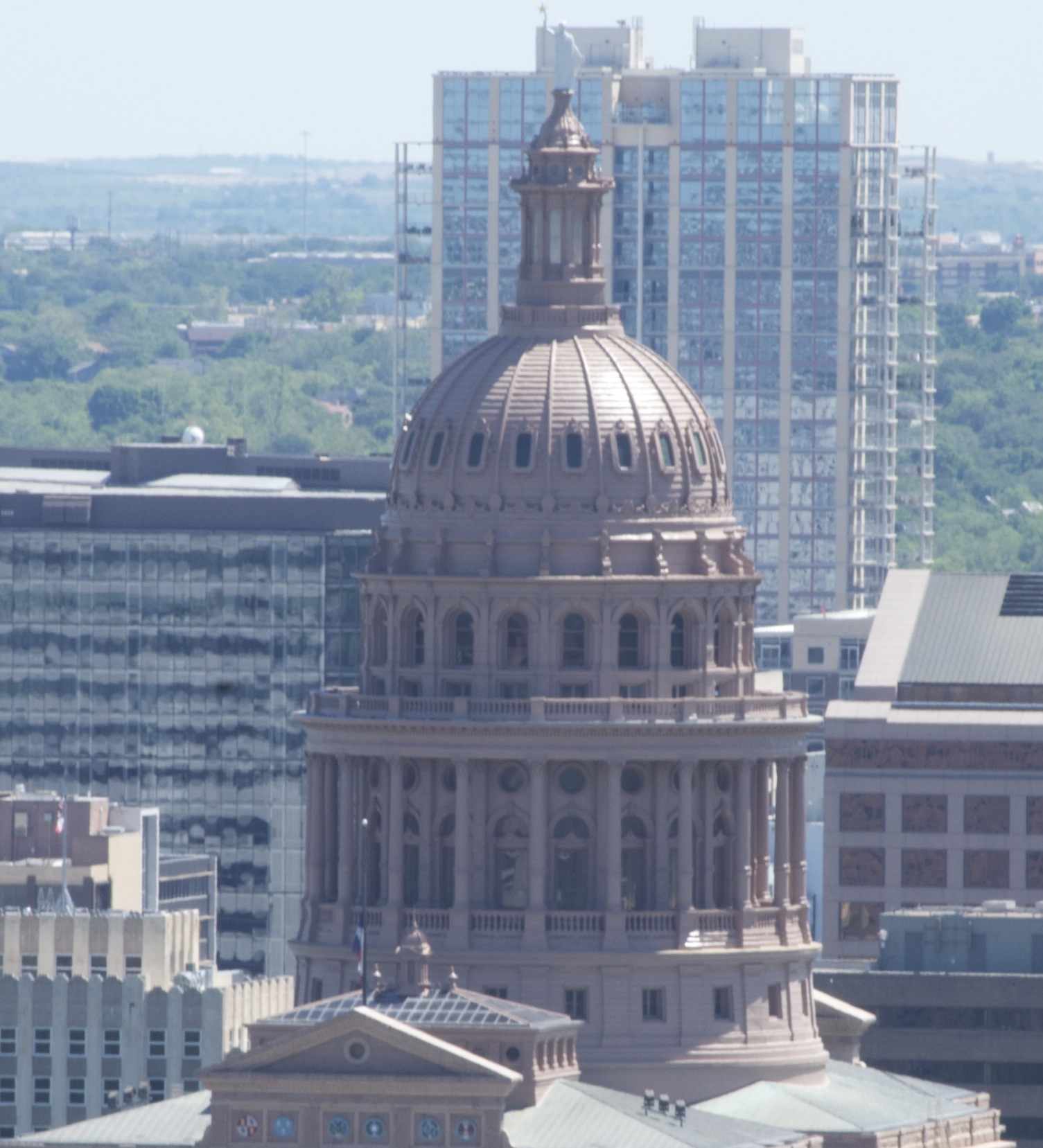
This is the upper portion of the Capitol, taken at 1/30 and f/22 with the same zoom at 200mm, and cropped some in iPhoto.