Archive for May 31st, 2021

Continuing adventures in hoplobibliophilia.

Monday, May 31st, 2021

I’ve actually bought a fair number of used gun books over the past few months. I didn’t bother writing about them here because they were pretty much all semi-crappy copies of books that I bought for reading purposes, not really worthy of a blog entry.

This is something I ran across today at Half-Price Books that I found interesting for more than one reason.
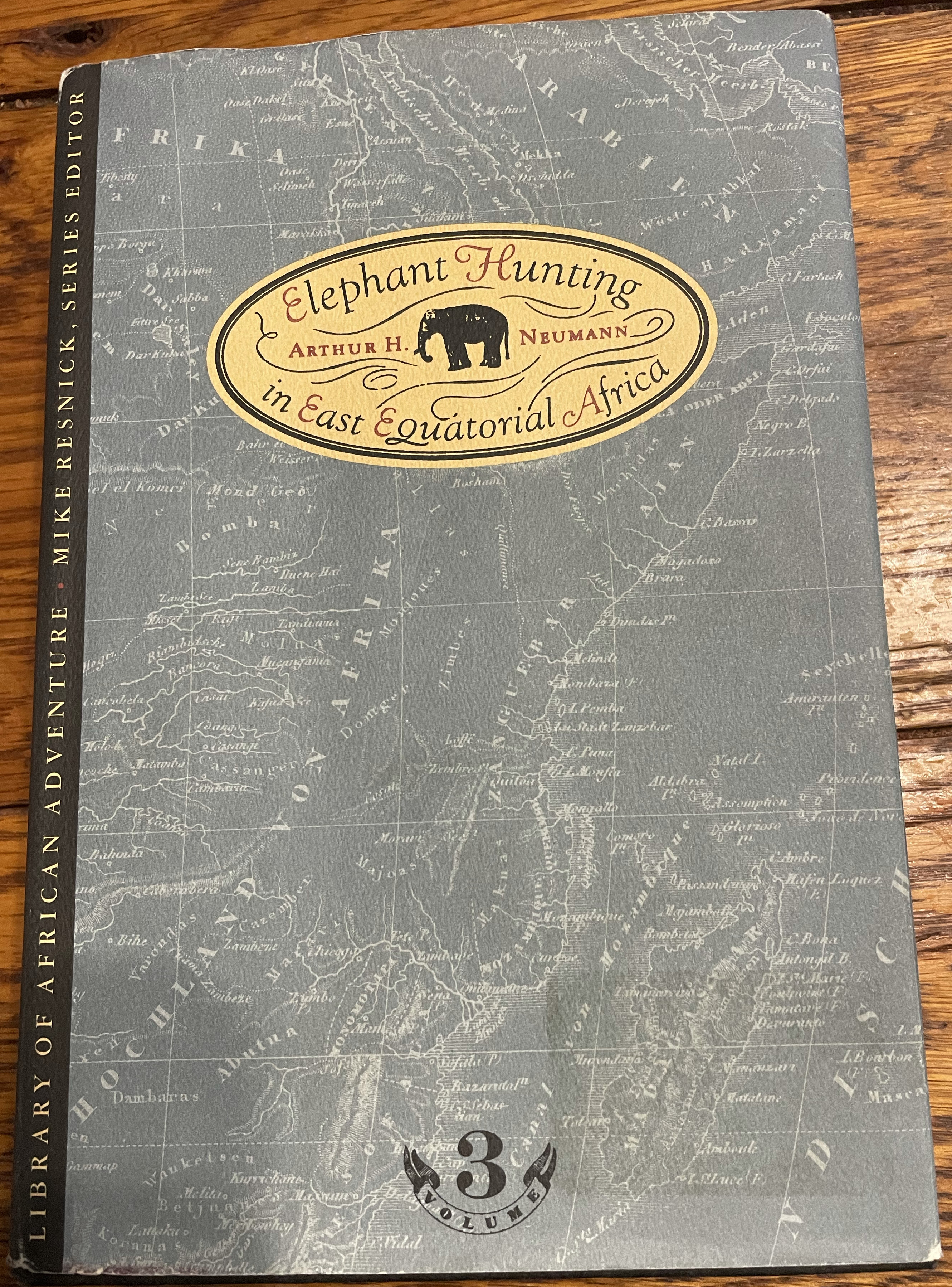
Elephant Hunting in East Equatorial Africa by Arthur H. Neumann. This is a reprint of the original 1898 edition, and volume 3 in the “Library of African Adventure” series from St. Martin’s Press. It has a little wear to the top and bottom of the dust jacket, but not too bad, and was purchased for about half of what “good” copies are going for on Amazon.

The other reason I found this interesting: you know who edited the “Library of African Adventure” series?

No, not that guy: he had his own series. The “Library of African Adventure” was edited by…noted SF writer Mike Resnick. Which is no great shock, as Resnick wrote extensively about Africa: it was simply an unexpected find.

Now I want to find the other volumes, especially since I’ve completed my Capstick set.

There is also something called “Resnick’s Library of African Adventure” that comes up when you search Amazon. I’m not 100% sure it is the same series – I suspect it is, but the bibliographical information on Amazon is scant, and the covers seem…less subdued.

Historical note, suitable for use in schools.

Monday, May 31st, 2021

You know who was a Marine?

If you’re one of my readers who was a Marine, the answer is probably “Yes”. I figure the list of famous Marines is drilled into folks at boot camp.

But for everyone else: Don Adams.

I kid you not. Before he was “Maxwell Smart”, he served in the Marines during WWII. He fought (and was wounded) in the battle of Guadalcanal. He also came down with “blackwater fever”, and was medically evacuated to New Zealand, where he was hospitalized for over a year. After that, he served as a drill instructor until 1945.

As a side note, I went down a rabbit hole about “blackwater fever” a few months ago when I was reading White Hunters: The Golden Age of African Safaris (affiliate link). It also comes up in “The Bridge on the River Kwai“, which I did finally watch Saturday.

Blackwater fever is a complication of malaria. From what I’ve picked up, red blood cells burst and release hemoglobin, which enters the kidneys and can cause them to fail. I’ve seen suggestions that quinine either caused it, or was a contributing factor: now that we have other anti-malarial drugs, the incidence of blackwater fever has decreased.

A lot of those old-time African hunters came down with blackwater fever at one time or another: the folk remedy (which seems to have worked for many of them) was…massive consumption of champagne. I would think that would overload the kidneys and make things worse, but enough of those guys seem to have survived (the mortality rate is claimed to be 90%) that maybe there was something to it…?

Father Joseph Timothy O’Callahan.

Monday, May 31st, 2021

Father O’Callahan was a good Boston boy. Shortly after he graduated from high school in 1922, he signed up with the Jesuits.

He was ordained as a Jesuit priest in 1934. Along the way, he picked up a BA and a MA from St. Andrew’s College, “specializing in mathematics and physics”. He was a professor of math, physics, and philosophy at Boston College for 10 years (1927-1937), then he went over to Weston Jesuit School of Theology for a year. From 1938 to 1940 he served as the director of the math department at the College of the Holy Cross.

When World War II began, O’Callahan was 36 and nearsighted, with a bad case of claustrophobia and high blood pressure—an unlikely candidate for military service, much less for heroic valor.

He enlisted in the United States Navy Reserve Chaplain Corps in August of 1940 as a lieutenant junior grade. But I gather he was pretty good at his job: by July of 1945 he had reached the rank of commander. He participated in Operation Torch and Operation Leader.

On March 2, 1945, Commander O’Callahan reported to the aircraft carrier USS Franklin.

On March 19, 1945, the Franklin was hit by two bombs from a Japanese aircraft. The bombs started a massive fire on the carrier deck.

A valiant and forceful leader, calmly braving the perilous barriers of flame and twisted metal to aid his men and his ship, Lt. Comdr. O’Callahan groped his way through smoke-filled corridors to the open flight deck and into the midst of violently exploding bombs, shells, rockets, and other armament. With the ship rocked by incessant explosions, with debris and fragments raining down and fires raging in ever-increasing fury, he ministered to the wounded and dying, comforting and encouraging men of all faiths; he organized and led firefighting crews into the blazing inferno on the flight deck; he directed the jettisoning of live ammunition and the flooding of the magazine; he manned a hose to cool hot, armed bombs rolling dangerously on the listing deck, continuing his efforts, despite searing, suffocating smoke which forced men to fall back gasping and imperiled others who replaced them. Serving with courage, fortitude, and deep spiritual strength, Lt. Comdr. O’Callahan inspired the gallant officers and men of the Franklin to fight heroically and with profound faith in the face of almost certain death and to return their stricken ship to port.

While leading the men through this inferno, he gave the Sacrament of Last Rites to the men dying around him, all while battling his claustrophobia.

Official Navy casualty figures for the 19 March 1945 fire totaled 724 killed and 265 wounded. Nevertheless, casualty numbers have been updated as new records are discovered. A recent count by Franklin historian and researcher Joseph A. Springer brings total 19 March 1945 casualty figures to 807 killed and more than 487 wounded. Franklin had suffered the most severe damage and highest casualties experienced by any U.S. fleet carrier that survived World War II.

There is a short documentary, “The Saga of the Franklin“, that you can find on the Internet Archive.

Commander O’Callahan was offered the Navy Cross, but refused it. There is speculation that his refusal had to do with “his heroic actions on USS Franklin highlighted perceived lapses in leadership by the ship’s commanding officer, Captain Leslie E. Gehres, which reflected poorly on the Navy”. Wikipedia claims there was a controversy at the time, Harry Truman stepped in…

…and Commander O’Callahan was awarded the Medal of Honor on January 23, 1946. (Another officer, Lieutenant junior grade Donald Arthur Gary, also received the Medal of Honor for his actions: “Lieutenant Gary discovered 300 men trapped in a blackened mess compartment and, finding an exit, returned repeatedly to lead groups to safety. Gary later organized and led firefighting parties to battle the inferno on the hangar deck and entered number three fireroom to raise steam in one boiler, braving extreme hazards in so doing.“)

Father O’Callahan retired from the Navy in 1948 and headed the math department at The College of the Holy Cross. He also wrote a book, I Was Chaplain on the Franklin (affiliate link).

He died in 1964 at the age of 58, and is buried in the Jesuit cemetery at The College of the Holy Cross. The destroyer USS O’Callahan was named after him.

One of Father O’Callahan’s students at Holy Cross before the war was John V. Power, who also received the Medal of Honor (posthumously).

A few months later, when awards were presented on the battered flight deck of the USS Franklin, O’Callahan’s mother came aboard the ship, and The New England Historical Society reports this telling conversation:

The ship’s captain, Les Gehres, went over to his mother and said, “I’m not a religious man. But I watched your son that day and I thought if faith can do this for man, there must be something to it. Your son is the bravest man I have ever seen.”

(Previously. Previously.)