Today is the 220th anniversary of the Burr-Hamilton duel.
Here’s a fairly good article about the pistols.
Fun fact that I did not know until a few days ago, when I went looking for the video online: Michael Bay directed this commercial.
Today is the 220th anniversary of the Burr-Hamilton duel.
Here’s a fairly good article about the pistols.
Fun fact that I did not know until a few days ago, when I went looking for the video online: Michael Bay directed this commercial.
Private Philip G. Shadrach (US Army) and Private George D. Wilson (US Army) were awarded the Medal of Honor on Wednesday.
The awards were posthumous, as the action they were involved in took place about 162 years ago.
Private Shadrach and Private Wilson were involved in the Great Locomotive Chase.
In the spring of 1862, a small group of Union Army saboteurs came up with a daring idea to cut off Confederate supply lines near Chattanooga by stealing a train, tearing up railroad tracks, burning bridges and cutting down telegraph wires — which would have denied means of travel and communication to enemy forces in the area.
Dressed in plain clothes, they launched their mission in April, sneaking behind enemy lines in Georgia, taking over a locomotive near Marietta and wreaking havoc for seven hours along miles of railway in an effort to help take the battle deep into Tennessee.But the stolen train, called “the General,” ran out of fuel 18 miles from Chattanooga, according to a U.S. Army account of the heist, which became known as the Great Locomotive Chase. The Union soldiers and civilians who took part in the mission fled, but all were captured after less than two weeks on the run.
…
In 1863, six survivors of the raid were the first American soldiers awarded the Medal of Honor, the nation’s highest decoration for valor in combat, which had been authorized by President Abraham Lincoln the year before.
In all, 19 of the men received the Medal of Honor in the years that followed. But two soldiers who were executed by Confederates soon after the mission were never recognized.
Private Shadrach and Private Wilson were those two soldiers.
Private Shadrach’s page at the Congressional Medal of Honor Society website. The citation is listed as “coming soon”.
Private Wilson’s page at the Congressional Medal of Honor Society website. Ditto on the citation.
Happy Bobby Bonilla Day, one and all!
…I’m going to sit back with a large knock of bourbon and some ginger ale (real ginger ale, not diet: Drink Canada Dry, or die trying), and drink a toast to guffaw and Gavrilo Princip Day!
I suppose, technically, it would be more fitting to take a shot. But I have a bottle around the house that I wanted to finish up.
“Kinky” Friedman followup: NYT. THR.
How about a little music?
Edited to add: Reason tribute. Noted here for two reasons:
1. Jesse Walker mentions another of my favorite Kinky songs that I decided not to use, but it was a close decision: “We Reserve the Right to Refuse Service to You”.
2. I had always associated Kinky with the “dropped acid and listened to Shiva’s Headband at the Armadillo World Headquarters” crowd, so this is an interesting quote:
This is pushing the definition of an “obit” just a bit, but Will Dabbs, MD, who is rapidly becoming one of my favorite modern gun writers, has a nice tribute up to Donald Sutherland.
More specifically, it is a tribute to Donald Sutherland’s role as “Oddball” in “Kelly’s Heroes”.
I’ve seen “Kelly’s Heroes”, but when I was a child, on the late night movies. (Kids, ask your parents about late night movies on TV.) I think the Saturday Movie Conspiracy is going to be re-watching it in the fairly near future. And I had not heard the story about the grenades.
A while back, some jerk said:
We have our answer: yes, you can.
The auction opens tomorrow, though some things have already sold at the “Buy It Now” price. Yes, it is pricy stuff, but it is also for (what I think is) a good cause.
And even if you don’t buy anything from the auction, there’s a lot of artists participating that might be worth looking into.
Apropos of nothing in particular:
I believe when most of us think of Winston Churchill, we think of his rather pungent turns of phrase. Which is fair. But there’s a story:
There was a joke going around, attributed to Churchill: “An empty taxi arrived and out of it stepped Attlee.”
John Colville, Churchill’s private secretary, repeated the joke – and the attribution – to him. Churchill responded:
It wasn’t all clever quips. There was a neat sense of personal honor there, too.
“Back to Tulsa AGAIN? You were just there in November.”
True that. But the Smith and Wesson Collectors Association tries to rotate the symposiums around the country: “West Coast” one year (that was last year’s Glendale symposium), “East Coast” one year (Concord in 2022 and again next year), and “Central” (Tulsa this year).
I’m glad to say that this year’s hotel (which we were also at in 2021) was very very happy to see us. Last year’s hotel…wasn’t, and I’ll just leave it at that. The Renaissance Tulsa Hotel & Convention Center, on the other hand, could not have been more accomodating. (They did have “No Firearms or Weapons” stickers on the doors, but I never heard anything about anybody being hassled by the hotel staff.) I was privy to a conversation between one of my friends (who is a S&WCA officer) and one of the hotel managers, and the manager was very excited about having us back. We tip well, we don’t throw loud obnoxious parties, we have our own security, and we don’t trash the place.
There are two popular questions people ask me. Well, maybe one “popular” question and one not-so-popular.
“Did I buy any guns?” Answer: yes, but we’re still going through the transfer process. Once that’s complete, I plan to do a post. Here’s a hint:
“Did I buy any books?” asked nobody, ever. Answer: Yes! My book buddy from the Association came down from Canada and brought a stack of books. He thought I might be interested in “some” of them and planned to put the others on his sales table. I bought the whole lot, which came out to ten books by my count. This includes two new-to-me Samworths, one duplicate Samworth that’s in better shape than my copy, three Jack O’Connor books that I didn’t have, and some miscellaneous books from other publishers. I will be annoying my loyal reader with posts on those books as time permits.
Additionally, I happened to be working the registration table with another gentleman who, it turned out, was also a gun book person. He had somehow wound up with a spare copy of a recent gun book and gifted his spare to me.
I also picked up a fair amount of old paper, some of which my book buddy threw in as part of my purchase and some of which I bought from other dealers. I may scan and post some of this, especially when I do the gun post.
(And as a side note: the night before I left, I got two huge and heavy packages from an auction lot I’d placed a lowball bid on, and won. The lot was for old “gun and ammo” books. So I’ll be sharing interesting bits from that lot as well.)
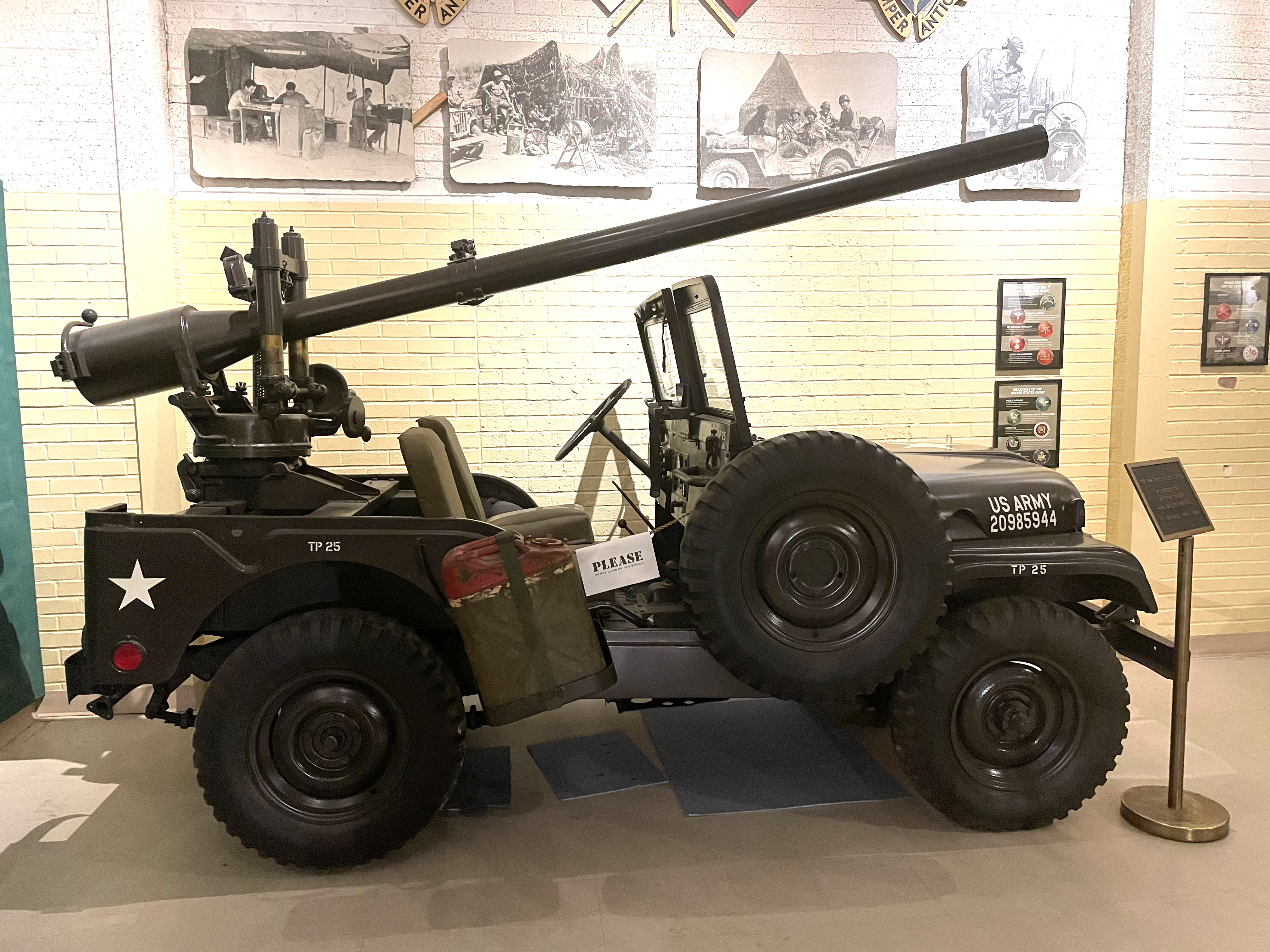
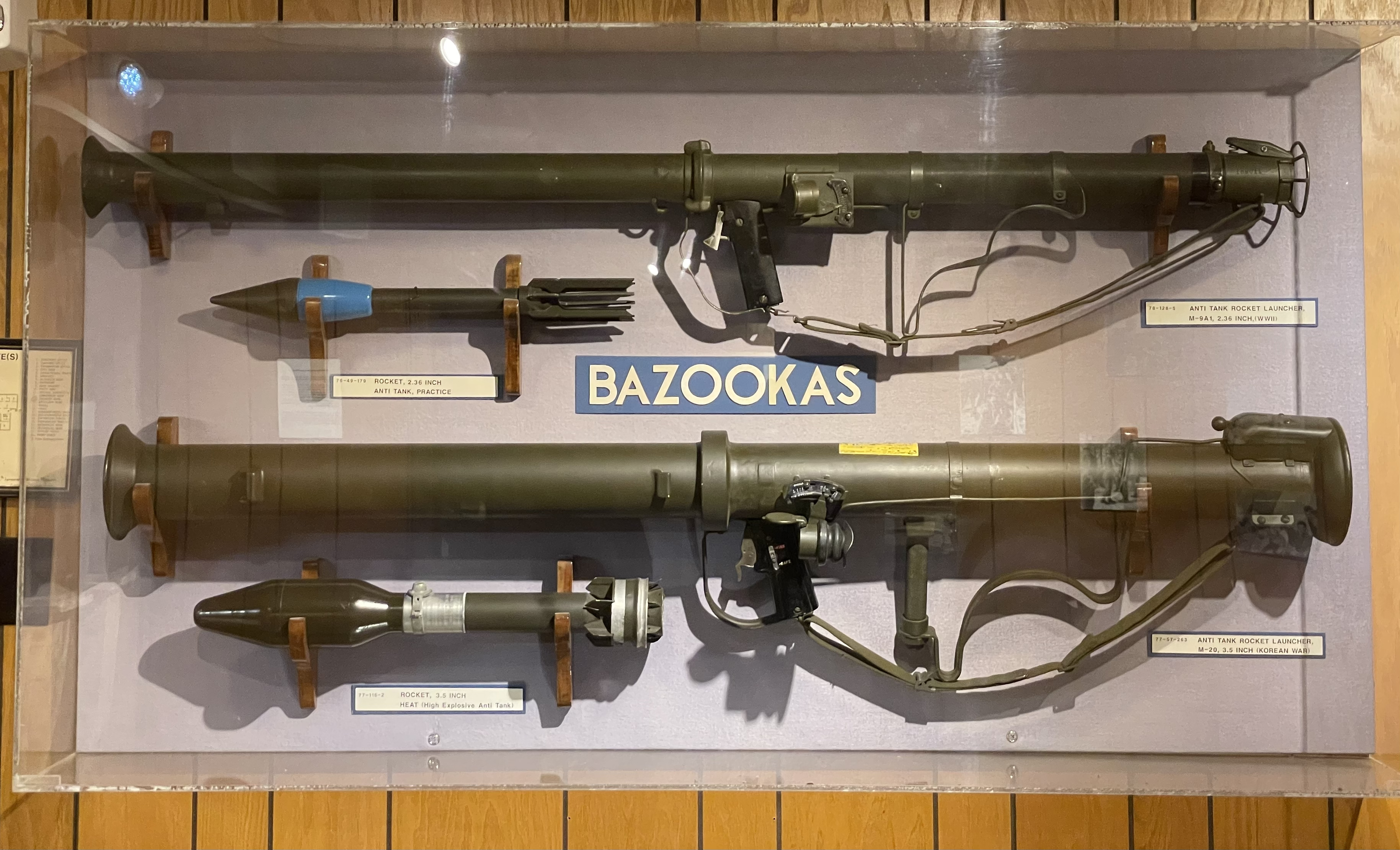
Since Sunday was an off day, I drove up to Oklahoma City specifically to see the 45th Infantry Division Museum, which is now known as the Oklahoma National Guard Museum (and which is moving to a new facility). You may recognize the 45th Infantry Division Museum from such hits as:
(Hattip: Lawrence.)
I thought it was a very nice museum. They had me when I discovered there was an entire room devoted to Bill Mauldin.
I’m very glad I went, especially now. As I noted above, the museum is moving to a new location. And I got into a conversation with the curator, who told me that they are planning to deaccession some things, as the new museum will be placing more emphasis on “telling stories”. I think that’s kind of a shame. Where else are you going to see this?
Except maybe in “The Green Berets“.
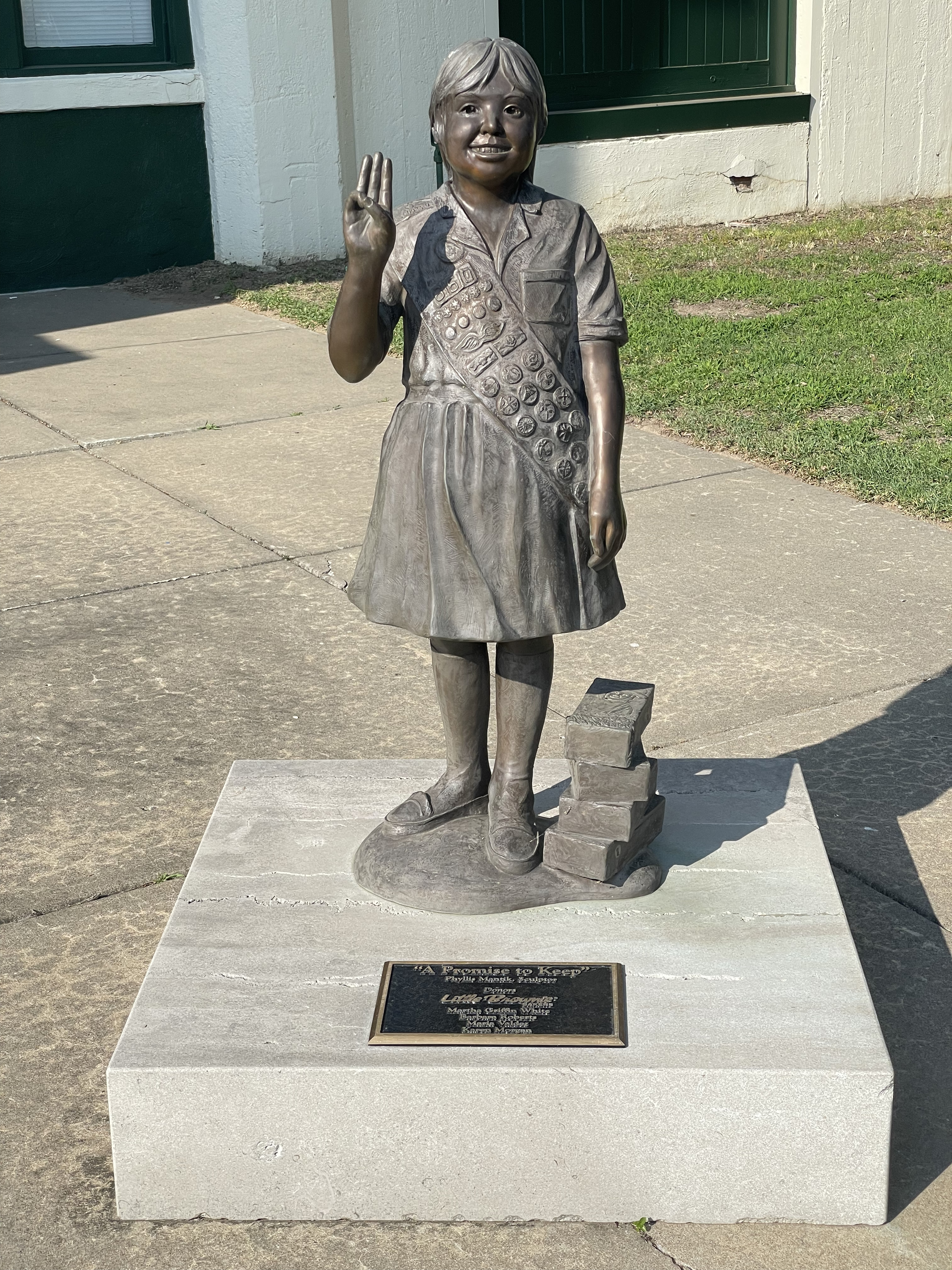
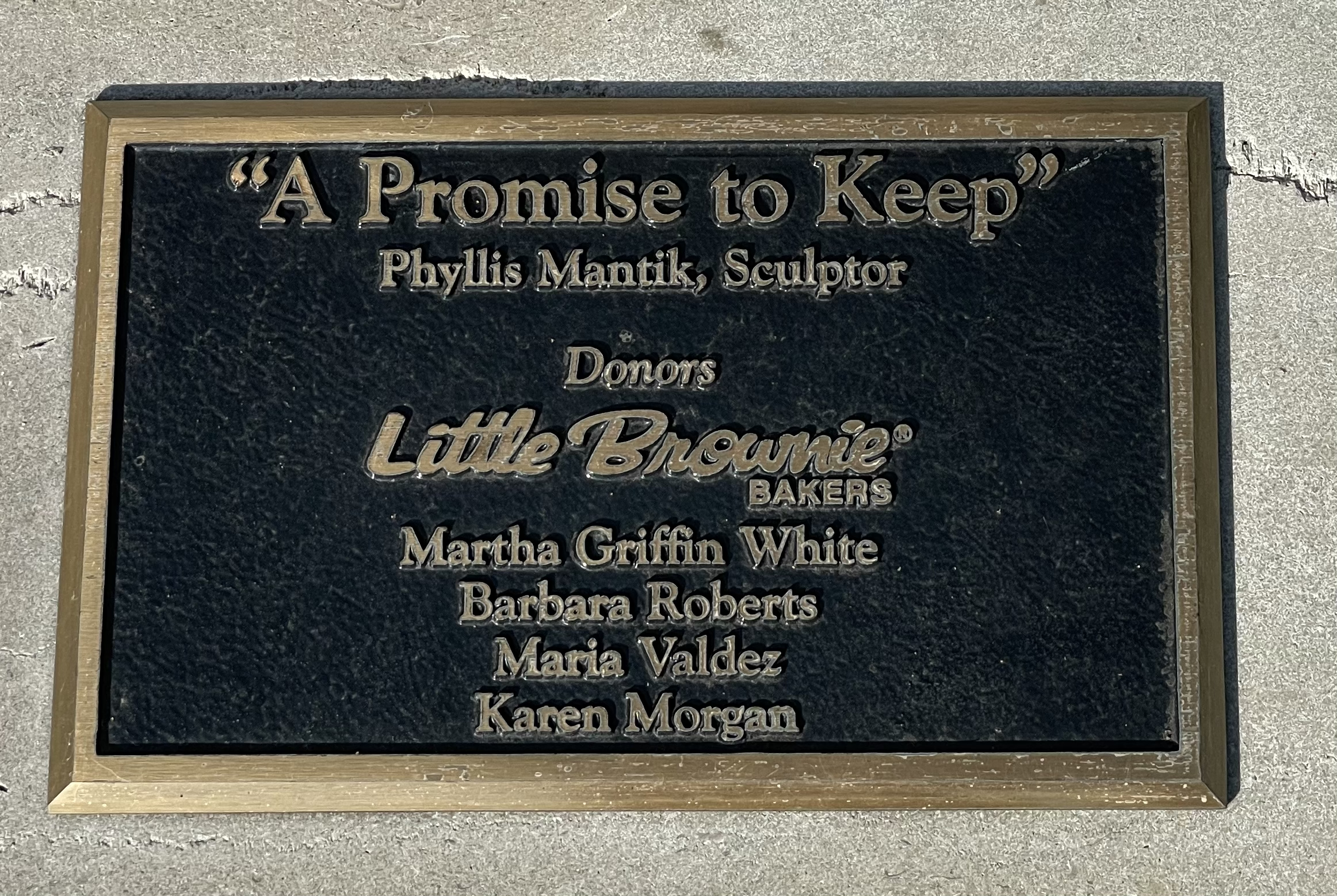
I encourage you to go now, if you’re in the area and have the opportunity. I would actually like to spend more time at the museum, but I wanted to get back in time for dinner and to take a couple of photos in Muskogee:
The first Girl Scout cookie sale took place in Muskogee in 1917. I could not find a reference to price at the time, but in 1922, the Girl Scouts recommended selling home-baked cookies for “25 to 30 cents per dozen”. $6 in 2024 money works out to 32 cents in 1922 money, and 24 cents in 1917 money, according to the inflation calculator I like to use.
I took a group of my friends to Siegi’s Sausage Factory and, as far as I could tell, everyone loved it. Another large group of my friends took me to the White River Fish Market and Restaurant, which I liked, but which was in a really gritty part of Tulsa.
We also went to an Abuelo’s one night, because it was very near the hotel. I went by myself one night to a place Mike the Musicologist calls “The Laugh-In Restaurant”: Sake 2 Me Sushi. It is all-you-can-eat, but I wasn’t wild about the sushi.
And Sunday night’s celebratory dinner was at The Chalkboard, because I haven’t been in forever and wanted some Beef Wellington.
Everything went smoothly. No complaints here, except that eight hours in a car does get a little tiring.
Usual thanks to the usual suspects. You know who you are. (It appears that word has gotten around within S&WCA circles that I have a blog.)
Geneviève de Galard has passed away at the age of 99.
After studying English at the Sorbonne during and after the war, Ms. de Galard received her nursing diploma in 1950. And, after a retreat at a Benedictine convent, she was admitted to the French armed forces’ corps of flight nurses, charged with tending to the wounded who had been evacuated from battlegrounds by plane.
With the war in French Indochina raging since late 1946, she went there for the first time in 1953, attached to Hanoi’s Lanessan hospital.
She was flown into a French base as a nurse, but the plane that brought her and the airstrip were knocked out. She was trapped.
The base was Dien Bien Phu.
Ms. de Galard, who was 29, was put “in charge of emergency care of the most seriously wounded,” she wrote.
“I worked under the light of an electric lamp in the corridor, one knee on the ground, the other on the edge of the stretcher,” she continued. “In this underground of suffering, every day I attended to the wounded, giving shots, changing bandages and distributing medicine.”
The doctor in charge, Major Paul-Henri Grauwin, wrote in a memoir: “While the shells were falling, I watched her and was astonished by her calm. She went from wounded man to wounded man, thinking nothing of it. She had the gestures that were needed, the sweetness, the precision.”
…
On April 29, with the Viet Minh closing in, she was summoned to the underground bunker of the commanding officer, Gen. Christian de la Croix de Castries, who pinned on Ms. de Galard the Légion d’Honneur, France’s highest civilian decoration, as shells exploded outside.
“She will always be, for the combatants at Dien Bien Phu,” the citation read, “the purest incarnation of the heroic virtues of the French nurse.”
…
…
Seriously, I thought by now I’d have a clever intro for this. But I don’t. My Strategic Clever Reserves are exhausted. So why don’t we jump into this one? Warning: I think this is longer than usual…
Robert Persichitti (US Navy – ret.) has passed away at the age of 102.
Persichitti, meanwhile, had served in Iwo Jima, Okinawa and Guam as a radioman second class on the command ship USS Eldorado during WWII.
He was among the US troops who witnessed the raising of the American flag atop Mount Suribachi on Iwo Jima on Feb. 19, 1945 — a moment that would go on to become one of the most famous photos captured during the war.
“I was on the deck,” Persichitti told Stars and Stripes in a 2019 interview when he returned to the region. “When I got on the island today, I just broke down.”
He was part of a group of veterans traveling to Normandy when he fell ill, was airlifted off the ship, and passed away in a hospital.
Bob Kelley. You might not know the name, but if you’re into cars, you know the book.
The Kelley Blue Book started in 1926 at the Kelley Kar Co., a Los Angeles dealership founded by Mr. Kelley’s father, Sidney, and an uncle, Leslie Kelley. As one of the biggest used-car dealerships in the region — and eventually the country — they had a constant need for new inventory, and the book originated as a simple list of prices that they were willing to pay for certain cars in certain conditions.
Mr. Kelley joined the company after the end of World War II, a prime time to get into the used-car business. The war had put an end to new-car production, and it would be several years before automakers could meet the demand.
He was initially in charge of both valuations on new inventory and compiling the book, and he brought a jeweler’s eye to the job. He studied all the factors that go into deciding a car’s road-worthiness and visual appeal — mileage, sound system, paint color — then developed a long list of data points that, combined, would produce a price.
…
The Kelleys closed their dealership in 1962 and sold the Kelley Blue Book to a fellow dealer in Los Angeles. By then Sidney and Leslie Kelley had largely left the business, but the new owners kept Bob Kelley and the rest of the team as employees.Mr. Kelley worried at first that without the dealership, confidence in the book would diminish. Instead its popularity continued to grow, largely because of Mr. Kelley’s reputation for evaluating cars.
As he deepened the data underlying his valuations, the Kelley Blue Book became increasingly valuable beyond used-car dealerships. Courts, insurance companies and banks all used it to evaluate what for most people constituted one of the biggest assets they would ever own.
He also expanded the scope of the book to encompass new cars as well as used, and to include motorcycles, boats, RVs and trucks as well as luxury vehicles and imports. Eventually, an updated edition of the book appeared every other month, selling a total of a million copies a year.
…
Tom Bower, actor. Other credits include “Hill Street Blues”, “Hardcastle and McCormick”, and “The Rockford Files”.
Brief because I have written about this before. (Previously. Previously. Previously.) But today is a significant day.
Today is the 50th anniversary of Ten Cent Beer Night, one of the top three greatest events in sports history.
I do not see any acknowledgement of this on the Entertainment and Sports Programming Network site. Or on Cleveland.com. Or on MLB.com. Gee, you’d think they are embarrassed or something.
If you live in Cleveland or Euclid, Collision Bend is celebrating once again.
Please drink responsibly and leave your fighting pants at home.
I just bought two new pairs of fighting pants, and you want me to leave them at home?
The legendary Tim Russert was a college student at the time and attended the game. He is quoted as saying, “”I went with $2 in my pocket. You do the math.”
Verne Lundquist interviews players:
There are quite a few Ten Cent Beer Night videos on the ‘Tube, but almost all the ones I’ve found are from third parties years after the fact, and I don’t want to link them here.
Edited to add: Hooray! And thanks to my beloved and indulgent aunt and uncle!
“10 Cent Beer Night: An Oral History of Cleveland Baseball’s Most Infamous Night”.
Two naked women ran in front of his car.
“I thought, ‘Oh, it’s THAT kind of a riot,’” he says.
Specialist Fifth Class Clarence Sasser (United States Army – ret.) passed away on May 13th at the age of 76.
Sp5c. Sasser received the Medal of Honor for actions as a medic on January 10, 1968. From his citation:
From the NYT:
As they arrived at a rice paddy, one helicopter was shot down. Mr. Sasser was “dumped,” he said, into the mud. Instantly he felt a bullet rip through his leg. Dozens of American soldiers were killed in minutes. As the injuries piled up, the company was left with only one of its four medics — Mr. Sasser.
A cry went out among his brothers in arms: “Doc! Doc!”
He heeded their calls.
He dashed through gunfire to one group of soldiers, and as he moved one to safety, a rocket explosion tore through his shoulder and back. But he kept running, through a barrage of rocket and automatic weapon fire, to help two more men. Injuries multiplied across his body: excruciating hot shell fragments embedding in his flesh, a ricocheting bullet slamming against his skull.
Mr. Sasser saw a safer way to move around the rice paddy. Rather than standing up and leaving himself open to attack, he lay down in the mud — which was two-and-a-half-feet deep, he estimated — and moved by grabbing one rice sprout after the next to pull himself along, almost like swimming.
He encouraged another group of soldiers to crawl to relative safety and spent hours continuing to attend to his comrades’ wounds until he ran out of medical supplies.
“The only thing I could offer was, shall we say, mental support, emotional support,” he recalled in the oral history. “Which I thought was part of medic’s job, too.”
About 4 or 5 a.m. the next day — nearly 20 hours after Mr. Sasser landed in the rice paddy — he and other survivors of the ambush were rescued.
He was also a Texas native. He studied chemistry at the University of Houston before he was drafted. After leaving the service, he attended Texas A&M: that university awarded him a honorary doctorate in 2014.
He often spoke about the privilege of being a medic. He got first choice of rations. Everyone called him Doc. He was an object of reverence. All of that, he said, explained, his battlefield bravery.
“There’s no way that I could have, in my mind, not went to see about someone when they hollered medic,” Mr. Sasser said in the 1987 oral history. “Repayment of the adulation these guys heaped on you demanded that you go.”
Congressional Medal of Honor Society webpage.
Fort Hood renamed one of their buildings (a medical training facility) after him in 2022.
According to the Congressional Medal of Honor Society, there are 61 living recipients.
Happy 150th birthday, G. K. Chesterton!
“The Innocence of Father Brown” on Project Gutenberg.
“You attacked reason,” said Father Brown. “It’s bad theology.”
Not everyone in the military who dies is killed in combat. Accidents take more than their fare share of brave people. And those folks are just as worthy of remembrance on Memorial Day as the ones who died in action against the enemy.
I’ve had this in my back pocket for a while. It is a little early to post this, but not too early, and it seems appropriate for today.
Some time back, I got a wild hair and went chasing down the military’s “sole survivor” policy. I think the Sullivan brothers led me to that, which in turn led me to the Melbourne–Evans collision. I had never heard of the Melbourne–Evans collision, and was quite shocked to find out that there was a major US Navy disaster I was unfamiliar with.
In 1969, the Southeast Asia Treaty Organization (SEATO) was conducting an exercise, Sea Spirit, in the South China Sea. Two of the ships involved were the US Havy destroyer USS Frank E. Evans and the Royal Australian Navy light aircraft carrier HMAS Melbourne.
At night on June 2nd and 3rd, the Melbourne was doing anti-submarine exercises. Evans was one of the escort ships assigned to the Melbourne. Melbourne was going to launch an anti-submarine aircraft, and ordered Evans to assume the “plane guard” position. There had been one near collision with another US ship (USS Everett F. Larson) a few days before, and the Melbourne’s commanding officer had warned all of his escort ships to be careful. He also increased the minimum separation between the carrier and escorts to 3,000 yards.
In spite of this, the Evans turned towards the Melbourne. Melbourne sent messages to the ship warning the Evans that it was on a collision course. Evans acknowledged the messages, but didn’t take any action. Melbourne’s captain ordered a hard turn to port: at about this time, Evans turned hard to starboard to avoid the collision. This put Evans right in the path of Melbourne, and at 3:15 AM, the two ships collided. Evans was cut in two. (Wikipedia has a good animation of the two ship’s paths.)
The bow section of the Evans sunk rapidly, while the stern stayed afloat. 74 crew members of the Evans died. It is believed that most of them were trapped in the bow and couldn’t get out before it sank. The crew of the Melbourne behaved, in my opinion, quite heroically. All of the survivors of the Evans were located in 12 minutes and rescued within a half-hour, and the Melbourne’s crew did their best to make them comfortable.
When 74 sailors are killed at sea, you can expect an investigation. The commander of the Evans, Albert S. McLemore, was asleep when the collision happened, though he had given orders that he should be awakened if needed. Of the two men who were standing watch, one had failed his qualification exam for standing watch, and the other one was on his first trip to sea.
The US Navy and the Royal Australian Navy conducted a joint board of inquiry. The results were, and are, controversial:
It seems like the collision was pretty much 100% the fault of the Evans, but nobody wanted to place all of the blame on the US Navy.
Despite admissions by members of the USN, given privately to personnel in other navies, that the incident was entirely the fault of Evans, significant attempts were made to reduce the US destroyer’s culpability and place at least partial blame for the incident on Melbourne. At the beginning of the inquiry, King banned one of the RAN legal advisers from attending, even as an observer. He regularly intervened for American witnesses but failed to do so on similar matters for the Australians. Testimony on the collision and the subsequent rescue operation was to be given separately, and although requests by American personnel to give both sets of testimony at the same time in order to return to their duties were regularly granted, the same request made by Stevenson was denied by King. Testimony of members of the RAN had to be given under oath, and witnesses faced intense questioning from King, despite the same conditions not applying to USN personnel. There was also a heavy focus on the adequacy of Melbourne’s navigational lighting. Mentions of the near miss with Larson were interrupted with the instruction that those details could be recounted at a later time, but the matter was never raised by the board.
The unanimous decision of the board was that although Evans was partially at fault for the collision, Melbourne had contributed by not taking evasive action sooner, even though doing this would have been a direct contravention of international sea regulations, which stated that in the lead-up to a collision the larger ship was required to maintain course and speed. The report was inconsistent in several areas with the evidence given at the inquiry, including the falsity that Melbourne’s navigational lights took significant time to come to full brilliance. Several facts were also edited out of the transcripts of the inquiry.
Commander McLemore was court-martialed, and found guilty of “dereliction of duty and negligently hazarding his ship”. The two watch standers were also court-martialed, pled guilty, and were convicted of “dereliction of duty and negligence”.
As a result of the inquiry, the commanding officer of the Melboure, Captain John Phillip Stevenson, was also court-martialed. He was chaged with negligence for “for failing to explicitly instruct Evans to change course to avoid collision and for failing to set Melbourne’s engines to full astern”.
There are two theories on why Captain Stevenson was even court-martialed in the first place. One is that it was an attempt to appease the US Navy, “which had court-martialled three officers from Evans and had threatened to prevent US ships from operating as part of Australian-led forces if no action was taken against Stevenson”. The other is that the court-martial was intended to clear Stevenson.
However, Stevenson’s next posting after the verdict was “chief of staff to a minor flag officer”, which was seen by him (and, I gather, pretty much everyone else in the RAN) as a demotion.
The US Navy made a training film about the incident, “I Relieve You, Sir”.
Three of the men killed on the Evans were brothers: Radarman 3rd Class Gregory Sage and Seaman Recruits Gary Sage and Kelly Sage. They were the first members of the same family allowed to serve on the same ship since WWII. There are memorials in Niobara, Nebraska (their home town) and Gurnee, Illinois. “The names of her 74 crew killed are inscribed under a flagpole at Long Beach Shoreline Marina.”
The stern of the Evans never sunk. It was towed to Subic Bay, stripped for parts, and used for target practice.
One of the most unusual aspects of this story, to me, is: this isn’t the first time HMAS Melbourne collided with another ship. She collided with the destroyer HMAS Voyager on February 10, 1964, under what sounds like similar circumstances: Voyager was supposed to be plane guard, but turned into Melbourne’s path and was cut in two. 82 men died in that collision. And, similarly, the captain of the Melbourne at the time was initially railroaded.