Archive for the ‘History’ Category

Obit watch: March 20, 2023.

Monday, March 20th, 2023

Simone Segouin. She was 97.

She was a French resistance fighter as a teenager.

Given false papers saying she was Nicole Minet, of Dunkirk, Ms. Segouin ferried messages and weapons among members of the local partisan network on a bicycle she had stolen from a German. Lt. Boursier said he taught her how to use submachine guns, rifles and handguns. According to President Macron’s office, she also helped the partisans sabotage German troop trains.

She was also the subject of a “Life” profile by Jack Belden:

His article, headlined “The Girl Partisan of Chartres” in the Sept. 4, 1944, issue of Life, made “Nicole” an international symbol of the French resistance. Its sub-headline — “Pretty 17-year-old Nicole tells Life’s war reporter the story of how she killed a Boche,” French slang for a German — offered a whiff of the sensational.

“The article gave her a larger-than-life profile,” Robert Gildea, the author of “Fighters in the Shadows: A New History of French Resistance,” wrote in an email. “Most women resisters operated in the shadow and were modest about their resistance activities.”

New York Public Library digital archive.

Lawrence sent over two interesting obits:

Gloria Dea, the first magician to perform on the Vegas Strip.

On May 14, 1941, at only 19 years old, Dea performed in the Roundup Room at the El Rancho Vegas. That made her the first magician to ever perform on Highway 91, which wouldn’t be renamed Las Vegas Boulevard for 18 more years. (At the time, only the El Rancho Vegas and Last Frontier lined the road. The Flamingo was still under construction.)
Dea performed two shows that night. The crowds went wild for her billiard-ball trick and a floating-card trick, both taught to her by her father.
“It felt good,” Dea told the R-J at her birthday bash in August. “Anytime someone likes something that you do, you feel good don’t you? Oh, yeah. I was received wonderfully. It was a great room. You had the audience seated, then floor-to-ceiling glass in the back, and on the other side of that was the swimming pool.”
“Then you were onstage, facing that. It was fancy. It was a fun place.”

Byrd Odum Holland, makeup artist and actor.

Lawrence pointed out “The Creeping Terror”. We have “Five Minutes to Live“: I bought it on a cheap gas station DVD that I couldn’t pass up because it also had “Land of the Free” (Shatner!) We haven’t watched “Five Minutes” yet, but I am trying to sell the Saturday Movie Group on it because it sounds interesting. Johnny Cash plays a psychotic killer in one of only two “theatrical film roles” he played in his career (as opposed to appearances on TV and in documentaries).

Mr. Holland’s other acting credits include “Swamp Girl” and “The Black Klansman” (1966).

NYT obit for Jim Gordon, which, while late, is better than some of the other obits I’ve seen.

Obit watch: March 11, 2023.

Saturday, March 11th, 2023

Traute Lafrenz (who also went by Traute Lafrenz Page) has passed away at 103.

She was the last surviving member of the White Rose.

The White Rose was short-lived and never counted more than a few dozen members, most of whom were young and idealistic. Ms. Lafrenz (who later in life went by the name Traute Lafrenz Page) carried political leaflets and helped the group gain access to ink, paper and envelopes to produce and disseminate its anti-Hitler tracts, and to urge Germans to turn against the Nazis.
But the response to its activities, peaceful as they were, seemed to betoken the profound intolerance displayed by the Third Reich to any hint of opposition among Germans, even as it pursued the extermination of European Jewry and what it called “total war” against its adversaries.

While Ms. Lafrenz was a medical student in Hamburg, she met Alexander Schmorell, a central player in the White Rose, who introduced her to the leaders of the group, the siblings Hans and Sophie Scholl, when she moved to Munich to continue her medical studies in the early 1940s.
Other leading players included Christoph Probst, Willi Graf and the group’s older mentor, Kurt Huber, a professor of philosophy who was committed to liberal democracy.

The White Rose’s leaflets began appearing in the summer of 1942, but the project faltered in February 1943 with the arrest of Sophie and Hans Scholl, who were distributing fliers in a university building in Munich when Jakob Schmid, a janitor, spotted them and tipped off the Gestapo. Four days after their arrest, on Feb. 18, 1943, they were executed. Ms. Lafrenz attended her friends’ funeral, even though it was conducted under Gestapo surveillance.
Other members of the White Rose followed the grisly trail to execution; they were among an estimated 5,000 people beheaded under a revival of the use of the guillotine ordered by Hitler. The beheadings continued until January 1945.

Ms. Lafrenz was arrested in March of 1943. She was set to be tried at Bayreuth in April of 1945, but the US Army liberated the prison (and the prisoners) before the trial started.

“Traute Lafrenz was not at the center of the White Rose,” Mr. Waage wrote. “She did not physically write any of the leaflets — but she did just about everything else. She helped lay the foundation for the revitalization of cultural heritage as a weapon against brutality; she helped make the distribution of the leaflets as practical as possible and helped to spread them.”
In the postwar era, Ms. Lafrenz remained stubbornly reticent about her activities. “I was a contemporary witness,” she told Bild Zeitung in 2018. “Given the fates of the others, I am not allowed to complain.” Her daughter Renee told the newspaper that she had not learned of her mother’s wartime struggle until 1970.
Indeed, it was only on Ms. Lafrenz’s 100th birthday, on May 3, 2019, that she was awarded Germany’s Order of Merit, a high civilian honor. The citation said she “belonged to the few who, in the face of the crimes of national socialism, had the courage to listen to the voice of her conscience and rebel against the dictatorship and the genocide of the Jews. She is a heroine of freedom and humanity.”

Suzy McKee Charnas, noted SF writer. I believe Lawrence mentioned this to me a while back, but I could not find a link I was willing to use. The NYT obit says she passed away January 2nd, but “her death was not widely reported at the time”.

Ms. Charnas, whose books were well regarded but who, by her account, did not make a living from her writing, was best known for her science fiction. But she also wrote vampire fiction, young adult fantasy novels with women as central characters, and a memoir about taking care of her father in his later years after a long period of estrangement.

The obit gives a lot of space to her “The Holdfast Chronicles” series.

In an epic that began with “Walk to the End of the World” (1974) and concluded 25 years later with “The Conqueror’s Child,” Ms. Charnas conceived a dystopic world in which an escaped female slave, Alldera, leads the rebellious Free Fems to brutally conquer and enslave their former male masters. The men had faulted women for the near-destruction of humanity, called the Wasting.

The other books in the Holdfast series are “Motherlines” (1978) and “The Furies” (1994). “The Conqueror’s Child” won the 1999 James Tiptree Jr. Award (now called the Otherwise), a literary prize for works of science fiction or fantasy that explore gender.
She also won two other science fiction and fantasy awards: a Nebula for a novella, “Unicorn Tapestry,” which is a chapter in her 1980 novel, “The Vampire Tapestry,” and the basis for her play, “Vampire Dreams”; and a Hugo, for “Boobs,” a short story.
“Suzy, to me, was a lot like David Bowie,” said Jane Lindskold, a science fiction and fantasy writer who knew Ms. Charnas from a writers’ group in Albuquerque. “She followed her own muse. She could have just written only vampire books, but she did what she wanted to do.”

Science fiction was not the only genre she explored. In “The Vampire Tapestry,” she created Dr. Edward Weyland, a vampire posing as an anthropology professor.Writing in The Washington Post, the fantasy writer Elizabeth A. Lynn praised the novel, saying it “works on many levels — as pure adventure, as social description, as psychological drama and as a passionate exploration of the web that links instinct, morality and culture. It is a serious, startling and revolutionary work.”
The director Guillermo del Toro, who is known for his science fiction and horror films, was an admirer of “The Vampire Tapestry.” He called it “flawless” on Twitter in 2015 and, after Ms. Charnas’s death, said, “It may be her masterpiece.”

The paper of record has a habit of running retrospective obits under the heading “Overlooked No More” for people who didn’t get an obit at the time. To the best of my knowledge, they still have not published an obit for Gardner Dozois.

However, this one struck home for me: Dilys Winn, mystery bookstore founder and writer.

When she opened Murder Ink — believed to be the nation’s first bookstore devoted entirely to the genre — she didn’t even have a window sign. But inside the store, compact though it was, one could find every type of mystery: British cozies, unsettling gothics, suspense thrillers, novels about hard-boiled detectives, police procedurals and even unpublished manuscripts — 1,500 titles in all.

Winn enjoyed hosting events so much that she sold the bookstore in 1975 and began holding Sunday afternoon mystery talks (admission $5) at the Steinway Concert Hall on the Upper West Side featuring mystery writers, editors and other guest speakers. She organized a 16-day mystery reader’s tour of the United Kingdom, with sites of interest that included the Tower of London, Jack the Ripper’s London neighborhood and the London docks. Excursions to Scotland and Wales provided more opportunities to commune with mystery writers, crime reporters and, supposedly, ghosts.
All the while, Winn was feverishly working on her opus: “Murder Ink.” Published by Workman Press in 1977, it included offbeat essays by established figures and Winn herself (under various nom de plumes), along with character studies, photographs, quizzes and even a guide to “terrible edibles” one might avoid — or seek, depending on the motive. In 1978, the Mystery Writers of America conferred an Edgar Allan Poe award on Winn, and the next year she published a sequel, “Murderess Ink: The Better Half of Mystery.”

I bought my mother a copy of Murder Ink as a present one year, so of course I read it. I loved it. I still think that’s a pretty swell book, and I want to say that’s one of the key books in influencing my lifelong love of mysteries.

“Spot”, or Glen Lockett, noted record producer for SST Records.

As the in-house producer for SST from 1979 to 1985, Mr. Lockett controlled the mixing board on landmark recordings that helped bring American punk from deafening gigs in garages and basements to the mainstream — the college-radio mainstream, at least.
He produced or engineered more than 100 albums for SST, including classics like Black Flag’s “Damaged” (1981), Descendents’ “Milo Goes to College” (1982), Meat Puppets’ first album (1982), Minutemen’s “What Makes a Man Start Fires?” (1982) and Hüsker Dü’s “Zen Arcade” (1984).

I never got into any of SST’s stuff (I tried listening to Hüsker Dü) but I’ve always liked the SST poster I saw once at a record store in Houston. “Home taping is killing the music industry. Keep up the good work.”

Rick Scheckman. He was David Letterman’s film coordinator.

Scheckman joined Late Night With David Letterman in March 1982, a month after the show debuted on NBC. The writers called on Scheckman so often, he was given a full-time job as film coordinator.
“If 20 minutes before tape time, the writers suddenly came up with a bit that required film of a monkey washing a cat, Shecky knew where to find it,” writer Mark Evanier wrote on his blog.
When Letterman moved to CBS in 1993, Scheckman came along and remained with the Late Show through its 2015 conclusion. For those 33-plus years, his stuff was referred to as “Shecky Footage,” Letterman archivist Don Giller pointed out in a tribute post on YouTube.
As did many Letterman behind-the-scenes staffers, Scheckman often wound up in front of the camera, playing, for example, Elvis Presley; a naked man in the shower with a copy machine; a fan of Star Wars and Pokémon; and himself, getting shot by Bruce Willis (“Yippee ki yay, Shecky!!”), as seen in another tribute video.

Tributes from Mark Evanier and Leonard Maltin.

Otis Taylor, of the Kansas City Chiefs.

Over an 11-year career that began in 1965, when Kansas City was one of the top teams in the American Football League, Taylor was one of quarterback Len Dawson’s key offensive targets. (Dawson died last year at 87.) Tall and acrobatic with soft hands, he was the prototype for the big receivers who would come to dominate the position.
In 1966, his breakout season, Taylor caught 58 passes for 1,297 yards, an average of 22.4 yards a catch. Five years later, after the A.F.L.’s merger with the N.F.L was finalized, Taylor led the league with 1,110 receiving yards, and United Press International named him the N.F.L.’s player of the year.

When the Chiefs faced the Vikings in Super Bowl IV on Jan. 11, 1970, it was their second appearance in the championship game. They had lost to the Green Bay Packers, 35-10, in the first Super Bowl.
The Vikings were 13 ½-point favorites, but the Chiefs handled them easily. Kansas City was leading, 16-7, late in the third quarter when Dawson tossed a short pass to Taylor. He shook off a tackle from Earsell Mackbee, a cornerback; faked Karl Kassulke, a safety; and ran in for a 46-yard touchdown. Their 23-7 victory would be the Chiefs’ only Super Bowl win until 2020; they won the championship again last month.
“That’s it, boys!” Chiefs coach Hank Stram said gleefully from the sideline. “Otis!”

In his rookie season, when he started four of Kansas City’s 14 games, he caught 26 passes for 446 yards. He emerged as a star the next season, and over his career he was chosen for the Pro Bowl three times and was a first-team All-Pro twice.
He caught a total of 410 passes in his career for 7,306 yards, with 57 touchdowns. He ranks third in Chiefs history in receiving yards, after Tony Gonzalez and Travis Kelce.

Obit watch: March 9, 2023.

Thursday, March 9th, 2023

Great and good FotB Borepatch sent over an obit from Military.com for Jack Holder, who died February 24 at the age of 101.

Mr. Holder was a WWII veteran and a survivor of Pearl Harbor.

The young sailor survived that day by diving into a ditch between airplane hangars to avoid getting strafed by a Japanese pilot.
He went on to fly as a flight engineer on a PBY at Midway, scouting for Japanese forces with squadron VP-23. He later flew missions over Guadalcanal, retrained on the new B-24 and completed his WWII service flying missions over the English Channel. All in all, the young man had himself quite an eventful war.

He wrote a memoir, Fear, Adrenaline, and Excitement which you can get from Amazon.

On the occasion of an honor flight that celebrated his 100th birthday in December 2021, Holder announced that the secret to his long life was “good heart exercise and two scotch and sodas every night.”
There was a party after the 2019 “Midway” screening at the STK Restaurant at the W Hotel, the kind of hip, contemporary joint that makes a lot of folks over the age of 50 uncomfortable. Holder was right at home and was one of the very last people to leave as the night wound down.
The Jack Holder I met was slyly funny, incredibly enthusiastic about meeting new people and very excited about the chance to talk to younger women. The bonus for him was that almost every single woman he met qualified as a younger woman.

The Notorious B.I.G. “B.I.G.” in this case is Bert I. Gordon, who passed away yesterday at 100. THR.

For those of you who don’t know, Mr. Gordon was a monster movie impresario.

Six months after the release of the popular “The Incredible Shrinking Man,” directed by Jack Arnold, American International Pictures distributed Mr. Gordon’s “The Amazing Colossal Man” (1957). Caught in a nuclear accident, the title character grows to 60 feet and is shot by the police in Las Vegas. Variety said the film’s technical aspects were “well handled,” and other reviews were generally positive.

I’ve actually never seen that, but I have the impression that it is pretty good.

In “Beginning of the End” (1957), a scientist (Peter Graves) uses radiation to make giant fruits and vegetables to end world hunger, but a plague of giant grasshoppers that has eaten the food invades Chicago and starts feasting on people. Lured into Lake Michigan with an electronic mating call, the grasshoppers drown. Mr. Gordon did the special effects in his garage, filming 200 grasshoppers jumping and crawling on photos of the city. Reviewers called the special effects absurdly obvious and the screenplay ludicrous.

Elements of the beach-party genre were combined with Mr. Gordon’s usual themes in “Village of the Giants” (1965). A substance called “goo,” produced with a boy’s chemistry set, causes gigantism in a gang of rocking teenagers, who become 30-foot delinquents running amok in a California town. More chemistry-set magic produces an antidote, and all returns to normal. The Los Angeles Times’s reviewer liked the special effects and the “endless views of healthy young torsos gyrating to the rhythms.”

We watched the MST3K version of this one fairly recently. It is not anywhere near as good as the NYT makes it sound.

Orson Welles, often desperate for money to finance his own films, starred in Mr. Gordon’s “Necromancy,” about a sinister man who wields mystical powers over a small town with rituals seeking to bring back the dead.
Ms. Lupino appeared in “The Food of the Gods,” one of three Gordon films loosely based on H.G. Wells tales, which portrayed people on an island fighting overgrown rats, wasps and chickens that have lapped up radioactive stuff that looks like pancake batter oozing from the ground. Vincent Canby of The New York Times called the film “stunningly ridiculous.”

His autobiography on Amazon.

All this was fodder for the hosts of the comedy series Mystery Science Theater 3000, which brought the Gordon canon to a new audience. “I watched it one time, and I didn’t like them making fun of [his work],” he said. “I take my films very seriously.”

Left out of most discussions I’ve seen: “Tormented”, which we also watched the MST3K version of. I don’t think it is as bad as “Village of the Giants”…

(Yeah, I might be a little unfair in referencing the MST3K versions. But for the ones I’ve seen, I’ll steal a line from Gene Siskel about another movie: “If the third reel had been the missing footage from Orson Welles’ The Magnificent Ambersons, this movie still would have sucked.”)

Chaim Topol, or just “Topal”, of “Fiddler on the Roof” fame. THR.

Other credits include both “The Winds of War” and “War and Rememberance”, “SeaQuest 2032”, “For Your Eyes Only”, and he played Dr. Zarkov in the 1980 “Flash Gordon”.

This. This right here is why the Internet was invented.

Saturday, March 4th, 2023

It is a few days old, but I only encountered it last night. And not so much for Joe Biden, but: Theodore Roosevelt.

Abe Lincoln.

And is it just me, or does Andrew Jackson look like he stepped out of a Universal werewolf movie?

Brief historical note, suitable for use in schools.

Wednesday, February 15th, 2023

If I had thought about it, I would have prepared a longer post. However, I’ve been distracted by other projects, and would have completely missed this if it wasn’t for McThag.

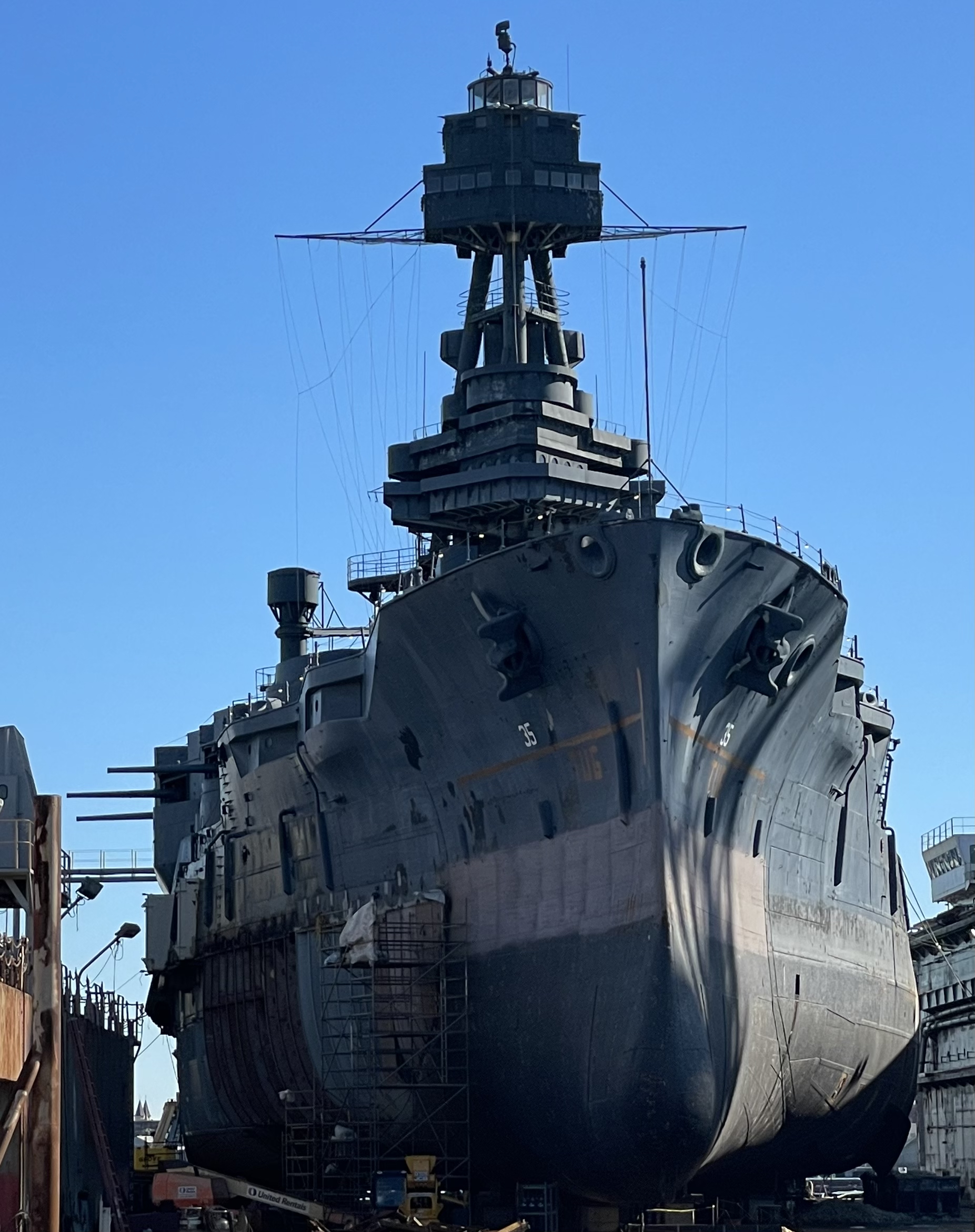
125 years ago today, on February 15, 1898, the battleship USS Maine exploded in Havana Harbor.

Interesting note from Wikipedia (I know, I know):

Maine is described as an armored cruiser or second-class battleship, depending on the source. Commissioned in 1895, she was the first U.S. Navy ship to be named after the state of Maine. Maine and the similar battleship Texas were both represented as an advance in American warship design, reflecting the latest European naval developments. Both ships had two gun turrets staggered en échelon, and full sailing masts were omitted due to the increased reliability of steam engines. Due to a protracted 9-year construction period, Maine and Texas were obsolete by the time of completion. Far more advanced vessels were either in service or nearing completion that year.

(Edited to add: I should clarify, since this is a little confusing: the “Texas” above is the 1892 USS Texas, not the 1914 USS Texas.)

Side note: one of the tour guides at the Texas made an interesting comment, and I’d like to do more research on this. In brief, the Germans pioneered modern welding.

Because of arms limitation treaties after WWI, the weight of battleships was limited. If you rivet battleship plates together, you have to overlap the plates. But if you weld battleship plates, you can basically butt the plates together rather than overlapping. This allows you to use less plate. Less plate means bigger battleship within the weight limitations.

I’d really like to find some good sources on welding history. I think that’d be a technically interesting area to explore.

Anyway, remembering the Maine: somewhere I have what I believe is a first edition of Rickover’s How the Battleship Maine Was Destroyed. (Affiliate link goes to a Naval Institute Press reprint edition.)

Edited to add 2: Thanks to valued commenter Chuck Pergiel for providing a link to his post on the Maine.

Drachinfel. This one is short:

The USS New Jersey. This is a little under 30 minutes.

Obit watch: February 6, 2023.

Monday, February 6th, 2023

Charles Kimbrough.

Ignoring “Murphy Brown” for the moment, he was also in the original Broadway casts of both “Company” and “Sunday in the Park With George”, among other theater credits.

Interesting side note: in 2002, he married Beth Howland, who was also in the original Broadway cast of “Company”.

Pervez Musharraf, former ruler of Pakistan.

Harry Whittington, most famous as the man Dick Cheney shot.

As a lawyer and investor, Mr. Whittington was a fierce proponent of property rights. He repeatedly questioned the city of Austin’s use of eminent domain to acquire private property — some of it his own — for public purposes.

In 1979, Gov. Bill Clements appointed Mr. Whittington to the Texas Corrections Board (now the Board of Criminal Justice), where he was the only Republican on a nine-member panel that had tended to rubber-stamp everything prison managers wanted.
“It was time for somebody to question,” Mr. Whittington said in an interview with The Austin American-Statesman. “There was no other way I knew how to do it.”
He uncovered secrets that stunned him: drug-running by prison officials, no-bid contracts, families paying off guards to protect their loved ones. At meetings, he asked hard questions.
His tenacity led to the creation of a separate unit for developmentally disabled prisoners and an end to wardens’ using prisoners to punish other inmates.

Lawrence emailed an obit for Shlomo Perel, Holocaust survivor with an interesting story.

So this man poses as an Aryan in order to appease the insane, fanatical Nazi Herrenrasse machine, becomes a Nazi translator, is conscripted into the Hitler Youth, and then joins the German military. That’s a fraught path to take.

Fred Terna, also a Holocaust survivor. He became famous for abstract art inspired by his experience.

Mr. Terna’s art became his Holocaust testimony. In acrylic works like “In the Likeness of Fire” and “An Echo of Cinders,” he painted in reds, yellows, oranges and blues to illustrate the flames that incinerated Jews in crematories. In some paintings, he used sand pebbles to represent ashes.
“I know how the fire of a crematorium chimney casts flickering light on a barrack wall,” he wrote in 1984 for the Berman Archive at Stanford University, which documents American Jewish communities. “How does one paint the near certainty of violent personal annihilation? How does one paint, and then make a viewer want to stop, to look at a canvas, to react to it?”

I know that some people would like for me to include photos. Pretty much all of the time, the obits I link to include photos. I’ve always generally assumed that, if you were that interested in the obit, you’d click through to the link, and including photos here would make these entries longer (and possibly infringe on intellectual property rights). I am trying to make more of an effort to link to archived articles, so people don’t have to navigate paywalls.

What do you guys think? Am I wrong about this?

Obit watch: January 31, 2023.

Tuesday, January 31st, 2023

Lt. Col. Dr. Harold Brown (USAF – ret.)

Dr. Brown flew 30 missions during the war in Europe and later served in the Korean War. He spent 23 years in the military before retiring, earning a doctorate and becoming a college administrator.
He was one of the last surviving members of the Tuskegee Airmen, a group that included 355 pilots who served in segregated units operating from the war’s Mediterranean theater after beginning their training at the historically Black Tuskegee Institute in Alabama. Fewer than 10 are still living, according to Tuskegee Airmen Inc., an organization dedicated to preserving their legacy.
After taking off from Italy at dawn on March 14, 1945, Dr. Brown, a second lieutenant at the time, was piloting a P-51 Mustang strafing a German freight train near Linz, Austria, when the locomotive exploded, hurling shrapnel into the engine of his single-propeller plane.
With only seconds before his plane lost power, he bailed out and parachuted to safety. But he landed not far from his target, where he was apprehended by two armed local constables and was soon surrounded by a furious mob of some two dozen Austrians whose town he and his comrades had just attacked.
I was met by perhaps 35 of the most angry people I’ve ever met in my life,” Dr. Brown said on the PBS podcast “American Veteran.” “There’s no doubt murder’s on their mind.”
“It was clear that they finally decided to hang me,” he recalled in a memoir, “Keep Your Airspeed Up: The Story of a Tuskegee Airman” (2017), which he wrote with his wife. “They took me to a perfect hanging tree with a nice low branch and they had a rope. I can still visualize that tree today.
“I knew at that moment I was going to die.”
But he was rescued from the vigilantes by a third constable, who threatened to fire on the crowd to protect Dr. Brown as a prisoner of war.

Dr. Brown was turned over to military authorities and served six weeks in prison camps until being liberated when the war ended.

The Boeing 747.

FotB RoadRich sent over a link: Boeing will be live streaming the handover ceremony at 1 PM Pacific (4 PM Eastern, 3 PM Central) this afternoon.

Bobby Hull as promised. ESPN. Chicago Tribune.

Cindy Williams. Other credits include “Cannon”, “The First Nudie Musical”, and the good “Hawaii Five-0”. And if you haven’t seen “The Conversation”, you really should.

She auditioned for Princess Leia on Star Wars (1977) but knew deep down that Lucas wanted a younger actress, and Carrie Fisher was hired.

Kevin O’Neal, actor. Other credits include “The Fugitive” (the original), “Perry Mason” (the good one), and “Lancer”.

One more.

Monday, January 23rd, 2023

Last boat post of the day, and until Memorial Day (I think), just because I think people might be getting tired of me going on about the Texas.

Did the stern, pretty much have to do the bow as well.

You dry-docked my battleship!

Monday, January 23rd, 2023

You don’t really realize how big these things are until you’re standing right next to them.

You also don’t realize just how large the infrastructure supporting these things is until you see it.

(If you live in Texas, or want to make a trip, the Battleship Texas Foundation is doing these tours through April 30th, only on Sundays. You can find details here if you’re interested.)

(This was a Christmas present from my beloved and indulgent brother and his family. Thanks, folks!)

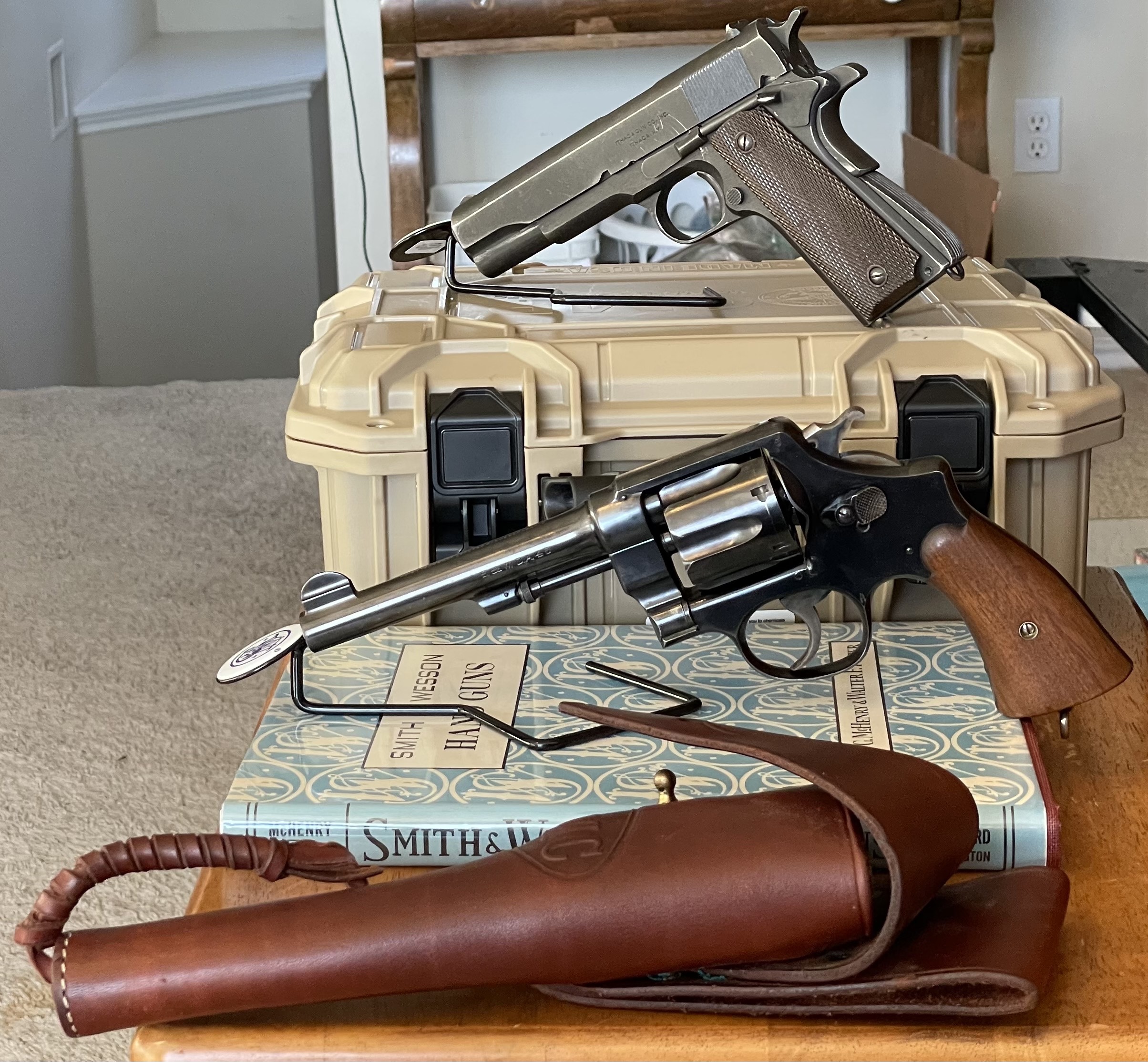
Day of the .45, part 1.5 (Brief random gun crankery)

Wednesday, January 18th, 2023

That FOIA request took about five days. The people at Redstone Arsenal (especially “Stephanie”) are a nice bunch of folks.

The following information was found in the Department of Defense (DoD) Small Arms/Light Weapons Registry for M1911A1, .45mm Automatic Pistol, NSN: 1005-00-726-5655, Serial Number XXXXXX.

1. 26 May 1995 - United States Property and Fiscal Office (USPFO) of Michigan (MI) National Guard (MIARNG), Lansing, Michigan performed multi-field corrections on the weapon.

2. 01 October 1996 - Rock Island Arsenal - Joint Manufacturing and Technology Center, Rock Island, Illinois received the weapon from United States Property and Fiscal Office (USPFO) of Michigan (MI) National Guard (MIARNG), Lansing, Michigan.

3. 28 January 1997, 30 November 1998, 18 March 2003, 13 August 2003, 08 October 2003, 07 January 2004, 02 March 2004, 21 April 2004, 01 July 2004, 04 October 2004, 03 January 2005, 22 February 2005, 18 April 2005, 15 July 2005, 31 January 2006, 04 April 2006, 05 February 2007, 22 January 2008, and 11 August 2008 - Rock Island Arsenal - Joint Manufacturing and Technology Center, Rock Island, Illinois performed reconciliations on the weapon.

4. 20 November 2008 - Rock Island Arsenal - Joint Manufacturing and Technology Center, Rock Island, Illinois shipped the weapon to Army General Supply (Logistics Modernization Program (LMP) Stock Records), Anniston, Alabama.

5. 17 April 2009 - Army General Supply (Logistics Modernization Program (LMP) Stock Records), Anniston, Alabama received the weapon from Rock Island Arsenal - Joint Manufacturing and Technology Center, Rock Island, Illinois.

6. 24 January 2010, 06 March 2011, 03 December 2011, 19 January 2013, 07 March 2015, 01 May 2016, 05 March 2017, 04 June 2017, 31 March 2019, 26 April 2020, 25 April 2021 - Army General Supply (Logistics Modernization Program (LMP) Stock Records), Anniston, Alabama performed reconciliations on the weapon.

Yes, I did edit out the serial number, which is plainly visible in the photos. But photos are not text, and I just feel better leaving that information out.

I’m slightly disappointed that the available information only goes back to 1995 (“The DoD Small Arms/Light Weapons Registry history only goes back to 1975 when the Registry was started.”) but that’s not Redstone’s fault. And I can talk myself into believing that this gun sat in a National Guard armory or depot in Lansing for a long time.

I’m not sure what “multi-field corrections” means: it might imply that the pistol was serviced at that time. But since the 1911 was replaced in service in 1985, it seems a little weird that they’d be working on them nine years later. Could be, though, that the military was keeping them in inventory and servicing them, just in case they were needed again. (See: the shortage of 1911 pistols during WWI.)

I am pretty sure “reconciliation” just means that they verified the serial number in question was still in inventory, and hadn’t grown legs and walked off.

Anyway, still a neat gun, and I see nothing in the historical record that refutes my theory this one may have seen action in WWII.

And thank you again, McThag!

Edited to add 1/19: according to this thread on the CMP Forums, “Multifield Correction” is “Used for correcting erroneous or invalid national stock number (NSN), owner DoDAAC/UIC, or weapon serial number (WSN) on the UIT Central Registry file”. So this seems to be more paperwork corrections than any sort of servicing/rebuilding/reworking of the gun.

Day of the .45, part 1. (Random gun crankery)

Monday, January 16th, 2023

Before I get too far into this, I want to say: McThag is responsible for this. I don’t “blame” him, but he is responsible (as he noted in a previous post), and I owe him a very public “thank you” for this. So: thank you, Angus McThag. I also owe you a beer or three if we’re ever in the same place at the same time.

After the jump, an explanation of why McThag is responsible, as well as some background and pictures. I’m doing a jump because I expect this to be long, there will be pictures, and a lot of background for my readers who are not People of the Gun…

(more…)

Obit watch: January 13, 2023.

Friday, January 13th, 2023

Paul Johnson, noted conservative British historian.

A writer of immense range and output, capable of 6,000 words a day when in harness, Mr. Johnson modeled his career after earlier English men of letters, like Thomas Babington Macaulay and G.K. Chesterton. With an affable prose style and supreme confidence in his own opinions, he was happy to deliver forceful judgments on almost anything: the tangled politics of the Middle East, his personal quest for God or the cultural meaning of the Spice Girls.
The author or the editor of more than 50 books, Mr. Johnson alternated between large histories (of Christianity, Judaism, England, the United States, the middle years of the 20th century, art) and slim biographies of eminences from the ancient or more immediate past (Socrates, Jesus, Edward III, Elizabeth I, George Washington, Mozart, Napoleon, Darwin, Churchill, Eisenhower, Pope John XXIII.)
Writing more for a popular audience than for the approval of specialists, he filtered his wide reading through an ethical lens. As a historian, he looked back to the Victorians, for whom readable prose was as crucial as archival research, and, like those old-fashioned moralists, he was fond of hierarchies. Whether the subject was Renaissance sculptors or American humorists, no era, nation, religion, politician, event, building or piece of art or music was safe from his need to compare and rank.

He had an eye for the telling fact: “Between 1800 and 1835 Parliament debated no less than 11 bills seeking to make the deliberate ill-treatment of animals unlawful; all failed, mostly by narrow margins.” And: “In 1730 three out of four children born in London failed to reach their fifth birthday. By 1830 the proportion had been reversed.”

Lawrence emailed an obit for William Consovoy, prominent lawyer.

Over the course of a relatively short career, Mr. Consovoy established a reputation as one of the best and most dogged conservative litigators before the Supreme Court, with a penchant for cases aimed at making major changes to America’s constitutional landscape.He clerked for Justice Clarence Thomas during the 2008-9 Supreme Court term, and he came away with the conviction that the court was poised to tilt further to the right — and that constitutional rulings that had once been considered out of reach by conservatives, on issues like voting rights, abortion and affirmative action, would suddenly be within grasp.

In 2013, in one of his early cases before the Supreme Court, Mr. Consovoy successfully argued the Section 4 case, Shelby County v. Holder, persuading the Court to get rid of the requirement that several states and counties, mostly in the South, had to receive federal clearance before changing their election laws.

Mr. Consovoy often led the charge in attacking existing laws in court or defending new ones. In 2020 alone, he argued against an extension of the deadline for mail-in ballots in Wisconsin, the re-enfranchisement of felons in Florida and a California plan to send absentee ballots to all registered voters.
He was equally involved in efforts to strike down affirmative action by colleges and universities. He played a supporting role in Fisher v. the University of Texas, a case that originated in 2008 and came before the Supreme Court twice. In both instances, the university successfully defended its plan to automatically admit in-state students who had graduated in the top 10 percent of their class.
Mr. Consovoy then worked closely with Mr. Blum on cases against Harvard and the University of North Carolina, arguing that their affirmative action programs — and, by extension, college and university affirmative action programs generally — were unconstitutional.
Those cases, brought on behalf of Students for Fair Admissions, an organization that Mr. Blum founded, reached the Supreme Court last fall. By then, Mr. Consovoy was too ill to argue them himself, so two of his partners did instead. The court is widely expected to decide in favor of Students for Fair Admissions before the end of the term, most likely in June.

The new firm took on a variety of cases, not all of them concerned with constitutional matters but most of them in service of conservative causes and ideas. After Uber announced in 2020 that its food-delivery branch, Uber Eats, would waive fees for Black-owned businesses, Consovoy McCarthy arranged for some 31,000 complainants to claim reverse discrimination through arbitration, leaving the company owing as much as $92 million.

Lisa Marie Presley. THR. Pitchfork.

Constantine II, Olympic gold medalist (sailing, 1960) and the last king of Greece.

A lot of this took place shortly before or shortly after I was born, but it’s an interesting story I was previously not aware of.

…public support faded after he tried to influence Greek politics, machinations that led to the collapse of the newly-elected centrist government of Prime Minister Georgios Papandreou.
Constantine appointed a series of defectors from Mr. Papandreou’s party as prime minister without holding elections, a widely unpopular chain of events that became known as “the Apostasy.”
The increasing instability culminated in a coup led by a group of army colonels in 1967, considered one of the darkest moments in Greece’s modern history. It set off seven years of a brutal dictatorship for which many Greeks still blame the former king.
Constantine initially accepted the junta before attempting a counter-coup in December of the same year. When it failed, he was forced to flee to Rome, where he spent the first years of his exile.
After the dictatorship ended in 1974, Greece’s new government called a referendum on the monarchy, and 69 percent of Greeks voted to abolish it. The vote effectively deposed Constantine and ended a monarchy that had ruled Greece since 1863, except for the period from 1924 to 1935, when it was first abolished and then restored.

In exile he lived mostly in London, where he is said to have developed a close relationship with his second cousin, Charles, now King Charles III. He was chosen to be one of the godfathers to Prince William, heir to the British throne.

His relationship with the Greek authorities after his dethroning remained prickly. In 1994, the Socialist government passed a law stripping him of his nationality and expropriating the former royal family’s property. Constantine took the case to the European Court of Human Rights, which in 2002 ordered Greece to pay him and his family nearly $15 million in compensation, a fraction of what he had sought. He accused the government of acting “unjustly and vindictively.”
“They treat me sometimes as if I’m their enemy,” he said in 2002. “I am not the enemy. I consider it the greatest insult in the world for a Greek to be told that he is not a Greek.”
The former king could have regained a Greek passport by adopting a surname, which the government demanded that he do to acknowledge that he was no longer king. But he insisted on being called only Constantine, and continued to cast himself as king and his children as princes and princesses.

In 1964, he married Princess Anne-Marie of Denmark, who became queen.
She survives him, as do their five children: Alexia, Pavlos, Nikolaos, Theodora and Philippos; nine grandchildren; and two sisters, Sofia, the former queen of Spain, and former Princess Irene.

Obit watch: January 10, 2023.

Tuesday, January 10th, 2023

Quinn Redeker, actor.

He did a fair number of cop and PI shows, among other credits, including “The Rockford Files”, “Harry O”…

…and “Mannix”. (“Falling Star“, season 1, episode 15. He was “Jim Dancy”.)

Mike Hill, film editor. He won an Oscar for “Apollo 13”.

Diamond Lynnette Hardaway, of “Diamond and Silk”.

Timothy Vanderweert. He ran the “Leicaphilia” blog, which has been on the sidebar for a while now.

Adolfo Kaminsky. I swear I have written something about him before, but I can’t find it now.

He was a forger. Specifically, he forged documents to get people out of the hands of the Nazis.

The forged documents allowed Jewish children, their parents and others to escape deportation to Auschwitz and other concentration camps, and in many cases to flee Nazi-occupied territory for safe havens.
At one point, Mr. Kaminsky was asked to produce 900 birth and baptismal certificates and ration cards for 300 Jewish children in institutional homes who were about to be rounded up. The aim was to deceive the Germans until the children could be smuggled out to rural families or convents, or to Switzerland and Spain. He was given three days to finish the assignment.
He toiled for two straight days, forcing himself to stay awake by telling himself: “In one hour I can make 30 blank documents. If I sleep for an hour 30 people will die.”

Using the pseudonym Julien Keller, Mr. Kaminsky was a key operative in a Paris underground laboratory whose members — all working for no pay and risking a quick death if discovered — adopted aliases like Water Lily, Penguin and Otter, and often contrived documents from scratch.
Mr. Kaminsky learned to fashion various typefaces, a skill he had picked up in elementary school while editing a school newspaper, and was able to imitate those used by the authorities. He pressed paper so that it, too, resembled the kind used on official documents, and photoengraved his own rubber stamps, letterheads and watermarks.
Word of the cell spread to other resistance groups, and soon it was producing 500 documents a week, receiving orders from partisans in several European countries. Mr. Kaminsky estimated that the underground network he was part of helped save 10,000 people, most of them children.

Preview of coming attractions. (Random gun crankery.)

Sunday, January 8th, 2023

Saturday did turn out to be The Day of the .45. Didn’t plan it that way, it just worked out.

Posts on both guns to come as soon as the cedar stops trying to kill me and I can get some better photos. But that’s 100+ years of history right there.

What was it some jerk said a while back?

Obit watch: January 6, 2023.

Friday, January 6th, 2023

Kenneth Rowe, also known as Lt. No Kum-Sok of the North Korean Air Force.

This is an interesting historical footnote (recommended for use in schools) that I was previously unaware of.

Lt. Kum-Sok was born in what was then “the northern part of the Japanese-occupied Korean Peninsula”. He became a navel cadet, transferred to the North Korean Air Force, and learned to fly MIGs.

He got his wings at 19.

Mr. Rowe had become a member of North Korea’s Communist Party and “played the Communist zealot,” as he put it, while serving in the Korean War. But he had been influenced by his anti-Communist father and his mother’s Roman Catholic upbringing to yearn for life in a democracy. He had been thinking of a way to get to America since Korea was divided after World War II and the Soviet-backed Kim Il-sung imposed Communist rule over what became North Korea.

On the morning of September 21, 1953, while flying in a patrol of 16 planes, he broke off from the formation and flew across the DMZ to Kimpo AFB in South Korea.

Luck was with him. The American air defense radar just north of Kimpo had been shut down for routine maintenance, and neither American planes aloft nor antiaircraft crews had spotted him.
During the late stages of the Korean War, the Air Force had dropped leaflets over North Korea offering a $100,000 reward to the first North Korean pilot to defect with a MIG. Mr. Rowe maintained that he knew nothing of that reward and said he had simply wanted to live a free life. But he accepted it.

This was the first intact MIG that the United States was able to analyze. (At least, according to the NYT: Wikipedia claims that Franciszek Jarecki, a Polish pilot, defected in one on March 5, 1953.)

Seeking to determine the MIG’s strengths and weaknesses in anticipation of future conflicts with the Soviet Union and its allies, the Air Force dispatched some of its most accomplished test pilots — including Maj. Chuck Yeager, who had gained fame in 1947 as the first flier to break the sound barrier — to put the MIG-15 through strenuous maneuvers. Their verdict: The F-86 was the superior warplane.

Again per Wikipedia (quoting Yeager’s autobiography), “the MiG-15 had dangerous handling faults…during a visit to the USSR, Soviet pilots were incredulous he had dived in it, this supposedly being very hazardous.”

He came to the United States in May 1954 and was something of a celebrity. He was introduced to Vice President Richard M. Nixon, was interviewed by Dave Garroway on NBC’s “Today” program and appeared on broadcasts for the Voice of America. He received an engineering degree from the University of Delaware, became an American citizen in 1962 and worked as an engineer for major defense and aerospace companies. He was later a professor of engineering at Embry-Riddle Aeronautical University in Daytona Beach.

He was 90 when he passed.

And his plane?

Seven decades later, that plane still exists, and resides at the National Museum of the U.S. Air Force near Dayton, Ohio.
Its red star repainted, it is on display alongside an American F-86 Sabre jet, a remembrance of the dogfights of the Korean War in the swath of sky known as MIG Alley.