Archive for the ‘Sports’ Category

If it ain’t a rambling wreck, it’ll do until the wreck gets here.

Monday, September 26th, 2022

Geoff Collins and athletic director Todd Stansbury out at Georgia Tech.

Collins was 10-28 as Georgia Tech’s coach after arriving from Temple. Stansbury had been Georgia Tech’s athletic director since 2016. Stansbury hired Collins and made the decision to bring him back last year after a 3-9 season.

Georgia Tech is 1-3 this season. That one win came against Western Carolina.

(Apologies for linking to ESPN, but the AJC is pretty much unreadable and unlinkable without a subscription.)

Your loser update: week 3, 2022.

Monday, September 26th, 2022

NFL teams that still have a chance to go 0-17:

Las Vegas

Still nothing much to say about the weekend’s games, since I was busy having fun all day yesterday. But I will throw in a quick obit watch: The Pro Bowl.

Noted.

Wednesday, September 21st, 2022

Robert Sarver is selling his majority stake in the Phoenix Suns. Also the Phoenix Mercury.

Previously.

Obit watch: September 21, 2022.

Wednesday, September 21st, 2022

Valery Polyakov, cosmonaut.

He was also a physician, specializing in space medicine. He volunteered for a mission to see how the human body would hold up in micro gravity on a proposed Mars trip.

Dr. Polyakov took off for the Russian Mir space station on Jan. 8, 1994, and returned to Earth 437 days, 17 hours and 38 minutes later, on March 22, 1995. He had orbited Earth 7,075 times and traveled nearly 187 million miles, according to the New Mexico Museum of Space History.

That’s still a record.

He worked out while in space and returned looking “big and strong” — “like he could wrestle a bear” — Wired quoted the American astronaut Norman Thagard as saying.
Rather than be carried out of his capsule on his return, Dr. Polyakov walked on his own strength, sat down, stole a cigarette from a friend and began sipping brandy, according to “The Story of Manned Space Stations: An Introduction,” by Philip Baker.

Rev. John W. O’Malley, prominent Catholic historian.

He was prolific, publishing 14 books and editing eight more. He wrote in a breezy, precise fashion that managed to convey deep thoughts in simple terms, and many of his books sold as well among lay audiences as they did among academics. Several were translated into multiple languages.
“This approach is a form of correction to myself,” he said in a 2020 interview with Brill, his Dutch publisher. “I have to be humble enough to acknowledge that if the 10-year-old does not understand, it means that, deep down, I did not understand.”
Father O’Malley wore his learning lightly. Friends called him puckish. His personal page on the website for Georgetown’s Jesuit community lists the Italian composer Giacomo Puccini among his favorite artists, but also the outré filmmaker John Waters. (Father O’Malley was especially partial to Mr. Waters’s movie “Hairspray.”)
He was perhaps best known as a historian of the Jesuit order, which was founded by Ignatius Loyola in 1540 to provide, according to conventional wisdom, the Vatican with a militant defense against the Reformation and to expand its influence through the founding of educational institutions.
Starting with “The First Jesuits” (1993), Father O’Malley showed that neither of those qualities were present at the order’s creation. By wading through thousands of letters written by Loyola and others, he concluded that the Jesuits were in fact designed as a pastoral project, intent on saving souls in the face of the dramatic social upheavals rocking Europe in the late medieval era, and only gradually took on their later reputation.

Arnold Tucker, Army quarterback.

At a time when college rules restricted substitutions, Tucker played not only quarterback but also safety, punt returner and kickoff returner. The one blemish on his team’s records was a 0-0 tie in a game against unbeaten Notre Dame in 1946 at Yankee Stadium.
That same year he earned first-team All-America honors and came in fifth in Heisman Trophy balloting — behind Blanchard and Davis, of course. (Davis won the trophy that year; Blanchard got his the year before.)
But before graduating in 1947, Tucker won the Sullivan Award as America’s outstanding amateur athlete. He was drafted by the Chicago Bears but never played professional football. For several years in the mid-1950s he was an assistant coach at West Point to Vince Lombardi, who went on to glory with the Green Bay Packers.

Blanchard and Davis were Felix “Doc” Blanchard and Glenn Davis, “Heisman Trophy-winning running backs remembered in football lore as Mr. Inside and Mr. Outside”. They somewhat overshadowed Mr. Tucker, who actually died on January 10, 2019.

There was a paid death notice published online and buried in the pages of The Miami Herald that January. And at the end of the year The Associated Press listed Tucker (just his name and age) among the many “notable sports deaths in 2019.” But his death was otherwise not widely reported in the mainstream press, which had, almost 80 years ago, chronicled his (and Blanchard and Davis’s) gridiron exploits and later, when their time came, gave both Mr. Inside and Mr. Outside substantial obituaries, Blanchard’s in 2009 and Davis’s in 2005.
Reached by phone on Tuesday, Tucker’s daughter, Patricia Nugent, confirmed his death. And when asked why it hadn’t gotten much publicity, she said that she had never reached out to the national news media. The Times discovered he had died in seeking to update an obituary about him that was prepared in advance in 2010.

Maury Wills.

Wills set a modern major league record when he stole 104 bases in 1962, eclipsing the record of 96 set by Ty Cobb in 1915 and transforming baseball from the power game that had prevailed since Babe Ruth’s heyday. He set the stage for Lou Brock of the St. Louis Cardinals, who stole 118 bases in 1974, and Rickey Henderson of the Oakland A’s, who set the current record with 130 steals in 1982.

…

In his rookie season with the Dodgers, the team won the World Series, defeating the Chicago White Sox, who had their own outstanding base-stealer in Luis Aparicio. Wills stole 50 bases in 1960, his first full season, and went on to win the National League’s base-stealing title every year through 1965.
He was named the league’s most valuable player in 1962. He played on Dodger World Series championship teams again in 1963 and 1965 and a pennant-winner in 1966, teams powered by the pitching of Sandy Koufax and Don Drysdale.

…

He stole 586 bases (putting him 20th on the all-time major league career list) and had a career batting average of .281, with 2,134 hits — only 20 of them home runs. He was a five-time All-Star and winner of the Gold Glove award for fielding in 1961 and 1962. He remained on the Hall of Fame ballot for 15 seasons but was never inducted.

Memo to Nick Chubb.

Wednesday, September 21st, 2022

Dear Mr. Chubb:

When your team’s defense gives up 13 points in the last two minutes of a game – the first time this has happened in 21 years – the loss is not your fault.

Just saying.

Your loser update: week 2, 2022.

Tuesday, September 20th, 2022

NFL teams that still have a chance to go 0-17:

Cincinnati
Tennessee
Las Vegas
Atlanta
Carolina

Not a whole lot to say this week. I didn’t catch a minute of any of the games.

Firings watch.

Monday, September 19th, 2022

Herm Edwards out as football coach at Arizona State.

He was 20-26 overall (about five years) and 1-2 so far this season. AZ State lost 30-21 at home to Eastern Michigan, who was playing their backup quarterback.

The bigger issue, though, seems to be that AZ State is under a major NCAA investigation.

In June of 2021 an investigation was launched into recruiting violations which occurred during a COVID-dead period. That resulted in the firing or resignation of five coaches including Antonio Pierce who was recruiting coordinator and defensive coordinator and at one point being groomed to be Edwards’ successor as head coach.

That investigation is still ongoing.

More from ESPN.

Sun’s up!

Tuesday, September 13th, 2022

Mike the Musicologist asked for a ruling on this one: which, frankly, I wasn’t even aware of until he asked, because I’d been busy with Godard and work and stuff.

Robert Sarver, majority owner of the Phoenix Suns and Phoenix Mercury franchises, will be suspended from any activities involving both teams for one year and fined $10 million for ”workplace misconduct and organizational deficiencies” found during an NBA investigation into allegations made against him, the league announced Tuesday.

The ruling here is: no, this does not count as a firing. Generally, I consider a defined length suspension to not be a firing by itself. If someone gets a one-year suspension and the team then announces they’re letting the guy go, that’s probably a firing. An “indefinite” suspension to me, counts as a firing. But in this case: not a firing, but still newsworthy.

The NBA statement said the firm’s investigation concluded that Sarver “engaged in conduct that clearly violated common workplace standards, as reflected in team and League rules and policies. This conduct included the use of racially insensitive language; unequal treatment of female employees; sex-related statements and conduct; and harsh treatment of employees that on occasion constituted bullying.”
Among the key findings:
• Sarver, on at least five occasions during his tenure with the Suns/Mercury organization, repeated the N-word when recounting the statements of others.
• Sarver engaged in instances of inequitable conduct toward female employees, made many sex-related comments in the workplace, made inappropriate comments about the physical appearance of female employees and other women, and on several occasions engaged in inappropriate physical conduct toward male employees.
• Sarver engaged in demeaning and harsh treatment of employees, including by yelling and cursing at them.

More from the Entertainment and Sports Programming Network:

As part of the suspension, Sarver is not allowed to be around any NBA or WNBA facility, including offices and practice facilities. He is also not allowed to be a part of any NBA or WNBA event or activity, or represent the Suns or Mercury in any public or private way.

Obit watch: September 13, 2022.

Tuesday, September 13th, 2022

An era has ended. Jean-Luc Godard has died at 91: per his legal advisor, he chose assisted suicide in a Swiss clinic due to “multiple disabling pathologies”. Alt link. THR. Variety.

As a young critic in the 1950s, Mr. Godard was one of several iconoclastic writers who helped turn a new publication called Cahiers du Cinéma into a critical force that swept away the old guard of the European art cinema and replaced it with new heroes largely drawn from the ranks of the American commercial cinema — directors like Alfred Hitchcock and Howard Hawks.
When his first feature-length film as a director, “Breathless” (“À Bout de Souffle”), was released in 1960, Mr. Godard joined several of his Cahiers colleagues in a movement that the French press soon labeled La Nouvelle Vague — the New Wave.
For Mr. Godard, as well as for New Wave friends and associates like François Truffaut, Claude Chabrol, Jacques Rivette and Eric Rohmer, the “tradition of quality” represented by the established French cinema was an aesthetic dead end. To them it was strangled by literary influences and empty displays of craftsmanship that had to be vanquished to make room for a new cinema, one that sprang from the personality and predilections of the director.
Although “Breathless” was not the first New Wave film (both Mr. Chabrol’s 1958 “Beau Serge” and Mr. Truffaut’s 1959 “400 Blows” preceded it), it became representative of the movement. Mr. Godard unapologetically juxtaposed plot devices and characters inherited from genre films and emotional material dredged up, in almost diarylike form, from the filmmaker’s personal life.

…

In 2010, Mr. Godard, long at odds with Hollywood, was awarded an honorary Oscar for lifetime achievement, but not without controversy. The award brought into focus long-simmering accusations that Mr. Godard held antisemitic views. He did not attend the ceremony at which the Academy of Motion Picture Arts and Sciences bestowed the honor, and when an interviewer afterward asked him what the award meant to him, he was blunt.
“Nothing,” he said. “If the academy likes to do it, let them do it.”

…

When his parents refused to support him financially, hoping that he would take more responsibility for himself, Mr. Godard began stealing money — from his family members and their friends and even from the office of Cahiers du Cinema. This went on for five years.
He distributed some of the proceeds to fellow filmmakers, lending Rivette enough money to make his film debut with “Paris Belongs to Us.”
“I pinched money to be able to see films and to make films,” he told The Guardian in 2007.
After his mother secured a job for him with a Swiss television outfit, he stole from his employer and, in 1952, landed in jail in Zurich. His father obtained his quick release, but only after Mr. Godard agreed to spend several months in a mental hospital.

…

As the 1960s unfolded, Mr. Godard continued to work at a breakneck pace, turning out sketches for compilation films — including “RoGoPaG” (1963) and “Paris vu Par ” (1965) — alongside features like “Band of Outsiders” (1964), “Une Femme Mariée” (1964), “Pierrot le Fou” (1965) and “Masculin Féminin” (1966).
In “Alphaville” (1965), Mr. Godard plucked a character from the French popular cinema, the private detective and secret agent Lemmy Caution, along with the expatriate American actor Eddie Constantine, who had played Caution (or variations on the character) in many films, and dropped him down in a dystopian future ruled by a giant computer.

…

As he grew older, Mr. Godard seemed more intolerant of other film directors. He quarreled bitterly with Truffaut, once his closest friends among the New Wave directors. He was especially scathing toward Steven Spielberg. In the 2001 film “In Praise of Love,” he portrays Spielberg representatives trying to buy the film rights to the memories of a Jewish couple who fought in the French Resistance. Commenting on the film’s sourness, the Times critic A. O. Scott wrote in 2002 that it “completes Mr. Godard’s journey from one of the cinema’s great radicals to one of its crankiest reactionaries.”
Mr. Godard’s personality was as difficult to warm to as many of his films were. Biographers filled paged after page with details of his feuds and schisms. He and his friend Truffaut got into a spat after the release of Truffaut’s “Day for Night” in 1973 and never reconciled before Truffaut died of a brain tumor in 1984. When a talk show interviewer reunited Mr. Godard and Ms. Karina in 1987, Mr. Godard’s indifferent response to a question about their romance caused Ms. Karina to leave the set.

This goes unmentioned in the obits, but I have to bring it up: “Made In U.S.A.”, about which I have written before. In brief: Goddard adapting a Westlake Parker novel, except he changed it around considerably and didn’t actually pay Westlake, leading to legal action. Pay the writer, you clown!

Lance Mackey. He won the Iditarod four times.

After receiving a diagnosis of throat cancer in 2001 and undergoing major health problems, Lance emerged to dominate the race, winning an unprecedented four straight Iditarod championships, from 2007 through 2010. During that run he also twice won the 1,000-mile (1,609-kilometer) Yukon Quest International Sled Dog Race between Canada and Alaska with only two weeks’ rest between races.

…

But after his string of wins, he was burdened by personal problems, health scares and drug issues that prevented him from ever again reaching the top of the sport.
The treatment for his throat cancer cost him his saliva glands and ultimately disintegrated his teeth. He was then diagnosed with Raynaud’s syndrome, which limits circulation to the hands and feet and is exacerbated by the cold weather that every musher must contend with in the wilds of Alaska.
In the 2015 race, he couldn’t manipulate his fingers to do simple tasks, like putting bootees on his dogs’ paws to protect them from the snow, ice and cold. His brother and fellow competitor Jason Mackey agreed to stay with him at the back of the pack to help him care for the dogs.

…

Mackey and his wife divorced after splitting up in 2011. She had earlier had three children who Mackey embraced as his own, Outside reported. During Mackey’s last Iditarod, in 2020, he raced with his mother’s ashes. He was later disqualified after testing positive for methamphetamine, and he entered rehab on the East Coast.
Months after the 2020 race finished, his partner, Jenne Smith, died in an all-terrain vehicle accident. They had two children.

He was 52. Cancer got him.

Javier Marías, prominent Spanish novelist. I’d never heard of the guy, though his name got mentioned a lot as a Nobel Prize candidate. But he sounds like someone I would have enjoyed drinking with.

Mr. Marías occupied a reputational perch in Spanish culture that would be almost inconceivable for an American author. His novels were greeted like blockbuster summer films, he received practically every prize available to a Spanish writer, and he was regularly considered a favorite to win the Nobel Prize in Literature, one of the few awards to elude his grasp. Most critics considered him the greatest living Spanish writer; some said the greatest since Miguel de Cervantes.
He was more than just a famous novelist. Mr. Marías wrote a widely read weekly column in El País, Spain’s leading newspaper, where he set down his thoughts on everything from bike lanes (he hated them) to the Spanish government (which he also detested, regardless of the party in power).
He cultivated a public image as a curmudgeon, but in person he was generous and witty, inviting interviewers for long conversations in his dimly lit study, his fingers tweezering an ever-present cigarette. (One column he wrote in 2006, for The New York Times, castigated Madrid’s antismoking laws as “far more befitting of Franco than a democracy.”)

…

He wore his fame lightly, and joked that such comparisons said less about his talents than they did about a general decline in literary achievement. When “The Infatuations” won the state-run National Novel Prize, one of Spain’s highest literary awards, he rejected the $20,000 in prize money, saying he did not want to be indebted to a government of any kind.
He did maintain one such relationship, though: In 1997 he became king of Redonda, an uninhabited island in the Caribbean. The fictional Kingdom of Redonda is something of a running in-joke among European artists, who occupy the throne and make up most of its peerage. After his predecessor, the author Jon Wynne-Tyson, abdicated in his favor, Mr. Marías took the royal name Xavier I.
Like most modern monarchs, his role was largely ceremonial, his primary duty being to dispense noble titles to other artistic worthies — he named the director Pedro Almodóvar the Duke of Trémula and Mr. Ashbery the Duke of Convexo.
As of press time, a successor to King Xavier I had not been named, though several pretenders claim the throne as theirs.

Your loser update: week 1, 2022.

Tuesday, September 13th, 2022

NFL teams that still have a chance to go 0-17:

New England
Jets
Cincinnati
Jacksonville
Tennessee
Denver
Las Vegas
Dallas
Detroit
Green Bay
Atlanta
Carolina
San Francisco
Arizona
Rams

I happened to be out at lunch with my mother on Sunday, sitting directly across from a TV playing the Houston-Indianapolis game. When we sat down, it was 20-3 Houston and the Texas seemed to be playing well. When we got up to leave, it was 20-6 and Indy was in scoring position after a Houston fumble.

Houston teams will always disappoint you.

Coverage of Denver’s WTF field goal attempt.

Frost bitten.

Monday, September 12th, 2022

We’re only two (or three, depending on schedules) games into the college football season, and we already have our first firing. (As far as I know: at least this is the first major school firing.)

Scott Frost out at Nebraska. Rather unceremoniously: they fired him now, three games in, rather than waiting until October 1st. On the first, his buyout amount would have been halved.

Frost was pretty well regarded: as a quarterback, he led Nebraska to the national championship in 1997. Nebraska hasn’t won a championship since. As a coach, he led Central Florida to a 13-0 season in 2017.

Then he came to Nebraska. His record in four and a quarter seasons was 16-31, “worse than any of the previous four Husker head coaches who had been fired this century”. His record in “one-score” games was 5-22.

The final straw seems to have been Saturday’s game against Georgia Southern, a cupcake team that Nebraska paid $1.423 million to play in Lincoln. Nebraska lost 45-42, at home, after being a a three touchdown favorite. They’re now 1-2 this season.

More from ESPN.
Norts spews.

Friday, September 9th, 2022

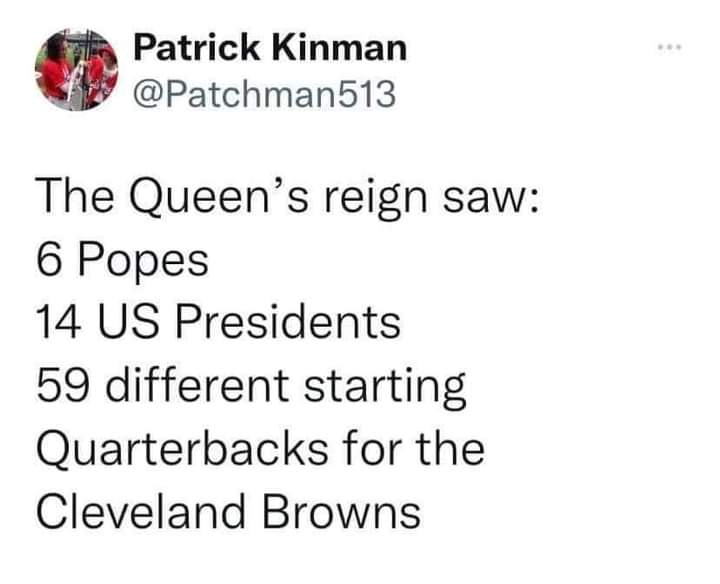
Stolen by me from my beloved and indulgent aunt:

Edited to add: I went through this list of Cleveland Browns starting quarterbacks and tried to come up with a count. I may be off, but I didn’t come up with 59.

I came up with 64.

Obit watch: September 8, 2022.

Thursday, September 8th, 2022

I started preparing the obit watch this morning, before things happened. Mike the Musicologist sent this over:

I’m reminded of C.S. Lewis’s passing…on November 22, 1963.

Bernard Shaw, former CNN anchor.

Shaw was CNN’s first chief anchor and was with the network when it launched on June 1, 1980. He retired from CNN after more than 20 years on February 28, 2001.
During his storied career, Shaw reported on some of the biggest stories of that time — including the student revolt in Tiananmen Square in May 1989, the First Gulf war live from Baghdad in 1991, and the 2000 presidential election.

NYT.

Anne Garrels, NPR correspondent.

As much as Anne Garrels loved Russia, she is probably best known for her reporting during the 2003 Iraq war. She was one of a handful of foreign reporters who remained in Bagdhad as the war began. As she told Susan Stamberg, she used a satellite phone for her reports and went to great lengths to conceal it from Iraqi authorities.
“And then I decided it would be very smart if I broadcast naked, so if that, god forbid, the secret police were coming through the rooms, that would give me maybe five minutes to answer the phone, pretend I’d been asleep and sort of go ‘I don’t have any clothes on!’ And maybe it would maybe give me five seconds to hide the phone,” she said.

NYT:

Her most acclaimed reporting came during the 2003 Iraq war. More than 500 journalists, including more than 100 Americans, covered the run-up to the war. But once the United States began the all-out bombing campaign known as “shock and awe,” she was one of 16 American correspondents not embedded with U.S. troops who stayed — and for a time was the only U.S. network reporter to continue broadcasting from the heart of Baghdad…
Once she was home, other reporters interviewed her about her ordeal. She told of subsisting on Kit Kat chocolate bars and Marlboro Lights, bathing by gathering water in huge trash cans, and powering her equipment by attaching jumper cables to a car battery, which she lugged up to her hotel room every night.

She was 71. Lung cancer got her.

Don Gehrmann. Hadn’t heard of him before, but he had an interesting story. He was a runner. In the “1950 Wanamaker Mile”, he ran the race in four minutes and 9.3 seconds.

It took him 314 days to win the race.

In the 1950 Wanamaker Mile, on Jan. 28, Gehrmann seemed to catch Fred Wilt at the tape, or did he? Both first-place judges said Wilt had won. Both second-place judges said Wilt had finished second. The finish-line picture from the phototimer was inadvertently blocked by a judge. And so it was left to the chief judge, Asa Bushnell, who was at the finish line, to make the call. He declared Gehrmann the winner, with a time of 4 minutes, 9.3. seconds.
But that did not settle the matter. Wilt, an F.B.I. agent when not competing and a future inductee of the National Track & Field Hall of Fame, protested, and 13 days later the Metropolitan Amateur Athletic Union’s registration committee, reversing Bushnell, declared him the winner.
Then Gehrmann protested that decision, and the matter carried over almost a year later to the A.A.U.’s national convention in Washington. By a vote of 314 to 108 — 314 days after the race — that ruling body’s board of governors upheld the chief judge’s decision and declared Gehrmann, forevermore, the victor.
Some were skeptical. As Howard Schmertz, the Millrose Games’ assistant meet director in 1950, told The New York Times in 2011, “The final decision was made by maybe a dozen people who saw the race and a few hundred who didn’t.”

…

In a 1976 interview with United Press International, Gehrmann described how the sport, by then having gone professional, had changed. He recalled that for his workouts he had usually run just 2 ¼ miles, that his pre-meet meal had usually consisted of a hamburger, French fries and soda pop, and that the cinder tracks he had run on stole a lot of energy.

CleCon!

Tuesday, September 6th, 2022

That’s Cleveland content, for my peeps in Ohio.

Daniel Stashower (The Beautiful Cigar Girl) has a new book out: American Demon: Eliot Ness and the Hunt for America’s Jack the Ripper, about the Cleveland Torso Murders.

He also has a good piece up at CrimeReads tied to the book and his family history in Cleveland. I had no idea he was a good Cleveland boy.

I’m probably going to wait to buy this one, but that has nothing to do with Mr. Stashower, and more to do with the fact that I’ve read a fair amount about Eliot Ness and the hunt for the torso murderer. That includes a good write-up in Bill James’s Popular Crime and (I think) the original version of In the Wake of the Butcher: Cleveland’s Torso Murders.

On the lighter side, Field of Schemes has a good piece up on the quest for a new Browns stadium:

You have time and resources to call a ton of people and interview them for a story about the local sports team’s potential $1 billion-plus stadium ask, and to talk to at least one of them for 25 minutes according to the story, and you choose to call: Three former city officials, one of whom has also worked for the Browns; three broadcasters who work for the Browns or a fellow Cleveland sports team; two real estate brokers; and two restaurateurs.

As I’ve said before, FoS runs a little left for my taste, but the one thing we agree on is opposition to giving money to sports teams.

(For the record, my Cleveland relatives who are sports fans informed me that they have given up on the Browns this year, as they are completely disgusted with their handling of the Watson debacle. I think this also means I can make jokes about the Browns without feeling guilty.)

This is stretching the definition of “Cleveland content” a little bit: Cedar Point is about an hour from Cleveland, but that’s close enough that a good number of Clevelanders go there. Anyway, Cedar Point is shutting down the Top Thrill Dragster coaster.

The Top Thrill Dragster gained fame for reaching speeds of 120 mph in just 3.8 seconds…
At the time it opened in 2003, it was the tallest and fastest roller coaster in the world. But it was later eclipsed by the Kingda Ka ride at Six Flags Great Adventure in New Jersey.

The coaster had been closed since last August, after a woman was badly injured. Top Thrill Dragster entry on Wikipedia.

Obit watch: September 2, 2022.

Friday, September 2nd, 2022

Earnie Shavers, boxer.

Fighting during boxing’s — and particularly the heavyweight division’s — golden era in the 1970s, Shavers recorded a 74-14-1 record throughout his career, with 68 of those wins coming via KO.

…

Lauded by his opponents for his overwhelming power, Shavers fought in two heavyweight title fights, suffering defeats in each. In 1977, he lost to Muhammad Ali for the WBA and WBC belts at Madison Square Garden via unanimous decision, but earned the GOAT’s praise after the bout.
“Earnie hit me so hard, it shook my kinfolk in Africa,” Ali said after the fight.

I am seeing reports that Frank Drake, noted astronomer (famous for the Drake Equation) has died, but I don’t have a reliable source to link to.

Barbara Ehrenreich, author. (Nickel and Dimed.)