Archive for the ‘Music’ Category

Obit watch: March 18, 2019.

Monday, March 18th, 2019

Dick Dale. Guitar World.

I missed the surf guitar era – I was too young. But Mr. Dale was an interesting guy: one of the other online obits I’ve seen (and can’t find now) states he practiced martial arts for 30 years. Not only that, but he used his martial arts practice as a tool to deal with the pain he suffered from multiple chronic illnesses.

How about a musical interlude?
Obit watch: March 14, 2019.

Thursday, March 14th, 2019

This literally just in, hot off the virtual press: Birch Bayh, former Senator from Indiana. Possibly more later.

Going out to great and good friend of the blog Borepatch: Hal Blaine, noted session drummer.

Mr. Blaine was part of a loosely affiliated group of session musicians who in the early 1960s began dominating rock ’n’ roll recording in Los Angeles. Along with guitarists like Glen Campbell and Tommy Tedesco, bassists like Carol Kaye and Joe Osborn, and keyboardists like Leon Russell and Don Randi, Mr. Blaine played on thousands of recordings through the mid-1970s.
He famously said he gave the group its name, the Wrecking Crew, although Ms. Kaye has insisted that he did not start using that term until years after the musicians had stopped working together.

He substituted for Dennis Wilson on many of the Beach Boys studio recordings:

Asked if Mr. Wilson was angry that he was replaced in the studio, Mr. Blaine said he was not.
“He was thrilled,” he said, “because while I was making Beach Boy records, he was out surfing or riding his motorcycle. During the day, when I was making $35 or $40, that night he was making $35,000” performing live.
Mr. Blaine’s other studio credits include Presley’s “Can’t Help Falling in Love,” Simon & Garfunkel’s “Mrs. Robinson,” the 5th Dimension’s “Aquarius/Let the Sunshine In,” the Byrds’ “Mr. Tambourine Man,” Ms. Streisand’s “The Way We Were,” the Crystals’ “Da Doo Ron Ron” and Herb Alpert and the Tijuana Brass’s “A Taste of Honey.”

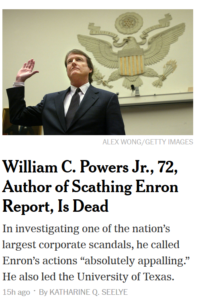
The NYT has an interesting way of presenting the obit for former UT president Bill Powers:

Francesco Cali passed away last night. He was shot six time outside his home, and (according to one report Lawrence sent me) run over by a pickup truck.

Mr. Cali was the current reputed boss of the Gambino family, John Gotti’s old outfit.

The assassination of Mr. Cali came on the same day that Joseph Cammarano Jr., the reputed acting boss of the Bonanno crime family, was acquitted at trial, and about a week after Carmine J. Persico, a longtime boss of the Colombo crime family, died in prison at age 85.

NYT on the Cammarano acquittal. Previously on Carmine “The Snake” Persico.

Edda Goering, Herman’s daughter, passed away. She was 80.

Obit watch: March 1, 2019.

Friday, March 1st, 2019

Edward C. Nixon, youngest brother of Richard M. Nixon.

Edward earned a bachelor of science degree in geology from Duke University in 1952 and a master’s in geological engineering from North Carolina State University in 1954. He served in the Navy as an aviator, helicopter flight instructor and in the Naval Reserve as a professor of naval science at the University of Washington.

André Previn.

He collected Oscars for scoring “Gigi” (1959), “Porgy and Bess” (1960), “Irma La Douce” (1964) and “My Fair Lady” (1965). He did not write classic songs like “Summertime” and “I Could Have Danced All Night”; rather, he arranged and orchestrated them, creating the soundtrack versions.

By way of Mike the Musicologist, an amusing story from Previn’s memoir:

I had an idea. “Let’s call Shostakovich,” I offered.

It surprises me a little that Previn wasn’t an EGOT. He never picked up an Emmy or a Tony (though he was nominated for both).

Obit watch: February 23, 2019.

Saturday, February 23rd, 2019

Yesterday was a busy day for the NYT: the obit writers were apparently playing catch-up. One of these I knew about, but was waiting for a reliable source on, while the others I had not heard about.

William E. Butterworth III, noted and bestselling author.

According to his website, there are more than 50 million copies of his books in print in more than 10 languages.

If the name doesn’t ring a bell with you, that’s because he wrote mostly under pseudonyms. His best known pen name was W.E.B. Griffin.

(Also: awesome photo, NYT.)

Ken Nordine, poet and “word jazz” guy.

Mr. Nordine became wealthy doing voice-overs for television and radio commercials. But he found his passion in using his dramatic baritone to riff surreally on colors, time, spiders, bullfighting, outer space and dozens of other subjects. His free-form poems could be cerebral or humorous, absurd or enigmatic, and were heard on the radio and captured on records, one of which earned a Grammy nomination.

I used to fall asleep with the radio on and wake up to it in the morning. As I recall, early on Sunday mornings, in that twilight zone when I was half-awake and half-asleep, our local public radio station aired re-runs of “Word Jazz”.

I had not heard of Ethel Ennis, but this is an interesting story: Playboy jazz poll winner for best female singer,

She recorded for major labels in the late 1950s and the ’60s; toured Europe with Benny Goodman; performed onstage alongside Miles Davis, John Coltrane and Louis Armstrong; and appeared on television with Duke Ellington. She became a regular on Arthur Godfrey’s TV show and headlined the Newport Jazz Festival.

And then she mostly walked away from it all and became Baltimore’s unofficial “First Lady of Jazz”.

“They had it all planned out for me,” she told The Washington Post in 1979, referring to the music executives in charge of her career. “I’d ask, ‘When do I sing?’ and they’d say, ‘Shut up and have a drink. You should sit like this and look like that and play the game of bed partners.’ You really had to do things that go against your grain for gain. I wouldn’t.”
She added: “I want to do it my way. I have no regrets.”

Finally, David Horowitz, newscaster and consumer reporter. I remember watching the syndicated version of “Fight Back!” on one of the Houston TV stations (though I don’t recall which one) back when I was young…

Obit watch: February 22, 2019.

Friday, February 22nd, 2019

For the historical record: Peter Tork, of The Monkees.

Obit watch: February 20, 2019.

Wednesday, February 20th, 2019

Don Newcombe, noted pitcher for the Brooklyn Dodgers.

An imposing right-hander, at 6 feet 4 inches and 225 pounds, with an overpowering fastball, Newcombe claimed a string of achievements: National League rookie of the year in 1949; four-time All-Star; the league’s Most Valuable Player in 1956, when he also won the first Cy Young Award as baseball’s top pitcher. Moreover, he was the first black pitcher to start a World Series game.

While Newcombe was proud of his accomplishments as a pitcher, he was gratified as well to have played a role in the civil rights struggle by helping to shatter modern baseball’s racial barrier after the arrival of the Dodgers’ Jackie Robinson and catcher Roy Campanella.
He once said that the Rev. Dr. Martin Luther King came to his house in the weeks before his assassination in 1968 and told him, “I would never have made it as successfully as I have in civil rights if it were not for what you men did on the baseball field.”

Also among the dead: Karl Lagerfeld, fashion designer.

Guy Webster, album cover photographer.

Mr. Webster’s work with the Rolling Stones — including the photo for the bucolic cover of the United States release of the anthology “Big Hits (High Tide and Green Grass)” (1966) — began with an unusual offer in 1965 from Andrew Loog Oldham, their producer and manager: Take photographs, but don’t expect to be paid because it’s an honor simply to work with the band.
“And I said, ‘Well, it’s an honor for you that I take these pictures,’ ” Mr. Webster said at the Annenberg event. “He paid me for one album cover. Three of them came out during the years using my photographs.”

For Exposure, call your office, please.

Tweet of the day.

Thursday, February 14th, 2019

Technically, from last night:

Obit watch: February 11, 2019.

Monday, February 11th, 2019

Great and good friend of the blog Borepatch, who has probably forgotten more about popular music than I know, sent over a couple of obits that I missed.

Bonnie Guitar passed away in January at the age of 95.

Ms. Guitar was best known for her recording of “Dark Moon,” a Top 20 country single on the Dot label that crossed over to the pop Top 10 in 1957. The record, a haunting nocturne sung in a clear-toned alto, was, along with Patsy Cline’s “Walkin’ After Midnight” — which reached the pop Top 40 the same year — one of the earliest records by a female country singer to cross over to the pop chart.

But the achievement for which Ms. Guitar never really received her due, perhaps because she decided to remain in her native Washington instead of resettling in a major recording center like Los Angeles or Nashville, was her trailblazing work as a studio maven and entrepreneur. Over seven decades she did everything from engineer recordings to scout talent and run a record label.

And Sanger D. “Whitey” Shafer also died in January. He was perhaps most famous for writing “All My Ex’s Live in Texas” and “Does Fort Worth Ever Cross Your Mind”.

In 2004, Shafer earned a different kind of hit, as his own recording of “All My Ex’s” appeared on the soundtrack of the hit video game Grand Theft Auto: San Andreas. Few country songwriters of his generation can claim that, and it’s one of many reasons we’ll not see his like again.

Tribute from “Austin City Limits”. Obit from Saving Country Music. Obit from WFAA.

Obit watch: February 5, 2019.

Tuesday, February 5th, 2019

This one goes out to Borepatch and Weer’d Beard: Jacqueline Steiner, who co-wrote “M.T.A.”. That song (also known as “Charlie on the M.T.A.”) later became a huge hit for the Kingston Trio:

The song remains embedded in Boston’s collective unconscious and is something of an unofficial city anthem.

Thing I did not know: it was originally written for a guy running for mayor in 1949. He only got one percent of the vote, and was later blacklisted as a Communist.

Also among the dead: Albert J. “Chainsaw Al” Dunlap, notorious corporate raider.

Obit watch: February 2, 2019.

Saturday, February 2nd, 2019

NYT obit for Dick Miller.

This one goes out to Mike the Musicologist: Sanford Sylvan, noted baritone. He did a lot of work with John Adams: among other roles, he was the first Chou En-lai in “Nixon in China” and Leon Klinghoffer in “The Death of Klinghoffer”.

His recordings, many with Mr. Breitman, include programs of Schubert, Fauré, Jorge Martin and Virgil Thomson, as well as a luminous, delicate 1991 release, “Beloved That Pilgrimage,” which includes Theodore Chanler’s “Eight Epitaphs,” Barber’s “Hermit Songs” and Copland’s “Twelve Poems of Emily Dickinson.” Mr. Sylvan took part in the New York premiere of Mr. Adams’s opera “A Flowering Tree” in 2009, and also performed contemporary works by composers like Peter Maxwell Davies, Philip Glass, John Harbison and Charles Fussell.

Finally, Captain Rosemary Mariner, United States Navy (ret.). She was one of the first six women to go through naval flight training, the first to fly an attack jet, and the first woman to command a naval aviation squadron. She also had a leading role in removing the restrictions on women flying combat missions.

When she retired from the Navy in 1997, Captain Mariner “had become one of the nation’s leading advocates for equal opportunity in the military,” Deborah G. Douglas wrote in “American Women and Flight since 1940” (2005).
Captain Mariner logged 17 landings on aircraft carriers and more than 3,500 flight hours in 15 different aircraft.

Obit watch: January 24, 2019.

Thursday, January 24th, 2019

Mary Boyd Higgins, trustee of the Wilhelm Reich estate and legacy.

When she was appointed trustee, in March 1959, Ms. Higgins had her work cut out for her.
She quickly discovered that most of Dr. Reich’s personal papers, which he had wanted sealed for 50 years before anyone could see them, had been stolen; she had to start litigation to retrieve them. He wanted his Maine property turned into a museum; she would need to become an expert in museum design. She also studied copyright law in seeking to have his books republished.

I wasn’t originally going to post this, but then it occurred to me that this obit gives me a flimsy excuse to embed this video:

Obit watch: January 16, 2019.

Wednesday, January 16th, 2019

I wanted to give the Carol Channing obit a chance to shake out before posting it. I’m kind of glad I did: now they’re leading off the obit with the Hirschfeld drawing, which fills me with delight down to the bottom of my coal black heart.

By the time she returned to the role on Broadway in October 1995, Ms. Channing had played Dolly more than 4,500 times, missing only one performance — in June of that year, when she left the show for a day to fly to New York from San Diego to accept a Tony Award for lifetime achievement. She had appeared onstage in a cast, a neck brace and a wheelchair, and with viruses that would have felled anyone with lesser determination. (By her own count, she went on to surpass the 5,000 mark.)

Ms. Channing’s own motion picture career never really took off, although she received an Academy Award nomination and won a Golden Globe for her performance in “Thoroughly Modern Millie” (1967). She did enjoy some success on television, and in her later years she did a lot of cartoon voice-over work. But the theater was her natural home.

As Lawrence pointed out to me yesterday, she was also in “Skidoo“. (Honest to Ghu, I thought that had been released on Criterion, but apparently not.)

This one goes out to my friend Todd: Alan R. Pearlman, synthesizer pioneer and founder of ARP Instruments.

ARP’s analog synthesizers — particularly the compact, portable ARP Odyssey, introduced in 1972 — grew ubiquitous in pop and electronic music. By the mid-1970s, ARP was the leading synthesizer manufacturer, commanding 40 percent of the market and outselling its predecessors and competitors, Moog and Buchla.
ARP sounds were central to numerous songs, including Edgar Winter’s “Frankenstein,” Herbie Hancock’s “Chameleon,” Kraftwerk’s “The Robots,” Underworld’s “Rez,” Nine Inch Nails’ “The Hand That Feeds” and the early-1980s version of the theme to the television series “Doctor Who.”
The five-note signature motif of “Close Encounters of the Third Kind” was played on an ARP 2500 synthesizer, which is seen in the film. An ARP 2600, mixed with natural sounds, provided the voice of R2-D2 in the first “Star Wars” movie.

Obit watch: January 3, 2019.

Thursday, January 3rd, 2019

For the historical records:

Daryl Dragon, the “Captain” in “Captain and Tennille”.

Bob “Super Dave Osborne” Einstein.

Gene Okerlund, wrestling guy.

Merry Christmas, everyone.

Tuesday, December 25th, 2018

Yeah, it doesn’t have vocals, but I find the combination of drums and organ striking. Let’s go old school.

And because that was short, here’s another one. The tempo is a little slower than I’d like, but there’s something about Alyth McCormack’s voice that gets me.

Bagatelle (#9)

Thursday, December 20th, 2018

Throwaway post instead of content. My five favorite Christmas songs:

(more…)