Archive for the ‘Books’ Category

Happy New Year! Have some more gun books!

Thursday, January 5th, 2023

But first, answers to a couple of questions:

“Did you get any guns for Christmas?” No, not as presents. I expect to pick up one gun on Saturday, and may pick up a second one off of layaway at the same time. I’ll blog them once I have them, as I think folks will find these guns historically interesting. (Hint: if everything works out the way I want it to, Saturday will be The Day of the .45.)

“Did you get any gun books for Christmas?” Not yet: my beloved and indulgent sister has been wrestling with Amazon, but I don’t know what she got me, I’m not looking (that’d ruin the surprise!), and so I don’t know if there are any gun books in the lot. (Speaking of new gun books, though, this interests me: I liked American Gunfight, his book with Stephen Hunter, so I’m willing to take a chance. And speaking of Stephen Hunter, I pre-ordred a signed copy of The Bullet Garden from The Mysterious Bookshop, but that won’t be released until later this month.)

(And before you say “Isn’t it kind of late for Christmas?”, as all people of goodwill know, the Christmas season runs through January 6th, the Feast of the Epiphany, and so anything given, or even ordered, in this period earns you full faith and credit. Also, you can leave your Christmas decorations up until after the 6th. If the Judgy McJudgersons say anything to you, tell them I have spoken. So let it be written, so let it be done.)

Anyway, some more gun books. One was ordered before Thanksgiving, one was picked up at Half-Price Books while I was out after the holiday.
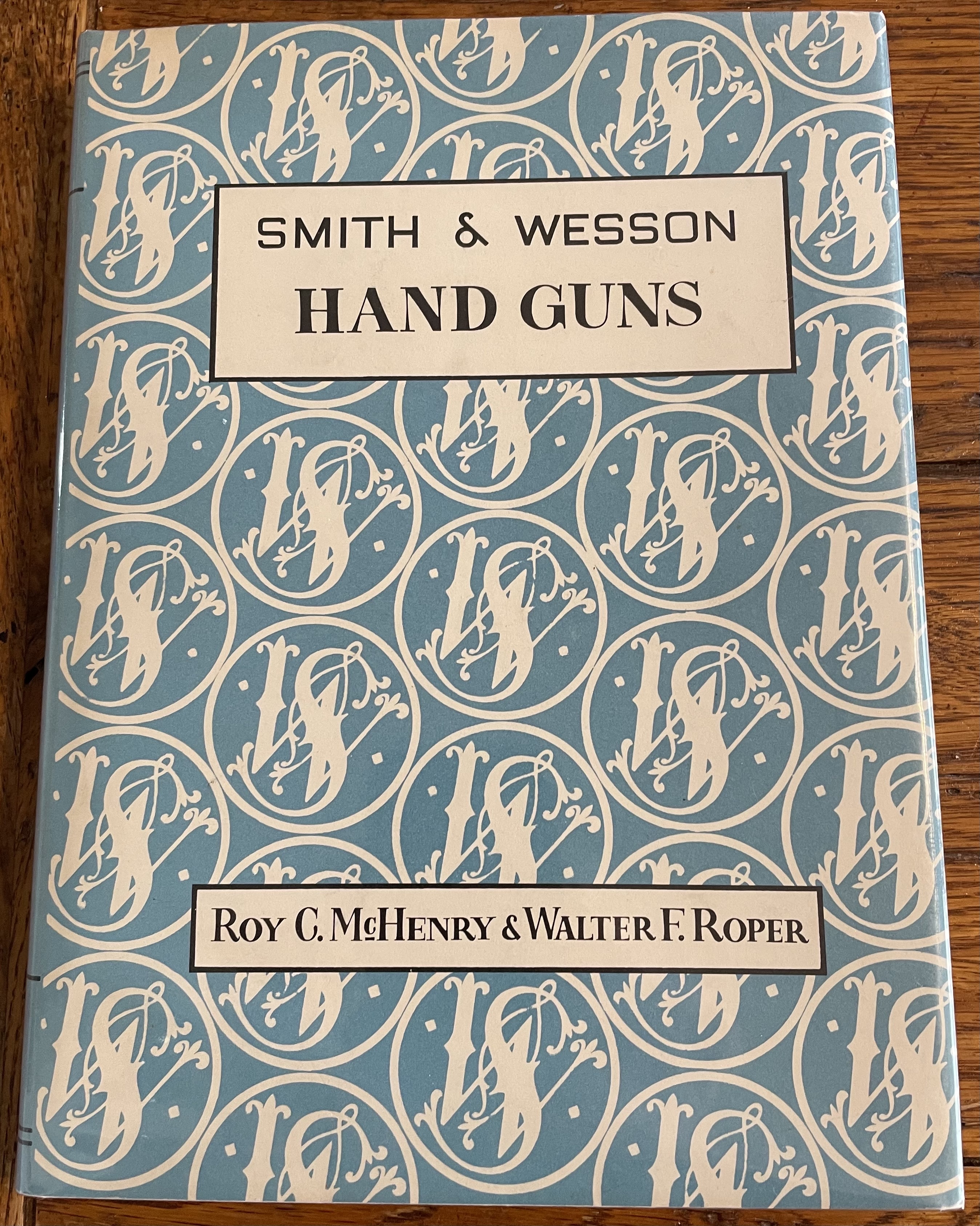
(more…)

Obit watch: January 5, 2023.

Thursday, January 5th, 2023

Fay Weldon, British novelist. (The Life and Loves of a She-Devil).

In 2001, she struck an unusual brand-placement deal with the jeweler Bulgari, reportedly worth £18,000 (about $23,000), to mention the company’s name and products in a book. The ensuing novel, “The Bulgari Connection,” raised eyebrows among purists, but she brushed the criticism aside.
At first, she said, she thought: “‘Oh, no, dear me, I am a literary author. You can’t do this kind of thing; my name will be mud forever.’ But then after a while I thought, ‘I don’t care. Let it be mud. They never give me the Booker Prize anyway.’”

James “Buster” Corley, co-founder of Dave and Busters. He was 72: according to his family, he suffered a stroke four months ago that caused “severe damage to the communication and personality part of his brain”, and his death was a suicide.

Hoplobibilophilia updates.

Tuesday, December 27th, 2022

I got a little behind in doing these, for reasons. But I’ve been on vacation all last week, and will be on vacation all this week and next, so I’ve got some time to catch up.

(more…)

Obit watch: December 10, 2022 (supplemental).

Saturday, December 10th, 2022

I think Lawrence is slightly annoyed at me. But it isn’t my fault.

There were a plethora of obits yesterday. It seems like I was sending emails every five minutes, though I know that’s not actually true. So here are the ones that weren’t for Col. Kittinger, because I wanted to break his out.

Dominique Lapierre, author. He started out as a foreign correspondent, and wrote some well-received travel books. Then he teamed up with Larry Collins, and they wrote several massive bestsellers: Is Paris Burning? and Freedom at Midnight, among others.

Mr. Lapierre also wrote other books, some collaboratively, some alone. Most famously, he wrote The City of Joy:

In 1981 he and his second wife, also named Dominique, returned to India as humanitarians. They lived for two years in a slum in Kolkata, once known as Calcutta, in a four-by-six room without running water.
“We left the slum every few weeks to take a good long bubble bath,” he told Metro, a French magazine, in 1986.
Mr. Lapierre wrote frequent dispatches from Kolkata and used his extensive reporting to write “City of Joy,” a 1985 novel populated by loosely fictionalized characters based on people he had met along the way, including a priest and a rickshaw puller.
The book was another giant hit — more than eight million copies were sold — and it was adapted into a 1992 movie starring Patrick Swayze. It brought attention to the conditions of India’s very poor, with mixed results.
The Indian government committed billions to bring running water and other services to Kolkata’s slums, but the light the book cast on the city also attracted thousands of international tourists to see the poverty for themselves.
“On the streets of Calcutta these days, the book is often seen clutched in the hands of Western tourists,” wrote The Los Angeles Times in 1987. “If Paris has the Guide Michelin, Calcutta has ‘The City of Joy.’”
Mr. Lapierre promised to give half his royalties from the book to improve public health in the city’s slums. He created a nonprofit to direct his efforts, and over time spent more than $1 million of his own money on things like mobile health clinics.
Others gave as well: Within a year of the book’s publication he had received more than 40,000 letters from readers seeking to help. Some sent cash or checks; one sent a wedding ring taped to a piece of paper.

Grant Wahl, soccer journalist.

Gary Friedkin, actor. The NYPost says he was in “Blade Runner” and “Return of the Jedi” but those are not reflected in his IMDB credits. Lawrence says he remembers him from “Young Doctors In Love”, which I have never seen, and he was also in “Under the Rainbow”.

Helen Slayton-Hughes, actress. Other credits include “Mafia on the Bounty”, “The Greatest Event in Television History”, amd “Don’t Worry, He Won’t Get Far on Foot”.

Obit watch: November 24, 2022.

Thursday, November 24th, 2022

Frederick P. Brooks Jr., one of the great figures in computer science, has passed away. He was 91.

…he is best known for being one of the technical leaders of IBM’s 360 computer project in the 1960s. At a time when smaller rivals like Burroughs, Univac and NCR were making inroads, it was a hugely ambitious undertaking. Fortune magazine, in an article with the headline “IBM’s $5,000,000,000 Gamble,” described it as a “bet the company” venture.
Until the 360, each model of computer had its own bespoke hardware design. That required engineers to overhaul their software programs to run on every new machine that was introduced.
But IBM promised to eliminate that costly, repetitive labor with an approach championed by Dr. Brooks, a young engineering star at the company, and a few colleagues. In April 1964, IBM announced the 360 as a family of six compatible computers. Programs written for one 360 model could run on the others, without the need to rewrite software, as customers moved from smaller to larger computers.

…

But there was a problem. The software needed to deliver on the IBM promise of compatibility across machines and the capability to run multiple programs at once was not ready, as it proved to be a far more daunting challenge than anticipated. Operating system software is often described as the command and control system of a computer. The OS/360 was a forerunner of Microsoft’s Windows, Apple’s iOS and Google’s Android.
At the time IBM made the 360 announcement, Dr. Brooks was just 33 and headed for academia. He had agreed to return to North Carolina, where he grew up, and start a computer science department at Chapel Hill. But Thomas Watson Jr., the president of IBM, asked him to stay on for another year to tackle the company’s software troubles.
Dr. Brooks agreed, and eventually the OS/360 problems were sorted out. The 360 project turned out to be an enormous success, cementing the company’s dominance of the computer market into the 1980s.

He did go on to found the University of North Carolina computer science department and chaired it for 20 years. I would actually say that he’s best known for something else:

Dr. Brooks took the hard-earned lessons from grappling with the OS/360 software as grist for his book “The Mythical Man-Month: Essays on Software Engineering.” First published in 1975, it soon became recognized as a quirky classic, selling briskly year after year and routinely cited as gospel by computer scientists.
The tone is witty and self-deprecating, with pithy quotes from Shakespeare and Sophocles and chapter titles like “Ten Pounds in a Five-Pound Sack” and “Hatching a Catastrophe.” There are practical tips along the way. For example: Organize engineers on big software projects into small groups, which Dr. Brooks called “surgical teams.”
The most well known of his principles was what he called Brooks’s law: “Adding manpower to a late software project makes it later.” Dr. Brooks himself acknowledged that he was “oversimplifying outrageously,” but he was exaggerating to make a point.
It is often smarter to rethink things, he suggested, than to add more people. And in software engineering, a profession with elements of artistry and creativity, workers are not interchangeable units of labor.

And this is a nice thing to see in an obit:

During his IBM years, Dr. Brooks became what his son described as “a convinced and committed Christian” after attending Bible study sessions hosted by his colleague and fellow computer designer Dr. Blaauw. “I came to see that the intellectual difficulties I was having as a scientist with Christianity were secondary,” Dr. Brooks recalled in the Computer History Museum interview. He taught Sunday school for over 50 years at a Methodist church in Chapel Hill and served as a leader and faculty adviser to Christian study and fellowship groups at the university.

…

The major prizes typically cited his work in computer design and software engineering. But during his years at North Carolina, Dr. Brooks also turned to computer graphics and virtual reality, seeing it as an emerging and important field. He led research efforts that experts say included techniques for fast and realistic presentation of images and applications for studying molecules in biology.
“The impact of his work in computer graphics was enormous,” said Patrick Hanrahan, a professor at Stanford University and a fellow Turing Award winner. “Fred Brooks was a thought leader way ahead of his time.”

I have read The Mythical Man-Month (a long time ago, when I was a young sysadmin) and enjoyed it. I wish I had met Dr. Brooks.

Obit watch: November 21, 2022.

Monday, November 21st, 2022

I don’t have a good link for this, but noted SF writer Greg Bear passed away over the weekend. Lawrence has written a very nice obituary for him, which I encourage you to go read.

Jason David Frank, “the original green ranger on Mighty Morphin Power Rangers”. He was 49.

Nicki Aycox, actress. She was 47. Other credits include “CSI: Original Recipe”, “Law & Order”, and “Cold Case”.

This doesn’t quite qualify as an obit, and I would suggest taking this with more than a grain of salt: Bruce Lee may have died from excessive water consumption. As opposed to a reaction from a prescription painkiller, being poisoned by gangsters, or heat stroke.

Yet another batch of hoplobibilophilia.

Friday, November 18th, 2022

As promised, two recently added vintage books…

(more…)

Obit watch: November 18, 2022.

Friday, November 18th, 2022

Ned Rorem, Pulitzer Prize winning classical composer.

The prize was awarded for “Air Music,” a suite commissioned for the American bicentennial by the Cincinnati Symphony Orchestra. Though he wrote many other orchestral works as well — including his Symphony No. 3, which was given its premiere by the New York Philharmonic under Leonard Bernstein in 1959 — Mr. Rorem’s enduring appeal rested more on his vocal pieces.
Robert Shaw, who was America’s foremost conductor of choral music, called him the greatest art-song composer of his time. And it was a remarkably long time.
Mr. Rorem was 74 when his masterwork “Evidence of Things Not Seen” was first performed, in 1998. An evening-long song cycle for four singers and piano, incorporating 36 poems by 24 authors, it was praised by the New York magazine critic Peter G. Davis as “one of the musically richest, most exquisitely fashioned, most voice-friendly collections of songs” by any American composer.
Mr. Rorem had no use for avant-garde theories or their proponents — modern masters like Pierre Boulez and Elliott Carter included. In turn, some critics found him short of original ideas and dynamism, a miniaturist unable to sustain longer pieces. Reviewing “Miss Julie,” the Rorem opera based on Strindberg’s drama, when it was presented by New York City Opera in 1965, Harold C. Schonberg of The New York Times wrote, “His melodic ideas are utterly bland, lacking in profile or distinction.”

Marcus Sedgwick, author. (Hattip: Lawrence.)

For the record: NYT obit for Robert Clary.

Obit watch: November 17, 2022.

Thursday, November 17th, 2022

Robert Clary, who played “Corporal LeBeau” on “Hogan’s Heroes”. He was “the last surviving member of the show’s original principal cast”. (Kenneth Washington, who joined the show in the final season, is still alive.)

Other credits include “Days of Our Lives” and “The Bold and the Beautiful”.

Noted:

Born Robert Max Widerman in Paris on March 1, 1926, Clary was the youngest of 14 children in a strict Orthodox Jewish family. At age 12, he began singing and performing; one day when he was 16, he and his family were rounded up and sent to Auschwitz.
“My mother said the most remarkable thing,” Clary told The Hollywood Reporter’s Peter Flax in late 2015. “She said, ‘Behave.’ She probably knew me as a brat. She said, ‘Behave. Do what they tell you to do.’”
Clary’s parents were murdered in the gas chamber that day.
At Buchenwald, Clary sang with an accordionist every other Sunday to an audience of SS soldiers. “Singing, entertaining and being in kind of good health at my age, that’s why I survived,” he told Flax.
Clary was incarcerated for 31 months (he worked in a factory making 4,000 wooden shoe heels each day) and tattooed with the identification “A-5714” on his left forearm. He was the only one of his captured family to make it out alive.

…

Did Clary have any reservations about doing a comedy series dealing with Nazis and concentration camps?
“I had to explain that [Hogan’s Heroes] was about prisoners of war in a stalag, not a concentration camp, and although I did not want to diminish what soldiers went through during their internments, it was like night and day from what people endured in concentration camps,” he wrote in his inspirational 2001 memoir, From the Holocaust to Hogan’s Heroes.

…

He sang on several jazz albums that featured the work of songwriters like Irving Berlin and Johnny Mercer. (Also a part of his discography: Hogan’s Heroes Sing the Best of WWII, recorded with his castmates Richard Dawson, Larry Hovis and Ivan Dixon.)

I can’t find the album anywhere, but the memoir is available from Amazon.

Edited to add: Thanks to Joe D. for his comment, which I greatly appreciate. Also, while I still can’t find the “Hogan’s Heroes” album, Mike the Musicologist pointed out that Robert Clary’s “Meet Robert Clary” (1955) and “Hooray for Love” (1956) are available on Apple Music and Amazon Music.

A fresh, steaming batch of hoplobibilophilia.

Friday, November 4th, 2022

I’m still a little behind documenting recent acquisitions, but I should be caught up in a week or two. Just in time for a new batch.

I thought I’d document some books I bought new. Not ABE purchases: those will be the next post.

After the jump…

(more…)

Obit watch: November 1, 2022.

Tuesday, November 1st, 2022

Gael Greene, noted restaurant reviewer for New York magazine.

After graduation, she was hired by United Press International, which on one memorable occasion sent her to cover a show by Elvis Presley in Detroit. She wangled an invitation to the singer’s hotel room, where one thing led to another. As she left, Presley asked her to order him a fried egg sandwich from room service.
Later, she wrote in her 2006 memoir “Insatiable: Tales From a Life of Delicious Excess,” she could not remember much about the sex, but the sandwich stayed in her mind: “Yes, the totemic fried egg sandwich. At that moment, it might have been clear I was born to be a restaurant critic. I just didn’t know it yet.”

…

In no time, her swaggering, fearless style made her one of the magazine’s star writers. She made short work of the Colony, an old society standby, and skewered the snobbery of Manhattan’s finer French restaurants.
In a town where snob, snoot and snub flower in perpetual renaissance, Lafayette is the ‘most,’” she wrote in one review. “Here the spleen is infinitely more memorable than the sweetbreads.”

Julie Powell, of the “Julie/Julia Project” and later Julie and Julia: My Years of Cooking Dangerously (affiliate link). She was 49.

In 2002, Ms. Powell was an aspiring writer working at a low-level administrative job in Lower Manhattan. She was about to turn 30 and had no real career prospects. It was, she said in an interview with The New York Times, “one of those panicked, backed-into-a-corner kind of moments.”
To lend structure to her days, she set out to cook all 524 recipes from her mother’s well-worn copy of Mrs. Child’s 1961 classic “Mastering the Art of French Cooking, Volume 1.” But as an untrained cook who lived in a small Long Island City loft, she found the road to be long, sweaty and bumpy.
In a blog for Salon.com that she called the Julie/Julia Project, she wrote long updates, punctuated by vodka gimlets and filled with entertaining, profane tirades about the difficulties of finding ingredients, the minor disappointments of adult life and the bigger challenges of finding purpose as a member of Generation X.

…

Ms. Powell’s second book, “Cleaving: A Story of Marriage, Meat, and Obsession,” published in 2009, dived deeply into their relationship, which sometimes flourished and sometimes faltered. She described in detail her struggle with an extramarital affair she had and, later, one her husband had. This time, the food connection was darker: She juxtaposed her apprenticeship as a butcher with a dissection of her moods and the marriage.
Without the sauciness and celebrity connection of her first book, “Cleaving” was not well received, and although Ms. Powell continued writing, it was her last book.
“She had so much talent and emotional intelligence,” said Judy Clain, editor in chief of Little, Brown, who was Ms. Powell’s editor. “I only wish she could have found the next thing.”

Obit watch: October 30, 2022.

Sunday, October 30th, 2022

Thomas Cahill, author. (How the Irish Saved Civilization)

D.H. Peligro, drummer for the Dead Kennedys. (Actually, he replaced the original drummer, “Ted”, in early 1981. Also, if you haven’t looked at the recent history of the Dead Kennedys, it’s a pretty sad story.)

Obit watch: October 27, 2022.

Thursday, October 27th, 2022

John Jay Osborn Jr., author. (The Paper Chase.)

Between 1978 and 1988, Mr. Osborn was credited with writing 14 episodes of “The Paper Chase” and one episode apiece of “L.A. Law” and “Spenser: For Hire.” In that period, he also wrote his fourth novel, “The Man Who Owned New York” (1981), about a lawyer trying to recover $3 million missing from the estate of his firm’s biggest client.
In the 1990s, he became a private estate planner and taught at the University of California, Berkeley, School of Law, and then at the University of San Francisco School of Law, where he taught contract law until his retirement in 2016.

Mike Davis, author. I’ve heard a lot about City of Quartz, and should probably read it one of these days.

Detractors questioned the accuracy of some of Mr. Davis’s assertions and the hyperbole of his prose. That criticism seemed to peak after he won a $315,000 MacArthur “genius” grant in 1998.
“A lot of writers are tired of Mike Davis being rewarded again and again, culminating in the MacArthur fellowship, for telling the world what a terrible place L.A. is,” Kevin Starr, California’s state librarian, told The Los Angeles Times in 1999.

…

“I understand having acquired a public stature and being someone with unpopular ideas that I’m going to get attacked — being a socialist in America today, you better have a thick skin,” he told The Los Angeles Times. “There is a kind of intolerance in the city for people who say things that went wrong haven’t been fixed.”

Jody Miller.

Signed by Capitol Records as a folk singer, Ms. Miller released her first album in 1963 and cracked the Billboard Hot 100 the next year with the pop song “He Walks Like a Man.”
Her career took off in 1965 when Capitol, seizing on the popularity of Roger Miller’s “King of the Road,” had her hastily record “Queen of the House,” which set distaff lyrics by Mary Taylor to Mr. Miller’s melody and finger-snapping rhythm.
Where Mr. Miller (no relation to Ms. Miller, although they both grew up in Oklahoma) sang of “trailers for sale or rent; rooms to let, 50 cents,” Ms. Miller rhapsodized in a similarly carefree fashion about being “up every day at six; bacon and eggs to fix.”
“I’ll get a maid someday,” she sang, “but till then I’m queen of the house.”

…

Over time, Ms. Miller landed about 30 singles on the Billboard charts, 27 of them in the country category and several of those in the top five. In the 1970s she worked with the prominent Nashville producer Billy Sherrill, who guided her to another crossover hit with a cover of the Chiffons’ 1963 song “He’s So Fine,” which reached No. 5 on the country chart and No. 53 on the pop chart in 1971.

More gun books!

Monday, October 24th, 2022

Another batch of books is icumen in, so time for some more documentation. I’m happy about this first one, as it fills a much needed void in my collection.

Smith and Wesson Hand Guns, Roy C. McHenry and Walter F. Roper. Standard Publications, 1945. As far as I can tell, this is a first printing. Riling 2527.

This was the first book that attempted to comprehensively cover S&W history (up through about 1944), and remains an important work for collectors.

I can’t find a flaw in this. I’d call it “fine”. Bought for just under $60 from a eBay vendor.

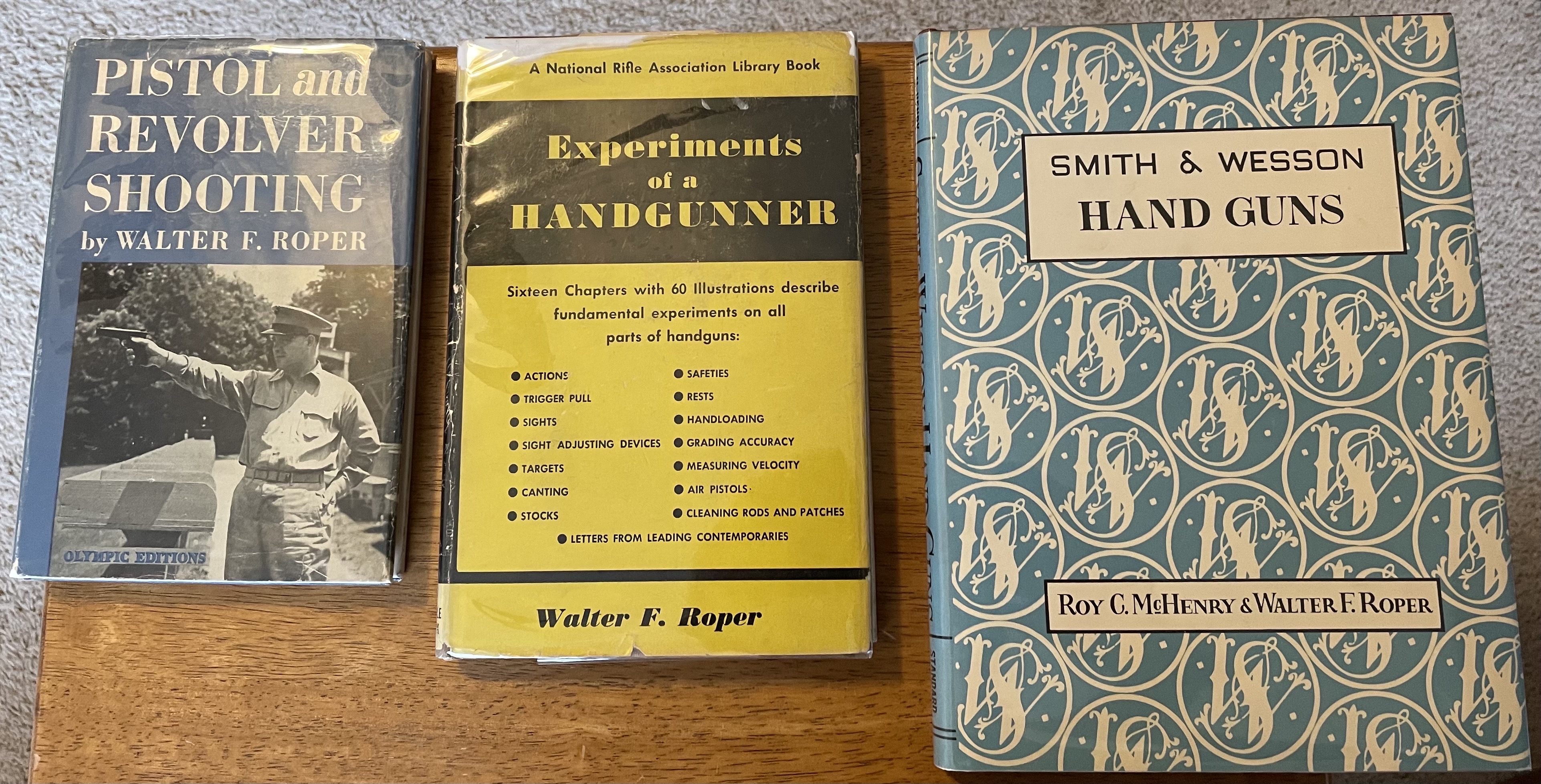
My Ropers, let me show them to you:

These are all (as far as I can tell) firsts of all three books Walter Roper wrote or co-wrote. They’re not quite three of a perfect pair, as the Experiments has a bit of wear. But I’ve still never found another first in the wild in a better state.

(Previously on Pistol and Revolver Shooting. Previously on Experiments of a Handgunner.)

After the jump, another small curiosity…

(more…)

Leonard, part II.

Sunday, October 23rd, 2022

Neat profile in the Detroit Free Press of Gregg Sutter. Alt link.

“Who?” For many years, he was what the Freep refers to as “Elmore Leonard’s leg man”.

He also operates ElmoreLeonard.com and oversees a Leonard Facebook page, lends periodic expertise to the archivists handling Leonard’s papers at the University of South Carolina, and leads the push to put Leonard on a 100th anniversary postage stamp.
Actually, he is the push. His idea, his research into the postal service’s Literary Arts series, his three-page nominating letter that will, according to the Oct. 6 response, “be submitted for review and consideration before the Citizens’ Stamp Advisory Committee at their next meeting.”

Damn skippy Leonard deserves a stamp.

In early October, he stumbled across the unveiling of Mama Cass Elliot’s star on the Hollywood Walk of Fame, with Stephen Stills and the Monkees’ Mickey Dolenz in attendance, and it reminded him of a disappointment.
“I have inquired about getting Elmore a star on Hollywood Boulevard,” he said, “but that costs $55,000,” and the appetite for a deceased author and screenwriter seems slight.

Kickstarter or one of the other funding services. (Not GoFundMe, because GoFarkThem.) I’d throw a few dollars in the direction of the Elmore Leonard Hollywood Boulevard Star. I bet you could get at least a few more out of the producers of “Justified” and “Justified: City Primeval”.

Mr. Sutter is also writing a memoir about his time with Leonard.

The library hopes to build an event around Leonard’s 100th birthday in 2025, she said, with exhibits, a movie or two, and presentations by Sutter and Leonard’s authorized biographer, C.M. Kushins, who has written books about rockers John Bonham and Warren Zevon.
That will require Sutter to finish his memoir. He says he will, in plenty of time.

I’ll be looking forward to both these books.