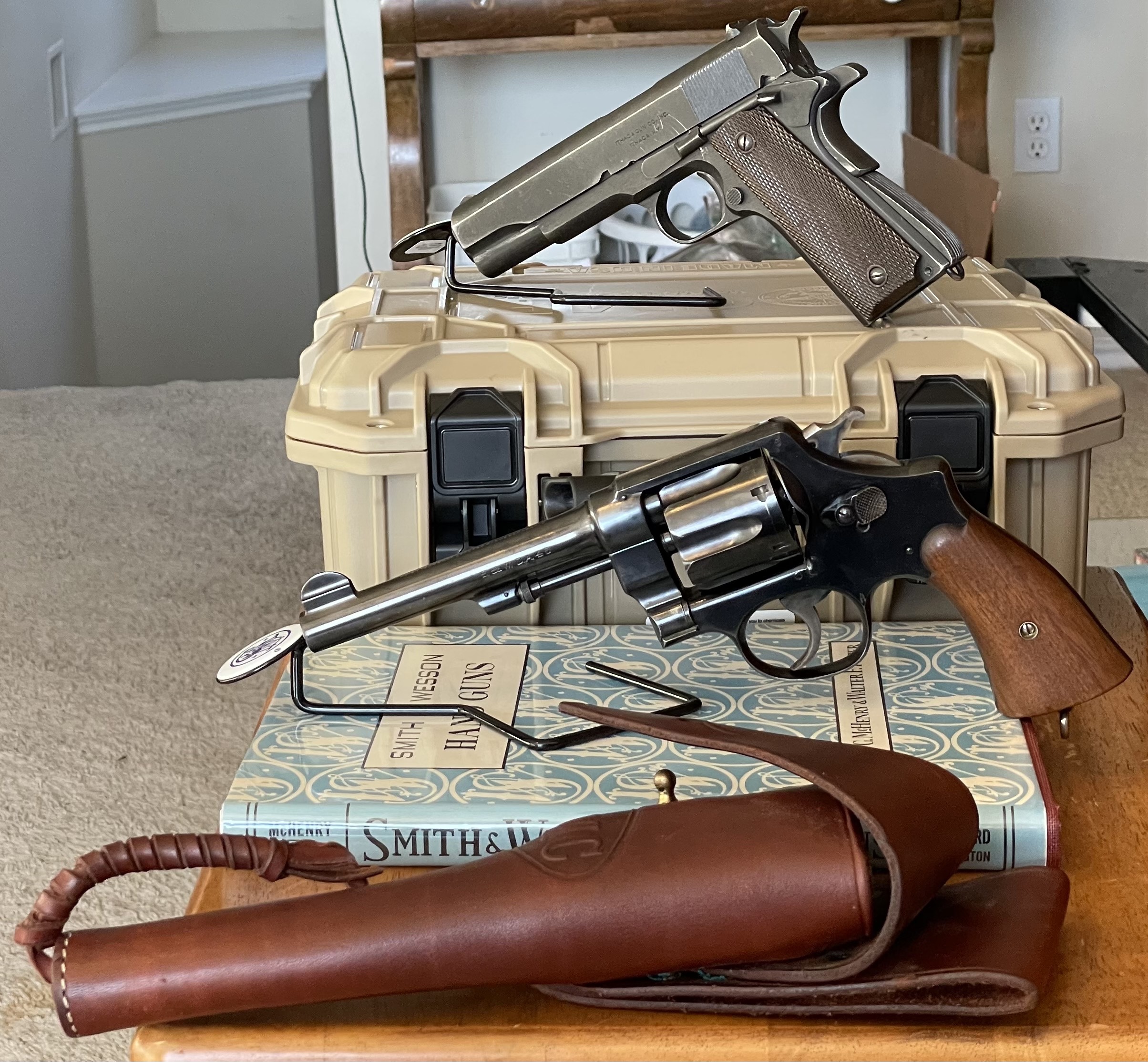
Saturday did turn out to be The Day of the .45. Didn’t plan it that way, it just worked out.
Posts on both guns to come as soon as the cedar stops trying to kill me and I can get some better photos. But that’s 100+ years of history right there.
Saturday did turn out to be The Day of the .45. Didn’t plan it that way, it just worked out.
Posts on both guns to come as soon as the cedar stops trying to kill me and I can get some better photos. But that’s 100+ years of history right there.
I like guns that have a story. Even if I don’t always know what that story is.
There are people who throw conniption fits when they see a vintage military gun that someone has modified. For me, it depends on two things:
I’ve written before about my fondness for esoteric small bore cartridges, like the .22 Jet and the .224 Harvey Kay-Chuk. This isn’t just limited to handguns, but extends to rifles as well. Indeed, I’ve been kind of looking for a good .22 Hornet. (CZ made nice ones for a while, but they seem hard to find now. The ideal would be a heavy-barrelled pre-64 Model 70, but those are not cheap.) I also wouldn’t mind finding a nice .22 Magnum rifle, to go with my two .22 Magnum revolvers, but those are more common and fairly easy to find.
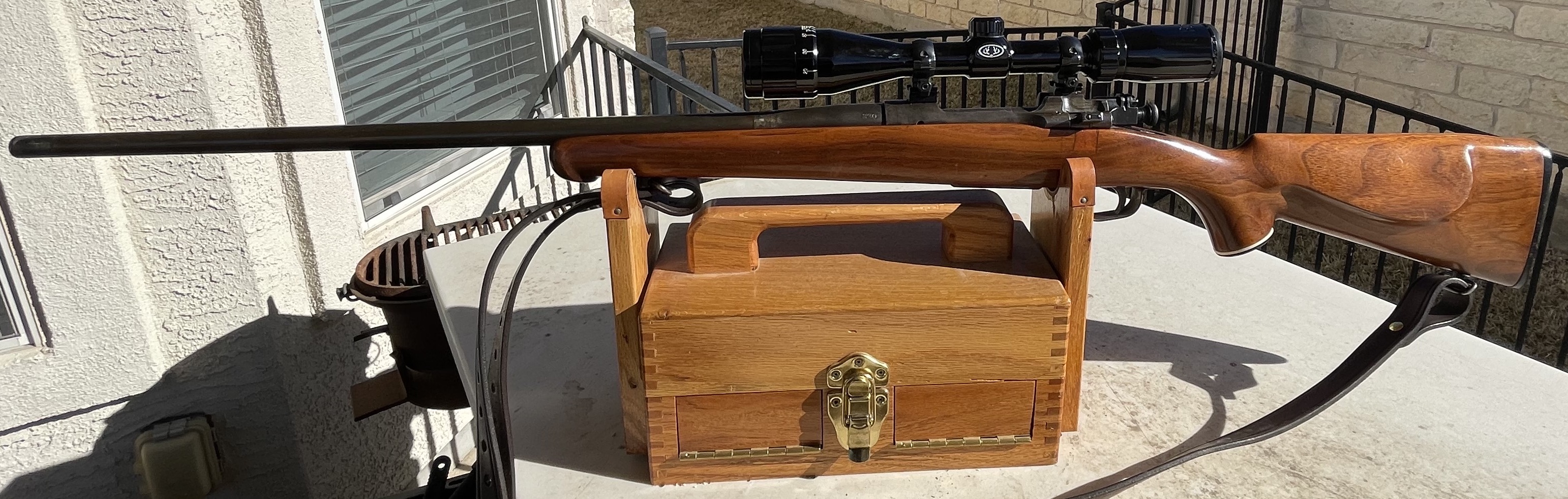
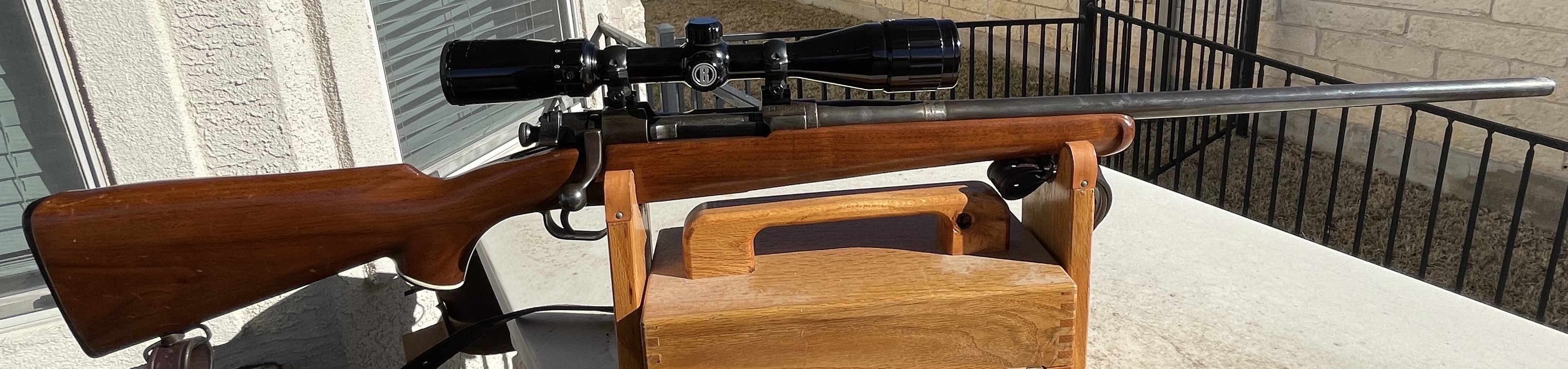
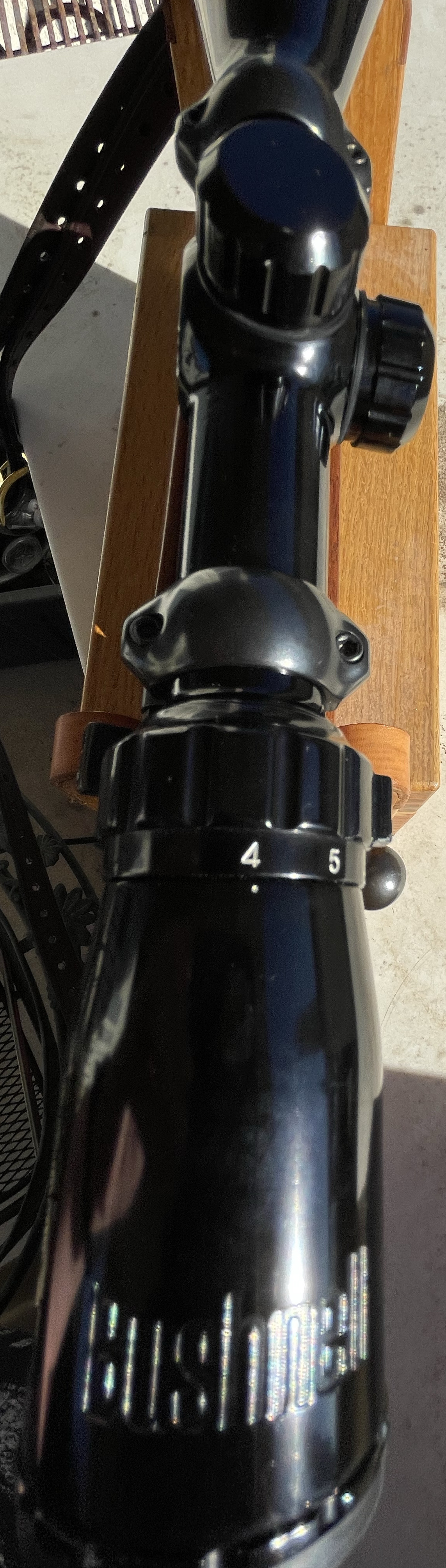
Mike the Musicologist and I were out a few months ago and visited Provident Arms in Spicewood. This was on the used rack and, while it isn’t in .22 Hornet, it was nicely priced ($400 plus tax, out the door). I heard it softly calling my name, and well…it followed me home. In addition to the nice price, it opens up several new rabbit holes for me. And it feels like this gun does have a story, though I don’t know what that story is.
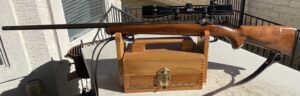
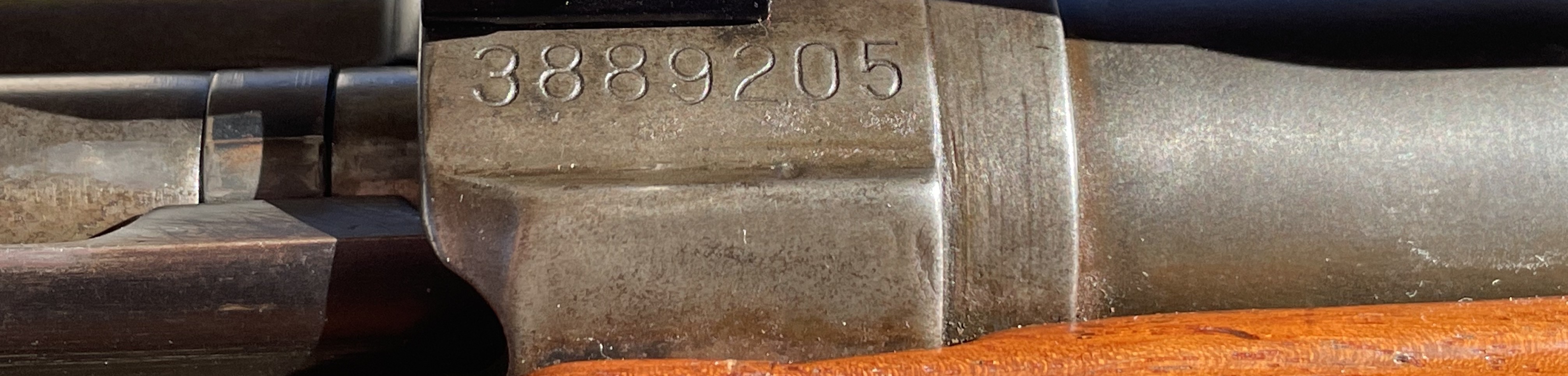
This is a custom gun. The base is a M1903A3 receiver. Some of the markings are obscured by the scope mount, but as best as I can figure out from what I can read, and this serial number table, it was made by Remington in 1942.
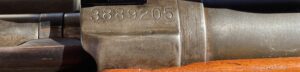
(This one says September 1943.) I’m pretty sure this is safe to shoot as it falls outside of the low serial number range, but I would welcome hearing from any 1903A3 experts out there. If you know anything about 1903A3 rifles, you know more than I do, and are thus an expert.
The scope is a Bushnell 3-14. It seems like a pretty good scope, though I won’t know for sure until I shoot the rifle. We’ll talk about that later. Assuming it holds zero and isn’t otherwise broken, I could probably take it off and get back at least $100 of the purchase price. But that would leave me with a gun with no sights, so why would I want to do that?
The other thing is, someone rechambered this in .220 Swift. No, really.

.220 Swift is one of those super-odd cartridges. Factory ammunition is “available”: Remington makes one loading, Federal makes one loading, and Winchester makes one. Good luck finding those in stock anywhere, though. Most folks seem to handload for .220 Swift.
And there are good reasons for that. You can really push .220 Swift, if you want. It uses a .224 diameter bullet, same as the .221 Fireball, .223/5.56, .22 Hornet, 5.7×28, and some other cartridges. I’ve seen claims that it is the fastest commercially produced rifle cartridge, and, based on skimming reloading data, that seems accurate. With lightweight bullets (35 grains or so) you can get over 4,000 feet per second out of the .220 Swift. That’s…astonishing. At that velocity, from what I’ve seen claimed, you can sight in 1.5″ high at 100 yards, and (depending on the the load) hold dead-on target out to 300 yards without the bullet being more than 1.5″ above or below your aim point. This would be a really great cartridge for varmint hunting.
But it is also a very controversial one. The sources I’ve read say that the factory ammo makers originally loaded it at the 4,000 fps level, but shooters found that it tore the crap out of barrels quickly, like within 500 rounds. The factories backed off their loads some in an attempt to improve barrel life. It’s also worth keeping in mind that the .220 Swift was introduced in 1935 (Winchester chambered it in the Model 54 at first, and then in the Model 70 when that was introduced the next year.) Since 1935, our knowledge of metallurgy and barrel-making has advanced considerably, and apparently newer barrels don’t get shot out as fast. Especially if you don’t feed them a high-volume of maximum loads in a short time: the consensus seems to be one or two shots on a varmint, then letting the gun cool down before taking more shots, is the way to go.
The other issue seems to be people trying to make .220 Swift do things it wasn’t designed to do, like take larger game. There was a guy in the 1940s who claimed it was the best cartridge he’d found for “feral burros”, while other people used it for deer, elk, and even tiger. On the other hand, if you’ve read Ruark’s Horn of the Hunter (and if you have, first drink’s on me next time we meet) the rifle he attempted to use to take a hyena (and threw away in disgust) was allegedly a .220 Swift. This may have been a bullet construction issue: fast moving hollow points would blow up on impact, while other bullet types (such as monolithic copper) give better penetration to vital areas.
Personally, I’d stick to game not much bigger than coyotes (Call me, Martha).
Of course, I’d welcome hearing from any .220 Swift experts out there. If you know anything about .220 Swift, you know more than I do, and are thus an expert.
I haven’t had a chance to shoot this yet. The temperatures are mild enough that I can finally go rifle shooting, but I need to find an outdoor range with open lanes. If I go to an indoor range, that makes it much harder to chronograph loads, and I do want to do some chrono work: not just with this gun, but with the Scout and the XP-100. And it seems like whenever I go indoor, there’s always someone there who has brought their .22 Eargesplitten Loudenboomer or something that produces an equal amount of concussion.
Mike the Musicologist, RoadRich, and I went shooting last Sunday at Lone Star. But the only range they had open without more of a wait than we wanted was the .22 rimfire range. That was fine, we brought .22s with us, but it did mean that I didn’t have a chance to check any of my other guns.
I actually do have ammo for this gun, oddly enough. I ordered some of the Remington load from Midway. Mike and I went down to Cabela’s the day after I bought the rifle: while they had no factory .220 Swift ammo, they did have two boxes of Hornady unfired .220 Swift cases, and RCBS loading dies for .220 Swift. Someone in my extended circle reloads, and did a batch of .220 Swift for me using those dies and cases. (As I recall, I bought 55 grain Hornady bullets for those loads.) I’ve also managed to accumulate some factory loaded ammo from various places (gun shows, gun shops, etc.).
This might turn into a fun project. It’s already been an interesting diversion.
And I’m still looking for a .22 Hornet. And a .22 Jet: I’m thinking a Jet might be my target of opportunity at the Symposium in June.
(This article from Outdoor Life was a useful source of background in writing this blog entry.)
But first, answers to a couple of questions:
“Did you get any guns for Christmas?” No, not as presents. I expect to pick up one gun on Saturday, and may pick up a second one off of layaway at the same time. I’ll blog them once I have them, as I think folks will find these guns historically interesting. (Hint: if everything works out the way I want it to, Saturday will be The Day of the .45.)
“Did you get any gun books for Christmas?” Not yet: my beloved and indulgent sister has been wrestling with Amazon, but I don’t know what she got me, I’m not looking (that’d ruin the surprise!), and so I don’t know if there are any gun books in the lot. (Speaking of new gun books, though, this interests me: I liked American Gunfight, his book with Stephen Hunter, so I’m willing to take a chance. And speaking of Stephen Hunter, I pre-ordred a signed copy of The Bullet Garden from The Mysterious Bookshop, but that won’t be released until later this month.)
(And before you say “Isn’t it kind of late for Christmas?”, as all people of goodwill know, the Christmas season runs through January 6th, the Feast of the Epiphany, and so anything given, or even ordered, in this period earns you full faith and credit. Also, you can leave your Christmas decorations up until after the 6th. If the Judgy McJudgersons say anything to you, tell them I have spoken. So let it be written, so let it be done.)
Anyway, some more gun books. One was ordered before Thanksgiving, one was picked up at Half-Price Books while I was out after the holiday.
I got a little behind in doing these, for reasons. But I’ve been on vacation all last week, and will be on vacation all this week and next, so I’ve got some time to catch up.
According to the NYT, Adair, Iowa has a population of about 800 people.
The chief of police has been using his law enforcement credentials to buy machine guns.
Lots of machine guns.
…
…
Extra bonus points:
According to the indictment, Mr. Wendt contacted a machine gun manufacturer in January 2021 and inquired about buying a weapon known as a minigun, which prosecutors described as “an electric motor driven Gatling gun designed for speed and accuracy” that has a magazine capacity of 4,000 rounds and a fixed firing rate of 50 rounds per second. This type of machine gun is used by the U.S. military and is typically mounted on helicopters; the Adair Police Department does not own a helicopter. Mr. Wendt put down a $40,000 deposit for the $80,000 gun. In his law letter, Mr. Wendt said the gun was “suitable for engagements and suppressive fire.”
The A.T.F. rejected the purchase because the minigun was “not suitable for law enforcement use.”
More extra bonus points: he also hosted a machine gun shoot.
In April 2022, Mr. Wendt and Mr. Williams hosted a public machine gun shooting event in Woodbine, Iowa, allowing patrons to fire a number of the machine guns in exchange for money.
Among the guns was a .50-caliber belt-fed machine gun that Mr. Wendt had claimed was needed for demonstration to the police department. In his law letter, Mr. Wendt said the gun was “ideal” for the department “based on its price and availability.” Mr. Wendt paid $17,896 for the gun. He mounted it to his armored Humvee and charged participants $5 per round.
Theodore Roosevelt’s Smith and Wesson went for $910,625.
Which is on the low end of what I expected.
Other credits include “Invasion of the Bee Girls”, “The Incredible Hulk”, “Salvage 1”, and “Halloween II”.
In honor of Mr. Emmich, the Saturday Movie Group watched “Thunderbolt and Lightfoot”, which I had never seen before. I like it, but it is kind of an odd film: sort of a weird blend of a road movie and a heist movie, with lots and lots of landscape. (No surprise there: this was the first movie directed by Michael Cimino. Arguably, one of the problems with “Heaven’s Gate” was Cimino’s obsession with landscapes, at the expense of plot, length, and coming in under budget.)
Notes:
Back in the day (before GCA 1968) you could purchase 20mm surplus anti-tank guns and shells. Today, Anzio Ironworks will sell you a single-shot 20mm for a mere $9,800, and a mag-fed one for $11,900. Add $3,200 for a suppressor.
And as a fun historical note, suitable for use in schools: here’s an article from American Rifleman about the real life heist that may have inspired “Thunderbolt and Lightfoot”.
Bob McGrath, longtime “Sesame Street” guy.
Aline Kominsky-Crumb, underground comic artist.
One of my grail guns (sort of: it’s complicated) is the H&K P7 pistol.
Yes, I know: “H&K: You suck and we hate you.” And I’ve heard the triggers on the P7 are…not great. (I’ve never actually shot one.) But it is such an interesting and cool design. And I could probably put together the money for one.
Stealing blatantly from Wikipedia:
You’d kind of think remembering to squeeze the lever would make it harder to learn the gun. Perhaps. As I’ve said, I’ve never fired one. But in my experience with other pistols, gripping them hard enough to where I would (probably) depress a (hypothetical) cocking lever has never been a problem. Indeed, I suspect that Karl (official firearms trainer to WCD) would tell anyone who asked that I have a death grip on my guns when shooting, that if you shoved a lump of carbon between me and the gun you’d get diamonds when I’m done, and that I’d shoot better if I relaxed.
(At least, I suspect he’d say that if he could. I also feel like Karl is probably much like a priest, in that confidentiality prevents him from discussing the flaws of his students. At least, not unless there’s a court order.)
My ideal would be the M13 variant, because 13 rounds of 9mm goodness. But I’d settle for a M8. Or the M10, which is the .40 S&W variant.
When I see them in shops or at fun shows, they seem to go for $2,000 and up. “Up” is doing a lot of work here: check GunBroker to see what I mean.
Noted:
Why is that significant? And what does this have to do with Christmas? (I’m really not expecting a P7 under the tree, thankyouverymuch, though I have been good this year. Mostly.)
The Internet Movie Firearms Database has a write-up on one of the more famous fictional users of the P7. He was originally intended to be carrying some sort of Walther, but I’m guessing the movie armorer suggested the P7M13 and everyone liked the look of it.
Because it’s just not Christmas until I see Hans Gruber fall from the Nakatomi Tower.
As promised, two recently added vintage books…
I’m still a little behind documenting recent acquisitions, but I should be caught up in a week or two. Just in time for a new batch.
I thought I’d document some books I bought new. Not ABE purchases: those will be the next post.
After the jump…
If I had a million dollars…
…I’d put in a bid on this. It does push two of my hot buttons:
But that might not be enough: the estimate is $800,000 – $1,400,000. That’s a lot of money, but still less than a vintage warbird or car. And it would be cheaper to maintain…
(I don’t know if you can get factory loaded .38 Long Colt ammo. Starline does offer brass, so you could load your own, but they currently list it as “backordered”.)
I think I actually saw this gun earlier this year, but I did not handle it. Nor did I ask to. Further, deponent sayeth not.
Good news, everyone!
Santa Clara County Sheriff Laurie Smith resigned Monday morning.
You may remember that former Sheriff Smith was indicted by a civil grand jury last December on corruption charges. You may also remember that those corruption charges (mostly) involved her issuing concealed carry permits to large campaign contributors.
What you may not know (and I missed it too) is that the corruption trial is going on right now, and the jury is actively deliberating whether she should be removed from office. Obviously, the fact that she’s resigned sort of takes the air out of the jury deliberations.
Which seemed to be part of her evil plan:
Except it didn’t work:
…
…
Markoff and Ruby also sparred over the collateral consequences of not allowing a verdict to be reached. Fineman and Markoff mentioned pension implications and eligibility to hold office in the future.
That touched on another ambiguity by the hybrid standing of the trial. A 2013 law penalizes a public official’s pension benefits if they are found guilty of a felony corruption crime, and bars them from holding public office again. Both Fineman and Markoff discussed how the law might apply because some of the current trial counts allege criminal elements.
…
A guilty verdict on any of the counts would prompt the court to expel Smith from office two months before her previously planned retirement, at the end of her sixth term in January. Her resignation undercut the trial, now in its final stages, by effectively removing its stakes and throwing into question whether the jury should be allowed to reach a verdict.
Both legal observers and Smith’s critics suspected that was a strategic move for her legacy, since an aborted trial means she can’t be formally cast in the public record as a corrupt public official thrown out of office for wrongdoing.
It isn’t clear to me: if she resigns and then is found not guilty, can she run again for the same office in the next election? If she is found guilty, is she barred from running for that office again? For any office in California?
As noted above, there’s not a lot of precedent for this. It does seem, based on the article quoted above, that it is very likely she will be found guilty of at least one charge:
(Hattip: Mike the Musicologist.)
Another batch of books is icumen in, so time for some more documentation. I’m happy about this first one, as it fills a much needed void in my collection.
Smith and Wesson Hand Guns, Roy C. McHenry and Walter F. Roper. Standard Publications, 1945. As far as I can tell, this is a first printing. Riling 2527.
This was the first book that attempted to comprehensively cover S&W history (up through about 1944), and remains an important work for collectors.
I can’t find a flaw in this. I’d call it “fine”. Bought for just under $60 from a eBay vendor.
My Ropers, let me show them to you:
These are all (as far as I can tell) firsts of all three books Walter Roper wrote or co-wrote. They’re not quite three of a perfect pair, as the Experiments has a bit of wear. But I’ve still never found another first in the wild in a better state.
(Previously on Pistol and Revolver Shooting. Previously on Experiments of a Handgunner.)
After the jump, another small curiosity…
What was that some jerk said about “you know you have a problem when you start buying bibliographies“?
About that…