Archive for the ‘Law’ Category

Banana republicans watch: July 31, 2012.

Tuesday, July 31st, 2012

I apologize: things were so hectic while I was away that I kind of let the banana republicans slip. I don’t think there was much that went on while I was in Las Vegas, anyway. But now that I’m back…

…this LAT story is kind of confusingly written, but it looks like Angel Perales of Cudahy, the “former head of code enforcement”, has pled guilty. Osvaldo “Bimbo and the Badge” Conde and former mayor David Silva are pleading Thursday.

Perales could receive a maximum sentence of 30 years in prison and a $500,000 fine.

And Louis Byrd and Fernando Pedroza, former council members in the city of Lynwood…

…were found guilty of misappropriating public funds following a month-long trial in which prosecutors used a novel legal argument that the officials broke the law by accepting tens of thousands of dollars in stipends for sitting on city commissions that appeared to do little, if any, work.

According to the LAT, this was the first test of this argument, but the LA County DAs office is expected to use this same approach against the city officials in Bell. Also:

In addition to taking aim at the salaries, prosecutors argued that the former council members also abused their position by charging inappropriate bills to the city. Among the most salacious charges: a $1,500 night out at a Guadalajara strip club, where dancers allegedly performed sexual favors for Pedroza and the then-city manager.

Strippers. Always with the strippers.

Hold me closer, tiny dancer. Count the headlights on the highway…

Tuesday, July 31st, 2012

Police say an officer had to swerve to avoid a woman who was dancing in the middle of the road overnight.

DEFCON 20 notes: day 3, part 1.

Monday, July 30th, 2012

The secret word for the day, boys and girls, is “routers”.

But first, a couple of pictures for my great and good friend Borepatch:
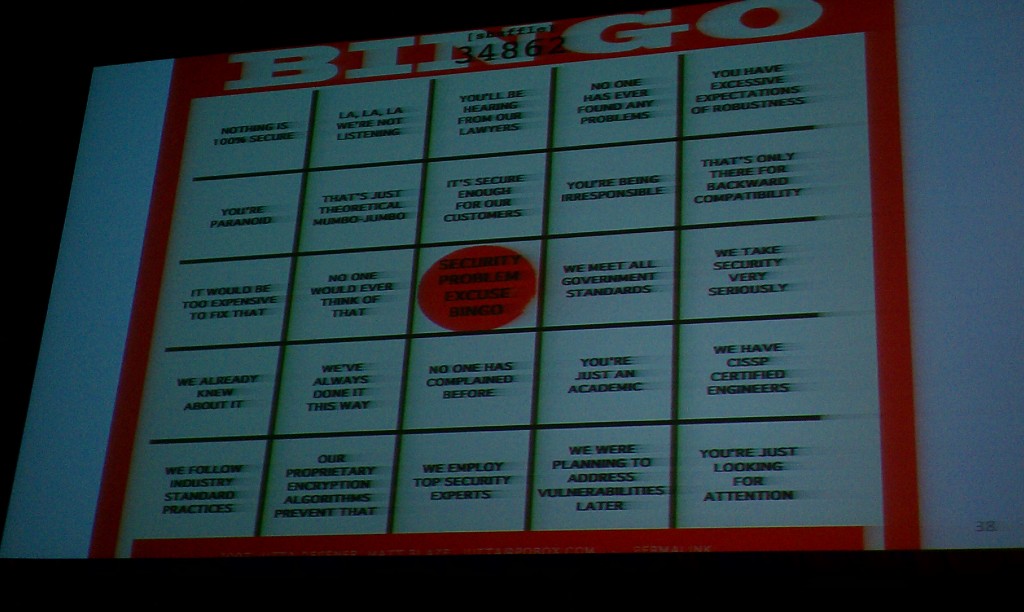
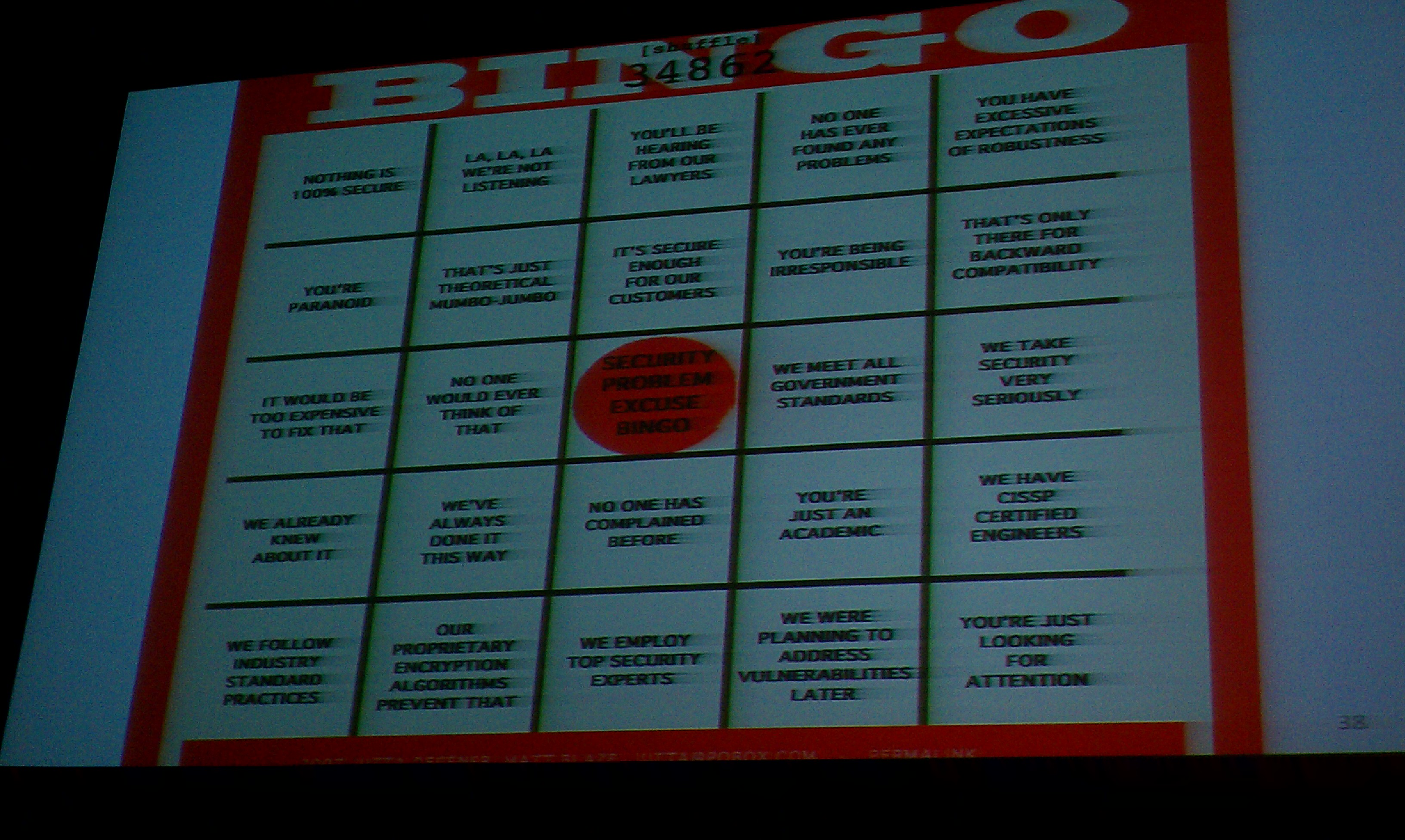
The Matt Blaze Security Bingo Card. (I hope folks can read it: I took that with a cell phone camera from the front row, so I didn’t have a great angle on it.)

And:
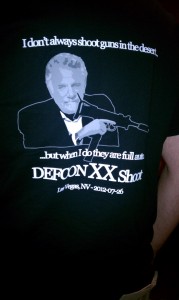
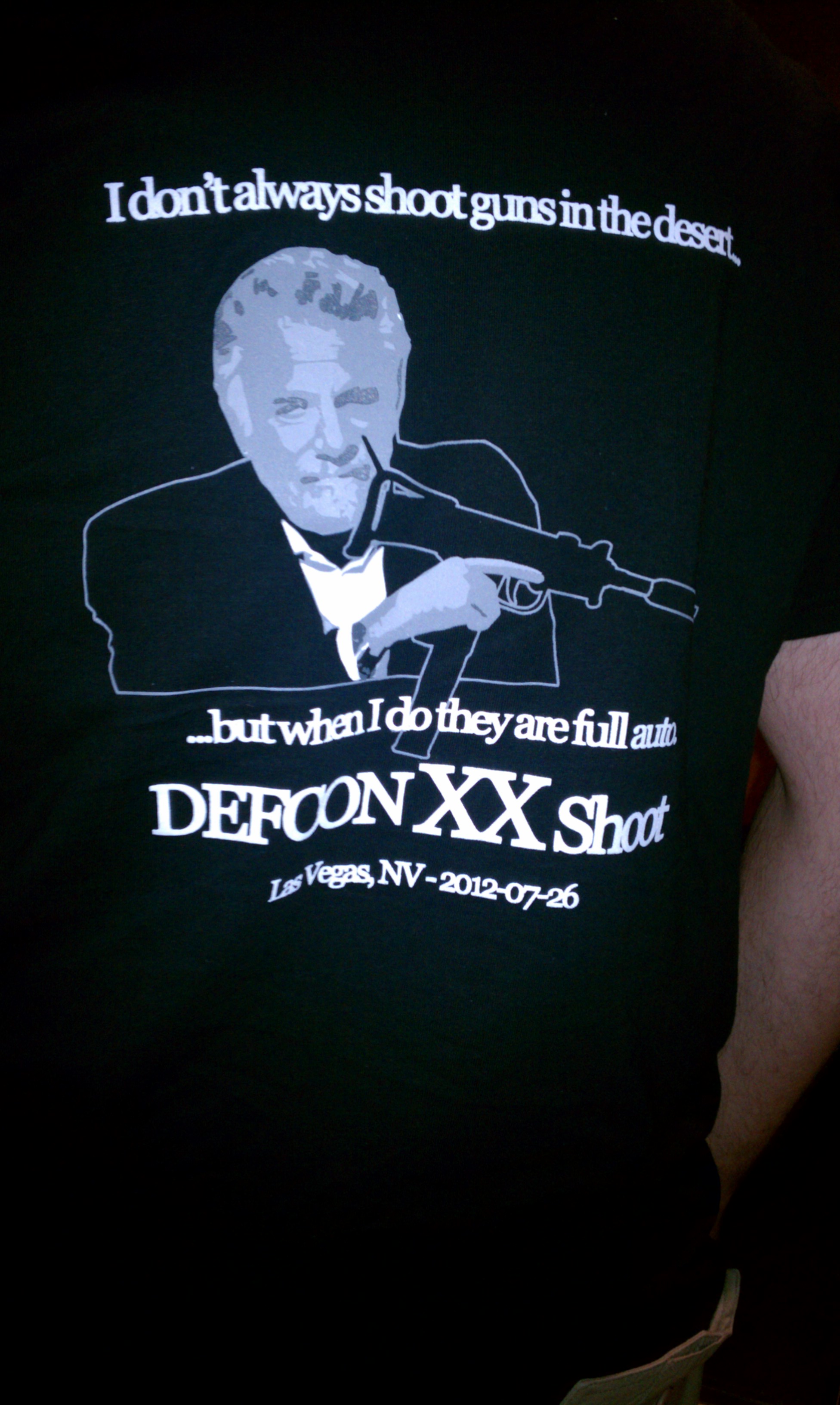
A gentleman in the hallway was kind enough to let me take a photo of his DEFCON Shoot shirt.

Speaking of Matt Blaze…

“SIGINT and Traffic Analysis for the Rest of Us” presented by Matt Blaze and Sandy Clark, and crediting a host of other folks.

For the past few years, Blaze and company have been working on APCO Project 25, or P25 for short. P25 is planned to be the next generation of public safety radio, and is intended to be a “drop-in” replacement for analog FM systems. Cryptographic security is built into P25: it uses symmetric algorithms and supports standard cryptographic protocols. All of this sounds great.

But there are a whole bunch of problems with this.

Encryption in P25 doesn’t work very well a significant portion of the time. There are user interface issues; on some radios, the “crypto” switch is in an obscure location, and the display doesn’t make it clear if encryption is on or off. Keys can’t be changed in the field; changing keys requires loading the radio in advance using a special device, or sending keys over the air (“Over The Air Rekeying”, or “OTAR”, which sometimes doesn’t work).

One important point is that the “sender” makes all the decisions: whether the traffic is encrypted, what encryption mode is used, what key is used, etc. The “receiver” doesn’t get to decide anything. If the “sender” sends in cleartext, either deliberately or by mistake, the “receiver” decodes it, automatically and transparently to the user. If the “sender” sends an encrypted message, the “receiver” first checks to make sure it has the proper key, then either decrypts the message or ignores it (if the “receiver” doesn’t have the key).

I feel like I am cheating a little here, but even Matt Blaze at this point in his talk recommended going and reading the group’s paper from last year, “Why (Special Agent) Johnny (Still) Can’t Encrypt: A Security Analysis of the APCO Project 25 Two-Way Radio System” for additional background.

But wait, there’s more! We have encryption, but do we have authentication? Do we know that the radios on our network are actually valid radios? Heck no! The radios transmit a “Unit ID” which is not authenticated, and which is never encrypted, even if the radio has encryption turned on. Just knowing the unit IDs lets you do some interesting stuff: you could, for example, set up two radios, do some direction finding on the received signals with the user IDs, and build a map of where the users are.

Even better: if you send a malformed OTAR request, the radios treat it like a UNIX “ping” and respond back with their Unit ID, even if they’re idle, and without the user ever knowing.

More: P25 uses aggressive error correction. But there’s a hole in the scheme; you can jam what’s called the “NID”, which is part of the P25 transmission, and render the transmissions unreadable. The Blaze group actually built a working jammer by flashing custom firmware onto the “GirlTech IM-Me”. (That was the cheapest way to get the TI radio chip they wanted to use.) You could use this to jam the NID in encrypted P25 traffic only, thus forcing cleartext on the users…

And even more: the basic problem with P25 and cryptographic security is usability. Every time an agency rekeys, someone is without keys for a period of time. Blaze mentioned the classic paper, ““Why Johnny Can’t Encrypt: A Usability Evaluation of PGP 5.0” and pointed out that many of the mistakes mentioned in that paper were repeated in designing P25.

How bad is the keying problem? Bad enough that agencies frequently transmit in cleartext, due to key management issues. (“NSA Rule Number 1: Look for cleartext.”) How frequently? Blaze and his group, for the past several years, have been running a monitoring network in several (unnamed) cites, recording cleartext P25 traffic and measuring how often this happens. About 20-30 minutes per day, by their estimate, of radio traffic is transmitted in unintended cleartext. And that traffic can contain sensitive information, like the names of informants.

Even if most of the traffic is encrypted, remember that the Unit IDs aren’t. So you’re getting some clear metadata traffic, which at the very least is useful for making inferences about what might be going on. (Zendian Problem, anyone?)

(If you’re monitoring P25 traffic, according to Blaze, the phrase you want to look for is “Okay, everyone, here’s the plan.”)

And what is the P25 community response to this? According to Blaze, the Feds have been very responsive and appreciate him pointing out the problem. The P25 standards people, on the other hand, claim Blaze is totally wrong, and that the problem is with the stupid users who can’t work crypto properly.

(This entry on Matt Blaze’s blog covers, as best I can tell, almost everything that was in his presentation. I haven’t found a copy of the actual presentation yet, but this should do to ride the river with.)

So it is getting late here, and I have to catch a plane early-ish in the morning. I think what I’m going to do is stop here for now, and try to get summaries of the three router panels up tomorrow while I’m waiting for my flight.
0-day DEFCON 20 notes.

Friday, July 27th, 2012

I got in line for my badge around 7:30 AM. Registration opened at 8 AM, according to the schedule.

I got my badge at 9:30 AM. I have no idea how many people were in line, but it was packed. We were told that folks started camping out for badges at 10:30 PM Wednesday night.

But, hey! I got mine!

After what was (in my opinion) last year’s badge fail, they went back to an electronic badge this year, still tied in to a “crypto-mystery” game, but at least the badge does something useful.

Or perhaps can do something useful, would be a better way of putting it. The designer calls it a “development platform”: there’s holes for I/O pins at the top, and we were issued VGA (1) and PS/2 connectors (2) with the badge to attach ourselves. And remember my inquiry a while back about microcontrollers? The badge CPU is a Parallax Propeller.

(I haven’t been able to get the badge and Project E talking yet. I suspect a bad or wrong USB cable.)

I hit two panels today. Worth noting is that today’s theme was “DEFCON 101”: there was only one programming track, and the theme of those items was more “introduction to” rather than “deep dive.”

DaKahuna’s “Wireless Security: Breaking Wireless Encryption Keys” wasn’t quite what I expected, in that he didn’t do a live demo. (Though he did suggest that there would be systems available for practice in the Wireless Village.) Rather, this was something of a “view from 10,000 feet” presentation, giving a basic introduction to hardware requirements and tools for attacking wireless keys, along with explanations of how WEP and WPA keys work, and where the vulnerabilities are. A lot of this stuff I already knew from my academic studies, but then again, I wasn’t the target audience here, and I did pick up a few tips.

The presenters for “Intro to Digital Forensics: Tools and Tactics” sold me in the first five minutes by pointing out that:

  • Not everyone knows everything.
  • It would behoove the community to stop acting like dicks when people ask reasonable questions, like “What switches should I use for NMap?”.

The presenters then proceeded to give example usages for what they considered to be the top five tools for testing and exploration:

  • The Metasploit framework, which they sadly ran out of time while discussing.
  • Ntop, the network traffic analyzer.
  • Nmap, for doing port scans and OS fingerprinting. For example:
    #nmap -v -sT -F -A -oG 10.x.x.x/24
    What does this mean?
    -v turns on verbose mode
    -sT forces NMap to do a full TCP connection to each host
    -F enables fast scan mode
    -A tells NMap to do OS fingerprinting
    -oG tells NMap to output in a format grep can work with,
    10.x.x.x/24 tells NMap the range of hosts to scan.
  • tcpdump, which captures packets on a given network interface.
    tcpdump -i eth1 -n -x
    -i specifies the interface
    -n turns off /etc/services translation, so instead of displaying the service name (ftp, telnet, etc.) it just shows the port number.
    -x dumps hex output to the screen
  • Netcat, which creates TCP sockets that can be used for communications between systems. But that’s a little misleading. Let’s say we have two systems, our localhost and a machine at 192.168.1.128. On the .128 machine, we run:
    nc -l -p 2800 -e cmd.exe
    -l tells netcat to listen for a connection
    -p tells netcat to listen for that connection on port 2800
    -e tells netcat to run a command when a connection is made on that port: in this case, netcat will run cmd.exe.
    On the local system:
    nc 192.168.1.128 2800 connect
    which establishes a connection between our system and the remote system. The remote system will run cmd.exe, which (on a Windows system) should give us a command shell on the remote system that we can use from our localhost.

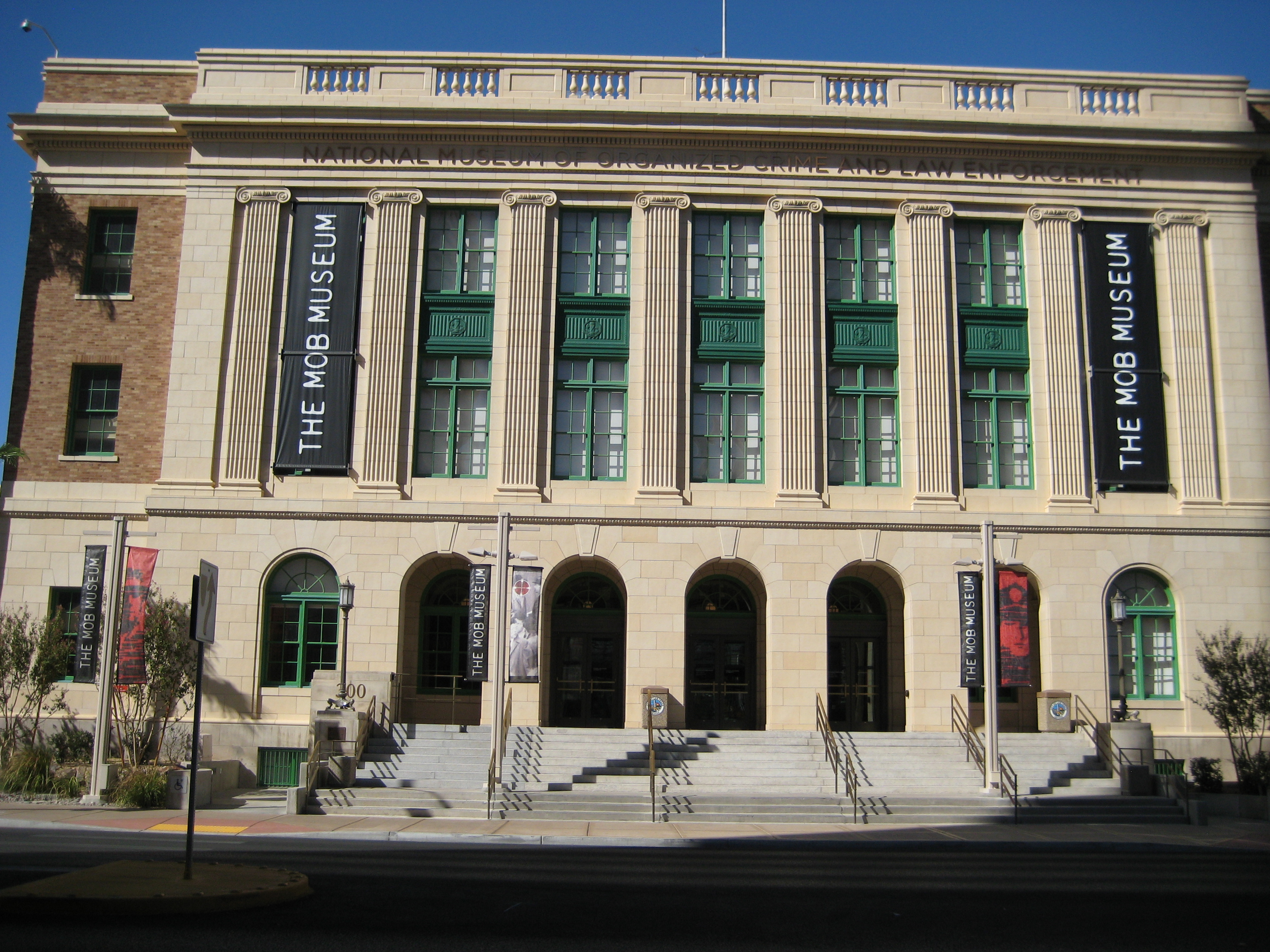
I took the rest of the day off to visit a couple of bookstores (both are still there, pretty much unchanged) and the Mob Museum.

My first thought was that $18 seems a bit stiff. Then again, the Atomic Testing Museum is $14, And the Mob Museum seems to have more people on staff, and may possibly be a little larger than the ATM. (I can’t tell for sure, but the Mob Musuem bascially has that entire building: all three floors.) ($5 for parking cheesed me off a bit, though.)

Anyway, while the Atomic Testing Museum is still my favorite Vegas musuem, the Mob Museum is well worth visiting, especially if you have an interest in organized crime in the United States. (Not just in Vegas, though that is a key focus; the museum also talks about organized crime in other areas, including NYC and Cleveland.) There is a lot of emphasis on Estes Kefauver, perhaps just a little more than I thought was warranted.(I admit, I chuckled at the “Oscar Goodman” display.)

Two things that surprised me:

  1. The number of families with small children at the Mob Museum. Parents, would you take your kids to a museum devoted to organized crime? (There’s some pretty graphic stuff, but the Museum confines it all to one section, warns you before you enter the section, and gives you an option to skip past it.) (And I feel kind of hypocritical saying this: if my parents had taken me to the Mob Museum when I was, say, 10, wild horses couldn’t have dragged me out of there.)
  2. The popularity among small children of the firearms simulator. Kids were having a lot of fun pretending to be cops, running through various scenarios (like a domestic dispute) and busting caps in bad guys. (I didn’t tell any of the kids that, had they actually been out on the street, they’d be dead before they got their first shot off. Do I look like an asshole?)

Tomorrow is when things start for real. Look for an update, but probably late in the evening.

(Oh, I did want to mention Chad Everett’s death yesterday, but I was using the Kindle to blog, which was a pain, and things got kind of sideways leaving LAX and arriving in Vegas, so consider this your obit watch.)

Random notes: July 24, 2012.

Tuesday, July 24th, 2012

Obit watch: Sally Ride.

Previously noted, but bears repeating: The Lustgarten Foundation for pancreatic cancer research.

Noted without comment. (See also.) (See also.) (See also.)

Faced with a crippling combination of low revenues, high labor costs and decreasing funding from the state, El Monte is moving to declare a fiscal emergency and seek a tax on sugary beverages sold within the city.

More:

El Monte officials said they are not at the edge of bankruptcy but need the sugary drinks tax revenue as a protection against insolvency down the road.

I’m fascinated by the events in Anaheim, but I don’t know what to make of them right now. (More here.)

We can’t make doughnut jokes any more.

Thursday, July 19th, 2012

But we can make burrito jokes. TJIC, call your office, please.

One of the surest places to find a police officer in downtown Brooklyn, other than the 84th Precinct station house, is the Chipotle Mexican Grill restaurant on Montague Street.

The popularity of this Chipolte among the NYPD might – just might – have something to do with the 50% discount they give to uniformed officers. Of course, accepting this discount violates NYPD policy, or so the department says. However, offering the discount does not violate Chipolte’s policy, according to a spokesman for the chain.

Sometimes, the questions are hard.

Thursday, July 19th, 2012

And sometimes there’s not an easy answer.

What is justice?

What is redemption? How do we decide when a person is redeemed? Are there crimes that are beyond redemption?

What is the purpose of prison? What should our goals be when we lock people up? Protection of society? Punishment? Reform?

How should we treat young people who commit horrible crimes? Do we lock them away for life? Do we give them a chance to reform? What if we’re wrong, and reform doesn’t take?

Greg Ousley is serving a 60 year sentence in the Indiana prison system. He’s been there since 1994. In that time, he’s earned a degree in liberal arts from Indiana State (summa cum laude, no less). The corrections staff at his prison apparently thinks the world of Mr. Ousley.

His former work supervisor, Cindy Estes, was more explicit. “This kid has jumped through every hoop the state has put in front of him,” she told me. “He deserves to come out. There’s absolutely nothing to be gained by keeping him in there for another 10 years.”

He’ll be eligible for parole in March of 2019, unless a judge agrees to modify his sentence.

What did Mr. Ousley do? At the age of 14, he shotgunned his parents to death.

I don’t know what to do with Mr. Ousley. I don’t claim to know whether he’s reformed enough that he deserves to be let out. I don’t have answers to those questions. The only thing I have is the knowledge that I’m glad I don’t work in the justice system, because I don’t have those answers.

Banana republicans watch: July 18, 2012.

Wednesday, July 18th, 2012

Joe Wolfe has either resigned or been fired from the Fullerton, CA police department. Former Officer Wolfe was involved in the (warning!) Kelly Thomas beating death (as always, graphic image warning at that link), but has not yet been charged with a crime.

Add Compton to the bankruptcy watch. With a $42 million deficit, I doubt even a tax on rap groups with platinum records will help.

…the city has consistently fallen behind on payments to vendors, including its sheriff’s contract.

Remember when Compton was talking about reopening the Compton PD and spent $1 million on “equipment” before giving up? Good times, good times.

More recently, the city’s independent audit firm refused to sign off on the annual financial statements and quit, after Mayor Eric Perrodin wrote a letter to the state controller’s office alleging fraud might have contributed to the city’s financial issues and asking for an audit.

I’ve avoided blogging this next story because I felt like there was a limit to what my readers (many thanks to both of you) would put up with. Surprisingly to me, though, these banana republican updates have been among the most popular recent posts on my blog. You put up something thoughtful and original, and it gets ignored, but people seem to love California political corruption.

Anyway, there’s an ongoing case involving the Los Angeles Memorial Coliseum and accusations of bribes and kickbacks. The Coliseum is nearly broke, and USC is in talks to take it over.

A bunch of people have been indicted in the case. Former “general manager” Patrick Lynch has already pled to conflict of interest charges and agreed to repay $385,000 he got from a man named Tony Estrada.

Estrada is a former contractor with the Coliseum, and has been charged with “embezzlement and conspiracy”. Estrada is also a fugitive from justice.

Today’s LAT has an interview with the fugitive Mr. Estrada.

Tony Estrada, rocking the ski mask.

No joke. Mr. Estrada claims to be “somewhere in South America”; the interviews that make up the story were conducted by telephone and over Skype. (It is unclear to me how the LAT verified that the man in the mask was actually Estrada.)

And:

Estrada regards himself as a whistle-blower — and some Coliseum officials described him that way in the past — because he came forward to tell a government lawyer and an outside investigator about alleged kickbacks he paid to former stadium General Manager Patrick Lynch and about other purported misconduct by stadium employees. Those payments are the basis of the charges against Estrada, who said Lynch pressured him for money as a condition of keeping his janitorial contract.

This just in: our old friend Cudahy City Councilman Osvaldo Conde (of the bimbo and the badge) has agreed to plead guilty to extortion and bribery. Actually, make that former city councilman: Conde resigned yesterday.

Conde is the last of the three indicted city officials (the others being former Mayor David Silva and former code enforcement head Angel Perales) to take a plea in the case.

Banana republicans watch: July 17, 2012.

Tuesday, July 17th, 2012

Today’s tale is brought to you by the town of San Fernando, where voters are trying to recall three of the city council members.

Fiscal irresponsibility? Criminal acts? Election fraud? No. The oldest motivation in the world.

Councilman Mario Hernandez, who has already resigned (but is still up for recall), was carrying on an affair with Councilwoman Maribel de la Torre. For some reason, he decided back in November to announce this. At a council meeting. In public. With his wife sitting in the front row.

Since then, the relationship has deteriorated, to the point where police were called on June 28th; both parties have restraining orders against each other. Hernandez has asked the DA to drop the domestic violence charges against de la Torre: as you might know from watching “COPS”, or living in California, this decision isn’t up to the alleged victim, and the DAs office states they will pursue charges if the evidence warrants.

More:

If prosecutors refuse to dismiss the case, Hernandez has agreed to testify that police officers persuaded him to pursue the report and get a restraining order.

Former councilman Hernandez may want to be very careful about that. I believe California still has laws against perjury.

Anyway, that’s two down. Number three on the recall parade is the Mayor, Brenda Esqueda, who is accused of having an affair with a sergeant on the police force.

In a memo last year, a police commander claimed he was prevented from placing the sergeant on leave by Esqueda and Hernandez. She told reporters this week, “We might be elected officials, but we still are human beings.”

I’ll have to try the “still are human beings” excuse sometime and see how it works out.

Olympic watch: July 16, 2012.

Monday, July 16th, 2012

The LAT would like for you to know that the United States is not fielding teams in all the Olympic sports. Notable exceptions: soccer (the US team was eliminated), men’s field hockey, and team handball.

Interesting aspects:

  1. “Team handball” is apparently a thing.
  2. “…in 2006, the sport’s governing body was decertified by the USOC”.
  3. There is apparently such a thing as “professional handball”, at least in Germany.
  4. “…imagine LeBron [James] and [Derrick] Rose and others like him playing handball. It wouldn’t take long, with proper coaching and funding, to get those guys competing at a level needed to earn a trip to the Olympics.” Maybe, guy, but I’m not sure the skill set that makes you good at basketball translates to being Olympic level at handball, team or solo.
  5. The guy who currently runs USA Team Handball is David Gascon. Perhaps you know him better as LAPD Cmdr. David Gascon, former second-in-command of the department, and the guy who went on TV to announce O.J. was a fugitive. (I wanted to embed video, but I can’t find any on YouTube.)

The WP would like for you to consider what happens to athletes who don’t make the team. Do they defer their dreams until 2016? (Not if you’re a baseball or softball player; those sports ain’t coming back in 2016.) Do you go pro on the woman’s boxing circuit?

“Yeah, I won a gold medal. Big deal,” [Decathlete Bryan] Clay said. “I still have to pay rent, still have to change diapers, still have to mow the lawn. In the grand scheme of things, the gold medal is awesome, but to live a full life, you need a lot more.”

Before enlightenment: chop wood, carry water.

Banana republicans watch: July 16, 2012.

Monday, July 16th, 2012

Ah, San Bernardino. You may remember that the city filed for bankruptcy, and that city officials say the budget figures were falsified for 13 out of 16 years.

Yeah. Well.

Officials in San Bernardino, which announced last week that it intended to file for bankruptcy, had known for years that the city’s finances were becoming critical.

More:

“I told the council two years in a row that, if this continues, we’re going to be looking at bankruptcy. I got criticized for bringing up the word ‘bankruptcy.’ They called it scare tactics,” said former City Manager Charles McNeely, who resigned unexpectedly in May. “The politics of that place are just impossible to deal with.”

And the county sheriff is looking into “allegations of ‘possible criminal activity within departments of the San Bernardino city government”, just for the record.

The mimes are food for the bums underground…

Monday, July 16th, 2012

New York, New York!

Several of the city’s most troubled hospitals are partially or completely uninsured for malpractice, state records show, forgoing what is considered a standard safeguard across the country.

This list includes Wyckoff Heights Medical Center, about which we have written previously.

In 2009, Wyckoff Heights Medical Center, in Bushwick, had $50,000 in its malpractice fund; in 2010, the amount put aside to cover claims had dwindled to “0,” according to its financial statements. Yet the hospital listed professional liabilities of $37 million. Ramon Rodriguez, the chief executive, declined to comment.

On the other hand, are these hospitals better off without insurance?

“Malpractice insurance is a lawsuit magnet,” said a former hospital administrator who did not want to be named to avoid upsetting potential employers. Malpractice lawyers said that underinsured hospitals put them in a tricky position.
“There is some arm-twisting,” said Alan Fuchsberg, a personal injury lawyer in Manhattan, as plaintiffs are told that they will end up with nothing and push the hospitals into bankruptcy if they do not “just take the little bit” that is offered to them.

Today is the 100th anniversary of the murder of Herman Rosenthal. Mr. Rosenthal was a small time crook who ran several gambling dens, and was allegedly paying off politicians and cops. One of the cops he was alleged to be bribing was Lieutenant Charles Becker of the vice squad; Lt. Becker raided Rosenthal’s establishment anyway, leading to a heated dispute between the two gentlemen.

This dispute ended with Mr. Rosenthal being shot outside a Manhattan hotel. Lt. Becker was tried, convicted, had his conviction overturned on appeal (due to alleged bias by the judge in the case), retried, convicted again, and finally executed. Lt. Becker is one of a very few police officers to face the death penalty for crimes committed while a police officer. (Incidentally, I still have not found an execution date for Antoinette Frank.)

The NYT has a retrospective article summarizing the case, and suggesting that Lt. Becker may have been innocent of ordering the Rosenthal murder. (There does not seem to be any question that Lt. Becker was a crooked cop; the main question is, did he order the murder, or were the killers acting independently?)

Historical note: one of the men who pinned the murder on Lt. Becker was Jack Rose. Yeah, that Jack Rose.

(Subject line hattip. Can I just mention that it is awesome that WikiQuote has an entire section of “Sam and Max: Freelance Police” quotes?)

Art, damn it, art! watch (#30 in a series).

Monday, July 16th, 2012

Jeremy Larner is the “business manager” for someone named Rob Dyrdek; as I understand it, Mr. Dyrdek is a skateboarder who has a show on MTV.

Point is, Mr. Larner is apparently fairly well-to-do, and describes himself as an “art geek”. Mr. Larner has several works by Shepard Fairey in his collection.

About 15 months ago, Mr. Larner won an auction for the right to sponsor a Fairey mural in the children’s wing at L.A. County-USC Medical Center, paying $30,000 for the privilege.

Mr. Larner is unhappy with the outcome and the way he was treated, and is suing for his money back.

I could snark on Mr. Fairey, or on the wisdom of paying $30,000 for his work, but it actually sounds like Mr. Larner has some legitimate gripes.

In a timeline in his lawsuit, Larner contended that he repeatedly reached out to the charity for updates on the mural but received no firm information for months. He said that after numerous queries to project manager Eli Consilvio, he received a prank phone call in November from a mutual friend and fellow art collector.

Part of Mr. Larner’s sponsorship included watching Mr. Fairey paint the mural. Unfortunately, Mr. Larner was “on vacation and unable to attend” when the mural was painted. It isn’t clear to me if this was a big deal to Mr. Larner. But:

As the months wore on, Larner grew frustrated that no dedication ceremony had occurred. [Project manager Eli] Consilvio said he told Larner that the administrative issues with the hospital were causing the delays and thought Larner understood. Larner filed a fraud and breach-of-contract suit in L.A. County Superior Court on June 25, detailing the delays and the prank call.

Crossing the streams.

Friday, July 13th, 2012

More banana republicans: the LAT today has a longer article about the allegations against Cudahy city officials. This is a doozy. Besides the election fraud I touched on yesterday:

Sex, drugs, bribes, and election fraud. This town was out of control.

[Edited to add: Secret decoder ring: “Silva” = former mayor David Silva. “Perales” = former code enforcement head Angel Perales. “G.P.” = an unnamed “former Cudahy official”. “Conde” = councilman Osvaldo Conde, of the bimbo and the badge.]

Random notes: July 13, 2012.

Friday, July 13th, 2012

The crawfish of Lake Tahoe.

No snark here: I think this story is awesome for several reasons.

  1. It is an example of the “defeat invasive species by eating them” strategy.
  2. I like crawfish.

Chuy’s is planning a stock offering. I like Chuy’s Mexican restaurants; they’re the most tolerable TexMex I’ve found in Austin so far, if you can deal with the crowd. But there is something I’m curious about:

Chuy’s was founded in 1982 by Mike Young and John Zapp with a single restaurant at 1728 Barton Springs Road in Austin. The company now operates 32 restaurants in seven states.

Are all the restaurants Chuy’s? A long time ago, the Chuy’s holding company ran the Romeo’s on Barton Springs, but they spun that off (and the restaurant closed several years later). I believe Chuy’s still runs the Hula Hut on Lake Austin, but I can’t find any proof of that. I’m thinking the Chuy’s holding company also runs a couple of other non-Chuy’s, but I can’t find a complete list of their holdings online.

Balko and Reason, among others, have been all over the painkiller issue. The government repeatedly and consistently has attempted to make criminals out of doctors who legitimately prescribe high doses of painkillers for patients suffering from intractable pain. Not just that; the government has stomped on the First Amendment by going after patient advocacy organizations, and has even threatened to shut down pharmacies for filling prescriptions.

As a Libertarian, I come down on the Balko/Reason side. Actually, I think if people want to take painkillers, they should be available OTC without a prescription; heck, let’s have the autonomous Glock/heroin/Oxycodone vending robots now!

But this s–t ain’t helping:

Though the X-ray for a German shepherd had the dog’s name, Recon, and the name of an animal hospital printed on it, the doctor wrote the deputy a prescription for a powerful narcotic painkiller and a muscle relaxant, law enforcement officials said.

On the other hand:

How in the frack did this man even have a license to practice?