Archive for the ‘Law’ Category

Toys, toys, toys.

Monday, August 13th, 2012

Did you know that the promo code SUCKITGROUPON will get you 45% off your Buckyballs order from getbuckyballs.com?

I didn’t, either, until I saw it on Overlawyered. I already got my first set of Buckyballs, but I just ordered some more: this time, I got some BuckyBigs, so I can pretend to be Captain Queeg while I’m sitting at my desk.

(Note that I have no financial relationship with the BuckyBalls people; I just want the CPSC to die in a fire.)

In other news, the Germans have shipped my USB TV receiver.

Obit watch: August 13, 2012.

Monday, August 13th, 2012

Gregory Powell, one of the two Onion Field killers, is dead.

Officer Ian Campbell was unavailable for comment.

Edited to add: Longer obit in the LAT. Karl Hettinger was also unavailable for comment. But Big Joe Wambaugh did have something to say.

More things I did not know.

Thursday, August 9th, 2012

Chain of causality: one of my cow-orkers was bitten by a dog (not seriously) which led to a discussion of The People’s Court (which, when I was watching it, seemed to be dominated by dog and dog-bite cases), which led to a discussion of Judge Marilyn Milan, which in turn led us inevitably to Wapner and Rusty the bailiff.

From the Wikipedia entry on The People’s Court:

Rusty Burrell (1925–2002) was a sheriff’s department court bailiff in several famous Los Angeles trials, the Manson murders, The Onion Field murder, the Patty Hearst/SLA bank robbery, and the Caryl Chessman “Red Light Bandit”. Burrell had previously appeared on TV in the 1950s Divorce Court, and it was also his job at that show to find real attorneys to appear on camera. One of those regular Divorce Court attorneys was Judge Joseph Wapner’s father.

Patty Hearst, Chessman, Manson and the Onion Field? Rusty must have had some great stories to tell.

August 8th updates.

Wednesday, August 8th, 2012

Longer Marvin Hamlisch: NYT, LAT.

Speaking of obits, noted astronomer and pioneer of radio telescopy, Sir Bernard Lovell, passed away on Monday.

There was an update to the Sheri Sangji story while I was on vacation that I wasn’t able to blog. Luckily, Derek Lowe was on the case. For those of you who don’t remember the story, Ms. Sangji was working with t-butyl lithium in a UCLA lab; the substance, which catches fire when exposed to air, spilled, Ms. Sangji was severely burned, and died 18 days later. The university and the primary researcher, Dr. Patrick Harran, faced felony charges.

While I was gone, the charges against the university were dropped. Apparently, UCLA made a deal with the prosecution. The charges against Dr. Harran still stand.

But then it gets weird. Dr. Harran’s defense team is trying to discredit the OSHA report on the accident, based on the accusation that the author of the report participated in a murder when he was 16 years old and failed to disclose this to his employers. I’m not sure at this point if it was actually established that the author of the report and the murderer were the same person, but the author resigned his position anyway.

This is intended to be a short update. The Derek Lowe blog entry linked above has a longer summary, including links to various other sources; I commend it to your attention.

Banana republicans watch: August 7, 2012, special “blood in the streets” edition

Tuesday, August 7th, 2012

The “Blue Line” runs from Long Beach to downtown Los Angeles. That’s about 22 miles. (The Houston METRORail is 7.5 miles long, just for comparison.)

With 22 accidents and six fatalities so far this year, officials say the Blue Line — one of the busiest light rails in the nation — is on pace to have more deaths in 2012 than any other year in its 22-year history — a considerable feat given the line’s checkered safety record of striking passing cars or pedestrians, or as a place where some go to commit suicide. Four of the fatalities this year were ruled suicides.

It would be nice to know what the accidents per mile traveled figure is, and how that compares to other systems. There’s no miles traveled figure in the LAT article. And finding information on METRORail crashes is nearly impossible these days; the transit authority doesn’t release that information, and the Houston-area bloggers who were maintaining counts have all moved on to other things.

In other news, the California city of Fullerton is considering shutting down the Fullerton PD and contracting out police services to the Orange County Sheriff’s Department. You may remember the Fullerton PD from the beating death of Kelly Thomas (graphic image at that link):

Two officers have been charged in his death, the police chief has left, three officers quit the force in the face of termination proceedings and three of the five council members were recalled in a June election.

But folks say it isn’t about Kelly Thomas, it is about the money:

Fullerton Councilman Bruce Whitaker, a sharp critic of how the police handled the violent encounter with Thomas, said that although the department needs to be examined, the driving force behind potentially contracting out police services is the $37 million required to operate the 144-officer department.

Another reason not to use Facebook.

Friday, August 3rd, 2012

Alberto Gutierrez was married to Mayela Gutierrez Gil. The relationship was somewhat rocky, and Mr. and Mrs. Gutierrez decided to divorce.

The divorce itself was somewhat unpleasant. Mr. Gutierrez was charged with “making criminal threats, stalking and two counts of disobeying a domestic relations court order”. The stalking charge was dismissed by a judge, who also threw out one of the two counts of disobeying a court order. Mr. Gutierrez was acquitted by a jury on the other counts.

So what? Well, it seems that Mrs. Gutierrez was romantically involved with Detective Phillip Solano of the Los Angeles County Sheriff’s Department.

…during Gutierrez’s criminal trial, information surfaced that the man’s wife, Mayela Gutierrez Gil, and the detective were Facebook friends who had exchanged messages and calls. “How are you precious? I miss you a lot,” read one from the detective, according to Gutierrez’s attorney, Arnoldo Casillas.

Mr. Gutierrez sued LACSO, detective Solano, and another LACSO deputy, Russell Verduzco. Verduzco was accused of “conspiring with Solano to cover up evidence that showed Gutierrez’s wife was in fact the one making threats against him.”

The jury awarded Mr. Gutierrez $457,500.

Sheriff’s Department spokesman Steve Whitmore said Solano will now face an internal affairs investigation. Although, he said, sheriff’s officials “believe we have very strong grounds for an appeal, so that’s going to be carefully considered.”

Random roundup, August 3, 2012.

Friday, August 3rd, 2012

We’ve got wrongful convictions, we’ve got banana republicans, and we’ve got pizza. Something for everyone: a comedy tonight. (Dammit, I miss Zero Mostel.)

In 2004, Omar Bradley, then mayor of Compton, was convicted of misappropriation of public funds. Also convicted with Mr. Bradley were Amen Rahh, a former council member, and John D. Johnson II, the former city manager.

Prosecutors said the men had used their city-issued credit cards for personal items and “double dipped” by taking cash advances for city business expenses and then charging the items to their city credit cards. Bradley was accused of misusing about $7,500 for purchases that included golf balls and shoes, cigars, a three-day stay in a penthouse hotel room and in-room movies.

Bradley’s conviction was on a felony charge: he served three years, could not hold public office, and lost his teaching credentials.

However, in another case last year, the California Supreme Court held:

…that officials must know or be “criminally negligent” for not knowing that they are doing something illegal in order to be guilty of misappropriation of funds.

The punchline?

Based on that case, the appeals court reversed its previous decision in Bradley’s case and overturned his conviction Wednesday.

(Rahh’s and Johnson’s convictions were not overturned.)

I’ve previously alluded to the police shootings in Anaheim, and observed that I don’t have a clear grasp of what’s going on. The NYT ran this story while I was on vacation, which I think gives a decent overview, and follows-up today with this story, which is more about the political and cultural divisions in Anaheim. (Note the correction at the bottom.)

As long as we’re on the NYT site, there’s another interesting story to talk about. Baithe Diop was a cab driver who was killed in 1995. Five men were convicted of his murder as part of  “an elaborate plot to distract the police from the intended crime: the theft of $50,000 worth of cocaine from a passenger in Mr. Diop’s car”.

But now, 15 years after the criminal trials, federal authorities have concluded that all five of those now imprisoned for the murder were innocent of the crime.

More:

The new findings suggest that there was a colossal breakdown in the criminal justice system. Robert T. Johnson, the Bronx district attorney since 1989, said through a spokesman on Thursday that his office had been notified of the new evidence discovered by federal prosecutors but had not yet been able “to resolve all of the questions that have been raised by this evidence.”

It now appears that the murder was actually committed by members of the “Sex Money Murder” gang.

So. Pizza. Mangia Pizza. As we have previously noted, Mangia went into Chapter 11 bankruptcy in 2010. Mangia’s founder has proposed a plan to get them out of Chapter 11. However, another creditor has proposed a counter plan. The founder’s plan would (in theory) pay back unsecured creditors 100% of what they’re owed over the next ten years; the competing plan would give that creditor control of the company, and pay back the unsecured creditors 22 cents on the dollar. The founders have since modified their plan so that the unsecured creditors will get 22 cents on the dollar immediately,”with assurances to pay the remainder of the amount owed in coming years”.

(If I was a creditor, given the situation, I wouldn’t count on getting 100% of my money back in ten years, or ever. I’d take my 22 cents on the dollar and consider anything after that found money.)

What makes this even more interesting is that the competing creditor, “Cloud Cap LLC,  a subsidiary of Austin-based management and investment firm Pileus Group LLC” became a creditor by buying a claim from a place called Knife Sharpist, which (duh) sells knives and does knife sharpening. (I’ve been there a couple of times. They do good work.) The total amount of Knife Sharpist’s claim was $244.66.

Cloud Cap’s plan calls for changes to Mangia’s menu, a revamp of the restaurant’s décor and additional locations.

(For Austin residents who might be confused, the Mangia at Gracy Farms (which the Statesman constantly calls The Domain: it isn’t) and the one on Lake Austin are owned by another company and aren’t involved in the Chapter 11 proceeding. The Chapter 11 proceedings only involve the location on Mesa and the one at the airport. But it does make me wonder: if Cloud Cap takes control, will they force those two locations to change the name?)

[Michelle] Musick [Mangia’s bookeeper] said Mangia’s management has already taken steps to get the company back on stable footing, including closing stores in Round Rock and on Guadalupe Street near the University of Texas campus.
“The Guadalupe store was actually breaking even, but the rent was so astronomically high,” she said. “The Round Rock store was bleeding money.”

Mangia, according to the article, owes “more than $750,000”. (How much more?)

Records show that the Internal Revenue Service is owed the most, about $190,000. Other creditors include the state comptroller’s office, Travis County and the Round Rock school district, as well as several businesses.

Banana republicans watch: August 2, 2012.

Thursday, August 2nd, 2012

Randy Adams wants severance pay.

That’s Randy Adams, former police chief for the city of Bell.

That’s Randy Adams, former police chief for the city of Bell, who was making $457,000 a year and cut a deal with the city of Bell to approve his disability pension at the same time the city was hiring him.

While I was on vacation, another story broke that I didn’t have time to cover. Last year, the state of California announced that they couldn’t keep all the parks in the park system open. Citizens and municipalities in California responded by donating money and coordinating fund raising events.

It turns out that the park system actually had $54 million stashed in various accounts. And folks are peeved.

In Ventura County, supervisors Tuesday sent a letter to state officials demanding the immediate return of $50,000 earmarked to repair a crucial sewer line at McGrath State Beach near Oxnard. Last year, the state said the popular beach would close because it lacked $500,000 for the fix. Officials even urged McGrath fans to vote early and often in a Coca-Cola contest that would award $100,000 to America’s “favorite” park.

Pity the poor Stockton PD. (Well, and the Stockton Fire Department, too.)

Stockton police officers and firefighters said they haven’t been able to fill the gas tanks of their emergency vehicles because the pumps at their stations are empty.

Since the city has filed for bankruptcy, the company that was providing gas has terminated the contract.

By the way, former Stockton Police Chief Tom Morris, who served as the chief for eight months and retired at 52, is getting an annual pension from the city of $204,000.

(Hattip for that last link to Instapundit.)

Yes, we have more bananas.

Wednesday, August 1st, 2012

The House Ethics Committee has recommended that Rep. Laura Richardson (D-Long Beach) be reprimanded for pressuring her congressional staff to work on her political campaign, dealing a severe blow to her reelection bid.

In a scathing report issued Wednesday, the ethics panel’s investigative subcommittee found Richardson improperly used House resources for campaign and personal purposes, compelled congressional staff to work on her campaign and obstructed the committee investigation “through the alteration or destruction of evidence” and “the deliberate failure to produce documents.”

Obstruction? “deliberate failure to produce documents”? “…callous disregard for her staff and the resources entrusted to her by the American people”? And she gets a reprimand?

You’re doing it WRONG!

Wednesday, August 1st, 2012

A suspect in a Smart Car led authorities on a high-speed chase from west Houston to northwest Houston Wednesday afternoon.

(Video of the “high-speed chase” at the link.)

Banana republicans watch: August 1, 2012.

Wednesday, August 1st, 2012

Tyrone Freeman used to be the president of Local 6434 of the Service Employees Industrial Union (SEIU).

Then things started happening. The LAT did a series of reports on Freeman’s spending as head of the local. The federal Department of Labor, the FBI, and the IRS started investigating.

Last month, his wife, Pilar Planells, pleaded guilty to an income tax charge in connection with more than $540,000 she received in consulting payments from the union. She is expected to be sentenced to three years’ probation and must pay about $130,000 in back taxes, interest and penalties, according to court records.

And now Freeman has been indicted on 15 counts:

Freeman was indicted on federal charges of stealing from those workers to enrich himself — even billing the union for costs from his Hawaiian wedding. The 15-count indictment, which also contains allegations that he violated tax laws and gave false information to a mortgage lender, carries combined maximum prison sentences of more than 200 years.

Oddly enough, I see no mention of strippers. Freeman was apparently big on cigars and cognac.

Still pending in state court is a civil lawsuit the union filed against Freeman and Planells over more than $1.1 million they allegedly pilfered. The suit contends that the money financed Freeman’s lifestyle of $175 glasses of cognac, $250 bottles of wine and a $3,400 trip to the NFL Pro Bowl.

Yeah, Hawaii is nice and all. But, dude, the Pro Bowl? Seriously?

Banana republicans watch: July 31, 2012.

Tuesday, July 31st, 2012

I apologize: things were so hectic while I was away that I kind of let the banana republicans slip. I don’t think there was much that went on while I was in Las Vegas, anyway. But now that I’m back…

…this LAT story is kind of confusingly written, but it looks like Angel Perales of Cudahy, the “former head of code enforcement”, has pled guilty. Osvaldo “Bimbo and the Badge” Conde and former mayor David Silva are pleading Thursday.

Perales could receive a maximum sentence of 30 years in prison and a $500,000 fine.

And Louis Byrd and Fernando Pedroza, former council members in the city of Lynwood…

…were found guilty of misappropriating public funds following a month-long trial in which prosecutors used a novel legal argument that the officials broke the law by accepting tens of thousands of dollars in stipends for sitting on city commissions that appeared to do little, if any, work.

According to the LAT, this was the first test of this argument, but the LA County DAs office is expected to use this same approach against the city officials in Bell. Also:

In addition to taking aim at the salaries, prosecutors argued that the former council members also abused their position by charging inappropriate bills to the city. Among the most salacious charges: a $1,500 night out at a Guadalajara strip club, where dancers allegedly performed sexual favors for Pedroza and the then-city manager.

Strippers. Always with the strippers.

Hold me closer, tiny dancer. Count the headlights on the highway…

Tuesday, July 31st, 2012

Police say an officer had to swerve to avoid a woman who was dancing in the middle of the road overnight.

DEFCON 20 notes: day 3, part 1.

Monday, July 30th, 2012

The secret word for the day, boys and girls, is “routers”.

But first, a couple of pictures for my great and good friend Borepatch:
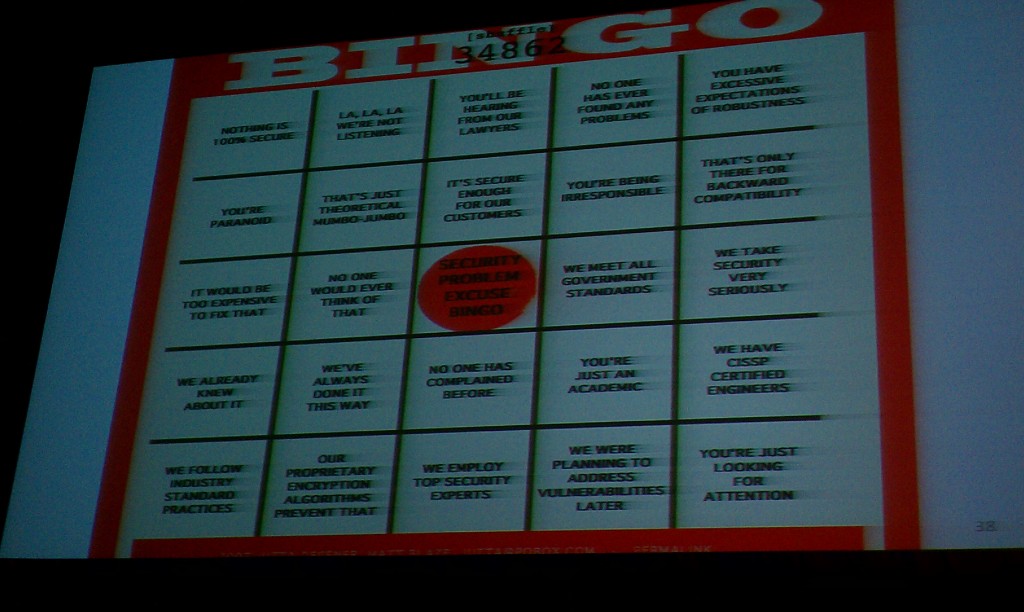
The Matt Blaze Security Bingo Card. (I hope folks can read it: I took that with a cell phone camera from the front row, so I didn’t have a great angle on it.)

And:

A gentleman in the hallway was kind enough to let me take a photo of his DEFCON Shoot shirt.

Speaking of Matt Blaze…

“SIGINT and Traffic Analysis for the Rest of Us” presented by Matt Blaze and Sandy Clark, and crediting a host of other folks.

For the past few years, Blaze and company have been working on APCO Project 25, or P25 for short. P25 is planned to be the next generation of public safety radio, and is intended to be a “drop-in” replacement for analog FM systems. Cryptographic security is built into P25: it uses symmetric algorithms and supports standard cryptographic protocols. All of this sounds great.

But there are a whole bunch of problems with this.

Encryption in P25 doesn’t work very well a significant portion of the time. There are user interface issues; on some radios, the “crypto” switch is in an obscure location, and the display doesn’t make it clear if encryption is on or off. Keys can’t be changed in the field; changing keys requires loading the radio in advance using a special device, or sending keys over the air (“Over The Air Rekeying”, or “OTAR”, which sometimes doesn’t work).

One important point is that the “sender” makes all the decisions: whether the traffic is encrypted, what encryption mode is used, what key is used, etc. The “receiver” doesn’t get to decide anything. If the “sender” sends in cleartext, either deliberately or by mistake, the “receiver” decodes it, automatically and transparently to the user. If the “sender” sends an encrypted message, the “receiver” first checks to make sure it has the proper key, then either decrypts the message or ignores it (if the “receiver” doesn’t have the key).

I feel like I am cheating a little here, but even Matt Blaze at this point in his talk recommended going and reading the group’s paper from last year, “Why (Special Agent) Johnny (Still) Can’t Encrypt: A Security Analysis of the APCO Project 25 Two-Way Radio System” for additional background.

But wait, there’s more! We have encryption, but do we have authentication? Do we know that the radios on our network are actually valid radios? Heck no! The radios transmit a “Unit ID” which is not authenticated, and which is never encrypted, even if the radio has encryption turned on. Just knowing the unit IDs lets you do some interesting stuff: you could, for example, set up two radios, do some direction finding on the received signals with the user IDs, and build a map of where the users are.

Even better: if you send a malformed OTAR request, the radios treat it like a UNIX “ping” and respond back with their Unit ID, even if they’re idle, and without the user ever knowing.

More: P25 uses aggressive error correction. But there’s a hole in the scheme; you can jam what’s called the “NID”, which is part of the P25 transmission, and render the transmissions unreadable. The Blaze group actually built a working jammer by flashing custom firmware onto the “GirlTech IM-Me”. (That was the cheapest way to get the TI radio chip they wanted to use.) You could use this to jam the NID in encrypted P25 traffic only, thus forcing cleartext on the users…

And even more: the basic problem with P25 and cryptographic security is usability. Every time an agency rekeys, someone is without keys for a period of time. Blaze mentioned the classic paper, ““Why Johnny Can’t Encrypt: A Usability Evaluation of PGP 5.0” and pointed out that many of the mistakes mentioned in that paper were repeated in designing P25.

How bad is the keying problem? Bad enough that agencies frequently transmit in cleartext, due to key management issues. (“NSA Rule Number 1: Look for cleartext.”) How frequently? Blaze and his group, for the past several years, have been running a monitoring network in several (unnamed) cites, recording cleartext P25 traffic and measuring how often this happens. About 20-30 minutes per day, by their estimate, of radio traffic is transmitted in unintended cleartext. And that traffic can contain sensitive information, like the names of informants.

Even if most of the traffic is encrypted, remember that the Unit IDs aren’t. So you’re getting some clear metadata traffic, which at the very least is useful for making inferences about what might be going on. (Zendian Problem, anyone?)

(If you’re monitoring P25 traffic, according to Blaze, the phrase you want to look for is “Okay, everyone, here’s the plan.”)

And what is the P25 community response to this? According to Blaze, the Feds have been very responsive and appreciate him pointing out the problem. The P25 standards people, on the other hand, claim Blaze is totally wrong, and that the problem is with the stupid users who can’t work crypto properly.

(This entry on Matt Blaze’s blog covers, as best I can tell, almost everything that was in his presentation. I haven’t found a copy of the actual presentation yet, but this should do to ride the river with.)

So it is getting late here, and I have to catch a plane early-ish in the morning. I think what I’m going to do is stop here for now, and try to get summaries of the three router panels up tomorrow while I’m waiting for my flight.

0-day DEFCON 20 notes.

Friday, July 27th, 2012

I got in line for my badge around 7:30 AM. Registration opened at 8 AM, according to the schedule.

I got my badge at 9:30 AM. I have no idea how many people were in line, but it was packed. We were told that folks started camping out for badges at 10:30 PM Wednesday night.

But, hey! I got mine!

After what was (in my opinion) last year’s badge fail, they went back to an electronic badge this year, still tied in to a “crypto-mystery” game, but at least the badge does something useful.

Or perhaps can do something useful, would be a better way of putting it. The designer calls it a “development platform”: there’s holes for I/O pins at the top, and we were issued VGA (1) and PS/2 connectors (2) with the badge to attach ourselves. And remember my inquiry a while back about microcontrollers? The badge CPU is a Parallax Propeller.

(I haven’t been able to get the badge and Project E talking yet. I suspect a bad or wrong USB cable.)

I hit two panels today. Worth noting is that today’s theme was “DEFCON 101”: there was only one programming track, and the theme of those items was more “introduction to” rather than “deep dive.”

DaKahuna’s “Wireless Security: Breaking Wireless Encryption Keys” wasn’t quite what I expected, in that he didn’t do a live demo. (Though he did suggest that there would be systems available for practice in the Wireless Village.) Rather, this was something of a “view from 10,000 feet” presentation, giving a basic introduction to hardware requirements and tools for attacking wireless keys, along with explanations of how WEP and WPA keys work, and where the vulnerabilities are. A lot of this stuff I already knew from my academic studies, but then again, I wasn’t the target audience here, and I did pick up a few tips.

The presenters for “Intro to Digital Forensics: Tools and Tactics” sold me in the first five minutes by pointing out that:

  • Not everyone knows everything.
  • It would behoove the community to stop acting like dicks when people ask reasonable questions, like “What switches should I use for NMap?”.

The presenters then proceeded to give example usages for what they considered to be the top five tools for testing and exploration:

  • The Metasploit framework, which they sadly ran out of time while discussing.
  • Ntop, the network traffic analyzer.
  • Nmap, for doing port scans and OS fingerprinting. For example:
    #nmap -v -sT -F -A -oG 10.x.x.x/24
    What does this mean?
    -v turns on verbose mode
    -sT forces NMap to do a full TCP connection to each host
    -F enables fast scan mode
    -A tells NMap to do OS fingerprinting
    -oG tells NMap to output in a format grep can work with,
    10.x.x.x/24 tells NMap the range of hosts to scan.
  • tcpdump, which captures packets on a given network interface.
    tcpdump -i eth1 -n -x
    -i specifies the interface
    -n turns off /etc/services translation, so instead of displaying the service name (ftp, telnet, etc.) it just shows the port number.
    -x dumps hex output to the screen
  • Netcat, which creates TCP sockets that can be used for communications between systems. But that’s a little misleading. Let’s say we have two systems, our localhost and a machine at 192.168.1.128. On the .128 machine, we run:
    nc -l -p 2800 -e cmd.exe
    -l tells netcat to listen for a connection
    -p tells netcat to listen for that connection on port 2800
    -e tells netcat to run a command when a connection is made on that port: in this case, netcat will run cmd.exe.
    On the local system:
    nc 192.168.1.128 2800 connect
    which establishes a connection between our system and the remote system. The remote system will run cmd.exe, which (on a Windows system) should give us a command shell on the remote system that we can use from our localhost.

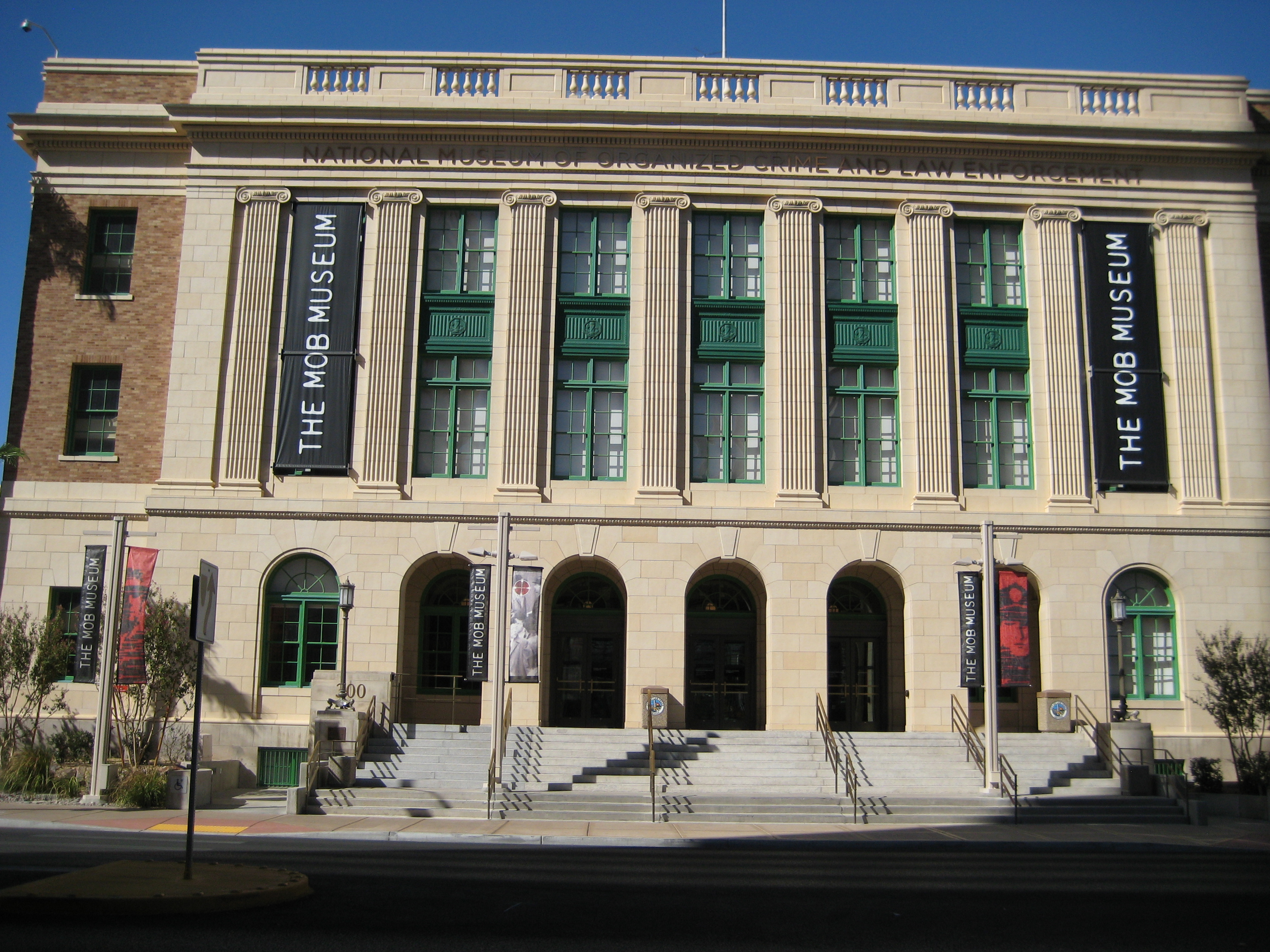
I took the rest of the day off to visit a couple of bookstores (both are still there, pretty much unchanged) and the Mob Museum.

My first thought was that $18 seems a bit stiff. Then again, the Atomic Testing Museum is $14, And the Mob Museum seems to have more people on staff, and may possibly be a little larger than the ATM. (I can’t tell for sure, but the Mob Musuem bascially has that entire building: all three floors.) ($5 for parking cheesed me off a bit, though.)

Anyway, while the Atomic Testing Museum is still my favorite Vegas musuem, the Mob Museum is well worth visiting, especially if you have an interest in organized crime in the United States. (Not just in Vegas, though that is a key focus; the museum also talks about organized crime in other areas, including NYC and Cleveland.) There is a lot of emphasis on Estes Kefauver, perhaps just a little more than I thought was warranted.(I admit, I chuckled at the “Oscar Goodman” display.)

Two things that surprised me:

  1. The number of families with small children at the Mob Museum. Parents, would you take your kids to a museum devoted to organized crime? (There’s some pretty graphic stuff, but the Museum confines it all to one section, warns you before you enter the section, and gives you an option to skip past it.) (And I feel kind of hypocritical saying this: if my parents had taken me to the Mob Museum when I was, say, 10, wild horses couldn’t have dragged me out of there.)
  2. The popularity among small children of the firearms simulator. Kids were having a lot of fun pretending to be cops, running through various scenarios (like a domestic dispute) and busting caps in bad guys. (I didn’t tell any of the kids that, had they actually been out on the street, they’d be dead before they got their first shot off. Do I look like an asshole?)

Tomorrow is when things start for real. Look for an update, but probably late in the evening.

(Oh, I did want to mention Chad Everett’s death yesterday, but I was using the Kindle to blog, which was a pain, and things got kind of sideways leaving LAX and arriving in Vegas, so consider this your obit watch.)