Archive for the ‘Law’ Category
I have no joke here. I just want to say…
Wednesday, June 26th, 2013Random notes: June 26, 2013.
Wednesday, June 26th, 2013Richard Matheson obits: NYT. Lawrence. LAT.
Please refrain from tasting the knob.
(Note that the musical in question, “Somewhere in Time” is based on the movie, which in turn was based on a novel, “Bid Time Return”, by Richard Matheson. I’m not linking to Amazon, but you should be able to find the novel easily: the cheaper editions are listed under “Somewhere in Time”, and the editions carrying the original title are pricy.)
You know what NYC needs? Strict pen control. And perhaps strict costume control, too.
More:

(Hotlinked: click on the photo to read the Daily News article.)
Random notes: June 25, 2013.
Tuesday, June 25th, 2013The NYT, LAT, and WP have not yet published obits for Richard Matheson. However, the A/V Club has a very nice tribute.
I feel kind of blocked when it comes to paying tribute to Mr. Matheson. The one thing I can say is: whenever I was trying to think of “who wrote this story?” – the box with the button, the family fleeing their home planet, the girl who falls into the fourth dimension – at least seven times out of every ten, the story I was trying to think of was written by Richard Matheson. It is impossible to overstate the depth of his influence on the genre.
In other news, I’m sure some of my readers remember the 2003 documentary Capturing the Friedmans about the child abuse convictions of Arnold and Jesse Friedman. Since the documentary was released, there’s been a lot of back and forth about the guilt or innocence of the Friedmans, leading up to an investigation by the Nassau County district attorney.
More, and I apologize for the length of this quote:
Additionally, the report points out that Jessie Friedman had “competent legal representation, weighed his options intelligently and pleaded guilty after determining it was ‘the optimal strategy’ in light of the available choices.”
About that: the investigation was overseen by a “four-member independent advisory panel” that included Barry Scheck of Innocence Project fame.
Another Ranger.
Thursday, June 20th, 2013This is the “front” side of the Armstrong family monument in Oakwood Cemetery.

This is the John B. Armstrong side:

Who was John B. Armstrong, other than a Texas Ranger? A serious badass, most famous for capturing John Wesley Hardin. Armstrong had been shot in the leg previously (according to his entry in the Handbook of Texas Online, it was a self-inflicted wound), and was using a cane:
(Some accounts say the bullet fired by Hardin’s man went through Armstrong’s favorite hat, seriously pissing him off, and that Armstrong’s blow knocked Hardin unconscious for two hours. These accounts are not well sourced, so I would take them with a grain of salt.)
Armstrong was also involved in the capture of Sam Bass, which is probably worthy of another post and some more photos next time I’m out near Round Rock.
Armstrong’s Texas Ranger Hall of Fame page. Armstrong on the “Badass of the Week” site (a little overwrought, but entertaining). Handbook of Texas online.
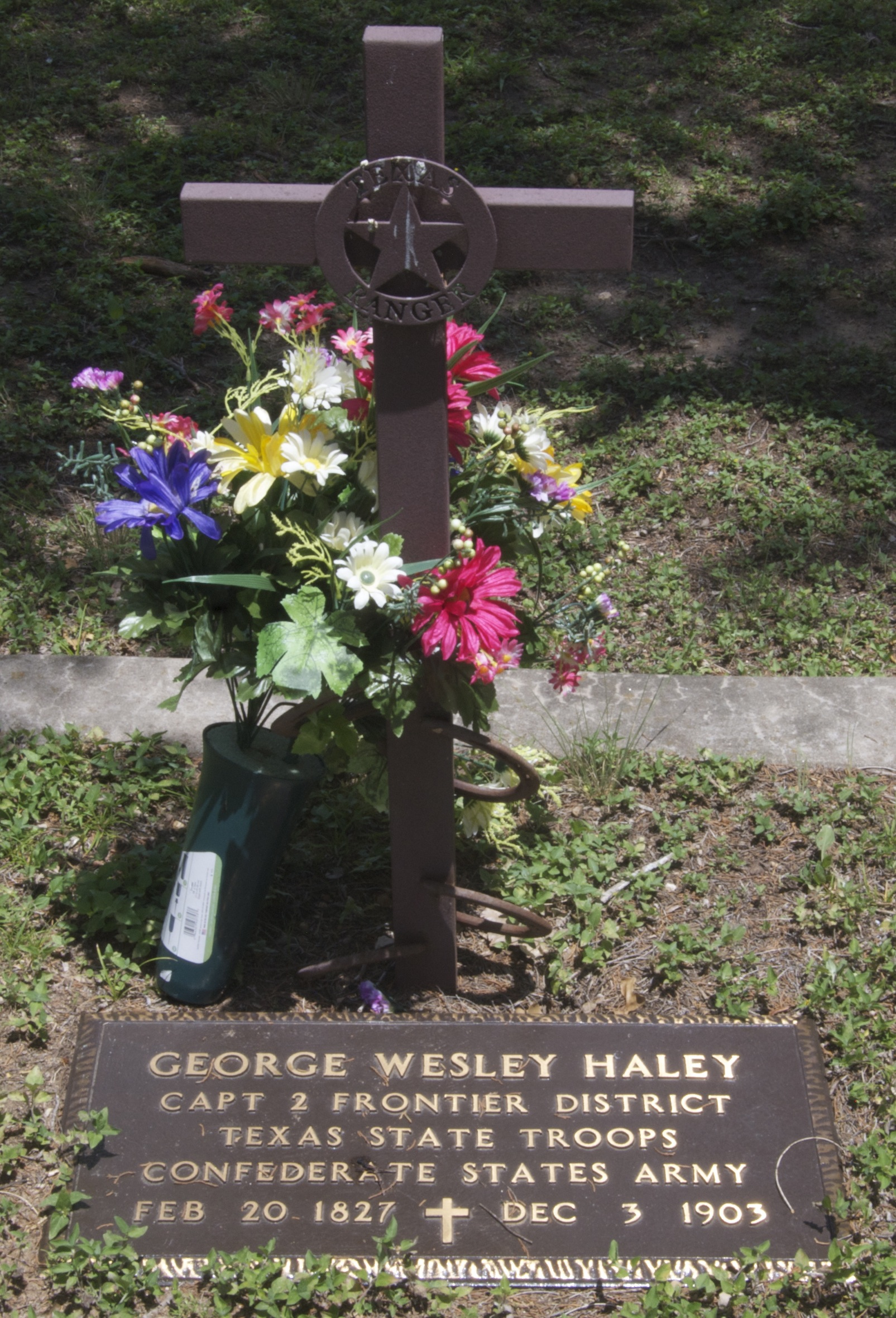
Another Ranger.
Wednesday, June 19th, 2013
Oakwood Cemetery, Austin, Texas.
Information about George Wesley Haley is hard to find online. If I dig up anything else, I’ll do an updated post.
Edited to add: here’s a second photo that I think I like just a bit better. Both of these were taken with the Nikon and 18-55 lens, but the second one used aperture priority instead of the auto setting.
Random notes: June 18, 2013.
Tuesday, June 18th, 2013I was all set to snark on this NYT headline:
For Its Latest Beer, a Craft Brewer Chooses an Unlikely Pairing: Archaeology
After all, craft brewers going back and doing beer anthropology isn’t exactly a new thing.
However, the paper of record gets a pass from me, because the brewer in question is Great Lakes Brewing Company, a personal favorite of mine.
Sam Kellner believed his son had been sexually abused by a Hasidic cantor. Mr. Kellner lobbied the Brooklyn DA to prosecute the cantor. As a result, he was shunned by his synagogue and other members of the Hasidic community.
The conviction of Mr. Lebovits was reversed:
On the other hand:
The NYT spin on this is that Charles J. Hynes, the Brooklyn DA, gets a lot of political support from the Hasidic community, and is therefore very deferential to their wishes. But if he is so deferential, why did his office bring the case in the first place? It seems like he could easily have ducked the prosecution by claiming the evidence was insufficient or some other issue. The NYT‘s timeline is a little fuzzy, but I’m picking up at least an implication that Hynes’s office had the tape in their possession at the time of the Lebovits trial.
(Also, if you go back to the NYT article on the reversal of the Lebovits conviction, the extortion plot is mentioned in passing by Dershowitz. But the actual reason given by the appeals court for overturning the conviction is not the alleged extortion plot, but a failure by the prosecution to turn over evidence to the defense in a timely fashion.)
Random notes: June 17, 2013.
Monday, June 17th, 2013NYT obit for the late Harold J. Cromer, also known as “Stumpy”, “half of the vaudevillian duo Stump and Stumpy”.
Recently, a bunch of gas stations in my area rebranded their associated convenience stores/markets as 7-11 franchises. I kind of liked this, as it is nice to be able to stop off and get gas and a Slurpee when it is 101 degrees outside. (Many of the stand-alone 7-11 stores in my area have closed over the past few years.)
But they just can’t stay out of trouble, can they?
More:
I wonder what the cops were drinking, and where they were getting it from. I also wonder if anyone is keeping track of the doughnut inventory at the seized stores.
Deborah Blum, author of The Poisoner’s Handbook: Murder and the Birth of Forensic Medicine in Jazz Age New York
(Blum’s piece is tied to the M.D. Anderson poisoning scandal, which I thought about mentioning last week. But there really wasn’t a lot I could say about it; as Blum notes, ethylene glycol isn’t a particularly exotic poison, and the incident itself seems to be your basic boring lover’s spat.)
(Edited to add: Oh, so that’s where I found the Blum piece! Thanks, Tam! And I wasn’t aware Blum was writing regularly for Wired: I’d read some of her articles in Slate, but none since I gave up on Slate as a site publishing outlandish and ridiculous crap in an attempt to get page views.)
One Ranger.
Monday, June 17th, 2013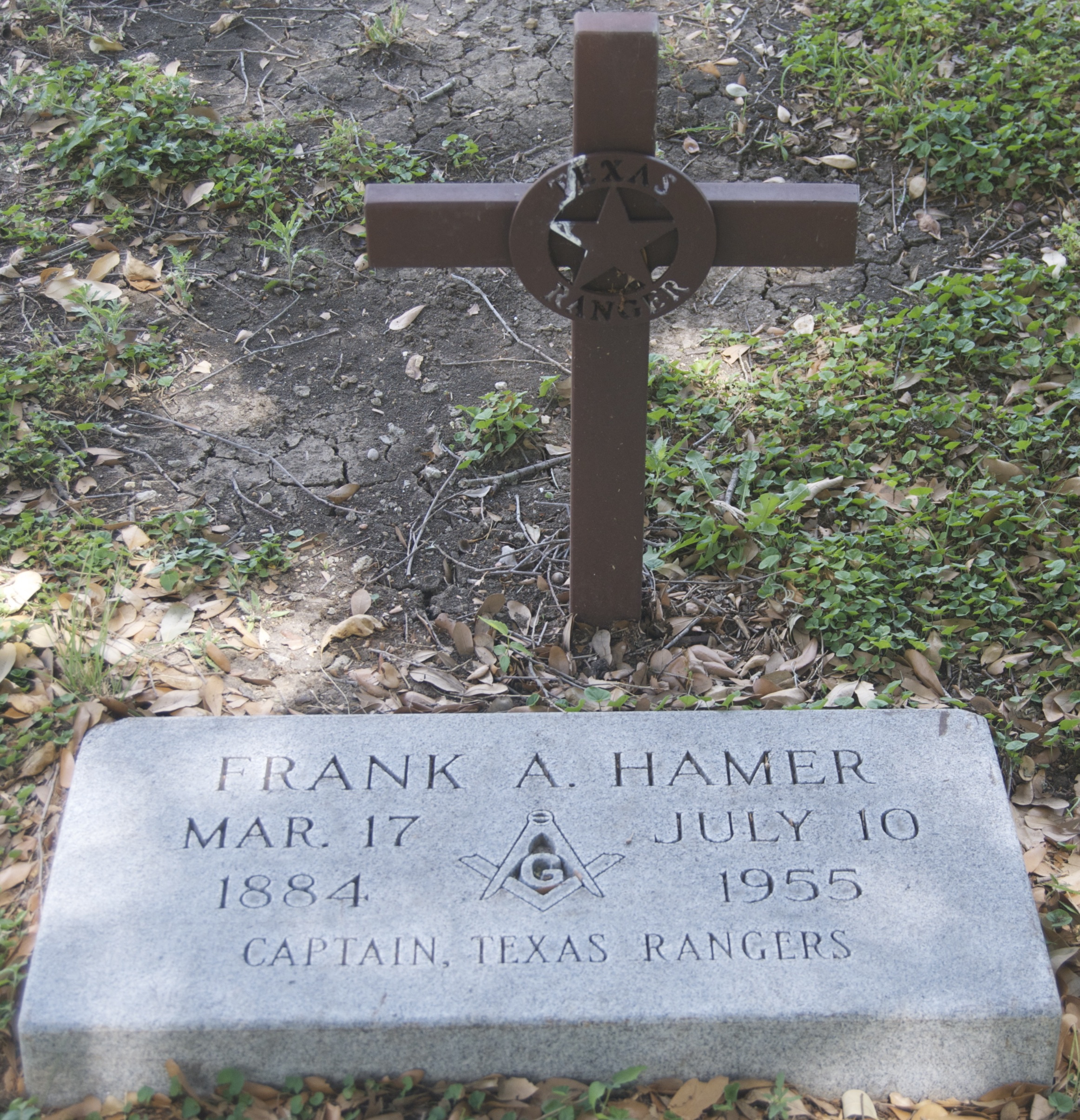
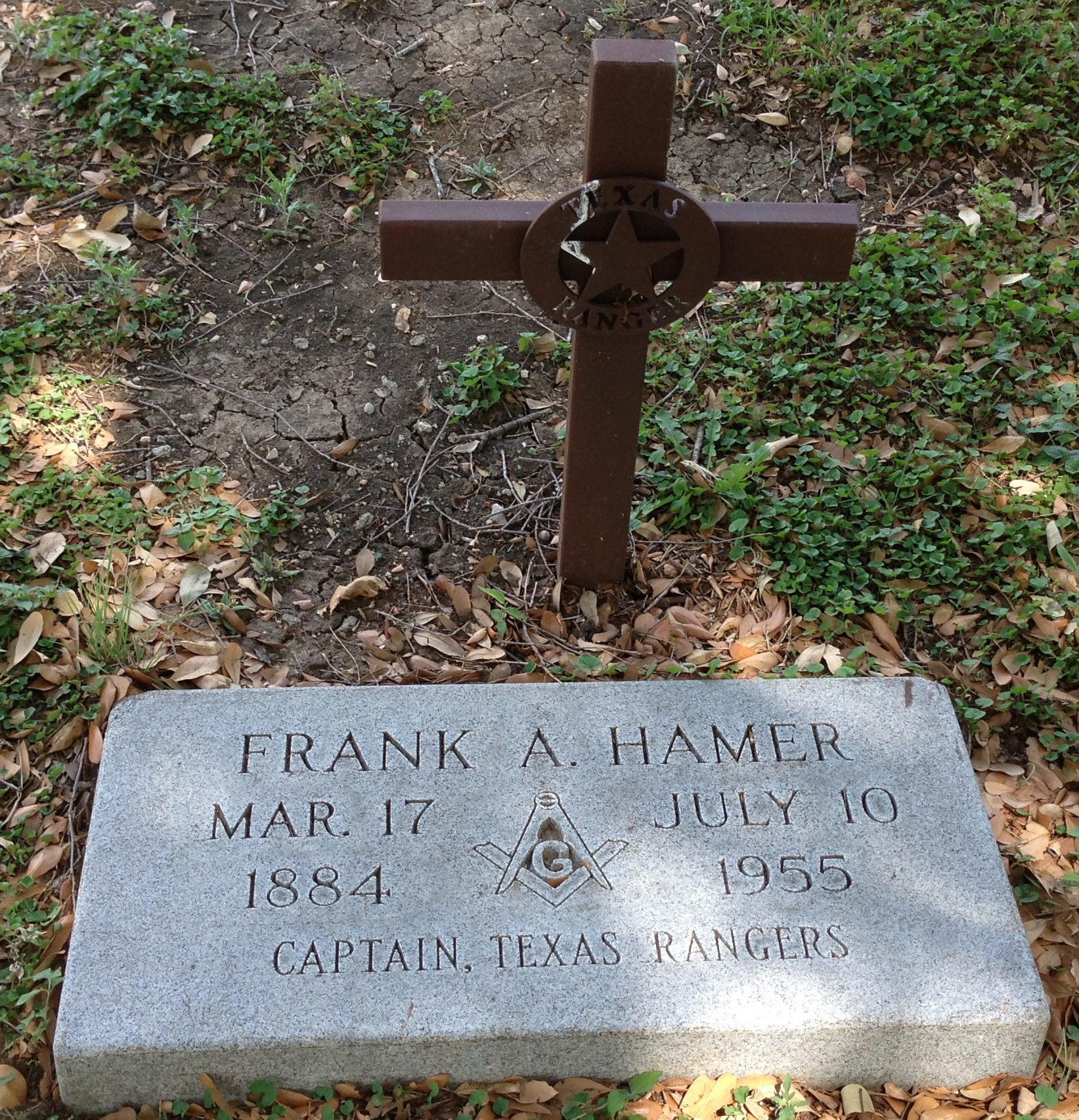
Grave of Frank Hamer, Austin Memorial Park Cemetery, Austin, Texas.
For those of you unfamiliar with the late Mr. Hamer, obviously he was a Texas Ranger, and perhaps one of the most famous of the Rangers. Among other things, Mr. Hamer led the posse that took down Bonnie and Clyde.
American Rifleman profile of Mr. Hamer. Jeff Guinn’s Go Down Together: The True, Untold Story of Bonnie and Clyde
Here’s a second picture that I actually like a little better than the first. It was taken with a different camera (the first one was taken with my Nikon D40X and the 18-55 kit lens). Note that I haven’t done anything to these two photos except crop them: I haven’t manipulated exposure, contrast, or anything else.
Random notes: June 15, 2013.
Saturday, June 15th, 2013NYT headline:
I think, with Father’s Day approaching, this is an important safety tip for everyone. A tie may be a good gift for Dad, if he has to wear ties and if you put some thought into it. However, I’d recommend staying away from ties with Nazi iconography, just as a general rule.
Randal Schwartz, call your office please.
(That was perhaps my only disappointment at YAPC. As I noted, I did get to shake Larry Wall’s hand, but I never saw Randal Schwartz; I’m not even sure if he was there.)
There’s a protest singer singing a protest song.
Another NYT headline:
Not Constantinople?
(Technically, I suppose that’s nobody’s business but the Turks. And, I guess, the IOC.)
Annals of law (#7 in a series).
Friday, June 14th, 2013It is a well known fact (at least among those interested in copyright, those obsessed with trivia, and those who wonder why restaurants make up their own birthday songs) that “Happy Birthday to You” is under copyright until 2030 in the United States (and 2016 in the EU).
But there is a significant dispute over whether this copyright is valid. Jennifer Nelson, a filmmaker working on a documentary about the song, has filed a lawsuit seeking to have the song declared to be in the public domain.
Random notes: June 13, 2013.
Thursday, June 13th, 2013Gun control works! How can a bunch of people with rifles and handguns defeat a heavily armed military? Just ask Syria!
More on our pal Louis Scarcella, the former NYPD detective whose cases are being reinvestigated: gee, there’s awfully similar language in many of the confessions he obtained.
Noted without comment:
Since Lawrence and I have both touched on this story, I thought I’d link to the followup: the “psychic” who claimed there was a mass grave in Liberty County has been ordered to pay $6.8 million in damages to the property owners. If I understand the HouChron correctly, this was a default judgment, as the psychic didn’t appear in court. (Insert your favorite psychic joke here.)
Unfortunate headline of the day.
Wednesday, June 12th, 2013“Texas lawyer gets 3 years, shot at census worker“.
Seems to me that Ms. Barnes has already had her shot (shots?) at the census worker, so why is the court giving her another one?
(Also: I told you so.)
From the legal beat.
Tuesday, June 11th, 2013I have previously written about the strange case of Carolyn Barnes, the local lawyer who was accused of shooting at a census worker, sent to the state mental hospital (where she continued to represent at least one client) and was later ruled competent to stand trial.
Ms. Barnes was convicted yesterday of assault with a deadly weapon.
She could be sentenced to up to 20 years in jail, though I have serious doubts that she will be given that much time.
In other news, the Statesman is reporting that Governor Perry is threatening to withhold funding for the “state’s Austin-based ethics-enforcement unit” unless Travis County DA Rosemary Lehmberg resigns. As you may recall, Ms. Lehmberg was convicted of DWI back in April and sentenced to 45 days in jail.
I apologize that the link stinks. The Statesman‘s new paywall goes into effect today, and I have been unable to find a link to this story elsewhere. (Edited to add: Link? What link? Seriously, I griped about the Statesman link but forgot to actually include it. Here’s a story from the HouChron “Texas Politics” blog that reports the same thing: the HouChron blogger suggests that this is part of an effort to cut off “a criminal investigation into the Cancer Prevention and Research Institute of Texas”.)
I haven’t decided what I’m going to do about the Statesman yet. Paying for digital access would give me a tax write-off for Low Fat Heavy Industries. On the other hand, the cheapest subscription is $9.99 a month. I already subscribe to the NYT and LAT for you, my readers, and I find it hard to justify $10 a month for the Statesman.
Quick notes: June 8, 2013.
Saturday, June 8th, 2013John Donne never met Richard Ramirez.
George Karl of the Denver Nuggets was this year’s NBA coach of the year.
George Karl of the Denver Nuggets was fired on Friday. He was 423-257 over nine seasons.
(Thanks to Lawrence for the hattip on this. I was away from the computer pretty much all day yesterday.)
Quickies: June 5, 2013.
Wednesday, June 5th, 2013Omar Bradley will not be the new mayor of Compton. (Previously.)
Former NYPD officer Ali Oklu could have had…
What happened?