Archive for the ‘Smith and Wesson’ Category

Gratuitous gun porn (#4 in a series)

Thursday, June 19th, 2014

For reasons I can’t fully explain, I’ve wanted a revolver chambered in .45 ACP.

When I went to my first S&WCA convention in Sturbridge, I was able to shoot one at the Smith and Wesson Shooting Sports Center. The gun I rented was a Model 625 JM. (The “JM” is for “Jerry Miculek”, who shoots for the Smith and Wesson factory team. The 625 is the gun he used to fire 12 shots in under three seconds, including a reload.) Model 625 revolvers show up used fairly frequently, and I’ve been tempted by them. But either I’ve not had the ready cash, or haven’t quite been able to overcome my bias against shiny guns. (Also, many of the used ones I’ve seen have these kind of pastel grips, for want of a better description, and those also turn me off.)

I think my affection for the .45 ACP revolver has something to do with being drawn to the oddball and unusual. With most revolver cartridges – your .38 Special, .357 Magnum, .44 Special/Magnum, etc. – the cartridge has a rim around the bottom. When you go to unload your revolver, there’s a little metal piece (“extractor star”) that catches the rim and pushes the cartridge out of the cylinder. With most automatic pistol cartridges – 9mm, .40 S&W, .45 ACP – the cartridge doesn’t have a rim, so there’s nothing for that bit to catch on, and the cartridge remains stuck in the chamber until you push it out with something like a pencil or cleaning rod.

This wasn’t a big deal until World War I. The military couldn’t get 1911 automatic pistols fast enough to supply everyone who needed a sidearm. Their other choice was to issue revolvers, but they didn’t want to deal with the logistics of having both an automatic pistol and a revolver caliber. They wanted revolvers that could easily use the same .45 ACP cartridge that the 1911 used. One of S&W’s engineers invented something called the “moon clip”, which comes in “half” and “full” moon variants. Cartridges snap into cutouts in the clip (a half-moon clip has three cutouts, a full moon clip has six), and then the clip is loaded into the gun. When you go to unload, the extractor star catches the moon clip and pushes it, and the fired cases, out of the gun. Moon clips are basically a primitive form of speedloader. Not that it matters that much in a defensive gun, but they are also a lot cheaper than a speedloader. (Amazon will sell you an eight pack of full moon clips for $8.95 with prime shipping. A single Safariland speedloader will run you about $11 to $16.) And there’s very little that can go wrong with a moon clip; it’s just a piece of stamped metal with no moving parts.

(Side note: you can also get revolvers and moon clips in 9mm and .40 S&W. There’s also been a trend towards moon clips in some of S&W’s .357 Magnum revolvers.)

Here’s a video from YouTube that explains how moon clips work. And no, I’m not just dropping this here for my own reference.


After the jump, more words! More pictures! You can do anything with words and pictures!
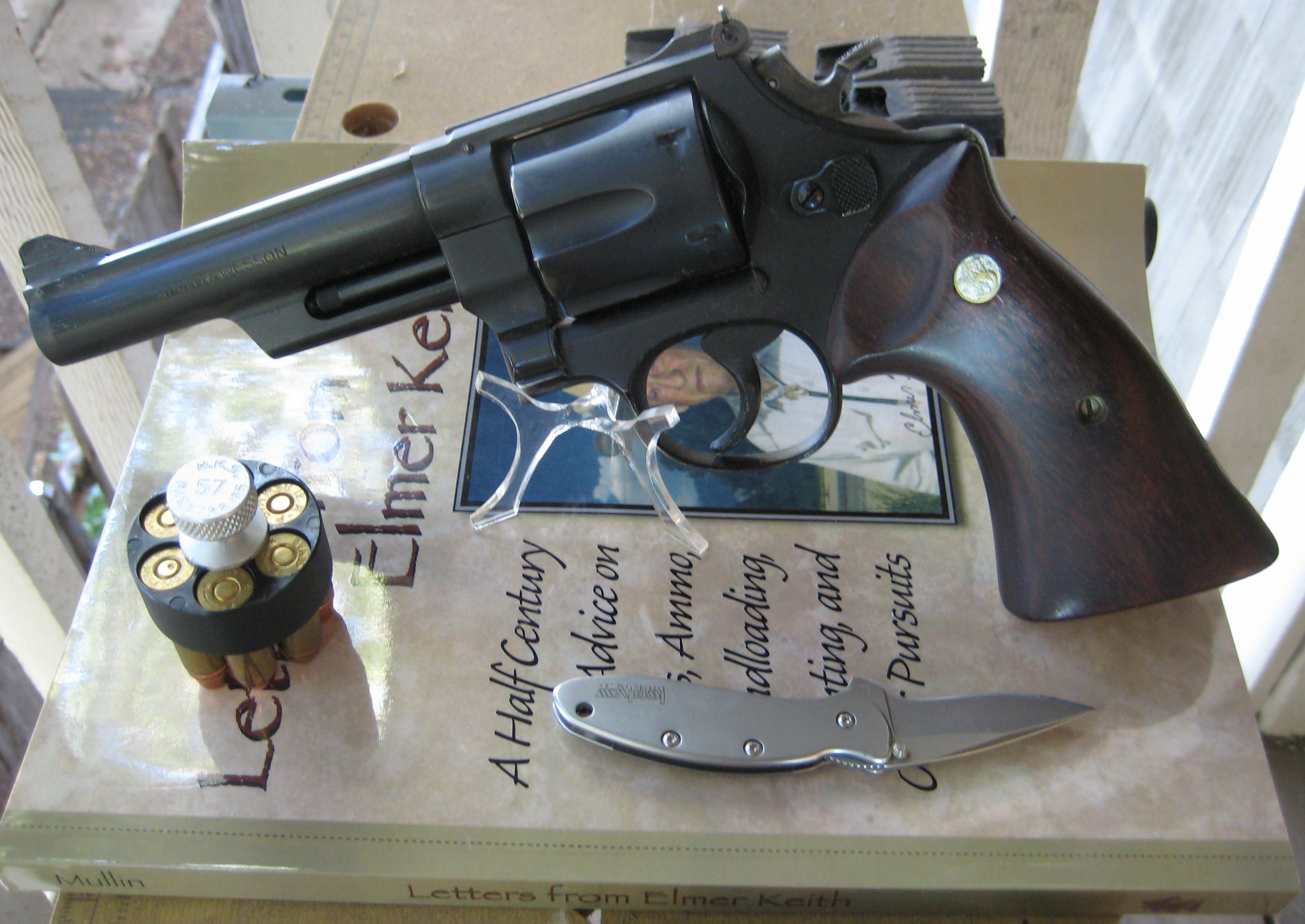
(more…)

Answers to Tam (Gratuitous Gun Porn)

Sunday, September 22nd, 2013

Tam posted hers, so I figured I’d respond by posting mine. Though mine’s not quite as pretty, and she’s a better photographer.

model57

My records show I bought this on my birthday in 2006. (I know I was working at The Other Place when I did buy it. I also know Tam was still working at Coal Creek Armory, because I emailed them looking for Safariland .41 Magnum speedloaders, and she responded.)

It was picked up used at McBrides for $417 (including tax). I figured it would make a nice home defense gun; if you can’t stop a rampaging home with six rounds of .41 Magnum, you should at least be able to fight your way to your elephant gun and put a couple of rounds of .460 Weatherby through the bay windows.

(Yes, I will be here all week. Try the veal, and remember to tip your waitress.)

Anyway, I got the gun home, picked up a box of remanufactured .41 Mag at the next gun show, and took it to the range. Can’t have a home defense gun you haven’t shot, can you?

I set up at the bay, took aim, and…

(click)
(click)
(click click click)
(click click click click click click)
(click)

Capstick mode.[1] Sigh. My friend Karl recommended a good gunsmith, and $125 later, I had a gun that would go “Bang!” instead of “Click!”. As I recall, the cylinder timing was a bit off, and my smith said the previous owner had apparently trimmed a spring to make the trigger pull lighter. It probably would have gone “Bang!” with factory .41 Mag ammo, but the remanufactured stuff had harder primers…

Even at $500+ all in, I’m still pretty fond of this gun. If I had to hike in bear country, this would be the sidearm I’d take. It doesn’t have a lot of collector value, thanks to the refinish (the barrel was also cut down from 6″). But, though I can’t prove it, it has the same feeling my pre-Model 10 does: that this was a gun carried and used daily by someone who relied on it, knew exactly what he wanted and why (like Earl Swagger), and made the changes he wanted without worrying about future collectors.

[1] “The most terrifying sound in the world is not the scream of a descending bomb nor the roar of a charging lion, but rather a click when you expected to hear a bang.” –Peter Hathaway Capstick

We do the legwork so you don’t have to.

Monday, October 1st, 2012

Since I posted twice about the auction that included some of Bonnie and Clyde’s guns, I felt that I owed it to my loyal readers (all four of them) to give some final results. All of these are by way of Invaluable.com, which notes that these prices have not yet been verified.

Bonnie’s Colt Detective Special went for $220,000.

Clyde’s Colt in “Fitz Special” style went for $37,000.

A 1911 that Clyde had in his waistband during the ambush went for $200,000.

The S&W Hand Ejector went for $41,000, against a pre-sale estimate of $75,000 – $100,000.

The “Baby Face” Nelson S&W “Safety Hammerless” went for $17,000, against a pre-sale estimate of $40,000 – $50,000.

I’m not sure what to make of these two Smiths. It may be that “Baby Face” Nelson associational items don’t have the same draw as Bonnie and Clyde, but I’m not sure why Clyde’s S&W didn’t meet expectations. Perhaps the fact that it has been re-finished had something to do with that…

And the Emmett Dalton .44 Russian top-break went for $15,000, against a pre-sale estimate of $25,000 – $30,000.

(Edited to add: Invaluable.com requires you to have an account and be signed in before showing prices, so if you don’t see prices at those links, that’s why.

Also, thinking about it some more, the 1911 and Bonnie’s Colt were probably big money guns because they were actually recovered from Bonnie and Clyde’s bodies after the ambush. The S&W was apparently in the car, but not found on either of them, and the “Fitz” was recovered from a car stolen by Clyde. So that may explain the pricing. Maybe. What do I know?)

(Edited to add 10/2: Here’s the report direct from RR Auction, which gives the prices including bidder’s premium. Invaluable’s prices apparently did not include that figure.)

Guns up!

Friday, September 28th, 2012

Remember the auction we noted earlier in the week? The one that included some of Bonnie and Clyde’s guns?

Well, by way of SayUncle, we learned that there was a bit of a kerfuffle. One of the guns in the auction is a Colt Detective Special that was found taped to Bonnie’s thigh. Frank Hamer, the man who led the posse that reduced Bonnie and Clyde to “a bunch of wet rags” [*], took that gun (and many, if not all, of their other guns) as spoils after the ambush, and it got handed down from Hamer through a couple of other folks before ending up in the auction.

So what’s the problem? The serial number on Bonnie’s gun was obliterated, and BATFE doesn’t much like people selling guns with altered or obliterated serial numbers.  Serial numbers, as I understand it, were actually not required until the Gun Control Act of 1968, so there are guns out there without serial numbers. But if the gun did have a serial number, like Bonnie’s did, and that serial number is defaced or altered, you can’t legally sell the gun.

What to do, what to do? If you’re the auction house, you contact your friendly local BATFE branch. I will now pause for a moment so you can laugh at the juxtaposition of  “friendly” and BATFE.

In this case, though, BATFE issued a new serial number for the gun, and had the gun re-stamped, making it all nice and legal for the auction. SayUncle and some of his commentators seem a little bent out of shape about BATFE doing this; personally, I’d rather have them do this than have the gun confiscated and melted down.

While I was writing this entry, Lawrence sent me an actual link to the auction. Bonnie’s Colt is here.

The “Fitz Special” that I wrote about previously is here. Looking over the auction description, a couple of things jump out at me. There are three documents giving the gun’s provenance, from various law enforcement officers, but there’s no Colt factory letter documenting the gun. The price of a Colt letter, according to their website, is $75; that’s a small percentage of the estimated auction price, and I’d personally like to see one of those letters with the gun before I bid (were I planning to bid; yeah, like I have $50,000). It might help document the story that Clyde stole this gun from a Texas Ranger. I strongly suspect (and the auction notes seem to confirm) that this is not an actual Fitzgerald modified gun, but one done in his style.

Why, yes, as a matter of fact, there is a Smith and Wesson Hand Ejector in this auction. And it has “a copy” of a factory letter. There’s also a “Baby Face” Nelson Safety Hammerless (Third Model) with a S&W factory letter, too. And a .44 Double Action First Model top-break carried by Emmett Dalton, also with factory letter. Except for those three, it seems that choosy gangsters chose Colts.

[*] That description, and some of the other background in this post, comes from Jeff Guinn’s stunning Go Down Together: The True, Untold Story of Bonnie and Clyde, the definitive work of Bonnie and Clyde scholarship and a book I enthusiastically recommend.

Delicious tears.

Wednesday, June 16th, 2010

Apparently, I have been out of the loop, as I was unaware until today that Smith & Wesson has introduced a pistol version of the M&P15-22 which uses the standard M&P15-22 magazines. I guess they’re trying to compete with things like the GSG-5.

After handling one, I really can’t see the point; the gun is too big and heavy to shoot like a handgun, and can’t really be fired effectively like a rifle. It looks like it’d be a fun gun for plinking and other putzing around, except for size and bulk considerations.

Other than that, the only purpose I can see is making Sarah Brady and her ilk scream and cry and wet their pants. That’s a pretty good purpose, but I’m not sure that it would be worth $400+ to me.

(I will add that Austin Gun Liquidators is a very nice store. They don’t have quite the used selection Tex-Guns has, but they’re about five minutes from work and open until 6 PM Tuesday-Saturday. Their price on M&P15-22 magazines was pretty reasonable as well.)

Clippings

Thursday, July 30th, 2009

I’m not exactly sure how to describe this *NYT* story; I would use the phrase “human interest”, but it’s actually about a revolver. Specifically, a vintage S&W .32 Hand Ejector that fell out of a perp’s waistband, went off, and hit a cop.

The revolver was traced to the Smith & Wesson plant in Springfield, Mass., according to law enforcement sources.

Oh, boy. That’s some fine police work there, tracing a Smith and Wesson revolver back to the Smith and Wesson plant.

But, when a .32-caliber revolver is fired, it keeps the casings inside its rotating chamber instead of spitting them out like a semiautomatic pistol, making it hard for forensic investigators to determine whether it had a criminal past.

Say what?

Like other guns seized by the police, it will be melted down and reincarnated as wire clothes hangers.

(insert cheap Mommie Dearest joke here)

(Above by way of the S&WCA mailing list.)

In other news, the legendary Reverend Ike has died.