Archive for the ‘Hoplobibilophilia’ Category

Recent acquisitions (some bibliohoplophilia)

Saturday, November 16th, 2019

Half-Price Books had another one of their coupon sales last week (the 4th through 10th).

Unfortunately, this was a busy week for me between voting and Wurstfest and meetings and other things, so I didn’t get as much of a chance to shop as I would have liked. Also, the gun book pickings have been kind of slim recently. Even the big central Half-Price has gotten rid of a lot of their fancy leather-bound books.

The only gun book that I found was A Varmint Hunter’s Odyssey by Steve Hanson for $10+tax after coupon. This is another one of those books published by the (now sadly defunct) Precision Shooting Press, and as I’ve written before, I like to snap those up when I find them.

Other than that…I found a nice trade paperback copy of Popular Crime: Reflections on the Celebration of Violence by Bill James to replace my old hardback. I enjoy this book (though James sometimes makes me go “What?!”) and didn’t realize that the trade paperback had some additional material. (Including James’s list of his 100 top true crime books.) $4.24+tax after coupon.

And I also found a good copy of The Annotated Tales Of Edgar Allen Poe by Stephen Peithman for $6+tax after coupon. Oddly enough, I did not have a collection of Poe’s short works previously, and it is a well known fact that I’m a sucker for annotated books…

…so now I’ve got my eye out for a copy of The Annotated Poe by Kevin J. Hayes. Because you can never have enough Poe.

More hoplobibilophilia.

Monday, September 2nd, 2019

Half-Price Books is having a 20% off sale over the long holiday weekend.

I haven’t found a lot of good stuff at the past few sales, but that didn’t stop me from going. And I think I see a break in the drought. I found some non-firearms related stuff:

I wouldn’t be posting, though, if I hadn’t gotten lucky and found some gun books. Which I will put after the jump…

(more…)

Hoplobibilophilia.

Tuesday, April 30th, 2019

My birthday was a week ago last Saturday (April 20th).

You know what this means, right?

Right. I’ve been buying books.

I ordered some things off of my Amazon wish list, since there were several items available used in the right combination of price and condition. Right now, I’m reading Tuchman’s Practicing History: Selected Essays: since that’s a collection of shorter work, I’m also planning to start Five Came Back: A Story of Hollywood and the Second World War and alternate the two for variety.

(And, yes, I kind of want to see the Netflix series based on Five Came Back. Between that and “The Highwaymen”, I’m really tempted to get a Netflix trial, even though I refuse to pay for television.)

(Other things that were in the Amazon batch: The Scientific Sherlock Holmes: Cracking the Case with Science and Forensics, which won an Edgar a few years back. The Pigeon Tunnel: Stories from My Life. The Life You Save May Be Your Own: An American Pilgrimage, for your obligatory Catholic content (CathCon?). More seriously, I like a lot of O’Connor, I know Rod Dreher is a big Walker Percy fan and I’d like to understand why, and I’m kind of interested in Merton. (Though, going back to Mr. Dreher again, I’m not sure now that I want to read Merton.) And The Infernal Library: On Dictators, the Books They Wrote, and Other Catastrophes of Literacy.)

Mike the Musicologist came up Friday night and we spent the weekend running around. We had a very good joint birthday dinner (Lawrence‘s is a few days before mine) at Lonesome Dove.

After dinner, we went back to Lawrence‘s and watched the 1943 “Stormy Weather“. “Stormy Weather” sort of presents itself as a loose “biography” of Bill “Bojangles” Robinson (renamed “Bill Williamson” for the film). In truth, the biographical elements are an extremely thin skeleton…upon which is hung a whole bunch of fantastic musical performances by Robinson, Lena Horne, Cab Calloway, Fats Waller, the Nicholas Brothers, and others.

(I love this entry from Wikipedia about the Nicholas Brothers: “Gregory Hines declared that if their biography were ever filmed, their dance numbers would have to be computer generated because no one now could emulate them.“)

Unfortunately, our plans for Sunday fell through (they caught the kangaroo) but we were able to spend the afternoon talking about kitchen remodeling with some friends of ours. Yes, this is the exciting life of a 54-year-old.

I took Monday off (another perk of being a full-time Cisco employee: you get a free day off on or around your birthday) and went running errands with Mom. This involved stopping at both the Round Rock and central Half-Price Books locations. And HPB sent me a 15% off your total purchase coupon for my birthday. And it just so happened that they had a whole bunch of interesting gun books…

(more…)

Bibilohoplophilia.

Sunday, March 17th, 2019

Or is it hoplobibilophilia? What do you call it when you have a fondness for gun books?

Whatever it is, I have the fever. And the only cure is…more cowbell, er, buying more books. Now it’s your turn to suffer for my -phila.

Seriously, I’ve picked up a couple of books lately that I want to endorse and document Lawrence style. (Please do not confuse “Lawrence style” with “Gangnam style“.) Half-Price Books has been having another coupon sale, but the first two books here I actually ordered new from the publishers.

(more…)

More quaint and curious volumes of forgotten lore.

Monday, July 16th, 2018

Half-Price Books had another coupon sale this week, and I picked up a few things that I feel like documenting here.

I picked up a lot of “popular culture”…stuff, I’d say, though other people might call it “crap”. Specifically, I got:

Of course, I wouldn’t be me if I hadn’t picked up some gun books, too…

(more…)

He shoots, he scores!

Sunday, March 18th, 2018

This week was another Half-Price Books coupon week. And I picked up a few things. Most of the books I bought were firearms related, so I thought I’d pull a Lawrence and document some of them here.

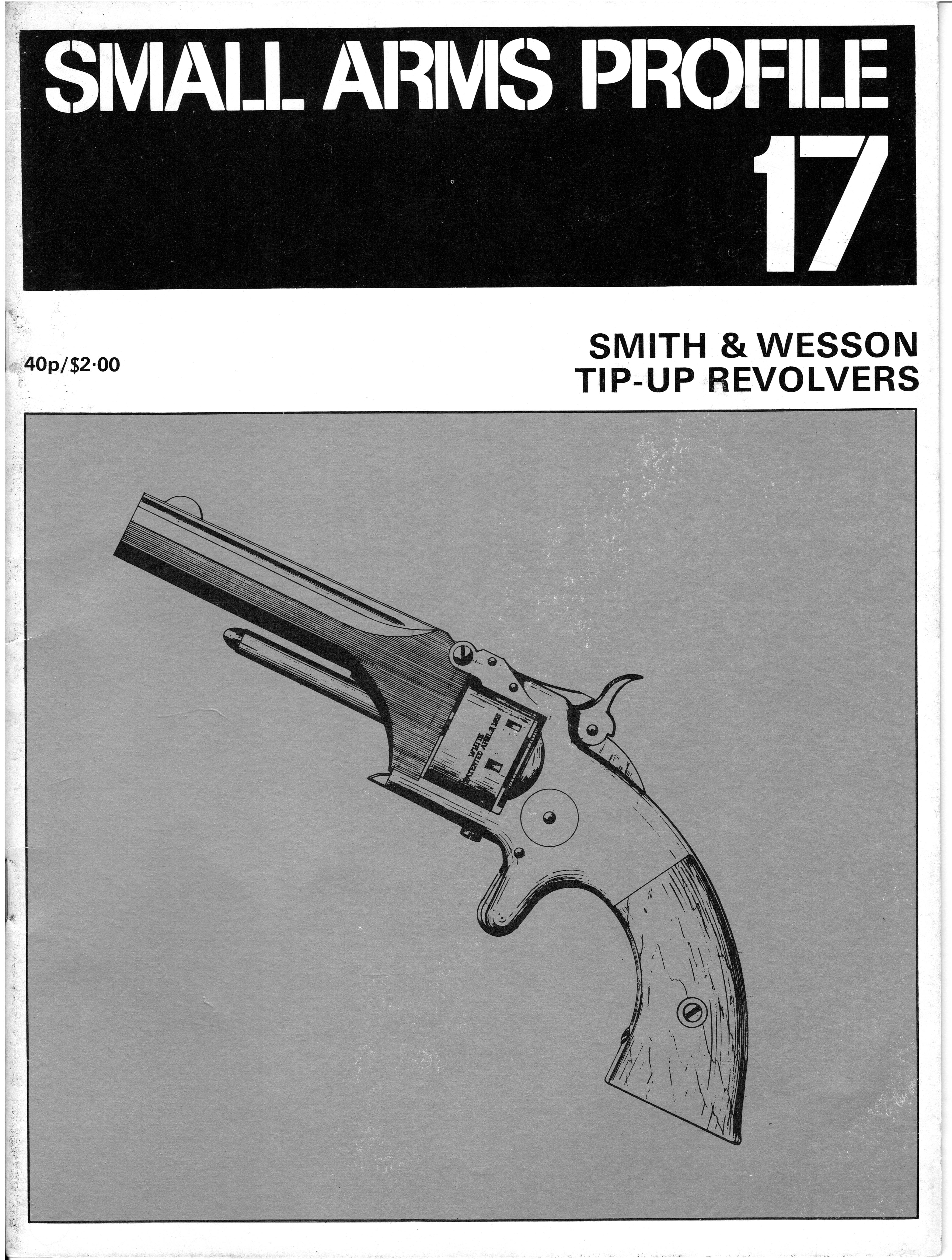
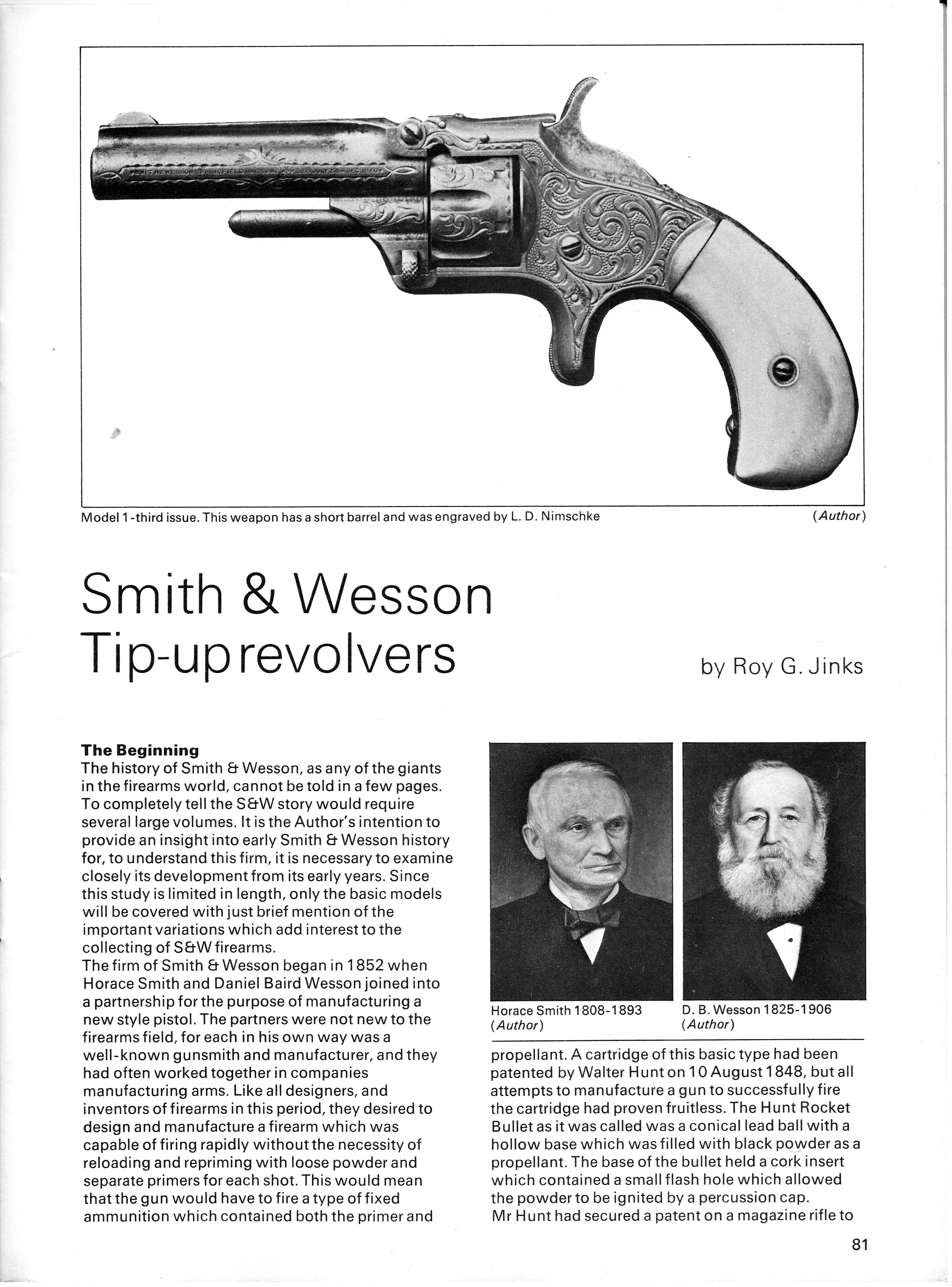
Small Arms Profile 17: Smith and Wesson Tip-Up Revolvers. This is a thin little pamphlet dated January 1973, and published by Profile Publications Ltd. in the UK. Profile had at least 17 other books on various types of small arms (including one specifically on ammunition). It also looks like they had separate series for aircraft, cars, and warships: I think they catered, at least in part, to model makers. This had a cover price of $2 US/40p UK in 1973 dollars: sources tell me that’s closer to $20 in 2018 money.

I was a little hesitant to shell out $6 for an 18 page British handgun publication, until I opened the front cover and saw “By Roy G. Jinks”. That’s pretty much a “must buy” flag.

Defensive Pistol Fundamentals by Grant Cunningham. This isn’t particularly rare or hard to find, but I note it here because it is one of KR Training‘s recommended books. $10 with no coupon discount (because I used the coupon for other things), which is inline with Amazon’s new price, but this is pretty much “like new” as well. I don’t feel rooked.

And I’ve written before about how much I like picking up those Firearms Classics books at a steep discount. I added a few more to the collection:

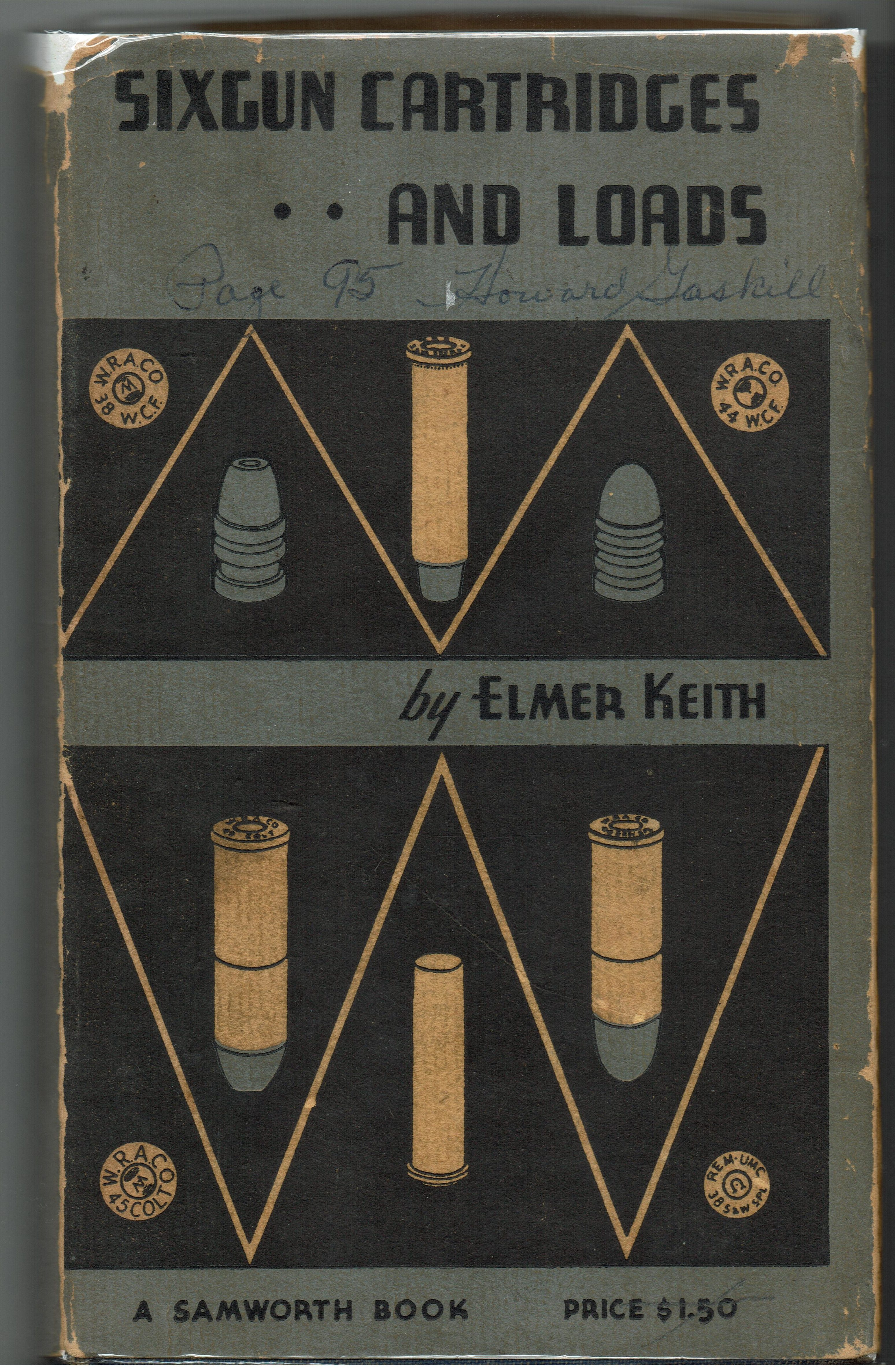
Not from the Firearms Classics library, but a limited edition reprint (#1383 of 1500) from “Wolfe Library Classics”: Big Game Rifles and Cartridges by Elmer Keith. (Originally published by Thomas G. Samworth, much like so many of these other books in my library.) $12 after 40% off coupon.

(Damn. I really ought to pick that up.)

Firearms Curiosa by Lewis Winant. I’ve only had a chance to flip quickly through this since I bought it on Friday, but it looks like a whole lot of fun: there’s an entire chapter, for example, on “Knife Pistols and Cane Guns”. Not a Samworth book, oddly. $6 after 40% off coupon.

Actual Firearms Classics Library reprints of actual Samworth books: With British Snipers to the Reich by “Captain C. Shore” (“a classic hands-on, nuts and bolts, how to sniping book” according to the intro), and Shots Fired In Anger by Lt. Col. John B. George. What I didn’t know, until I flipped through the introduction to Shots, is that these two books complete my quartet of Samworth “war” books (the other two being McBride’s A Rifleman Went to War and Dunlap’s Ordnance Went Up Front). Together, the two of these with one coupon were $22.50: I probably could have gotten away with making three trips instead of just two, but I didn’t want to push my luck. And I’d been looking for a copy of With British Snipers for several months now.

Finally, this is in the Firearms Classics Library, but I think this copy may be a true first (I’m having trouble tracking down bibliographic information):

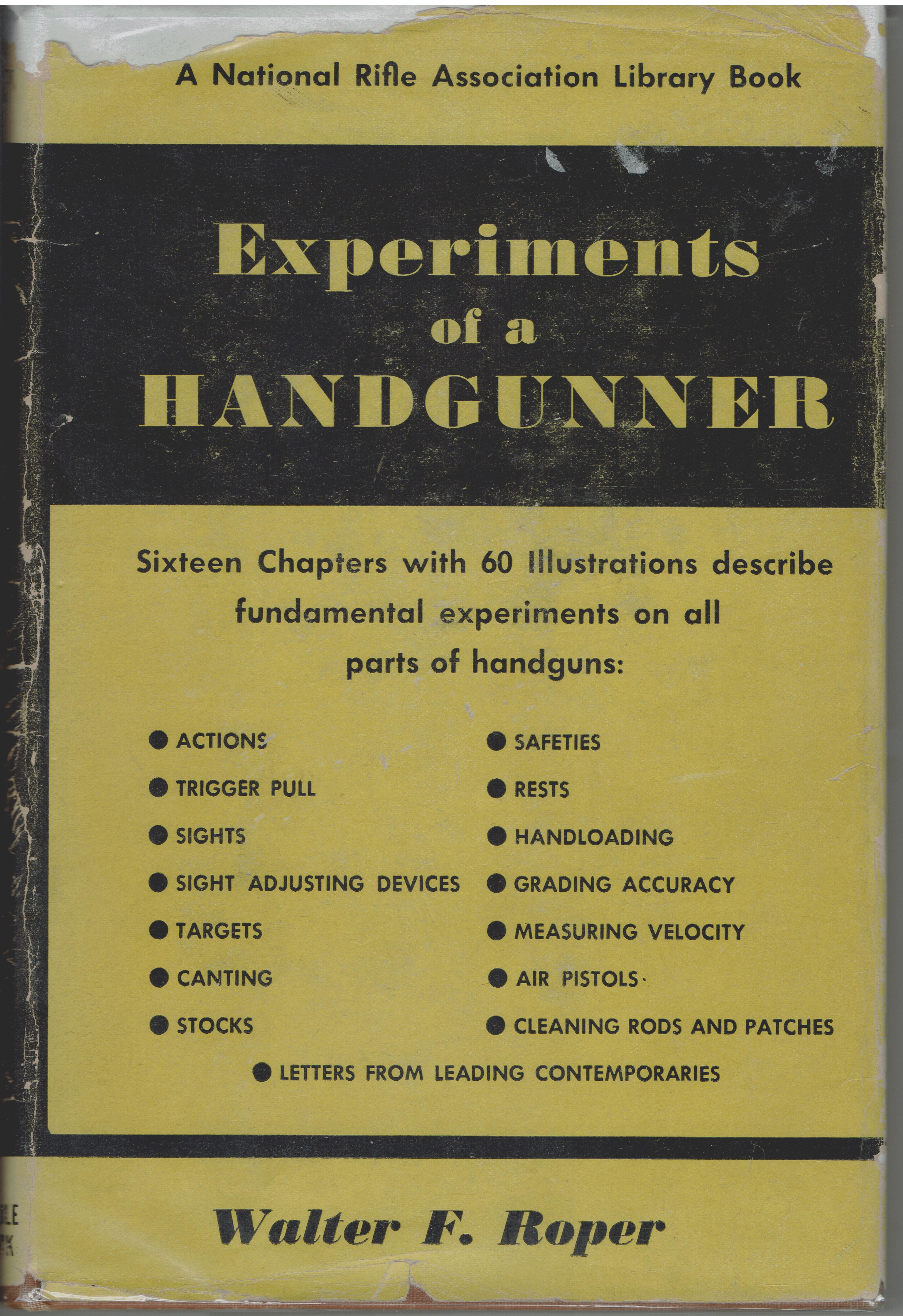
Experiments of a Handgunner by Walter F. Roper. Roper was a somewhat famous gun guy: among other accomplishments, he designed the N-frame “Target” grip for Smith and Wesson revolvers. Yeah, the dust jacket is pretty badly worn (it has a plastic cover protector). But I’ve never seen a copy of this before – Firearms Classics or otherwise – and it was $12.50 after coupon.

Quaint and curious

Sunday, January 28th, 2018

Lawrence forwarded me a link to a website that looks interesting, and that I hope to be able to explore further in the near future: targetballs.com.

Yes, yes, I know: you didn’t know targets had balls. Ha ha, very funny. But seriously: targetballs.com is “the online presence of On Target!, The International Journal for Collectors of Target Balls”. “Target balls” being what exhibition shooters used in their demonstrations if they weren’t shooting live birds, and before the “clay pigeon” was introduced.

Quoth the “About” page:

These balls, similar in size and appearance to today’s glass Christmas tree ornaments, were the “only substitute ever invented for the living bird,” something that Annie Oakley is said to have had silk streamers stuffed inside, something that in one summer the Bohemian Glass Works (in New York City) was making at the rate of 1,250,000 over six months’ time, something Buffalo Bill Cody chased after on horseback, “old ladies” darned socks on and babies allegedly cut their teeth on — all according to an 1878 ad! In their heyday, target balls sold for a little over a penny each; today one ball has sold for as much as $28,500, although “common” balls, generally in amber or blue, can be acquired for as little as $100.

Of course, you can’t really talk about target balls without talking about the people who used them. Which is why On Target! tickles my fancy: I’m going to have to scrape up the bucks for a subscription and set of back issues.

====

Found at Half-Price Books a few days ago:
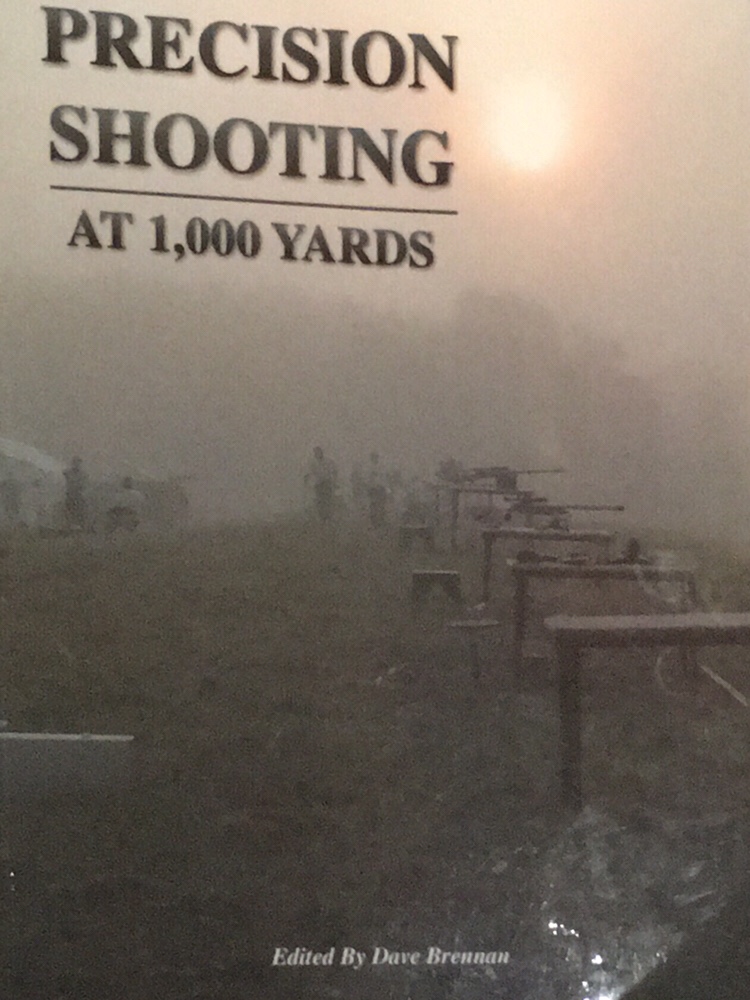
Precision Shooting at 1,000 Yards, edited by Dave Brennan. I’ve written before about the late and much lamented Precision Shooting magazine: I think I’ve also mentioned that there was a small press associated with it. I try to snap up books from that press whenever I find them, because:

  • they’re usually jam-packed with information
  • Even if they are old, the fundamental principles of accuracy don’t, and won’t change, barring some major revolution in arms technology (like caseless cartridges and electronic ignition systems, both of which have been ten years away for the 45 years I’ve been an avid person of the gun).

This is a collection of articles from the magazine. I paid $40 minus a 10% coupon for it, which is a little more than I usually like to spend on gun books. But asking prices for used copies on Amazon are in the $75 and up range, and the condition was good…

…and what made me pull the metaphorical trigger, so to speak, was the two-part article included in the volume, in which a small handful of eccentrics (and I mean that in the best possible way: I want to hang out with these guys) attempt to recreate Billy Dixon’s legendary long shot at the Second Battle of Adobe Walls in 1874.

Whodewhatnow? Billy Dixon was a buffalo hunter. He was part of a small group that was attacked by Comanches at Adobe Walls, Texas. They were besieged for the better part of three days (the Comanches initially intended to slaughter them in a sneak attack, but rolled a critical fail on initiative): on that third day, Mr. Dixon, encouraged by other members of the party, took a shot at a group of mounted Indians about 7/8ths of a mile away (remember, he was using an 1874 vintage Sharps rifle, with black powder cartridges, and no telescopic sight)…

…and knocked one of the warriors off his horse. The Comanches broke off the siege shortly afterwards.

For the rest of his life, Billy Dixon never claimed that the shot was anything other than a lucky one; his memoirs do not devote even a full paragraph to “the shot”.

(Side note: the Dixon memoirs are available from Project Gutenberg.)

(Side note 2: Mr. Dixon sounds like another person I’d love to have a few beers with. I love one of the things the authors of the Precision Shooting article say about him: to paraphrase, he didn’t hunt buffalo for the money, but because he loved long range shooting. Hunting buffalo was a great way to indulge that passion, and by the way make a few bucks on the side.)

Last time Mike the Musicologist was in Austin, this came up in discussion, though I disremember exactly how: I think we were discussing contemporary makers of falling block rifles, which led to a Google search, which led to me finding either this one or this one.

One other thing I find intriguing about this article: the shooters used rifles and bullets as close to Dixon’s as you could get at the time of their experiment, but used a modern smokeless black powder substitute instead of actual black power. Their reasoning for this:

What many modern shooters might not know is that black powder was, in that era, as highly developed as today’s best smokeless powders. Produced in England, Curtis & Harvey’s Diamond Grade was the world’s best, likely because of a superior charcoal root stock and extended blending time. As folklore had it, their charcoal came from a certain type of willow tree that grew only in one locale. Further, C&H could afford to prolong the blending operation because they could get a premium price for the superior product they produced. Serous target shooters widely acclaimed Kentucky Rifle from a United States producer, Hazards, as the best alternative choice but, nonetheless, a second-best choice. Behind these two premier powders came an entire plethora of brands, manufactured in various places around the world.

The author goes on to note that, if there was sufficient demand, someone somewhere would be turning out super-high-grade black powder today. But there isn’t enough demand, so the quality smokeless BP substitutes seem like a good choice for consistent results.

This casts a new light for me on a quote of the day I highlighted a while back from another buffalo hunter: “…by then I had begun to use the English powder…and it added 10 to 30 percent efficiency to my shooting.” I suspect this might have been a reference to the C&H product. Sadly, the Mayer book does not appear to be on Gutenberg, so I haven’t been able to confirm this.
More book stuff.

Monday, July 17th, 2017

I’m a sucker for those “collector’s” reprints of various firearms related books, like the stuff in the Palladium Press Firearms Classics Library. I’m not a total sucker: Half-Price Books gets these in every once in a while, and while I’m generally not willing to pay their marked price ($30-$35), if there’s a sale or a coupon, I’m there.

I know they generally don’t have a lot of value to book collectors, but that’s fine: I think they look nice on the shelves. Plus, to take one example, I think I paid $15 for Ordnance Went Up Front. Amazon has a Kindle edition for $9, but I’d rather pay the extra few dollars for a nice physical copy. And there’s a lot of that stuff that doesn’t have a Kindle edition.

This is a different publisher, and a little more expensive, but there’s a catch:

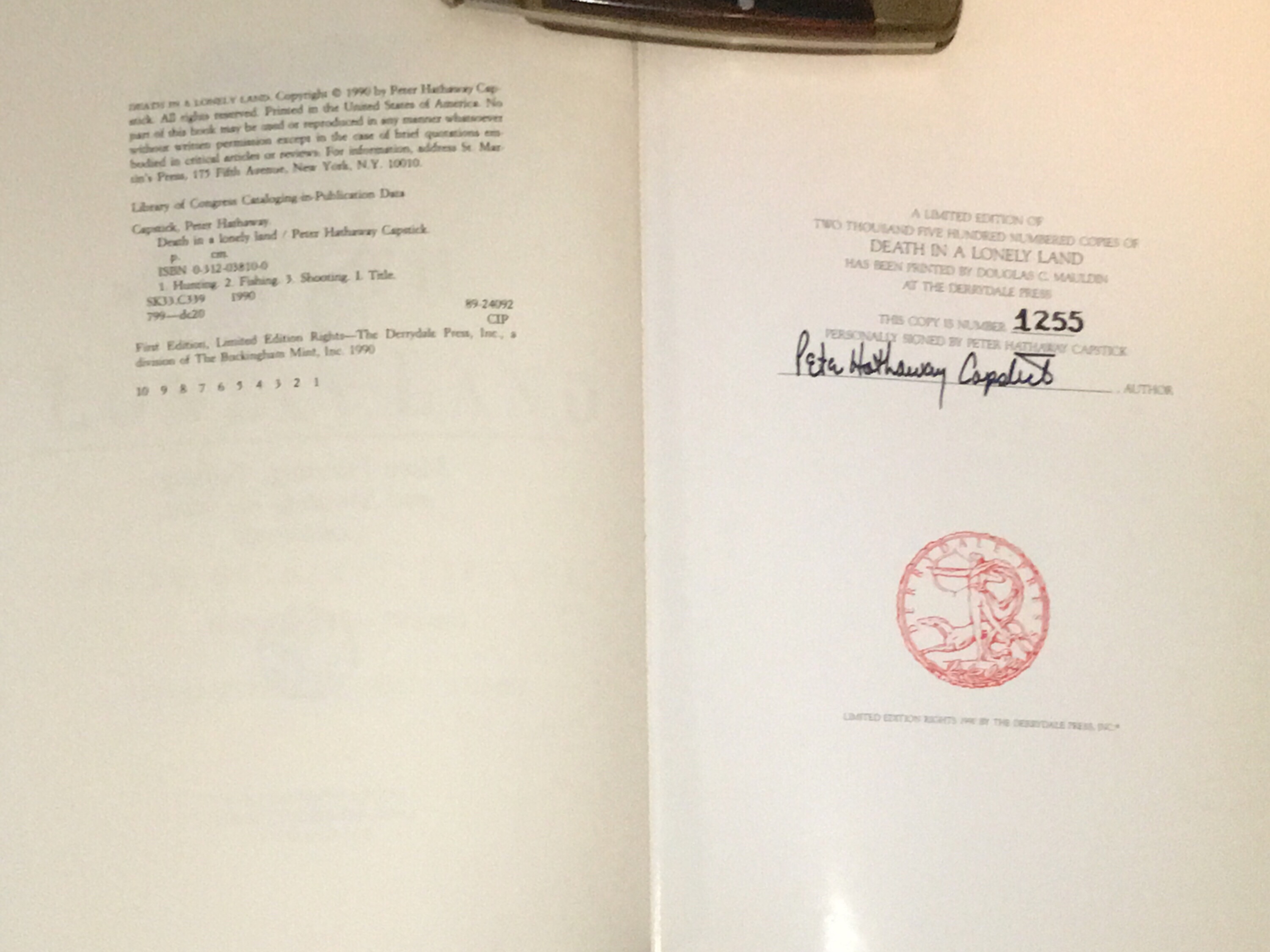
Capstick, Peter Hathaway. Death In a Lonely Land: More Hunting, Fishing, and Shooting on Five Continents. Derrydale Press, 1990.

Yes, it’s a reprint. A “limited” edition reprint of 2,500 numbered copies, which makes it almost certainly worthless to collectors and anybody who doesn’t have the word “sucker” stamped on their forehead.

(looks in mirror)

Well, I’ll be darned. Where did that come from?

But I digress.

I don’t remember exactly how I first came into possession of Death in the Long Grass: I want to say I was a teenager (or pre-teen?) visiting my maternal grandmother, we went by a bookstore on one of our rare ventures out of the house, either I talked her into buying it for her grandchild or I had some pocket money of my own, and…

…I was already kind of gun-crazy at the time, but that book was a revelation to me. It wasn’t just that the whole “let’s go hunting elephants in Africa” thing appealed to me as I was straining the bounds of my existence: it was also that the guy could write. The young me found him sometimes screamingly funny. The old me still does. I think sometimes I even try a little too hard to emulate Capstick’s prose style, the end result being something like if you left my prose next to a complete collection of Capstick books and a gallon of milk for a week in a non-working refrigerator outside in a Texas July.

Point being, I didn’t just want to hunt lions and tigers and buffalo like Capstick, I wanted to write like him as well. At least back in those days. These days, I’m working on developing my own style, but Capstick is still an influence.

This was $75, marked down by 50% because of the coupon. It was still a little more than I would usually have paid, but this book has one great advantage that my other Capstick books don’t:

Capstick died in 1996 of complications from, of all things, heart bypass surgery. I never met him – I don’t think he did a lot of book tours, and I don’t move in Safari Club circles – so this is the only signed Capstick in my library right now. It was worth it to me, and to that small boy inside me.

Consumer advisory.

Tuesday, November 15th, 2016

Remember The Jerk?

Some of the good folks who read this blog might be interested to know that the Standard Catalog of Smith & Wesson 4th Edition is available in print and Kindle editions.

My print copy is on the way, but not here yet. The one person who had copies in Tulsa had already sold out of them when we got to his table. And I do plan to order the digital edition, but not right away: I’m not complaining, but the price of the new digital edition is about double what I paid for the digital version of the 3rd Edition, and just slightly under what the 528 page print edition goes for.

(Why both? Because the digital edition is a lot easier to carry around than the phone book sized print version. But sometimes, I just want print.)

Quote of the day.

Wednesday, June 24th, 2015

I was proud of that first Sharps of mine…At first it used a 320-grain bullet, but I experimented with one a hundred grains heavier, and thereafter used the 420-grain projectile. It killed quicker. In making this change I didn’t sacrifice anything in velocity, because by then I had begun to use the English powder…and it added 10 to 30 percent efficiency to my shooting. After a year or two, having plenty of buffalo dollars in my jeans, I talked myself into believing I needed an extra rifle in reserve–so I bought two. [Emphasis added – DB] One was a .40-70-320–a light little gun for deer and antelope but too impotent for buff. The other was another .40-90-420. Both used bottle-necked cartridges; don’t ask me how I fell for that sort of thing after vowing I was off bottle-necks for life.

—buffalo hunter Frank Mayer, quoted in David Dary’s The Buffalo Book.

The more things change, the more they stay the same.

Seriously, it just tickles me to see the “well, I had some money, and I thought I needed a second one” justification being used as far back as the 1870s. Also, I love that throwaway line, “So I bought two,” and the “don’t ask me how I fell for that sort of thing”. I’m pretty sure anyone and everyone who’s a serious gun person and been around for a while is familiar with all of those.

(Heck, you’re welcome to name your favorite “don’t ask me how I fell for that”, “so I bought two”, or “well, I had some money…” justification in the comments.)

Incidentally, I was curious about the reference to “the English powder”. A quick Google search turned up what looks like an interesting ebook, though I haven’t had time to go through all of it yet: “A memoir on gunpowder” by John Braddock, published in 1832. This looks to be one of the earliest extant books on methods for making and testing gunpowder, and falls squarely into “quaint and curious volumes of forgotten lore” territory.

Score!

Sunday, September 16th, 2012

This weekend was the grand opening for the new Half-Price Books in Round Rock.

As they usually do, Half-Price was distributing coupons: 40% off one item on Thursday, 30% off on Friday, 20% off on Saturday, and 50% off on Sunday. (I heard one clerk complain that those coupons were only supposed to apply to the Round Rock store, but they made them valid for all the stores in error. I think that clerk was full of it, but that’s just my opinion.)

Anyway, I picked up a few interesting things Thursday through Saturday, including a copy of An Economist Gets Lunch: New Rules for Everyday Foodies (at 40% off of half cover price) and Appetite City: A Culinary History of New York (which I didn’t burn a coupon on, as the copy I found was marked down to $4.99).

Today was 50% off day. I had some things I was thinking about picking up, but then I got lucky. Fortunately, I had two coupons…

The new (2010) of Bill Warren’s magnificent book, Keep Watching the Skies! American Science Fiction Movies of the Fifties, The 21st Century Edition, complete with Howard Waldrop introduction. Cover is $99, so take half of that, and then take 50% off of that with the coupon…

Hoglegs, Hipshots and Jalapenos, the other collection of Skeeter Skelton’s work from Shooting Times. Some of you may remember me mentioning I found a copy of Good Friends, Good Guns, Good Whisky in a Las Vegas bookstore last year and paid (mumble mumble) for it. This was in a locked glass case at HPB and I nearly walked past it; I’m glad I didn’t. I won’t say how much I paid, but with the coupon, it was about half of the (mumble mumble) price I paid for volume one in Vegas, and nowhere near the asking prices on Amazon.

Squee!

Kindle notes.

Sunday, July 8th, 2012

Thursday and Friday were kind of slow days at work. For various reasons (including a series of discussions with several co-workers) I ended up downloading the Shooter app, which does run on the Kindle Fire. (I find that slightly surprising, but I won’t look a gift horse in the mouth.)

Since the Kindle Fire lacks GPS and Bluetooth, you do miss out on a few features, such as interfacing with the Kestrel and GPS-based weather station input. On the other hand, I think the interface on a Kindle Fire may be slightly more pleasant; since you can apparently do cloud-based syncing, what I suspect will work out well is to do data entry on the Kindle Fire, sync with Shooter on your smart phone, and use the phone at the range.

This, in turn, led to me consider .22 LR ballistics. In turn, my consideration of same led me to start poking around on Amazon for some things I’d seen previously, such as The Complete Book of the .22: A Guide to the World’s Most Popular Guns (available used at a good price) and Rifleman’s Guide To Rimfire Ammunition (a book I want, but the Amazon prices aren’t that good; I’d rather support my local gunshop).

One of the books I found while poking around is a quaint and curious volume called The Art of Rimfire Accuracy by a gentleman named Bill Calfee. From what I can tell, Mr. Calfee has forgotten more about .22 accuracy than most people ever knew; he’s somewhat famous in the community as a .22 specialist gunsmith. (One thing that particularly amuses me is that Mr. Calfee builds custom .22 benchrest guns based on the XP-100 action; when I was six years old, I thought the XP-100 was the coolest gun in the world. I still want one chambered in .221 Fireball, but a Calfee .22 conversion sounds like it would be a neat thing to own as well.)

My understanding is that the book is mostly a collection of Mr. Calfee’s writings for Precision Shooting magazine: the book is 700+ pages long.

Mr. Calfee’s book is published by Authorhouse, a POD publisher and one that seems popular in the gun community. (Authorhouse also publishes The Rifleman’s Rifle: Winchester’s Model 70, 1936-1963, a book I want badly but can’t justify the $90 price tag for.)

Anyway, here’s my point: Mr. Calfee’s book in paperback is $42.63 with Prime shipping. Interestingly, it is also available on the Kindle…

…and the Kindle edition is $9.99. I’ve only made through the first three chapters so far, but it doesn’t look to me like there’s any photographic or other detail lost on the Kindle Fire. Welcome to the future of publishing. Now if we could only get more gun books on the Kindle, like History of Smith & Wesson or The Rifleman’s Rifle or Hatcher’s Notebook or even Applied Ballistics For Long-Range Shooting, things would be hopping…

(I can even see a version of the Litz book that runs as an application, and allows you not only to read the text, but also to do ballistic calculations based on Litz’s equations interactively within the book itself, instead of using the supplied CD. Hey, a fellow can dream, can’t he?)

0 day DEFCON 19 (and related random) notes

Thursday, August 4th, 2011

So far, things have been relatively smooth. Just a few minor problems; I left a couple of things behind in Austin, but nothing that I can’t make do without.

There have been a couple of slightly unpleasant surprises. I discovered yesterday that one of my other favorite restaurants in Las Vegas, the Tillerman, abruptly closed in February. Google turned up this account of events from the Las Vegas Weekly: there’s a lot I disagree with in it (the neighborhood doesn’t strike me as being particularly sketchy, for example) but it is the best account I’ve been able to find.

I do have a badge, and I only had to wait in line two hours to get it. The other slightly unpleasant surprise, though, was that DEFCON decided that electronic badges are “passé”: this year’s badges are inert hunks of titanium, tied in with some sort of “puzzle based reality game”. (Joe Grand’s big enough to take care of himself, but the reference to “gameboy on a string” in the DEFCON program seems to me to be a nasty, though perhaps unintended, slap.)

Last night, I decided to try a place I’ve been driving past and thinking of trying since…oh, about 2000 or so. Yes, I know they’re a chain, but have you ever been to a Lawry’s The Prime Rib? Did you even know Lawry’s had restaurants, or were you just familiar with their seasoning salt? (There’s four Prime Ribs in the US: Vegas, Chicago, Beverly Hills, and Dallas.)

Having finally crossed that off my list, I have to say I’m glad I went. The Prime Rib’s an interesting place; the decor (at least in Vegas) reminds me of photos I’ve seen of Chasen’s and other old star hangouts in Los Angeles. And the whole experience has a certain…theatricality to it that’s missing from pretty every restaurant in existence today. Your waiter preps your salad in a spinning salad bowl at the table. When you’re ready for your meal, a carver comes by with a massive polished steel cart and cuts your prime rib off of what must be at least half a cow right in front of you. Plus there’s mashed potatoes and honest-to-Ghu Yorkshire pudding served with it. I think my late stepfather would have loved this place. He was a big prime rib fan, but I think he also would have gotten a kick out of the whole sort of…vintage experience, is the best way I can think of to describe it.

I’ve never really thought of Las Vegas as a bookish town, but Lawrence tipped me off to two vintage bookstores that I visited today. I heartily endorse both of them, and strongly recommend that you visit both. Doing so is pretty easy, as they’re basically right across the street from each other.

I’m sorry I didn’t catch the name of the gentleman who runs Greyhound’s Books, but he came across to me as someone who’s very much worth knowing. I wouldn’t describe him as “kind”, as I so often describe others; he seems intolerant of the rude, the willfully ignorant who wish to remain so, and others who would waste his time. (While I was there, he literally chased one person out of the store for using a cell phone.) But for the serious and polite book shopper, this store is a delight. He seems to be very strong on mystery, military history, and history in general. His food and cooking selection also seemed strong to me; he had the only copy of Cross Creek Cookery I’ve seen in probably five years of searching. (The owner also writes, along with other folks, at Books of Worth, an entertaining site I was previously unaware of.)

I didn’t want to press for details (I’m not sure it is any of my damn business) but Amber Unicorn Books appears to be related in some way to Greyhound’s Books. I didn’t have as much interaction with the owners there as I did with the Greyhound’s Books owner, but they certainly seemed like very nice folks. Amber Unicorn appears to be stronger in paperbacks, especially genre paperbacks, but also has a good stock of history, mystery, and law/true crime.

One thing that really struck me about both stores; the folks at both knocked 10% off the total of my purchases for no apparent reason, other than (I guess) I was reasonably polite and didn’t use my cellphone or urinate on their rugs. They didn’t have to do that, and it was very much appreciated.

(And it helped, especially at Amber Unicorn. They had a copy of Skeeter Skelton’s Good Friends, Good Guns, Good Whisky, a book I didn’t even know existed until today. I’ve written before about the gun writers I read growing up; I remember Skelton’s stories with great fondness. Especially the one reprinted in this volume about Dobe Grant and his crate full of Colt Single Action Army parts. When I read that for the first time, man, I wanted a vintage Single Action Army. Still do, come to think of it. I don’t want to say what I paid for that book; let’s just say “Nostalgia is a moron” and leave it at that.)

If you’re a serious book person, you have to visit both of these stores if you’re ever in Las Vegas.