Archive for the ‘Geek’ Category

Under the Double Eagle.

Wednesday, September 16th, 2009

The NYT offers up an update in the case of ten 1933 $20 gold pieces confiscated by the U.S. Mint; in brief, the government has been ordered either to give the coins back, or provide proof the coins were stolen.

I’ve been interested in these coins since reading David Tripp’s book Illegal Tender. The short version of this story is that the 1933 $20 gold piece was never officially issued; FDR took the country off the gold standard after the coins were produced, but (supposedly) before the U.S. Mint distributed any of them. Some of these coins made it out to the public, but the government claimed they were stolen property and, until 2002, confiscated and destroyed all of the ones that turned up. For complicated reasons (outlined in Tripp’s book) the government allowed the sale of one coin at auction in 2002 for $7.6 million.

Tripp’s book makes it very clear (in my opinion) that the government believed all of these coins that made it out of the Mint were stolen property, that the government was allowing the 2002 sale as a one-off deal, and that any future coins that showed up would also be confiscated and destroyed.  I find it very difficult to believe that Mr. Langbord and his family were not aware of this, and I have a lot of trouble siding with them.

(As a side note, I haven’t read Alison Frankel’s Double Eagle, though I very much want to. Tripp’s book is okay, but I think it suffers some from his lack of experience in writing long form narrative.)

People who died, died…

Monday, September 14th, 2009

Obit watch:  Jim Carroll, author (The Basketball Diaries) and musician.

I’m not really wild about embedding the YouTube videos, so here’s a link to Catholic Boy on Amazon. When I get a chance, I’m going to put on the headphones and crank “People Who Died” all the way up.

Edited to add: Here’s a link to the NYT obit for Norman Borlaug as well. I didn’t note this over the weekend, even though I’m part of the Borlaug Fan Club, because it seemed to be well covered by FARK and the mainstream media.

Project e, Part 3: The Virtualizing

Thursday, September 3rd, 2009

Work on Project e continues, slowly, as time permits.

  • The Alfa WiFi adapter worked right out of the box; just a simple plug and play operation. Who’d a thunk it?
  • Built-in wireless continues to be a problem, but mostly on my home network. I am starting to wonder if this is an issue with the access point. Wireless at St. Ed’s (where I’m spending a lot of time these days) isn’t great, but at least the connections stay up.
  • As far as I can tell, the current version of Wireshark for Ubuntu 9.04 is 1.0.7, while the current stable version for other platforms (including Ubuntu Karmic, aka 9.10) is 1.2.1. Between that and the other wired/wireless networking issues, I think I’m going to wait until Karmic drops in late October, then upgrade and install Wireshark and Kismet if networking is stable.

In the meantime, I’ve spent the last few days playing around with something else…

(more…)

We like the moon, but not as much as a spoon…

Sunday, August 30th, 2009

The Austin American-Statesman has a wonderful profile of UT geology professor Bill Muehlberger, the man who has been teaching geology to NASA astronauts since 1964.

…he believes it’s important for humankind to return to the moon — and not just to finish the work begun at the old landing sites.

“I think it would be more valuable to go to new places,” he says. “One of my favorites is the Copernicus Crater. You could land in the bottom of it and be within a mile of the central uplift, which brings you stuff in from deeper in the moon. Or you could go over a mile in the other direction, to stuff that fell back out of the crater during the impact, and get a 3-D sampling. You’d be landing on glass, on the melt rock that flowed in during the impact. Hey. We could keep going forever … “

I’m fascinated by geology, but, sadly, not very good at it. That hasn’t stopped me from reading John McPhee’s and Simon Winchester’s books, though. In that vein, I’d like to recommend Donald Beattie’s great book, Taking Science to the Moon, which is the most detailed and readable account I’ve found so far of the Apollo science program.

I heartily endorse this event or product. (#2 in a series)

Thursday, August 27th, 2009

No Starch Press.

I’ve generally been pleased with the quality of the No Starch books I’ve picked up. And they’ve been a constant and friendly presence at DEFCON for as long as I’ve been going.

What pushed me over the edge, though, is that I ordered some books on Saturday. They were at my PO Box by Wednesday, shipped priority mail, and No Starch didn’t charge me anything over actual cost for the shipping.

No Starch is also running a 30% off sale through August 31st; enter voucher code 100896985 at checkout.

Project e: Part 2: The Ubuntuing

Sunday, August 23rd, 2009

Before I begin, a couple of notes:

First, I’d like to publicly acknowledge D. D. Tannenbaum as the first person to actually leave a real substantive comment on Whipped Cream Difficulties. (There was one spam comment before his, which I guess makes some sort of pathetic statement about the state of the Internet.) Thank you, sir.

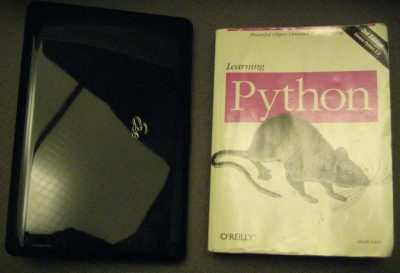
Second, another size comparison:

IMG_0334 (Modified)

That’s my (somewhat beat up, as I’ve been toting it for a while) copy of Learning Python, 3rd Edition. As you can see, the eee is only slightly larger than the book; you can’t see this in the photo, but it is substantially thinner. I wanted to get a weight comparison between the two as well, but I don’t have a scale that will work well for that purpose; manufacturer’s quoted weight for the eee is 2.9 pounds.

On to The Ubuntuing.

(more…)

3.1415926535897932384626433832795028841971693993751

Thursday, August 20th, 2009

The Japanese have set a new world’s record for calculating pi: 2,576,980,377,524 decimal places in 73 hours 36 minutes.

Those of you who know me well, also know of my long standing fascination with calculations of pi, and should realize I couldn’t pass this one up.

Project e: Part 1, the unboxing

Friday, August 14th, 2009

I’ve been wanting a netbook for a while now.

Why?

It isn’t because I’m unhappy with my MacBook; I love the MacBook (especially now that I’ve taken it up to 4 GB). I love it so much that the MacBook has almost become my primary desktop machine (pushing the beige G3 down on the stack; I’m now mostly using that for word processing and updating the SDC pages). Because the MacBook has become more of a primary machine, disconnecting everything to take it on the road has become an increasingly unattractive proposition.

What about the Nokia N800? Nice machine, very handy, very useful for checking email and some web browsing. Also great for running Maemo Mapper. But the N800 has been discontinued; while there’s a pretty active open source community right now, I don’t know how well that’s going to hold up in the future. Doing LINUX development on it is possible, but painful. And I’m getting to the point where I have trouble seeing the screen unless I zoom to 120% or 150%; doing that often messes up rendering in the browser.

What I wanted was a mid-size machine that I could use as a dedicated LINUX box, with a reasonably sized display, to do various things on:

  • sharpen my LINUX skills
  • penetration testing
  • Wi-fi hacking
  • learning Python
  • brushing up on my Perl, which has become rusty.

What I really wanted was one of the ASUS Eee PC 901 machines; the solid-state drive, form factor, and pre-installed LINUX were pretty attractive. But by the time I got ready to act, these machines had more or less vanished.

“Life is compromise”, said the Buddha. Or, if he didn’t, he should have. After the jump…

(more…)

Light blogging

Wednesday, August 12th, 2009

Blogging has been light this week because I’ve been down with a nasty cold. Plus I’ve been working on getting the SDC pages updated.

I did want to call out this Austin American-Statesman article about the goings-on at our local public radio station. Briefly, KUT cancelled two shows (“Paul Ray’s Jazz”, which ran twice a week, and “Phil Music”, which ran on Thursday) and replaced them with a new show, hosted by the station’s new music director. They also cut back the hours of the two hosts (Paul Ray and Larry Monroe). The end result has been vocal outrage on one side, and spin by KUT.

Several things stand out in this. There’s the sense of entitlement that many of the loud protesters apparently feel. (“How dare you cancel Paul Ray’s Jazz, even if only 300 people listen to in in a city of a million!”) There’s the relationship dynamic going on. (“Stop pledging to the station? Make them suffer financially for a decision I disagree with? I can’t do that!”) There’s the (possibly legit) complaint that the current station management is trying to make KUT sound more like (popular local radio station) KGSR. There’s the fact that KUT apparently has two HD radio channels. (Really? Do you have an HD radio? Do you know anyone who does? Do you know anyone outside the radio industry that gives a flying flip at a rolling doughnut about HD radio?)

Too many people in this world need to grow the heck up.

Since I promised light blogging, here’s a nifty little Flash simulation of the Michelson-Morley experiment, one of my all time favorite scientific experiments.

Hello feline, hello funtime…

Thursday, August 6th, 2009

By way of Lawrence: Hello Kitty Warhammer 40K miniatures. (Lawrence says he found those while searching for this, which I think came from a FARK Photoshop thread.)

The Texas Monthly “Eat My Words” web log provides a handy list of the burgers covered in their “50 Best Burgers In Texas” article. (The full article is subscriber-only.)

You may ask yourself, how many of the Austin burger places has the SDC been to? Well…

“2. Counter Cafe, Austin, Counter Burger”. Not yet.
“12. Cover 3, Austin, Chop-House Burger (with cheese and bacon)“. Not yet; we were actually kind of turned off by Cover 3, as it looks like a high-end (read: expensive) sports bar, which went in one of the SDC Spots Of The Damned. But we could get motivated to try the burger. (Edited to add: we finally got motivated to try the burger. Link goes to review.)
“14. Burger Tex II, Austin, Burgogi Burger”. Been to Burger Tex, were not all that impressed, but did not have the burgogi burger. Lawrence seems unenthusiastic about the prospect of a return visit, so I may have to go on my own. I admit I’m curious.
“16. Max’s Wine Dive, Austin and Houston, Kobe Beef Burger”. Not yet; Max’s Wine Dive is fairly new, and we haven’t scheduled it.
“26. Parkside, Austin, Cheeseburger”. Not yet.
“27. Black Sheep Lodge, Austin, Black Buffalo Burger”. Not yet.
“30. Roaring Fork, Austin, Half Ass Burger (also in San Antonio)”. Been to the Roaring Fork, like it, but have not tried the burger.
“37. Mighty Fine, Austin, Hamburger”. Yes.

Also on the list, but outside of Austin:
“3. Alamo Springs Cafe, Fredericksburg, Cheeseburger (with green chiles on a jalapeno-cheese bun)”. Somewhat off the usual path for us, but not out of the question.
“29. Mel’s Country Cafe, Tomball, Double Hamburger”. I think Lawrence has actually been here.
“38. Roadhouse, Bastrop, Jalapeno Cream Cheese Burger”. See #3.

DEFCON notes: Day 3, or “Killing Priest won’t bring back your G–d–n honey!”

Monday, August 3rd, 2009

Apparently, one of the pools at the Riviera was overrun by killer bees. The fake ATM has been well covered elsewhere.

Final set of quick takes:

“RAID Recovery: Recover Your PORN By Sight and Sound”: Technically, a pretty decent presentation on recovering RAID, building on Moulton’s previous presentations on the inner workings of hard drives and their recovery/rebuilding. (Those presentations are linked here: I’m actually pretty interested in the one on SSD drives.)
Key takeaways:

  • Many people don’t understand RAID levels; they think that RAID 0 actually offers some protection against data loss, or there’s no hurry to replace that one drive in the RAID 5 that failed. (The presenter seemed to believe that photographers are particularly bad about these things, perhaps based on bitter personal experience.)
  • If you have a RAID full of pictures, some sub-$100 tools, along with intelligent analysis of reconstructed images, can help you rebuild the array. Even if you don’t know what order the drives were in originally.

“Cracking 400,000 Passwords, Or How To Explain to Your Roomate why the Power Bill Is a Little High” (preview): Or, how to use John the Ripper, and how to optimize your JtR runs.
Key takeaway: Lists of previously cracked passwords are good fodder for JtR. Would you believe people use the same password on more than one site? Even better, you can use lists of previously cracked passwords to build JtR word mangling rules.

People who deserve a “Thank You” (part 1 of an ongoing series)

Monday, August 3rd, 2009

Joseph Hall, for his excellent set of instructions on setting up WireShark under OS X.

DEFCON notes: Day 2

Monday, August 3rd, 2009

Saturday was a little calmer than Friday from my perspective. Part of the reason for that may have been Adam Savage‘s talk (and the meet and greet afterwards) took a lot of folks out of circulation for two or three hours. (I didn’t go.)

More quick takes:

“Hacker vs. Disasters Large & Small”: Michael Schearer, who did the first part of the presentation, also did the Hacker In Iraq presentation. As a Naval officer, he went through SERE school, so he’s got some hands-on survival experience which makes him worth paying attention to. Schearer’s part of the presentation basically covered short-term wilderness survival (as in, “I’m cold and there are wolves after me.“) and was more practical. Renderman’s half of the presentation was a more long-term, “How do we survive and rebuild society after the Big One?”, philosophical presentation. (Edited to add: links to the final versions of the slides; Part 1, Part 2.)
Key takeaways:

  • “Hacker skills are largely compatible with the skills necessary to survive in the wilderness or during a natural disaster.”
  • “Don’t be squeamish about breaking or destroying something to help you stay alive.”
  • “You are not Jack Bauer, MacGuyver, or Survivorman; you need practice to survive.”

“Personal Survival Preparedness”: Nice guy, okay talk, mostly dealing with survival in an urban environment after some devastating event (Katrina or worse).

“Picking Electronic Locks Using TCP Sequence Prediction”: Excellent presentation, short, and scary. Brief summary: many electronic lock systems are IP based and the traffic on the network is not encrypted. This makes the locks vulnerable to a man-in-the-middle attack (to capture an unlock command) and a replay attack with a spoofed TCP sequence number (to replay the command). These attacks bypass the existing control software, so the spoofed unlock command leaves no audit trail. The author is a network admin at Texas State University; woo hoo! Greater Austin/San Marcos Metropolitan Area represent!

“Sniff Keystrokes With Lasers/Voltmeters”: Two pretty amusing guys with another excellent presentation. In the first half, they presented an attack on PS/2 keyboards with very simple hardware; all you need is a slightly hacked power cord connected to a common circuit with the computer in question on one end, and an ADC plus a micro-controller (for data acquisition, filtering, and storage) on the other and viola! In the second half, they outlined a acoustic-based attack that builds on previous research, combined with microphone hardware using freaking laser beams. As the authors said, “How cool is that?”
Key takeaway: “girls will melt when you show this…”

“Bluetooth, Smells Like Chicken”: Pretty much what I expected from the summary. Using software-defined radio gear (about $1000) you can monitor the Bluetooth frequencies. Bluetooth does frequency hopping over about 79 MHz, and the software-defined radio gear can only monitor about 25 MHz (max) at one time. But you can monitor one channel and use information from that packet to actually predict the frequency hopping cycle. The authors also presented a technique that allows aliasing of the entire Bluetooth spectrum to the 25 MHz available in the radio gear they were using without compromising the ability to extract packets. Finally, they discussed Bluetooth attacks using off-the-shelf sub-$10 hardware to sample and inject data.

Key takeaway: there is no longer any such thing as a non-discoverable Bluetooth device.

DEFCON notes: Day 1

Sunday, August 2nd, 2009

I’ve been running a little behind on these, but I’m trying to catch up. I’m also going to try to insert links to the actual presentations as they go up.

Quick takes:

“Is your IPhone Pwned?”: This was turned into a more general talk about the whole class of smartphones, including Windows mobile devices. They demonstrated one exploit that involves settings on Windows devices from some vendors. (Basically, the exploit involves misconfigured security settings that allow a remote computer to send malicious WAP push messages that the phone will accept.) Patching mobile vulnerabilities is difficult; there’s a lot of QA issues that have to be dealt with by each vendor for each platform, plus the FCC gets involved if you touch the radio code. Beyond that, the presenters spent a lot of time discussing the design of their Fuzzit tool for finding phone vulnerabilities. Key takeaway: the state of mobile security today is roughly equivalent to the state of network security as of 1999.

“Hacking With the iPod Touch”: Key takeaways:

  • There’s a lot of tools available for penetration testing on the iPod Touch if you’re willing to jailbreak the device. (Wilhelm’s presentation includes a long list of available tools. Did you know that you can run Perl, Python, and Ruby on the iPod Touch? Neither did I.)
  • Nobody gets suspicious if they see you fiddling with your iPod Touch. A full-sized laptop, or even a netbook, might be a different matter.

“That Awesome Time I Was Sued For Two Billion Dollars”: Jason Scott is a pretty good speaker, but this was sort of a “meh” talk. “Yeah, I got sued for two billion dollars by someone who is apparently mentally unbalanced (in the speaker’s opinion -DB) and the case got thrown out of court.” Key take away: Don’t let yourself be intimidated by legal (or legal-looking) documents.

“Three Point Oh”: Couldn’t get in to see Long’s talk.

“Something About Network Security”: Kaminsky’s talk this year concentrated on vulnerabilities in the PKI infrastructure, and specifically certificate attacks. I still think Kaminsky is the cat’s pajamas, but his talk this year seemed a bit off, compared to some of his previous talks (for example, the tunneling data over DNS hack).

I heartily endorse this event or product.

Saturday, August 1st, 2009

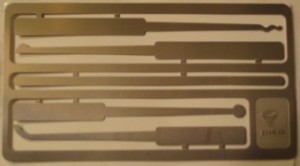
Pico, makers of fine FPGA development boards.

I haven’t actually worked with any of their products (though learning more about FPGAs is on my list of things I’d like to do) but the people they sent to DEFCON 17 were very nice. I even got two of their “business” cards.

IMG_0318

Someone’s getting one of these as a slightly late birthday present.