Archive for the ‘Food’ Category

My culture!

Friday, March 13th, 2020

They are appropriating it!
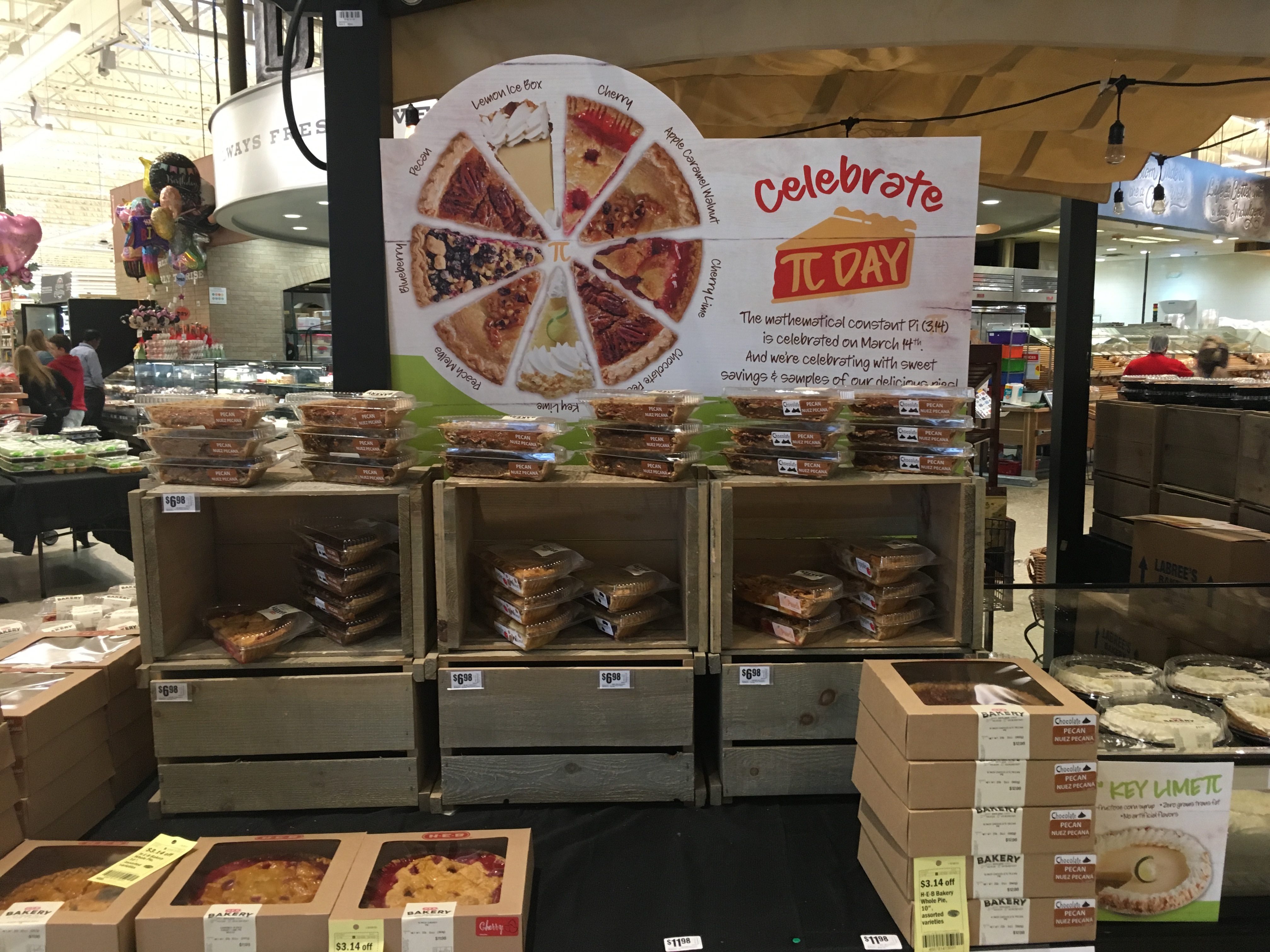
Seen at the HEB in Lakeway last night.

In other news, stuff’s getting serious: Buzzard Day in Hinkley, Ohio, has been “postponed”. It is not clear to me if anybody has conveyed this message to the buzzards.

Also, by way of Mike the Musicologist: the High Caliber gun show this weekend in Conroe has been cancelled by the city. I checked the Premier and Saxet web sites, and don’t see anything there about those shows. But none of these organizations is really good about updating their websites, in my opinion.

(For the record, I don’t see any grand conspiracy here to run gun shows out of business. I think it’s just precautionary. But I’m open to evidence otherwise.)

Also by way of MtM: Blue Bell has closed their “Visitor Center, Ice Cream Parlor, Country Store and Observation Deck” until further notice. The ice cream parlor and country store in Sylacauga are also closed until further notice.

And. of course, no bet with Lawrence on Gonzaga this year. That’s a shame, as I was pretty sure this was Gonzaga’s year.

This week in fraud.

Monday, January 27th, 2020

A couple of stories came to my attention over the weekend, and I thought they’d make an interesting diversion from the endless parade of obits.

1) Back in 1973, David Rosenhan (a social psychologist at Stanford) published what became one of the most famous papers in psychology. Summarizing:

Rosenhan himself and seven mentally healthy associates, called “pseudopatients”, attempted to gain admission to psychiatric hospitals by calling for an appointment and feigning auditory hallucinations…
All were admitted, to 12 psychiatric hospitals across the United States, including rundown and underfunded public hospitals in rural areas, urban university-run hospitals with excellent reputations, and one expensive private hospital. Though presented with identical symptoms, seven were diagnosed with schizophrenia at public hospitals, and one with manic-depressive psychosis, a more optimistic diagnosis with better clinical outcomes, at the private hospital. Their stays ranged from 7 to 52 days, and the average was 19 days. All were discharged with a diagnosis of schizophrenia “in remission”, which Rosenhan considered as evidence that mental illness is perceived as an irreversible condition creating a lifelong stigma rather than a curable illness.

(I would link to his paper, “On Being Sane In Insane Places” here, but I can’t find a trustworthy non-paywalled version. If someone else can, please leave a link in the comments and I’ll update.)

This caused a great deal of consternation in the profession, and led to the creation of the DSM and other changes.

Susannah Cahalan (the author of Brain on Fire: My Month of Madness, a book I haven’t read yet but plan to) got interested in Rosenham’s paper and the story behind it:

‘On Being Sane in Insane Places’ was the only significant scholarship he ever produced, and he lived off this famous paper throughout his career. It occurred to her that it would be fascinating to track down as many of the pseudo-patients as she could, and to explore the circumstances under which Rosenhan had come to undertake his study.

The Great Pretender: The Undercover Mission That Changed Our Understanding of Madness is her new book (it came out in November) about Rosenham and his experiment. I haven’t read it, so I can’t really spoil it, but the title probably gives away a lot:

With two and a half exceptions, even as skilful an investigative reporter as Cahalan was unable to locate the pseudo-patients. Rosenhan himself was easily identified as the first of them. His files included his admission as ‘David Lurie’ to Haverford State Hospital in Pennsylvania. (He was then teaching at Swarthmore College.) And internal clues in the files enabled her to track down Bill Underwood, who had been a Stanford graduate student at the time. Another pseudo-patient, Harry Lando, surfaced — once also a graduate student and now an academic — but he only half counts, for, as a usually overlooked footnote in Rosenhan’s paper recounts, one pseudo-patient had been dropped from the study, and this was he. As for the rest: nothing, nada, no trace.

In a larger sense, it scarcely matters, because Cahalan uncovered so much other evidence of Rosenhan’s malfeasance and lies. He claimed, for example, to have carefully coached his volunteers before sending them forth. Bill Underwood and Harry Lando emphatically denied this. Lando appears to have been dismissed from the study, not because he violated protocol, but because, as Rosenhan incredulously noted about his confinement, ‘HE LIKES IT!’ And then some of the things Lando reported about his experiences reappeared in the published paper attributed to a different pseudo-patient.
Most damning of all, though, are Rosenhan’s own medical records. When he was admitted to the hospital, it was not because he simply claimed to be hearing voices but was otherwise ‘normal’. On the contrary, he told his psychiatrist his auditory hallucinations included the interception of radio signals and listening in to other people’s thoughts. He had tried to keep these out by putting copper over his ears, and sought admission to the hospital because it was ‘better insulated there’. For months, he reported he had been unable to work or sleep, financial difficulties had mounted and he had contemplated suicide. His speech was retarded, he grimaced and twitched, and told several staff that the world would be better off without him. No wonder he was admitted.

In summary (this is the reviewer talking, not me):

…the evidence she provides makes an overwhelming case: Rosenhan pulled off one of the greatest scientific frauds of the past 75 years, and it was a fraud whose real-world consequences still resonate today.

2) Randy Constant was a farmer. He bought and sold orgainc grain, and raised fish commerically. In 2017, he was named to the list of “10 Sucessful Farmers to Watch” published by “Successful Farming”.

And about the same time he was named to that list, the FBI raided his home and businesses.

Records showed that in 2016 he sold 7 percent of all the corn labeled organic and 8 percent of all the soybeans carrying that designation. More than $19 million worth that year, $24 million the year before and so on every year before that back to 2010 at least.
It was impossible for him to have done that legitimately. He didn’t have access to enough organic crop acres to supply so many bushels.

With the FBI’s assistance, the USDA would go on to prove that Constant was a swindler on a grand scale: More than $140 million in fraudulent sales between 2010 and 2017 for grain that was likely worth half that.
The Star’s subsequent reporting found that, in fact, his scheme stretched back further than that, to 2007 or 2006.
Constant scammed grain buyers, meat producers and millions of American consumers for a decade or more. The organic beef and poultry countless Americans were eating during those years wasn’t organic after all.

And what did he do with the money?

Not only did he bankroll extravagant family vacations every summer — counting kids and grandkids, he’d treat a dozen to stays at luxury resorts like Hilton Head, South Carolina — Constant also admitted to using the grain sales money to pay for sex with prostitutes and wagering at casinos.
He took more than 20 trips to Las Vegas, often alone, during the seven-year period covered in his indictment. There he spent hundreds of thousands of dollars in illegal profits on gambling on the Vegas strip, hiring female escorts and providing financial support to three women with whom he had extramarital affairs.
He shared a bank account with one of them, and spent $110,000 on her car payments and other bills, a trip to Spain and surgery to enhance her breasts.
“During a roughly seven-month period in the course of the scheme,” Constant admitted in court records, “another account in my name and under my control incurred more than $250,000 in Las Vegas-related expenses.”

(As Lawrence said when I read him that quote, “The rest of it he just wasted.”)

The Kansas City Star piece is long, but I think it’s worth reading. It covers not just Constant and what may have motivated him, but also the flaws in the government’s system of certifying organic crops.

Constant pled guilty to one count of wire fraud and was sentenced to 10 years in prison. He committed suicide before his sentence began.

I heartily endorse this event or product. (#17 in a series)

Saturday, December 14th, 2019

Thirty Eight Pecans.

It’s a store. That sells pecans. He does wholesale and mail order all year, but he has a retail store (buried in the back of a strip center off of 183, next to an animal hospital) that’s open during the holiday season.

His selection is amazing: Tennessee Honey or Jack Daniels flavored pecans? Got them. Amaretto chocolate? Dark chocolate? Milk chocolate? Cajun? Just plain ones for baking? Got it all. Looking to ship a sampler to someone? Just go in: he’ll take care of the packing and shipping. All you need is an address (and payment).

We’ve been there twice since the season started, picking up pecans for ourselves and to ship to relatives. The thing that finally pushed me into writing an endorsement, though, is this: Mark, the guy who runs the place (origin story here) is incredibly nice and flexible. It seems like everything we asked for (and granted, we didn’t ask for anything really exotic and outlandish), his response was, “Sure, I can do that,” as well as, “Sure, I can get those in the mail today. I’m going to the post office anyway.”

This is another one of those people who I want to have trouble sleeping at night: because all of those $100 bills stuffed in his bedding are making too much noise.

My impression is that he’s going to be open next week (if you want to do last minute shopping), closed Christmas week, and will be open again January 2nd. After the first of the year, he plans to have a fire sale to clean out inventory until he opens up again next winter.

If you don’t have a convenient Knights of Columbus branch selling nuts, or even if you do, throw some business Mark’s way. I want these people to stay around and prosper: they’re really good folks.

(I didn’t get anything for writing this endorsement. Not even free samples. I just wrote it because I really like Mark, and his store.)

Callbacks to old jokes are the best kind of humor.

Tuesday, September 17th, 2019

I brought in some cookies for the office yesterday.

The good news is: Choco Leibniz are fairly cheap on Amazon with prime shipping.

Bad news 1: that package is pretty small.

Bad news 2: Amazon stuffed the package into my mailbox, where it sat in the Texas heat for several hours until I got home, causing the Choco in the Choco Leibniz to melt. If I do this again, I’m either going to have to find a local gourmet store that stocks them, or wait until winter in Texas, when the temperature drops below 90 degrees.

(Callback.)

Obit watch: July 26, 2019.

Friday, July 26th, 2019

P. Rajagopal, prominent Indian restaurateur.

He founded Saravana Bhavan, a chain of vegetarian restaurants based on Southern Indian cooking:

The restaurant focused on South Indian cuisine, serving freshly cooked dosas, a type of crispy golden rice and lentil crepe. As his chain expanded, the dish would earn him the nickname the “dosa king” in the media. He also sold snacks like idlis, soft round steamed rice cakes, and vadas, a kind of lentil doughnut, serving them with freshly cooked chutneys.
As his tasty, inexpensive food gained a following, his restaurant eventually turned a profit, enabling him to open branches. In 2000, with about 20 locations in India, Saravana Bhavan ventured overseas, opening in neighborhoods where the Indian diaspora had a strong presence. The chain expanded first into Dubai, then to cities like New York, London and Sydney, Australia. Though it operates under a franchise model, its chefs continue to come from Chennai.

But, as you might have guessed, there’s more to the story. Mr. Rajagopal was also a convicted murderer and was trying desperately to stay out of prison when he died.

Apparently, he desperately wanted to marry the daughter of one of his assistant managers: she wanted nothing to do with him and took up with another guy. (Mr. Rajagopal is described in the obit as a “strict disciplinarian”, so I imagine that must have make the work relationship awkward.) Anyway, Mr. Rajagopal did not take kindly to being rejected…

In 2001, after several attempts to separate the couple, associates of Mr. Rajagopal forced the man into a car and drove off. His body was found in a resort town in the Western Ghats mountain range. He had been strangled.

At first, Mr. Rajagopal was convicted of “culpable homicide” in 2004 and sentenced to 10 years in prison. However, he didn’t serve any time, for medical reasons.

In 2009, an Indian high court upgraded the conviction to murder, and the sentence was changed to life in prison. He spent the rest of his life trying to avoid jail, until India’s Supreme Court rejected his final appeal this month.

If you’re confused about how a court can “upgrade a conviction to murder”, well, I am, too. But I freely admit to being unfamiliar with the Indian legal system.

Ill health had kept Mr. Rajagopal away from his business in recent years. He had diabetes and hypertension and also had a stroke. By the end of his life he was almost completely blind.

He was 71 when he died.

Obit watch: June 3, 2019.

Monday, June 3rd, 2019

Leah Chase, New Orleans restaurateur.

I haven’t managed to eat at Dooky Chase yet, though I have heard of it (probably by way of Calvin Trillin). As much as I prefer to link to local obits, I like the way the NYT puts it:

Mrs. Chase possessed a mix of intellectual curiosity, deep religious conviction and a will always to lift others up, which would make her a central cultural figure in both the politics of New Orleans and the national struggle for civil rights. “She is of a generation of African-American women who set their faces against the wind without looking back,” said Jessica B. Harris, who is an author and expert on food of the African diaspora and who said Mrs. Chase treated her like another daughter. “It’s a work ethic, yes, but it’s also seeing how you want things to be and then being relentless about getting there.”

Mrs. Chase was as compassionate as she was strict, always adhering to a code shaped in large part by her Catholic beliefs. She held up Gen. George S. Patton of World War II fame as a hero and was a fan of baseball, which she often used as a metaphor.
“I just think that God pitches us a low, slow curve, but he doesn’t want us to strike out,” she said in a New York Times interview. “I think everything he throws at you is testing your strength, and you don’t cry about it, and you go on.”

Mrs. Chase believed in corporal punishment, opposed abortion and believed women should dress modestly. But she was always a champion of women, especially young women coming up in the kitchens of America’s restaurants. Her frequent advice to them was, “You have to look like a girl, act like a lady, think like a man and work like a dog.”

I love this, too:

During that period, Mrs. Chase started catering the openings of fledgling artists so they could offer hospitality to people who had come to admire – and, perhaps, buy – their creations. She helped them pay their bills, and she hung their works in the restaurant.
This love of art, born when she studied art in high school, led to service on the boards of the New Orleans Museum of Art and the Arts Council of New Orleans. Mrs. Chase also sat on the boards of the Louisiana Children’s Museum, the Urban League of Greater New Orleans and the Greater New Orleans Foundation.

Mrs. Chase regularly provided food for nonprofit organizations’ fundraisers and refused to submit bills, said Morial, the widow of one New Orleans mayor and the mother of another.
“She provided food for the Amistad Research Center and would not take money. That was her contribution,” said Morial, an Amistad board member. “We’d tell her this was a fundraiser. She said, ‘I know, and you need all the money you can raise.’”

My feelings about baseball are well known, but I thought this was an interesting obituary: Marc Okkonen.

Mr. Okkonen, a commercial artist and baseball aficionado with an appreciation for vintage apparel, spotted flaws in the purported uniforms of the Pittsburgh Pirates and Chicago Cubs and wondered why they were not precise replicas of the originals from 1939, when the movie takes place. Given how thoroughly documented baseball’s history is, he thought, accurate details would not have been too difficult to uncover.
But, to Mr. Okkonen’s surprise, he could find no single volume containing images of historic uniforms, so he set out to fill that void. He spent the next five years poring through books, microfilms and archives, including those at the Library of Congress and the Baseball Hall of Fame, to find images of every home and road uniform worn by all major league teams, starting in 1900.

And then he wrote that book: Baseball Uniforms of the 20th Century: The Official Major League Baseball Guide. This is the kind of obsessive historical study that I find admirable, in the same way that (for example) some people document the minute details of Smith and Wesson history…

(Eight days and a wake-up in country, and then I’m off to the S&WCA symposium.)

Roky Erickson, noted psychedelic musician with the 13th Floor Elevators. I wish I had more to say about this, but I pretty much missed the psychedelic era. Also, the treatment of Roky Erickson (and Daniel Johnston) locally seemed, to me, to be kind of “let’s point and laugh at the weirdo”. Not everyone was that way: I’m sure there were some people who were motivated by compassion and love of the music, but I felt like that was an undercurrent running through the scene. Perhaps some of my musician readers will have more to say on the subject.

(Edited to add 6/4: NYT obit for Mr. Erickson.)

Last and least: infamous heroin dealer Frank Lucas, whose life was adapted into “American Gangster”.

Richard M. Roberts, who led the prosecution of Mr. Lucas in New Jersey, had befriended him in recent years but was under no illusions about what he did long ago. “In truth,” Mr. Roberts told The New York Times in 2007, “Frank Lucas has probably destroyed more black lives than the K.K.K. could ever dream of.”

Random notes: May 13, 2019.

Monday, May 13th, 2019

I’ve avoided discussing the recent NRA issues because, frankly, I don’t trust anybody to cover them fairly and objectively. If you want to read a take on what’s going on, though, Lawrence put up a post last week on his blog: if you’re not a regular reader there, you might want to check it out.

Also brought up by Lawrence, though this was just a quick hit in the Linkswarm: the New Orleans Times-Picayune was bought out by The Advocate, and the entire Times Picayune staff was laid off. The NYT has a considerably more detailed story on what happened and why, if you care about New Orleans newspaper wars. Personally, I pretty much relied on nola.com for anything involving the city, so I’ll be interested in seeing what changes.

(Also, good to know that there are still places where you can get Baked Alaska.)

Hoplobibilophilia.

Tuesday, April 30th, 2019

My birthday was a week ago last Saturday (April 20th).

You know what this means, right?

Right. I’ve been buying books.

I ordered some things off of my Amazon wish list, since there were several items available used in the right combination of price and condition. Right now, I’m reading Tuchman’s Practicing History: Selected Essays: since that’s a collection of shorter work, I’m also planning to start Five Came Back: A Story of Hollywood and the Second World War and alternate the two for variety.

(And, yes, I kind of want to see the Netflix series based on Five Came Back. Between that and “The Highwaymen”, I’m really tempted to get a Netflix trial, even though I refuse to pay for television.)

(Other things that were in the Amazon batch: The Scientific Sherlock Holmes: Cracking the Case with Science and Forensics, which won an Edgar a few years back. The Pigeon Tunnel: Stories from My Life. The Life You Save May Be Your Own: An American Pilgrimage, for your obligatory Catholic content (CathCon?). More seriously, I like a lot of O’Connor, I know Rod Dreher is a big Walker Percy fan and I’d like to understand why, and I’m kind of interested in Merton. (Though, going back to Mr. Dreher again, I’m not sure now that I want to read Merton.) And The Infernal Library: On Dictators, the Books They Wrote, and Other Catastrophes of Literacy.)

Mike the Musicologist came up Friday night and we spent the weekend running around. We had a very good joint birthday dinner (Lawrence‘s is a few days before mine) at Lonesome Dove.

After dinner, we went back to Lawrence‘s and watched the 1943 “Stormy Weather“. “Stormy Weather” sort of presents itself as a loose “biography” of Bill “Bojangles” Robinson (renamed “Bill Williamson” for the film). In truth, the biographical elements are an extremely thin skeleton…upon which is hung a whole bunch of fantastic musical performances by Robinson, Lena Horne, Cab Calloway, Fats Waller, the Nicholas Brothers, and others.

(I love this entry from Wikipedia about the Nicholas Brothers: “Gregory Hines declared that if their biography were ever filmed, their dance numbers would have to be computer generated because no one now could emulate them.“)

Unfortunately, our plans for Sunday fell through (they caught the kangaroo) but we were able to spend the afternoon talking about kitchen remodeling with some friends of ours. Yes, this is the exciting life of a 54-year-old.

I took Monday off (another perk of being a full-time Cisco employee: you get a free day off on or around your birthday) and went running errands with Mom. This involved stopping at both the Round Rock and central Half-Price Books locations. And HPB sent me a 15% off your total purchase coupon for my birthday. And it just so happened that they had a whole bunch of interesting gun books…

(more…)

Happy Pi Day!

Thursday, March 14th, 2019

Yes, there is pie: a bunch for work, and a bunch more to take down to the CPA class tonight.

Obit watch: February 13, 2019.

Wednesday, February 13th, 2019

Rick Schmidt, former owner of Kruez Market in Lockhart.

Kreuz Market first opened in 1900. Rick’s father, Edgar “Smitty” Schmidt, purchased it in 1948, and Rick and his brother Don Schmidt bought the legendary Lockhart barbecue restaurant from their father in 1984. Don retired from the family business in 1997, and in 1999, Austin-native Rick relocated Kreuz Market from its previous location on Main Street to Colorado Street, near Town Branch creek, following a public dispute with his sister, Nina Sells, who inherited the old brick building on Main Street.
Sells converted the original Kreuz Market location into Smitty’s Market, while Schmidt opened his massive, red-brick building about a mile up the road. The family feud made headlines in Austin and landed the family on an episode of the CBS newsmagazine “48 Hours.″

Pork chop sandwiches!

Friday, February 8th, 2019

A Florida Woman is facing a domestic battery charge after allegedly clobbering her boyfriend in the face with a frozen pork chop during a dispute Friday night in their residence.

Remember, folks: when guns are outlawed, only outlaws will have frozen pork chops.

(Hattip for the submission: Mike the Musicologist. We also would have accepted his suggested title: “Roald Dahl, call your office, please.” even though that’s not quite technically accurate. Hattip for the title.)

Also by way of Mike:

Boston cop on leave after service weapon allegedly stolen by strippers

Strippers. Always the strippers.

A Boston cop who had his city-issued gun allegedly stolen by two strippers after a night out bar-hopping last week in Rhode Island is not being identified because he is “a victim,” police told the Herald today.

Note that the arrest report values the Glock at $5,000. Should we be calling the unnamed police officer “The Man With the Golden Gun” from now on?

Headline of the day.

Wednesday, February 6th, 2019

Autopsy: Man died of meth overdose before being eaten by bear at national park

Drugs are bad, kids. Mm’kay?

(Obligatory.)

Tweet of the day.

Tuesday, January 8th, 2019

Mostly for this followup:

You don’t tug on Superman’s cape…

Friday, December 7th, 2018

…and you don’t mess around with The Joy of Cooking.

Shot: Brian Wansink, a professor at Cornell University (he runs the “Food and Brand Lab”) published a paper in 2009: “The Joy of Cooking Too Much”.

…Wansink and his frequent collaborator, the New Mexico State University professor Collin R. Payne, had examined the cookbook’s recipes in multiple “Joy” editions, beginning with the 1936 version, and determined that their calorie counts had increased over time by an average of forty-four per cent.

The people currently behind Joy were a little upset by this, and a little skeptical. But they didn’t really get fed up until 2015. They started looking at Wansink’s research and found that some of his claims didn’t quite add up.

Recently, Buzzfeed came into the picture:

Academic standards call for researchers to articulate a hypothesis ahead of time, and then to conduct an experiment that produces data that will either prove or disprove the hypothesis. Lee’s article—which was based on interviews with Cornell Food and Brand Lab employees, and also private e-mails from within the lab, which were obtained through a public-records request—showed that Wansink regularly urged his staff to work the other way around: to manipulate sets of data in order to find patterns (a practice known as “p-hacking”) and then reverse-engineer hypotheses based on those conclusions. “Think of all the different ways you can cut the data,” he wrote to a researcher, in an e-mail from 2013; for other studies, he pressed his staff to “squeeze some blood out of this rock.” One of Wansink’s lab assistants told Lee, in regard to data from a weight-loss study she had been assigned to analyze, “He was trying to make the paper say something that wasn’t true.”

Here’s the Buzzfeed article.

And here’s chaser #1: Wansink’s paper has been retracted. Per “Retraction Watch”, this is retraction number 17 for Wansink.

Chaser #2: Wansink has been found guilty of academic misconduct, and has “resigned” effective June 2019.

In a statement, the university told BuzzFeed News that Wansink was found to have “committed academic misconduct in his research and scholarship, including misreporting of research data, problematic statistical techniques, failure to properly document and preserve research results, and inappropriate authorship.”

Random notes: November 18, 2018.

Sunday, November 18th, 2018

A few things I’ve stumbled across over the past couple of days:

“I Found the Best Burger Place in America. And Then I Killed It.” In which the author visits 30 cities, eats 330 burgers, names a burger place in Portand as having the best burger in the country…and five months later, the places closes.

Each time I was there, my story would somehow find a way into conversation, like the one with my Lyft driver who asked if I liked burgers. Yes, I said tentatively. “Well, we had a great one here,” he said, as we drove over the Burnside Bridge. “But then some asshole from California ruined it.” Or the time, while sitting at the bar at Clyde Common, the bartender came up to me and in a soft, friendly voice inquired if I’d planned on closing any more burger restaurants while I was in town.

I like this story: it’s a good discussion of the impact of criticism on dining establishments, especially smaller ones. But it’s also frustrating: as it turns out, there was more going on with the burger place than just simply being named “best burger in the country”.

Recently retweeted by Popehat:

I don’t like and don’t read the Huffington Post. But this (also by way of Popehat):

It was still dark outside when Amanda woke up to the sound of her alarm, got out of bed and decided to kill herself. She wasn’t going to do it then, not at 5:30 in the morning on a Friday. She told herself she would do it sometime after work.

Glybera is a drug developed in Canada. It’s a hugely effective treatment for a rare genetic condition, lipoprotein lipase disorder. People with this disorder can’t metabolize fat. Their blood literally turns white from all the suspended fat in their bloodstream.

One round of treatment with Glybera can fix this genetic condition. Only 31 people have ever been treated with the drug, and it is no longer available.

Why? One possible reason: a round of treatment costs one million dollars. (But a round of treatment, as far as anyone’s been able to determine, is a permanent cure. This is a drug that literally edits genes.) And this isn’t a “oh, health care in the US stinks” story: the drug was only used in Canada and Europe, pretty much on an experimental basis, before it was pulled.

On the historic significance of “Hee Haw”: