Robert Hogan. Man, he was in every damn thing: as the headline notes, his career stretched from “Peyton Place” to “The Wire”, with stops along the way at the various “Law and Order” franchises, “Quincy, M.E.”, “Alice”, “Barnaby Jones”, “The Rockford Files”, “Richie Brockelman, Private Eye”, the good “Hawaii Five-O” and many other series…
…yes, including “Mannix”. (“The Crime That Wasn’t”, season 4, episode 18)
Buddy Van Horn. He has 109 credits in IMDB for stunt work: many of those were as Clint Eastwood’s stunt double or as a stunt coordinator on Eastwood movies.
He also directed three Eastwood movies: “Any Which Way You Can”, “Pink Cadillac”, and “The Dead Pool”.
I’ve actually bought a fair number of used gun books over the past few months. I didn’t bother writing about them here because they were pretty much all semi-crappy copies of books that I bought for reading purposes, not really worthy of a blog entry.
This is something I ran across today at Half-Price Books that I found interesting for more than one reason.
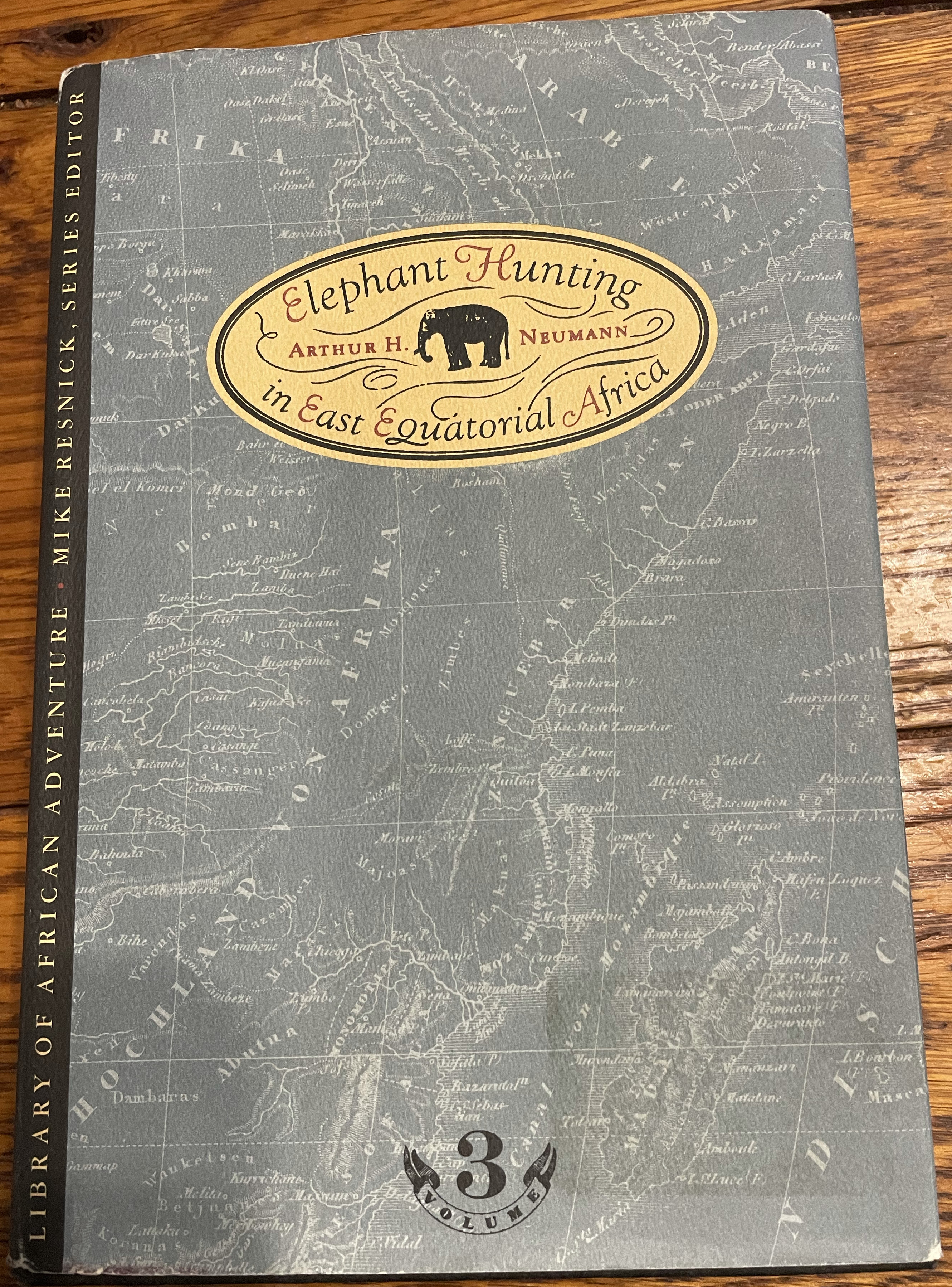
Elephant Hunting in East Equatorial Africa by Arthur H. Neumann. This is a reprint of the original 1898 edition, and volume 3 in the “Library of African Adventure” series from St. Martin’s Press. It has a little wear to the top and bottom of the dust jacket, but not too bad, and was purchased for about half of what “good” copies are going for on Amazon.
The other reason I found this interesting: you know who edited the “Library of African Adventure” series?
No, not that guy: he had his own series. The “Library of African Adventure” was edited by…noted SF writer Mike Resnick. Which is no great shock, as Resnick wrote extensively about Africa: it was simply an unexpected find.
Now I want to find the other volumes, especially since I’ve completed my Capstick set.
There is also something called “Resnick’s Library of African Adventure” that comes up when you search Amazon. I’m not 100% sure it is the same series – I suspect it is, but the bibliographical information on Amazon is scant, and the covers seem…less subdued.
I kid you not. Before he was “Maxwell Smart”, he served in the Marines during WWII. He fought (and was wounded) in the battle of Guadalcanal. He also came down with “blackwater fever”, and was medically evacuated to New Zealand, where he was hospitalized for over a year. After that, he served as a drill instructor until 1945.
Blackwater fever is a complication of malaria. From what I’ve picked up, red blood cells burst and release hemoglobin, which enters the kidneys and can cause them to fail. I’ve seen suggestions that quinine either caused it, or was a contributing factor: now that we have other anti-malarial drugs, the incidence of blackwater fever has decreased.
A lot of those old-time African hunters came down with blackwater fever at one time or another: the folk remedy (which seems to have worked for many of them) was…massive consumption of champagne. I would think that would overload the kidneys and make things worse, but enough of those guys seem to have survived (the mortality rate is claimed to be 90%) that maybe there was something to it…?
Father O’Callahan was a good Boston boy. Shortly after he graduated from high school in 1922, he signed up with the Jesuits.
He was ordained as a Jesuit priest in 1934. Along the way, he picked up a BA and a MA from St. Andrew’s College, “specializing in mathematics and physics”. He was a professor of math, physics, and philosophy at Boston College for 10 years (1927-1937), then he went over to Weston Jesuit School of Theology for a year. From 1938 to 1940 he served as the director of the math department at the College of the Holy Cross.
He enlisted in the United States Navy Reserve Chaplain Corps in August of 1940 as a lieutenant junior grade. But I gather he was pretty good at his job: by July of 1945 he had reached the rank of commander. He participated in Operation Torch and Operation Leader.
On March 2, 1945, Commander O’Callahan reported to the aircraft carrier USS Franklin.
On March 19, 1945, the Franklin was hit by two bombs from a Japanese aircraft. The bombs started a massive fire on the carrier deck.
There is a short documentary, “The Saga of the Franklin“, that you can find on the Internet Archive.
Commander O’Callahan was offered the Navy Cross, but refused it. There is speculation that his refusal had to do with “his heroic actions on USS Franklin highlighted perceived lapses in leadership by the ship’s commanding officer, Captain Leslie E. Gehres, which reflected poorly on the Navy”. Wikipedia claims there was a controversy at the time, Harry Truman stepped in…
Father O’Callahan retired from the Navy in 1948 and headed the math department at The College of the Holy Cross. He also wrote a book, I Was Chaplain on the Franklin (affiliate link).
He died in 1964 at the age of 58, and is buried in the Jesuit cemetery at The College of the Holy Cross. The destroyer USS O’Callahan was named after him.
One of Father O’Callahan’s students at Holy Cross before the war was John V. Power, who also received the Medal of Honor (posthumously).
If it hasn’t already been written, somebody could get a good book out of the history of comedy records roughly mid-century (I’m guessing 1950-1975, maybe slightly later). Especially if they went into the history of “blue” or “party” records: not just Ms. Warren, but Redd Foxx, Moms Mabley, Rudy Ray Moore, and lots of other now mostly forgotten folks.
Lawrence sent over two: Shane Briant, British actor. (“Frankenstein and the Monster from Hell”, “Cassandra”, “The Picture of Dorian Gray”)
My turn. Readers should be aware up front that I have never served with any branch of any military anywhere in the world: my opinions about war movies basically come down to “Did I enjoy it? Did I think it was a good story, well told?” Not necessarily “Were they using a period correct AR platform? Were the missile launch scenes accurate?”
If you think I’m ignorant and want to skip to the next entry, go right ahead. Something else will be coming along soon.
With my lack of qualifications out of the way, my takes on the list. The Art of Manliness first:
“Saving Private Ryan”: I’ll get this out of the way up front. Never seen it. I guess I wouldn’t mind seeing it, but I feel like it was one of those movies that was so overhyped at the time, it triggered my rejection gland. (See also: “E.T.”)
“The Great Escape”: Also have not seen it. Do have the DVD, it is on our list, and I do want to watch it soon.
“Das Boot”. Saw the director’s cut in a theater with Lawrence, loved it.
“Glory”: Never seen it. Unlike Lawrence, I am not a big Civil War buff, so this movie has little appeal for me.
“Apocalypse Now”: I liked it, but I need to watch it again. Is it a good war movie? I don’t know: Aesop and others don’t seem to think so. Is it a good movie? I thought so.
“The Thin Red Line”: Have not seen it. Primarily because I have some friends who went to see it in a theater and walked out.
“Patton”: one of my favorite movies of all time.
“1917”: Didn’t get around to seeing it in theaters, would not mind seeing it. But putting a movie from 2019 on the best list? Really? Could we get some historical distance here? Perhaps a five or ten year gap before we start calling movies “best”? (Also, I have seen “All Quiet on the Western Front” and “They Shall Not Grow Old”, both of which are excellent films. Frankly, I am shocked that neither Borepatch or Aesop mentioned the latter.)
“The Longest Day”: saw large parts of it on TV when I was younger, would not mind seeing the whole thing again. But it strikes me as one of those relics of the old Hollywood system where everybody is in it, and it may be just a little overstuffed.
“The Bridge on the River Kwai”: haven’t seen it, believe it or not. Very much want to, and it is on the list.
Aesop’s list:
“Zulu”: Heck to the yes!
“The Great Escape”: See above.
“Patton”: See above.
“Lawrence of Arabia”: also heck to the yes!
“Blackhawk Down”: Saw that in a theater with Lawrence as well. Am a huge fan of the book. Another damn fine movie.
“Hamburger Hill”: have not seen it, would be interested in seeing it.
“Das Boot”: see above.
“Gettysburg”: have not seen it, see my comments above on “Glory”.
“Braveheart”: have not seen it. I believe it is on our list as an Oscar winner.
“A Bridge Too Far”: watched it recently with Lawrence and the gang. It’s…okay. But to my taste, it was way too long.
Borepatch:
“Glory”: see above.
“Stripes”: it has been a long damn time since I’ve seen that, and I need to watch it again. I do agree with Borepatch’s comments that comedy doesn’t get any respect.
“Band of Brothers”: haven’t seen anything but clips on YouTube, but those make me want to watch the series. Once Lawrence and I get some of our other TV series out of the way, that may be next on the list.
“Hogan’s Heroes”: also been a long damn time since I’ve seen an episode of that, even though it is on MeTV.
Things that I’m surprised are missing from all three lists:
“12 O’Clock High”. The movie, though what I have seen of the TV series is also good. But I think “12 O’Clock High”, like “Patton”, would go on my top ten list.
“The Hunt For Red October”: yes, I think this qualifies as a war film.
“They Shall Not Grow Old”: see above.
“All Quiet on the Western Front”: see above.
“300”: I’m more just surprised that nobody mentioned it, rather than being willing to argue that it’s actually great. (I enjoyed it, but I’m not sure I would call it “great”.) I’d be happy to have a discussion with Aesop and Borepatch about this one.
“Paths of Glory”: you didn’t like “Full Metal Jacket”? How about this one? (I think “FMJ” is about half of a good movie.)
“Kelly’s Heroes”: I think I didn’t see “Great Escape” because this one was the one that was all over late-night TV when I was growing up. I have fond memories of it, but need to re-watch it.
“The Wind and the Lion”: I think it counts.
“Run Slient, Run Deep”
“The Alamo”: the good one, with John Wayne.
“Mister Roberts”: speaking of comedy not getting any respect…also, I think there’s a good leadership lesson in this one. (Don’t be like James Cagney.)
I feel we’ve reached the point where we are, more or less, out of jail: restrictions are being relaxed, I am fully vaccinated, and I’m seeing many businesses doing away with mask requirements.
I originally started this as a diversion while we were all on home confinement. If you were locked in, what did you have that was better to do than watch weird old videos that popped up in my YouTube recommendations? Now, it seems like this…feature? recurring trope?…has gone beyond what originally motivated it. This seems like a good time to wrap it up.
Mostly. I’m holding a couple of things in reserve for days in the future. And if we’re hit by a new variant and have to lock ourselves in again, I reserve the right to restart this.
I have something special I want to post, as the final entry, and also as a tribute.
Kevin Clark. He was the drummer in “School of Rock”. According to reports, he was hit and killed while riding his bicycle home.
Samuel Wright. He voiced “Sebastian” in “The Little Mermaid”, and also did a lot of Broadway work. He also played “Mufasa” in the original cast of “The Lion King” on Broadway.
Bonus #2: Couldn’t get away without one more bit of random gun crankery. This is part of an episode of “Wild West Tech” (an old History Channel show) talking about holsters.
Edited to add: My mother and stepfather lived in Virginia during part of the time John Warner was a senator. My mother is kind of upset at the press coverage: she feels it focuses too much on Sen. Warner being Number Six in the long line of Liz’s husbands, and not enough on his accomplishments as a Senator. One of the things she mentioned to me: there was a time when they were having trouble getting money out of SSI for my stepfather. She called Senator Warner’s office and spoke to one of his people, who said, “Oh, I know somebody over there. Let me make some calls.”
I’m moving Travel Thursday to Tuesday this week, for reasons. I have something else coming up for Thursday.
Today: “New Horizons: Argentina” from our friends at Pan Am. We’ve done South America in general previously, but we haven’t focused specifically on Argentina.
This apparently dates to 1965, so I can’t really make any “Evita” jokes here, alas.
Bonus #1: But I can put up something relevant to Lawrence’s interests, and maybe Andrew’s as well: “MOUTH-WATERING STEAK at an Argentine Steakhouse in Mar del Plata, Argentina”.
This is also the last entry in MilHisMon. Sort of. It’s complicated.
Somewhere in my collection of books on leadership, I have a thin little pamphlet that I picked up at the National Museum of the Pacific War: “Arleigh Burke on Leadership”.
“Saluting Admiral Arleigh Burke”, circa about 1961 (around the time he retired, after three terms as Chief of Naval Operations).
Bonus #1: This might be the last chance I get to do one of these. Plus: CanCon!
“Canadair CF-104 Starfighter”.
Bonus #2: And as long as I’m taking last chances…”Secrets of the F-14 Tomcat: Inflight Refueling” from Ward Carroll.
As a side note, which I learned from Mr. Carroll this past weekend, did not know previously, and don’t really have a good place to stick it: one of Donald Trump’s final pardons was granted to Randall “Duke” Cunningham.
Bonus #3: A documentary about “Operation Blowdown”.
“Operation Blowdown”? Yes: back in 1963, the Australian military decided to simulate a nuclear blast in a rain forest, just to see what conditions would be like afterwards. Because, you know, why the heck not?
A device containing was detonated to partially simulate a ten kiloton air burst in the Iron Range jungle. The explosives were sourced from obsolete artillery shells and placed in a tower 42 metres (138 ft) above ground level and 21 metres (69 ft) above the rainforest canopy. After the explosion, troops were moved through the area (which was now covered in up to a metre of leaf litter), to test their ability to transit across the debris. In addition, obsolete vehicles and equipment left near the centre of the explosion were destroyed.
For the final Science Sunday, I thought I’d go back to one of my favorite topics – computing history and computer science – and cover two companies whose machines I find fascinating.
“Cray Research at Chippewa Falls – A Story of the Supercomputer”.
I apologize for the quality on this one: it is from 1976, but I think it is worthwhile because…Seymour Cray introduces the Cray-1.
Bonus: During this week’s episode of one of the podcasts I listen to, one of the hosts made a reference to the Connection Machine. The other two hosts had never heard of the Connection Machine, so they were part of that day’s lucky 10,000.
For those of you who fall into the same boat, this is a fairly recent (so higher quality) talk by a guy named Dan Bentley about the Connection Machine and the concept of “Data Parallel Algorithms”.
There’s someone on the ‘Tube who has a channel, “Demolition Dave Drilling and Blasting”. I think he’s ‘stralian, mate.
In this video, Dave reviews a Chinese generator.
How do you say “Harbor Freight” in Australian?
Mike the Musicologist sent me this: it is a little more recent than I’d like, and I think I’ve seen it linked on Hacker News, but I still think it’s worth highlighting here.
“What Really Happened at the Oroville Dam Spillway?” from Practical Engineering.
Finally, here’s something that’s just about 25 minutes long, and that I think some folks will enjoy: “The Unfortunate History of the AMC Pacer”.
“There’s a fine line between uniqueness and strange.”