Obit watch: June 26, 2013.

June 26th, 2013

Alan Myers passed away on Monday, though I did not find out about it until today.

Myers…

…was Devo’s third drummer, joining in 1976 before the band released its Brian Eno-produced debut, “Q: Are We Not Men? A: We Are Devo!” and remained in the band until the mid-’80s. He played on all the Akron, Ohio-born, Los Angeles-based Devo’s most mind-bending material, including the deconstructed version of “(I Can’t Get No) Satisfaction” that first propelled them onto the national stage, “Whip It” and “Girl U Want.”

I’m trying to find some appropriate links. I’m not sure this one shows Myers or the rest of the band well, but it is from the right era as well as being one of my favorite Devo songs. Plus, does anyone remember “Fridays”?

And now, here’s something we hope you’ll really like:

Also, a shoutout to my homeboys at Popehat:

Random notes: June 26, 2013.

June 26th, 2013

Richard Matheson obits: NYT. Lawrence. LAT.

Please refrain from tasting the knob.

(Note that the musical in question, “Somewhere in Time” is based on the movie, which in turn was based on a novel, “Bid Time Return”, by Richard Matheson. I’m not linking to Amazon, but you should be able to find the novel easily: the cheaper editions are listed under “Somewhere in Time”, and the editions carrying the original title are pricy.)

You know what NYC needs? Strict pen control. And perhaps strict costume control, too.

Busking being serious business in Midtown, long-simmering tensions between the box man and one of his rivals erupted into violence on Friday night, when the box man was said to have stabbed a competing panhandler, Wayne Semancik, five times in the head and chest with a pen.

More:

…a photograph in The Daily News showed the police interviewing Alien and Predator as witnesses after the episode.

(Hotlinked: click on the photo to read the Daily News article.)

Random notes: June 25, 2013.

June 25th, 2013

The NYT, LAT, and WP have not yet published obits for Richard Matheson. However, the A/V Club has a very nice tribute.

I feel kind of blocked when it comes to paying tribute to Mr. Matheson. The one thing I can say is: whenever I was trying to think of “who wrote this story?” – the box with the button, the family fleeing their home planet, the girl who falls into the fourth dimension – at least seven times out of every ten, the story I was trying to think of was written by Richard Matheson. It is impossible to overstate the depth of his influence on the genre.

In other news, I’m sure some of my readers remember the 2003 documentary Capturing the Friedmans about the child abuse convictions of Arnold and Jesse Friedman. Since the documentary was released, there’s been a lot of back and forth about the guilt or innocence of the Friedmans, leading up to an investigation by the Nassau County district attorney.

…it concluded, “By any impartial analysis, the reinvestigation process prompted by Jesse Friedman, his advocates and the Second Circuit, has only increased confidence in the integrity of Jesse Friedman’s guilty plea and adjudication as a sex offender.”

More, and I apologize for the length of this quote:

The report centered on four points raised in the film and by the appeals court: that the case may have been tainted by repeated police interviews that pushed children toward confessions; that children may have been hypnotized to recover memories not based on fact; that the case was distorted by a “moral panic” that created false accusations and a predisposition toward conviction; and that Jesse Friedman’s guilty plea may have been unlawfully coerced by the police, prosecutors and a hostile judge.

The review rejected them all. It said that though some interviews late in the case may have been flawed, the rapid pace and early flow of accusations from children in the classes indicated that the allegations arose from spontaneous accounts, not from investigators pushing children toward accusations. It said the first child interviewed reported improper behavior, 12 children leveled accusations of illegal sexual behavior at Arnold Friedman in the investigation’s first two weeks and, five weeks into the investigation, 13 boys described criminal behavior by Jesse Friedman.

It said, that despite one student’s account in “Capturing the Friedmans” of making allegations after being hypnotized, any use of group therapy or hypnosis came after all the indictments were filed. It disputed the one account of hypnosis in the film.

Additionally, the report points out that Jessie Friedman had “competent legal representation, weighed his options intelligently and pleaded guilty after determining it was ‘the optimal strategy’ in light of the available choices.

Mr. Friedman’s lawyer, Ron Kuby, and the film’s director, Andrew Jarecki, reacted with disappointment and anger, saying the report was a biased whitewash by the office that originally botched the case.

About that: the investigation was overseen by a “four-member independent advisory panel” that included Barry Scheck of Innocence Project fame.

The report was prefaced by a four-page statement by the panel. It said its job was about process more than findings. It did not reinvestigate the case itself, and it was not given access to key documents like grand jury records and interview reports.

Still, it commended the investigation, and said that if the evidence had pointed toward exoneration, “we have no doubt the Review Team was prepared to recommend without reservation that Friedman’s conviction be overturned.”

The statement, signed by all four members, said it was not the role of the panel to make an ultimate judgment about Jesse Friedman’s guilt, but added: “We do have an obligation to express a view as to whether we believe the conclusions expressed in the Review Team’s report are reasonable and supported by the evidence it cites. We think they are.”

Obit watch: June 24, 2013.

June 24th, 2013

My brother forwarded me a report (from a site I do not link to) that Richard Matheson has passed away.

I will try to do a fuller appreciation with links tomorrow.

Historical note, suitable for use in schools.

June 21st, 2013

A thread on FARK led me to the 1931 movie The Viking, which I was previously unfamiliar with. (This should not be confused with the 1928 movie The Viking.)

The Viking is somewhat interesting because it was the first talkie shot in Canada, because it was one of the earliest films shot in a documentary style (inspired by Nanook of the North) and because of how it was shot:

Much of the film takes place aboard the ship or on the ice floes of the Grand Banks of the North Atlantic, making for a difficult production.

The basic story of The Viking is your classic “young man runs away and joins up with seal hunters to prove himself worthy of his girlfriend’s love”:

Luke spots a seal herd, and, in a scene sure to be difficult viewing for modern-day audiences, dozens of hunters take to the ice floes to track the seals and slaughter them. During the chaos of the hunt, Jed attempts to shoot Luke, but snow blindness prevents him from hitting his target.

But other than the location aspects, and the seal hunting, why is The Viking interesting? After it premiered, the producer, Varick Frisell, decided “What this movie needs is more footage of ice floes.” So he and some film crew members went out to get pickup shots of the ice floes while their ship (the real ship named Viking) was hunting seals. The Viking (the ship) got stuck in the ice…

….and, on March 15, 1931, the good ship The Viking exploded, killing Frisell, his dog, and 26 other members of the crew.

Ice-breaking seal boats routinely carried explosives onboard to crack up the ice; authorities speculated that the explosion was likely due to an accident in the powder room.

As far as I know, and have been able to determine, this is the largest number of people killed in a single accident during the making of a film. I’m a little surprised I’d never heard this story before today.

TCM page on The Viking. Wikipedia. Entry on The Viking from the Canadian Film Encyclopedia.

Perhaps he should consider Kickstarter.

June 20th, 2013

In his most recent Facebook video, Gilley reached out to those who may want to invest in a 21st century Gilley’s concept. He didn’t give out a monetary goal or figure that it would take to get Gilley’s 2.0 off the ground.

(Inspired by this and this.)

(I looked around a while back: there are several people who have registered Kickstopper-like domain names, but the associated sites seem to be dormant. Which is a shame, as I think a Kickstopper blog dedicated to highlighting possible scams and stupid projects is something the Internet needs. If I thought I could make money off of it, I’d do it: after all, my hero April Winchell parlayed Regretsy into a book deal. But right now I’m putting my energy into job hunting, not starting new blogs.)

Another Ranger.

June 20th, 2013

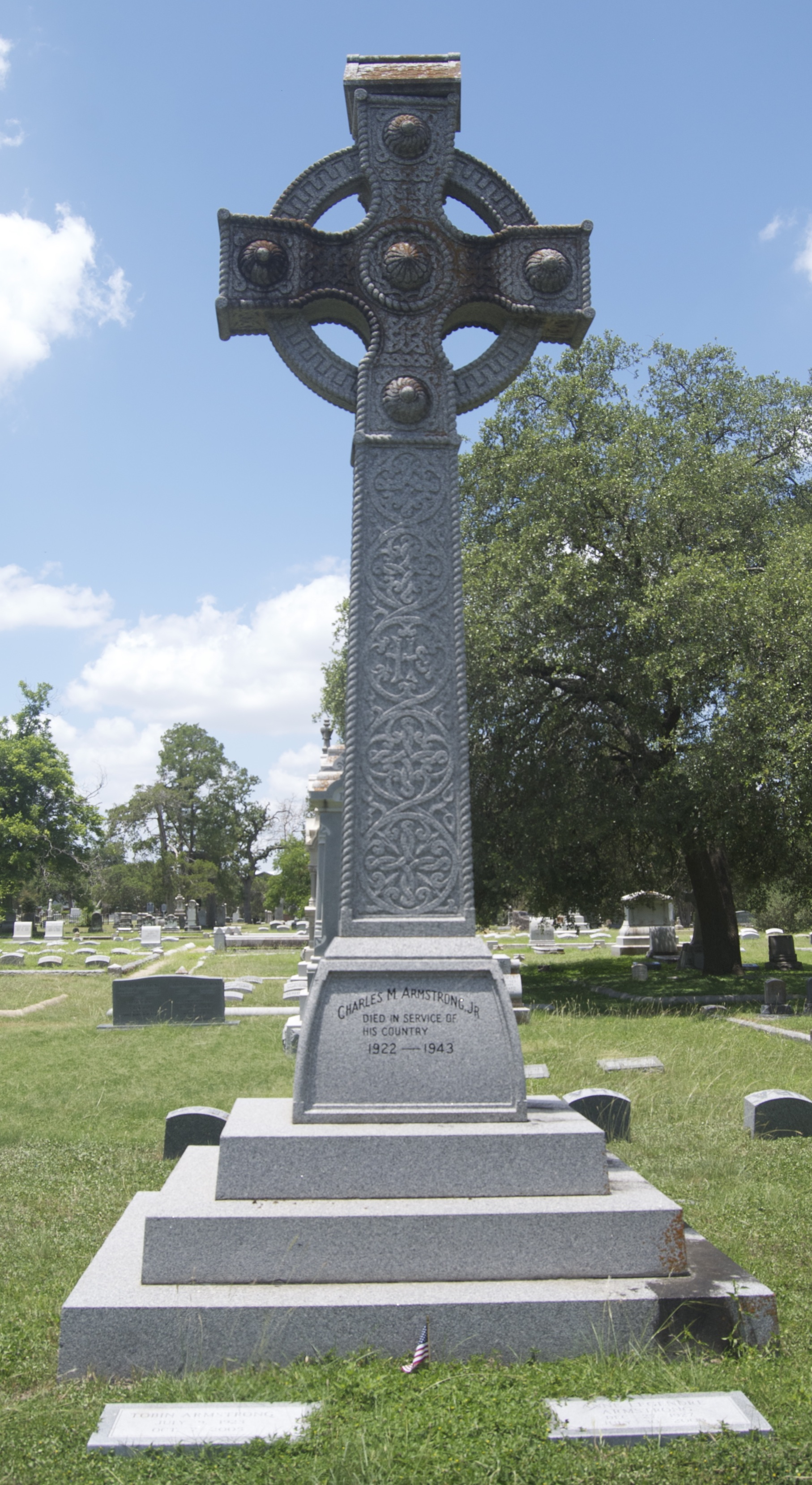
This is the “front” side of the Armstrong family monument in Oakwood Cemetery.

armstrong1

This is the John B. Armstrong side:

armstrong2

Who was John B. Armstrong, other than a Texas Ranger? A serious badass, most famous for capturing John Wesley Hardin. Armstrong had been shot in the leg previously (according to his entry in the Handbook of Texas Online, it was a self-inflicted wound), and was using a cane:

When the train carrying Hardin came into the station, Armstrong entered the front of the coach. Switching his cane to his left hand, he drew his Colt .45 with his right and confronted Hardin and four members of his gang. One of the men drew and shot at Armstrong who returned the fire killing the man. Hardin’s gun had hung up on his suspenders allowing the Ranger time to hit Hardin over the head, knocking him unconscious. He unarmed the other three men.

(Some accounts say the bullet fired by Hardin’s man went through Armstrong’s favorite hat, seriously pissing him off, and that Armstrong’s blow knocked Hardin unconscious for two hours. These accounts are not well sourced, so I would take them with a grain of salt.)

Armstrong was also involved in the capture of Sam Bass, which is probably worthy of another post and some more photos next time I’m out near Round Rock.

Armstrong’s Texas Ranger Hall of Fame page. Armstrong on the “Badass of the Week” site (a little overwrought, but entertaining). Handbook of Texas online.

Chapter 9, Chapter 9, Chapter 9…

June 20th, 2013

Last Friday, the city’s emergency manager, Kevyn D. Orr, started negotiations with creditors, asking them to accept pennies on the dollar for the $15 billion to $17 billion they are owed. Short of bankruptcy, he says, he has no plans to sell off assets.

But if Detroit does file for bankruptcy, one of the great tragedies (at least, according to the NYT) is that the historical society might have to sell off all or part of its collection of “62 lovingly maintained classic cars”. This collection includes a 1924 two-door Hupmobile, Henry M. Leland’s 1905 Cadillac Osceola, a 1960 Chevrolet Corvair…and an AMC Pacer as well as a 1984 Dodge Caravan.

Obit watch: June 20, 2013.

June 20th, 2013

James Gandolfini roundup: NYT. LAT. A/V Club.

This makes me kind of sad: one of Gandolfini’s pending projects was “Bone Wars” with Steve Carell, about the 19th Century paleontologists Edward Drinker Cope and Othniel Charles Marsh. The Cope/Marsh story is fascinating, and I would have enjoyed seeing what Gandolfini and Carell did with it.

Slim Whitman: NYT. LAT.

Also among the dead: thriller writer Vince Flynn. I’ve never read any of his novels, but I was aware of them: the Mitch Rapp books are ubiquitous in my local grocery stores, right up there with James Patterson and Lee Child. (I don’t say that with any snark intended; when your books are in every grocery store, you’re pretty much doing okay for yourself.)

Art, damn it, art! watch (#38 in a series)

June 20th, 2013

The paper of record has a story about a new exhibition at the Park Avenue Armory. (Despite the name, it is an exhibition hall, “with one of the largest open exhibition floors in the world”. But it did start life as a National Guard armory.)

The new exhibit is by Paul McCarthy, described by the NYT as a “revered Los Angeles video artist and sculptor”. The exhibition, “WS”, is described as a retelling of the story of Snow White.

What fun! Take the kids, right?

…the Armory, which has developed a reputation as a family-friendly destination, made the unusual decision, with Mr. McCarthy’s agreement, to restrict visitors to those over 17. And even for adult visitors, the Armory has built a virtual phalanx of warnings: advisories about the show’s graphic content on its Web site, on placards in front of its large oak doors, and inside the building before the entry to the exhibition itself.

Whoa.

Mr. McCarthy’s creation is decidedly not Disney’s version of the fairy tale. Composed of a massive forest-and-house set, accompanied by a seven-hour video of performances shot in and around the set — it is meant to be an apotheosis of the dark and deeply human themes he has been exploring for four decades concerning the body, social repression, consumerism, sex, death, dreams and delirium, and the power of art to deepen our understanding of life.

“an apothosis of the dark and deeply human themes”?

The video narrative and related videos secluded to the side of the main exhibition include plentiful nudity, of both sexes, along with scenes of urination and men masturbating to orgasm, not to mention highly unorthodox use of processed foods. The story also includes gory violence that is no less jarring for using Hollywood techniques like fake blood and sculptural body doubles.

I have no joke here, I just like saying “highly unorthodox use of processed foods”. (Karen Finley, call your office, please.)

As the NYT notes, exhibiting something so…out there…that you don’t want to let minors in to see it is unusual by NYC art world standards: MoMA didn’t ban minors from the Marina Abramović retrospective (though they did put up warning signs), and the Brooklyn Museum recommended (but did not require) parental guidance for “Sensation”.

On the other hand, I did not attend either of those events, and the Wikipedia summaries are unhelpful in determining if processed foods were used in a highly unorthodox manner.

Thus concludes our broadcast day.

June 19th, 2013

Lawrence sent me an email earlier today noting that I had a 1970s TV show theme going, and asking

How long can you keep it up?

Libertarian themes in television.

June 19th, 2013

Sounds like the title of a Community episode, doesn’t it?

But I’ve been trying to think of television shows, especially 1970s television shows, that reflect libertarian themes, and I’m having a hard time coming up with many. For my purposes, I’m defining “libertarian themes” as: self-reliance/entrepreneurship, distrust of big government, and adherence to the non-agression principle.

I don’t remember how well Little House on the Prairie followed these ideas: the books certainly are libertarian (for obvious reasons) but I just don’t remember the TV show well enough to recall how that translated. (I think I avoided the TV show because I had a perception it was a chick thing. Though I do want to see the episode where Pa and Mr. Edwards do a remake of The Wages of Fear.)

Beyond that, pickings seem slim for the 1970s. I think Gunsmoke may have incorporated those themes, but I don’t remember the show well enough to be sure.

There is one show I can think of that, to me, is a nice example of libertarian thought:

Really, what could be more libertarian than a private space program? How about a private space program that intends to make a profit by selling off discarded government property? I seem to recall that there were frequent conflicts with one officious government p—k or another, always resolved in Andy Griffith’s favor – and without much force or violence.

Any other series I may be missing? Feel free to leave comments. They don’t even have to be series from the 1970s: I’ll take anything from the birth of television all the way up until now. It does seem to me, though, that libertarian thought became more and more mainstream and was better represented on television after the 1980s.

Also…

June 19th, 2013

I’m going to wait to say anything about James Gandolfini; this is still breaking news, and by tomorrow the papers should have their obits and appreciations up.

I guess this kind of breaks the 1970s television theme, but, you know, you do what you gotta do.

Obit watch: June 19, 2013.

June 19th, 2013

The A/V club and other reliable sources are reporting the death of legendary musician Slim Whitman.

(Yes, this does count as 1970s television: quoth the A/V Club, “That changed in 1979, with a saturation TV ad campaign promoting a greatest-hits collection by an artist who, the commercials swore, had sold more records than Elvis and The Beatles. The commercial simultaneously revived the 55-year-old Whitman’s domestic career and turned him into a pop-culture punchline.”)

The things you find on YouTube.

June 19th, 2013

Two clips. First, the opening from Movin’ On, the trucker series starring Claude Akins and Frank Converse, with Merle Haggard doing the theme music.

I have fond memories of this series, but the usual (“nostalgia is a moron”) caution applies. Fortunately, you don’t have to spend a lot of money to confirm or refute my thesis: you can watch all of the first season on Hulu for free. (It does not look like the pilot is included.)

Second, a series that I don’t have fond memories of, but which I recall my brother loving when he was a child. It isn’t on Hulu, but people have been uploading episodes to YouTube.

I know, I know: how can you go wrong with a man and a monkey? I guess there’s something about the plots that rubbed me the wrong way, as opposed to what I recall as the relative realism of Movin’ On. On the other hand, I do have to give the series credit: it did with one man (and a monkey) what it took The A-Team four men to do.

(My brother was also a big fan of The A-Team. I never got into it, but I do believe it was a better show than B.J. and the Bear.)