Archive for June, 2013

Random notes: June 17, 2013.

Monday, June 17th, 2013

NYT obit for the late Harold J. Cromer, also known as “Stumpy”, “half of the vaudevillian duo Stump and Stumpy”.

Recently, a bunch of gas stations in my area rebranded their associated convenience stores/markets as 7-11 franchises. I kind of liked this, as it is nice to be able to stop off and get gas and a Slurpee when it is 101 degrees outside. (Many of the stand-alone 7-11 stores in my area have closed over the past few years.)

But they just can’t stay out of trouble, can they?

Federal authorities seized 14 7-Eleven stores on Long Island and in Virginia early Monday, arresting nine owners and managers and charging them with harboring and hiring illegal immigrants and paying them using sham Social Security numbers, people briefed on the case said.

More:

The store remained closed through the early morning, with law enforcement agents turning away customers who ordinarily stop in for coffee. A worker for the Town of Islip said he had seen similar law enforcement activity at several other nearby 7-Elevens.

I wonder what the cops were drinking, and where they were getting it from. I also wonder if anyone is keeping track of the doughnut inventory at the seized stores.

Deborah Blum, author of The Poisoner’s Handbook: Murder and the Birth of Forensic Medicine in Jazz Age New York (another book I enthusiastically recommend) has an interesting piece in Wired about why ethylene glycol is such a swell poison. (Pure ethylene glycol is colorless, odorless, and sweet tasting. I hope that I never tick off someone to the point that they’re willing to poison me, because if they put ethylene glycol in my iced tea, I wouldn’t be able to tell.)

(Blum’s piece is tied to the M.D. Anderson poisoning scandal, which I thought about mentioning last week. But there really wasn’t a lot I could say about it; as Blum notes, ethylene glycol isn’t a particularly exotic poison, and the incident itself seems to be your basic boring lover’s spat.)

(Edited to add: Oh, so that’s where I found the Blum piece! Thanks, Tam! And I wasn’t aware Blum was writing regularly for Wired: I’d read some of her articles in Slate, but none since I gave up on Slate as a site publishing outlandish and ridiculous crap in an attempt to get page views.)
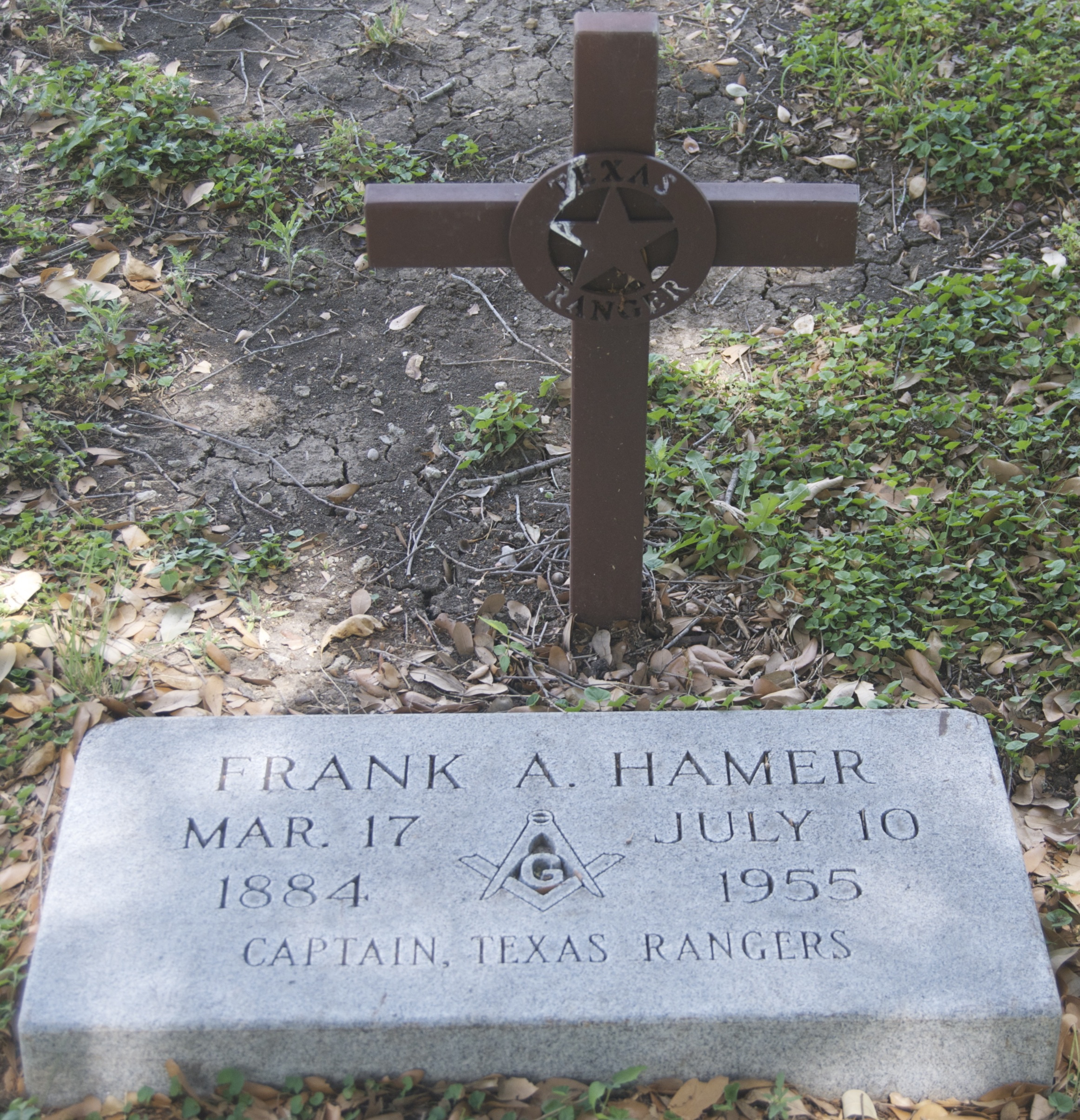
One Ranger.

Monday, June 17th, 2013

hamer_1

Grave of Frank Hamer, Austin Memorial Park Cemetery, Austin, Texas.

For those of you unfamiliar with the late Mr. Hamer, obviously he was a Texas Ranger, and perhaps one of the most famous of the Rangers. Among other things, Mr. Hamer led the posse that took down Bonnie and Clyde.

American Rifleman profile of Mr. Hamer. Jeff Guinn’s Go Down Together: The True, Untold Story of Bonnie and Clyde, which I have previously recommended, also has considerable background on Hamer. Hamer’s Wikipedia entry.
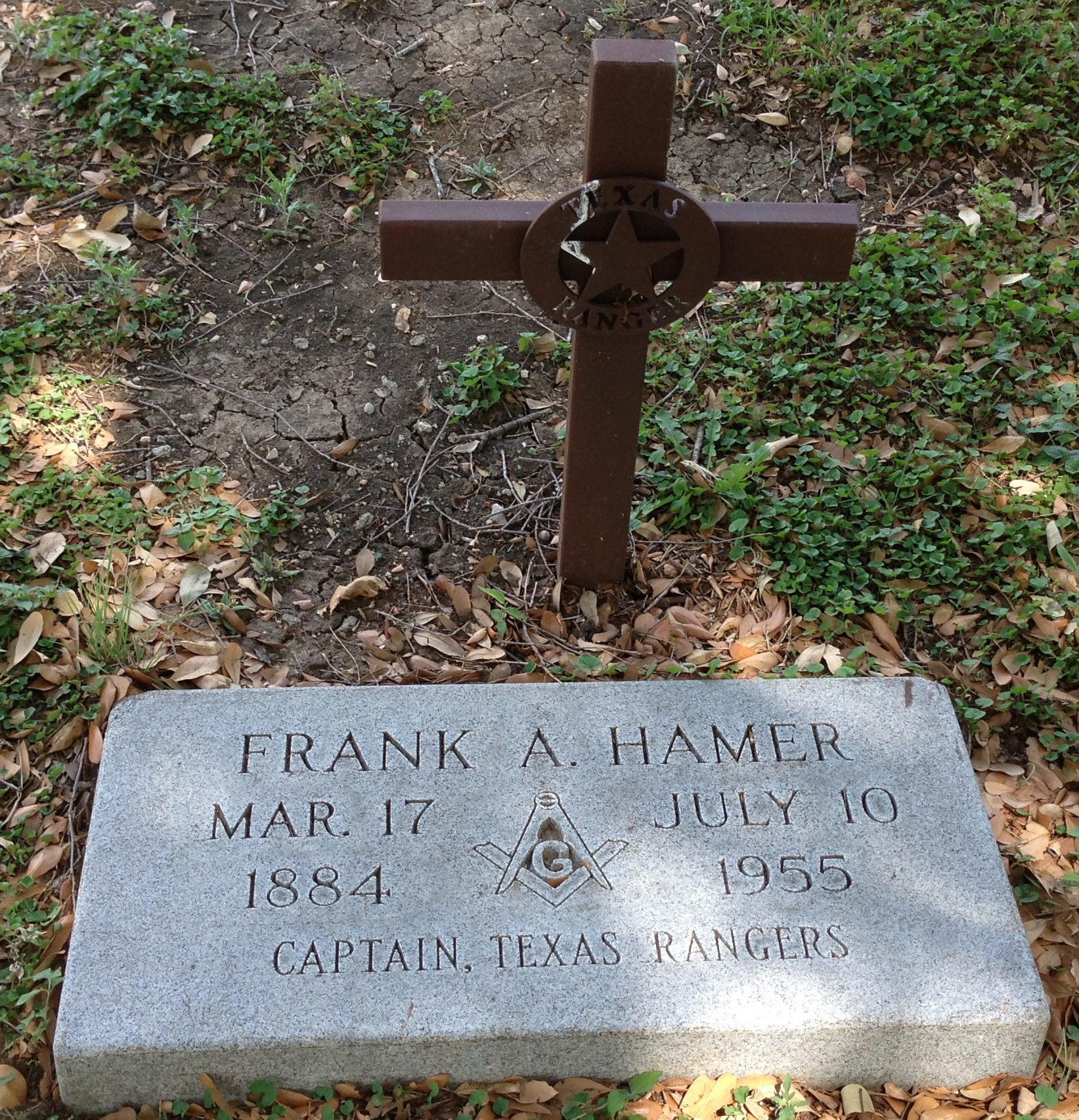
Here’s a second picture that I actually like a little better than the first. It was taken with a different camera (the first one was taken with my Nikon D40X and the 18-55 kit lens). Note that I haven’t done anything to these two photos except crop them: I haven’t manipulated exposure, contrast, or anything else.

hamer_2

A Bob Clampett cartoon!

Saturday, June 15th, 2013

mosasaur

(Onion Creek Mosasaur, Texas Memorial Museum, Austin, Texas.)

Random notes: June 15, 2013.

Saturday, June 15th, 2013

NYT headline:

Minnesota Man, 94, Is Investigated for Nazi Ties

I think, with Father’s Day approaching, this is an important safety tip for everyone. A tie may be a good gift for Dad, if he has to wear ties and if you put some thought into it. However, I’d recommend staying away from ties with Nazi iconography, just as a general rule.

When two student journalists from Paw Prints, the newspaper of West Islip High School, set out to investigate school security, they thought they might do some good, maybe win the award for story of the year in the Long Island Press high school journalism contest. Instead, the article was quashed, and they wound up with a grown-up lesson in the consequences of testing nerves in a post-Newtown-massacre world.

Randal Schwartz, call your office please.

(That was perhaps my only disappointment at YAPC. As I noted, I did get to shake Larry Wall’s hand, but I never saw Randal Schwartz; I’m not even sure if he was there.)

There’s a protest singer singing a protest song.

Another NYT headline:

A Precarious Olympic Bid for Istanbul

Not Constantinople?

(Technically, I suppose that’s nobody’s business but the Turks. And, I guess, the IOC.)

Obit watch: June 14, 2013.

Friday, June 14th, 2013

By way of The Rap Sheet, I have just learned of the passing of Joan Parker, “tireless fundraiser for a host of different charities” and wife of the late great mystery writer Robert B. Parker.

I want to believe the two of them are sitting at heaven’s bar: Mrs. Parker taking small, careful sips of her drink, and Mr. Parker drinking Amstel. (If you can’t get Amstel in heaven, where can you get it? I mean, other than the Netherlands?)

This amused me.

Friday, June 14th, 2013

I was out with my mother yesterday afternoon, and we stopped for lunch.

emerson

Something about the juxtaposition of the “this way to the bathrooms” and the Emerson quote kicks over my giggle box. I mean, what is the message they’re trying to send here: don’t follow the path to the men’s room, but instead go outside and…shall we say, leave a trail to mark your territory?

(Pieous, Dripping Springs, Texas.)

(By the way, the Bacon Bleu pizza and mozzarella plate were both really, really good.)

Rabbit season!

Friday, June 14th, 2013

rabbit

Annals of law (#7 in a series).

Friday, June 14th, 2013

It is a well known fact (at least among those interested in copyright, those obsessed with trivia, and those who wonder why restaurants make up their own birthday songs) that “Happy Birthday to You” is under copyright until 2030 in the United States (and 2016 in the EU).

But there is a significant dispute over whether this copyright is valid. Jennifer Nelson, a filmmaker working on a documentary about the song, has filed a lawsuit seeking to have the song declared to be in the public domain.

The rich history of the song’s evolution and the conclusion that it might be in the public domain closely tracks the findings of Robert Brauneis, a professor at the George Washington University Law School and the author of a 68-page article titled “Copyright and the World’s Most Popular Song.”
In the study, Professor Brauneis said that “it is doubtful that ‘Happy Birthday to You,’ the famous offspring of ‘Good Morning to All,’ is really still under copyright.

Random notes: June 13, 2013.

Thursday, June 13th, 2013

Gun control works! How can a bunch of people with rifles and handguns defeat a heavily armed military? Just ask Syria!

Across northern Syria, rebel workshops like these are part of a clandestine network of primitive arms-making plants, a signature element of a militarily lopsided war.
Their products — machine-gun mounts, hand grenades, rockets, mortar shells, roadside bombs and the locally brewed explosives that are packed inside — help form the arsenal of a guerrilla force that has suffered serious setbacks this year in its effort to overthrow President Bashar al-Assad.

More on our pal Louis Scarcella, the former NYPD detective whose cases are being reinvestigated: gee, there’s awfully similar language in many of the confessions he obtained.

In at least four more murder cases, suspects questioned by Mr. Scarcella began their confessions with either “you got it right” or “I was there.”

NYT obit for Iain Banks.

Noted without comment:

“Ann,” Holland Taylor’s solo show about the former Texas governor Ann Richards, will close on June 30 at Lincoln Center’s Vivian Beaumont Theater, two months before its scheduled closing date of Sept. 1, the show’s producers announced on Wednesday. Directed by Benjamin Endsley Klein, “Ann” opened on Broadway in March to mostly positive reviews and was extended once. But weekly grosses never surpassed $400,000, and in recent weeks it has never played to more than 50 percent of its capacity at the Beaumont.

Since Lawrence and I have both touched on this story, I thought I’d link to the followup: the “psychic” who claimed there was a mass grave in Liberty County has been ordered to pay $6.8 million in damages to the property owners. If I understand the HouChron correctly, this was a default judgment, as the psychic didn’t appear in court. (Insert your favorite psychic joke here.)

Unfortunate headline of the day.

Wednesday, June 12th, 2013

Texas lawyer gets 3 years, shot at census worker“.

Seems to me that Ms. Barnes has already had her shot (shots?) at the census worker, so why is the court giving her another one?

(Also: I told you so.)

From the legal beat.

Tuesday, June 11th, 2013

I have previously written about the strange case of Carolyn Barnes, the local lawyer who was accused of shooting at a census worker, sent to the state mental hospital (where she continued to represent at least one client) and was later ruled competent to stand trial.

Ms. Barnes was convicted yesterday of assault with a deadly weapon.

She could be sentenced to up to 20 years in jail, though I have serious doubts that she will be given that much time.

In other news, the Statesman is reporting that Governor Perry is threatening to withhold funding for the “state’s Austin-based ethics-enforcement unit” unless Travis County DA Rosemary Lehmberg resigns. As you may recall, Ms. Lehmberg was convicted of DWI back in April and sentenced to 45 days in jail.

I apologize that the link stinks. The Statesman‘s new paywall goes into effect today, and I have been unable to find a link to this story elsewhere. (Edited to add: Link? What link? Seriously, I griped about the Statesman link but forgot to actually include it. Here’s a story from the HouChron “Texas Politics” blog that reports the same thing: the HouChron blogger suggests that this is part of an effort to cut off “a criminal investigation into the Cancer Prevention and Research Institute of Texas”.)

I haven’t decided what I’m going to do about the Statesman yet. Paying for digital access would give me a tax write-off for Low Fat Heavy Industries. On the other hand, the cheapest subscription is $9.99 a month. I already subscribe to the NYT and LAT for you, my readers, and I find it hard to justify $10 a month for the Statesman.

Werewolf?

Tuesday, June 11th, 2013

There, wolf! There, castle!

wolf

(Dire wolf, Texas Memorial Museum, Austin, Texas.)

It’s a bird! It’s a plane!

Monday, June 10th, 2013

Actually, it’s a big sort of bird-like object. And DARPA apparently used it as the basis for a model aircraft back in the mid-1980s.

northropi

(Quetzalcoatalus northropi, Texas Memorial Museum, Austin, Texas.)

Random notes: June 10, 2013.

Monday, June 10th, 2013

LAT obit for Iain Banks.

As best as I can tell, there has been no mention of Banks’s death in the NYT yet.

At dinner Saturday night, Lawrence, Andrew, and I were talking about how bad the Marlins (and Astros) are. I remembered that someone on FARK posted a link to a site that provides updated win-loss projections for each MLB team, but I was unable to find that site in my history, on FARK, or in Google.

“DeWayne Mann” on FARK was kind enough to respond to my inquiry with three links, which I provide here for bookmarking purposes:

CoolStandings, which currently projects Miami at 106.9 losses and Houston at 103.1.

Baseball Prospectus, which has Miami at 102 losses and Houston at 99.5.

FanGraphs, which has Miami at 104 losses and Houston at 99.

(As Dewayne notes, all three sites use a more sophisticated model than (winning percentage * 162). Based only on that calculation, the Marlins project out to 115 losses, and the Astros to 106. For comparison purposes, the 1962 Mets lost 120 games and had a .250 winning percentage. The 2003 Detroit Tigers lost 119 games, and had a .265 winning percentage.)

Art, damn it, art! watch (#37 in a series)

Monday, June 10th, 2013

Back in 1995, an artist named Douglas Davis created an Internet-based work called “The World’s First Collaborative Sentence”, which…

…functioned as blog comments do today, allowing users to add to the opening lines. An early example of interactive computer art, the piece attracted 200,000 contributions from 1994 to 2000 from all over the globe.

Now we’re in 2013. The Whitney Museum of American Art wanted to bring back “The World’s First Collaborative Sentence”. But:

…the art didn’t work. Once innovative, “The World’s First Collaborative Sentence” now mostly just crashed browsers. The rudimentary code and links were out of date. There was endlessly scrolling and seemingly indecipherable text in a format that had long ago ceased being cutting edge.

This raises some questions about the nature of digital art. If you change the code to make it work on newer hardware, are you changing the art itself? Could the Whitney have run the code on an emulator? Would that change the nature of the art as well? And even if you run the code in emulation, what do you do about broken links?

“We’re working on constantly shifting grounds,” said Rudolf Frieling, a curator of media arts at the San Francisco Museum of Modern Art, which has been at the forefront of sustaining online art. “Whatever hardware, platform or device we’re using is not going to be there tomorrow.”

“Frankly speaking,” he added, “it’s a huge challenge. Not every museum is set up to do that. It takes huge technical expertise.”

More:

After much deliberation, the curators decided on a nearly unheard-of artistic solution: to duplicate Mr. Davis’s installation and present it in both original and updated forms.

One version is the frozen original, with broken code, pages of oddly formatted, garbled text and instructions for users who wanted to fax in their contributions (including the number for the Lehman College gallery, which first showed the piece). Links were redirected, through the archiving site the Wayback Machine, to their 1990s counterparts.

Noted:

In 1995 Mr. Davis’s piece was shown in a biennial in South Korea attended by the celebrated video artist Nam June Paik. It has hundreds of comments in Korean, but the code for the characters was so degraded that Mr. Fino-Radin was stumped. If other viewers fix it, he said, seeing those messages “will be a first for Western audiences.”

Dear digital artists: this is why it is important to make your code Unicode safe. (Yes, yes, I’m aware that Unicode 2.0 didn’t come along until 1996. This is a note to the future.)