Archive for the ‘History’ Category

Obit watch: October 3, 2024.

Thursday, October 3rd, 2024

Jay J. Armes passed away on September 19th. He was 92.

I had been thinking about him recently, wondering if he was still around and enjoying a comfortable retirement, or if he was still working.

I’m not sure how many people remember him, but he was a pretty famous private investigator in El Paso.

Described as “armless but deadly” by People magazine, Mr. Armes appeared to live the life of a superhero. In the 1970s, the Ideal Toy Corporation even reproduced him as a plastic action figure, with hooks like those he began wearing in adolescence after an accident in which railroad dynamite exploded in his hands.

In May 1946, Julian and an older friend were horsing around one afternoon with a teenager who had a pair of railroad blasting caps. Julian was holding them when they blew up, shooting him into the air, mangling his hands and nearly killing him.
A few months later he was fitted with prosthetic hooks.

He tried acting for a bit, but went into PI work.

Mr. Armes (pronounced arms) catapulted to investigatory stardom in 1972 after Marlon Brando hired him to find his 13-year-old son, Christian, who had been abducted in Mexico. Working with Mexican federal agents, Mr. Armes said he found the boy in a cave with a gang of hippies.
He told other daring tales of triumph: flying on a glider into Cuba to recover $2 million for a client; helping another client escape from a Mexican prison by sending him a helicopter, which he said inspired the 1975 Charles Bronson movie “Breakout.”

He was a self-promoter. Perhaps a bit too much of one.

After Newsweek, People and other national publications chronicled his adventures, the Texas Monthly writer Gary Cartwright went to El Paso to write a profile of Mr. Armes. His article — headlined “Is Jay J. Armes For Real?” — is widely regarded as a classic of magazine writing.

The Cartwright article is linked from the obit, but Texas Monthly is kind of skirty about reading without a subscription. Here’s an archived version. Brutally summarizing (you should really read the whole thing), Mr. Cartwright found a lot of inconsistencies between what Mr. Armes claimed and what could be documented.

Mr. Armes’s son said in an interview last week that Mr. Cartwright’s article was a “hatchet job” and that it was retaliation for his father’s unsuccessful campaign for sheriff of El Paso County against a friend of the writer. Mr. Cartwright died in 2017.
In 2016, the public radio program “Snap Judgment” revisited the Texas Monthly article and the puzzle of Mr. Armes.
The private eye couldn’t tolerate even hearing Mr. Cartwright’s name.
“He’s got a wilted hand, and I guess he had an inferiority complex,” Mr. Armes told “Snap Judgment.” “He saw Jay Armes had accomplished all this. So, he had to write a cutthroat story. Don’t tell me about anything about this corrupt Gary Cartwright. Don’t even mention his name to me.”

He told interviewers that he appeared in more than three dozen movies and television shows. But he is credited as an actor with just one TV appearance on the Internet Movie Database — a 1973 episode of “Hawaii Five-O” in which he played an assassin.

“Hookman”, season 6, episode 1. He was a violent criminal who was out for revenge against the four cops that caused him to lose his hands…one of whom was Steve McGarret. I admit, I haven’t seen every episode of the good “Hawaii Five-O”, but I have seen this one, and I would agree it is one of the best of those I’ve seen. Mike Quigley seems to agree with me.

(It was remade for the bad “5-0” (season 3, episode 15), but without Mr. Armes.)

He had some notable successes and seemed to earn enough money to support his lifestyle. In 1991, he was credited by authorities with tracking down the body of Lynda Singshinsuk, a Northwestern University student who had gone missing. Mr. Armes also persuaded the suspect, Donald Weber, to confess to killing her.
“Without Mr. Armes’s assistance, there is a significant possibility that Mr. Weber would not be brought to justice,” a prosecutor told The Chicago Tribune.

I found two action figures on eBay. One is $61.19 and it doesn’t look complete. The other one is $149.99. I can’t tell how complete it is, but it does have the “briefcase” with the various “hands”.

In other news, Masamitsu Yoshioka has passed away. He was 106.

His death was announced on social media on Aug. 28 by the Japanese journalist and author Takashi Hayasaki, who spoke with Mr. Yoshioka last year. He provided no other details.

He was “the last known survivor among some 770 crew members who manned the Japanese airborne armada that attacked Pearl Harbor on Dec. 7, 1941”.

He explained last year in an interview with Jason Morgan, an associate professor at Reitaku University in Kashiwa, for the English-language website Japan Forward, “I’m ashamed that I’m the only one who survived and lived such a long life.”
Asked in that interview if ever thought of visiting Pearl Harbor, he at first replied, “I wouldn’t know what to say.” He then added: “If I could go, I would like to, I would like to visit the graves of the men who died. I would like to pay them my deepest respect.”

This made me snort:

He participated in the attack on Wake Island on Dec. 11, 1941, and a raid in the Indian Ocean early in 1942. (As Professor Morgan put it, he “was involved in many additional campaigns for the liberation of Asia from white colonialism.”) But when Emperor Hirohito announced his nation’s surrender, Mr. Yoshioka was on an air base in Japan.

“…the liberation of Asia from white colonialism”.

The Rape of Nanjing.

“Now I think of the men who were on board those ships we torpedoed. I think of the people who died because of me,” Mr. Yoshioka said. “They were young men, just like we were. I am so sorry about it; I hope there will not be any more wars.”

Bob Yerkes, stuntman. IMDB.

His backyard was equipped with rigs for high falls, mats to practice flips and a springboard powered by compressed air that launched people end-over-end. He is said to have invented the airbag for stunt use.
“There will never be another backyard like Bob’s where you could train for free or even live for free if you needed a place to stay,” Williams wrote.

Obit watch: October 2, 2024.

Wednesday, October 2nd, 2024

John Amos. NYT (archived). Other credits include “The Rockford Files: Shoot-Out at the Golden Pagoda”, “Hardcastle and McCormick”, and “Hunter”.

Frank Fritz, of “American Pickers”.

Burning in Hell watch: Song Binbin, commie.

A daughter of a prominent general in the People’s Liberation Army, Ms. Song was enrolled at Beijing Normal University Girls High School when she and classmates responded to Mao’s call for young people to turn against intellectuals, educators and others who supposedly held bourgeois values.
On Aug. 5, 1966, students attacked Bian Zhongyun, a 50-year-old mother of four who headed the school. She was kicked and beaten with sticks spiked with nails. After passing out, she was thrown onto a garbage cart and left to die.
Her death has been widely described as the first killing of a teacher during the Cultural Revolution, a violent spasm establishing Mao’s cult of personality, with masses waving his Little Red Book of his writings.

Two weeks after Ms. Bian’s death, more than one million young Red Guards thronged Tiananmen Square, where Ms. Song had been selected to pin a red armband around Mao’s left sleeve as they stood atop the towering Gate of Heavenly Peace. A photograph of the moment appeared across the country. Praised by Mao, Ms. Song, at 19, became a kind of celebrity in China.
But the whirlwind of the Cultural Revolution soon turned on Ms. Song’s family. Her father, Song Renqiong, was purged from the Communist Party in 1968, and Ms. Song and her mother were put under house arrest. The Cultural Revolution ended only when Mao died in 1976.

On Jan. 12, 2014, Ms. Song visited her old school and expressed remorse, bowing before a statue of Ms. Bian and delivering a 1,500-word speech. “I am responsible for the unfortunate death of Principal Bian,” she said, according to The Beijing News. (Ms. Bian’s title was officially deputy principal, but she was referred to as the principal because she was serving in that role at the time in an acting capacity.)
In 2004, Wang Youqin, a schoolmate of Ms. Song’s who later became a historian at the University of Chicago, published “Victims of the Cultural Revolution,” a book that included a description of the death of Ms. Bian and of Ms. Song’s role in the turmoil at the girls’ high school.
After Ms. Bian’s death, Ms. Wang wrote, “Every school in China became a torture chamber, prison or even execution ground, and many teachers were persecuted to death.”
Ms. Song denied that she had participated directly in the beating; she said, in fact, that she had tried to stop others who did. But she acknowledged that she and a fellow student were Red Guard leaders and that they were among the first to post so-called big-character posters — publicly displayed signs handwritten in a large format — denouncing teachers.

Some commenters stressed that Ms. Song should bear a greater burden because of her prominence among the Red Guards. “It’s meaningless to say you witnessed a murder and then say you don’t know who the killers were,” said Cui Weiping, a retired professor of literature who writes about China’s past, as quoted by The New York Times in 2014.
One person who was unsatisfied was Ms. Bian’s widower, Wang Jingyao. He had taken photos of his wife’s battered body after her death as well as of the posters that her tormentors had hung in their apartment after breaking in. One sign threatened to “hack you to pieces,” another to “hold up your pigs’ ears.”
“She is a bad person, because of what she did,” Mr. Wang told The Times in 2014, when he was 93. “She and the others were supported by Mao Zedong. Mao was the source of all evil. He did so much that was bad.”

Obit watch: September 16, 2024.

Monday, September 16th, 2024

Dr. George Berci, Holocaust survivor, violinist, and big damn hero, passed away on August 30th. He was 103.

Dr. Berci was one of the pioneers of minimally invasive surgery.

Dr. Berci brought a precise eye and an inventor’s zeal to innovations that enabled doctors to better visualize the bladder, colon, esophagus, prostate, common bile duct and other body parts. Until earlier this summer, he was the senior director of minimally invasive surgery research at Cedars-Sinai Medical Center in Los Angeles, where he had worked since 1969.
His innovations were critical to the revolution in minimally invasive endoscopies and laparoscopies, which dramatically reduced the need for surgeons to make large incisions.
In endoscopies, doctors use a flexible tube with a light and a camera to examine the upper and lower digestive system. Dr. Berci focused mainly on the area around the throat and vocal cords.
In laparoscopies, surgeons place a thin rod with a video camera attached at the end through a small abdominal incision. Carbon dioxide is then used to inflate the space to give doctors enough room to use small instruments to, among other things, remove gallbladders, cysts, tumors, appendixes and spleens; diagnose endometriosis; and repair hernias.

“It is unlikely that there will ever be another surgeon who so single-handedly impacts an entire field of surgery as Dr. Berci did,” said Dr. Brunt, the producer of the documentary, who is a professor of surgery at Washington University School of Medicine in St. Louis. “He understood the potential for laparoscopy and its applications long before most surgeons saw any value in it.

Tito Jackson. THR.

Herbie Flowers, session musician who played bass on “Walk on the Wild Side”.

Tommy Cash, Johnny’s brother, but he had a music career of his own. THR.

Obit watch: August 28, 2024.

Wednesday, August 28th, 2024

Things have been kind of slow on the obit front. I don’t know if it just too hot for people to die, or what’s going on, but it just doesn’t seem like there’s been a lot to report.

I have had this one in my pocket for a few days now. I’m wondering if it will ring a bell with any of my readers: Mitzi McCall.

Ms. McCall was a pretty successful entertainer. She had a comedy act with her husband, Charlie Brill.

They got a big break on the night of February 9, 1964. They were booked to appear on “The Ed Sullivan Show”. The lists of acts that night included:

…Fred Kaps, a Dutch magician; the cast of the Broadway musical “Oliver!” (which included a then-unknown Davy Jones, soon to be a member of the Monkees); the impressionist Frank Gorshin; the music-hall singer and actress Tessie O’Shea; and, finally, McCall & Brill.

Oh, yeah, there was one other act booked that night: a group of obscure British musicians that called themselves the Beatles.

In their sketch, Mr. Brill played a producer casting a young actress for a new movie. Ms. McCall played his secretary and three other roles: a nervous former Miss Palm Springs, a pushy stage mother and a Method actor. The sketch fell with a thud, except for some chuckles when Ms. McCall tossed in an ad lib as the stage mother.
“My little girl was waiting outside, you know,” she said. “She used to be one of the Beatles.”
“Oh, what happened?” Mr. Brill asked.
“Somebody stepped on her.”

They bombed. Their agent didn’t call them for six months. But they recovered:

They performed their act — which Mr. Brill said was influenced by the comedy of Mike Nichols and Elaine May — until the mid-1980s, opening for Ann-Margret, Ella Fitzgerald and Marlene Dietrich. They had a recurring role as the bickering “Fun Couple” on “Rowan & Martin’s Laugh-In”; appeared on many variety and talk shows, and on game shows like “Tattletales”; and portrayed a detective and his fun-loving wife on the crime drama “Silk Stalkings” in the 1990s.

Ms. McCall was 93. Her husband, Mr. Brill, survives her.

On her own, Ms. McCall was seen on numerous sitcoms, including “Maude,” “Roseanne” and “Ellen,” and wrote episodes of “One Day at a Time” and “ALF.”

She was also the dry cleaner’s wife in that “Seinfeld” episode. Other credits include “Twilight Zone” (both the original and the 1986 revival), “The Jim Backus Show”, “The Dennis O’Keefe Show”, the 1990 “Dragnet”, and “Madman of the People”.

Short random gun crankery.

Friday, August 16th, 2024

I am hoping to be able to get back to gun crankery (and gun book crankery) next week. I expect things to be a little less busy (famous last words). And I have a hysterical historical letter coming from Colt about another old gun (though not quite as old as the last one) so I want to put up a post about it.

In the meantime, I wanted to highlight this: “Killing Lincoln: John Wilkes Booth’s Philadelphia Deringer” by Dr. Dabbs. Greg Ellifritz had this in his weekend link dump (which you should really be reading: I resisted for a long time, even though Karl regularly linked to it, and now I regret not reading it) but I probably would have gotten to it eventually since I subscribe to American Handgunner.

I note this for two reasons:

1) The blog’s ongoing interest in presidential assassination weapons, which appears to be shared by Dr. Dabbs.

B) “The tiny little pistol pushes a 143-grain lead ball to around 250 feet per second when charged atop 25 grains of FFFG black powder. I used mine to shoot an eggplant, because I hate eggplant.”

Obit watch: August 13, 2024.

Tuesday, August 13th, 2024

Captain Paul Bucha (United States Army – ret.).

Captain Bucha received the Medal of Honor for actions between March 16 and 19th, 1968. His citation:

For conspicuous gallantry and intrepidity in action at the risk of his life above and beyond the call of duty. Capt. Bucha distinguished himself while serving as commanding officer, Company D, on a reconnaissance-in-force mission against enemy forces near Phuoc Vinh. The company was inserted by helicopter into the suspected enemy stronghold to locate and destroy the enemy. During this period Capt. Bucha aggressively and courageously led his men in the destruction of enemy fortifications and base areas and eliminated scattered resistance impeding the advance of the company. On 18 March while advancing to contact, the lead elements of the company became engaged by the heavy automatic-weapon, heavy machine-gun, rocket-propelled-grenade, claymore-mine and small-arms fire of an estimated battalion-size force. Capt. Bucha, with complete disregard for his safety, moved to the threatened area to direct the defense and ordered reinforcements to the aid of the lead element. Seeing that his men were pinned down by heavy machine-gun fire from a concealed bunker located some 40 meters to the front of the positions, Capt. Bucha crawled through the hail of fire to singlehandedly destroy the bunker with grenades. During this heroic action Capt. Bucha received a painful shrapnel wound. Returning to the perimeter, he observed that his unit could not hold its positions and repel the human wave assaults launched by the determined enemy. Capt. Bucha ordered the withdrawal of the unit elements and covered the withdrawal to positions of a company perimeter from which he could direct fire upon the charging enemy. When one friendly element retrieving casualties was ambushed and cut off from the perimeter, Capt. Bucha ordered them to feign death and he directed artillery fire around them. During the night Capt. Bucha moved throughout the position, distributing ammunition, providing encouragement, and insuring the integrity of the defense. He directed artillery, helicopter-gunship and Air Force-gunship fire on the enemy strong points and attacking forces, marking the positions with smoke grenades. Using flashlights in complete view of enemy snipers, he directed the medical evacuation of three air-ambulance loads of seriously wounded personnel and the helicopter supply of his company. At daybreak Capt. Bucha led a rescue party to recover the dead and wounded members of the ambushed element. During the period of intensive combat, Capt. Bucha, by his extraordinary heroism, inspirational example, outstanding leadership, and professional competence, led his company in the decimation of a superior enemy force which left 156 dead on the battlefield. His bravery and gallantry at the risk of his life are in the highest traditions of the military service. Capt. Bucha has reflected great credit on himself, his unit, and the U.S. Army.

He was a West Point graduate:

He was soon appointed commander of the last rifle company to be formed during an Army expansion — one that left him with a collection of the least coveted recruits: men who had flunked basic infantry tasks, former prisoners and “guys with master’s degrees in Elizabethan literature,” Mr. Bucha later recalled to the National Purple Heart Honor Mission, a veterans group.

In April 1970, around the time his tour of duty ended, Mr. Bucha returned to West Point to teach social science. But in 1972, he was one of 33 highly qualified young officers teaching at the military academy to resign over 18 months. Their resignations, to seek other professional opportunities, were reported on the front page of The New York Times.

Ross Perot hired him.

Mr. Bucha rose to become the executive in charge of foreign operations for Mr. Perot’s best-known company, Electronic Data Systems, which provided information technology services.

Mr. Bucha later openly criticized Mr. Perot for exaggerating stories about his career and traveled around the country on behalf of President George H.W. Bush’s campaign for a second term. In 2008, Mr. Bucha was a foreign policy adviser to Barack Obama’s presidential campaign.
There was a point of consistency across his political stances, Ms. Whaley, his daughter, said: “He was a person who valued character and integrity.”

He served as president of the Congressional Medal of Honor Society from 1995 to 1999.

Though Mr. Bucha became well known for his Medal of Honor, he often appeared publicly without it.
“I never wear it if I’m giving a speech that might get political,” he told the Purple Heart Mission. The medal, he said, belonged not principally to him but to the men he had fought alongside, and he did not want to say anything while wearing it that they might have disagreed with.

Statement from the Congressional Medal of Honor Society. According to the society, there are 60 surviving recipients.

Obit watch: August 9, 2024.

Friday, August 9th, 2024

Jacques Lewis has passed away. He was 105.

Mr. Lewis is believed to have been the last surviving French soldier who went onshore at Normandy on D-Day.

In 1944, Mr. Lewis was a member of the Free French Forces, the army that Gen. Charles de Gaulle had assembled in exile in London after Germany invaded and occupied France in 1940. Fluent in English, he was assigned as a liaison officer attached to the U.S. Army’s 70th Tank Battalion as the D-Day landings approached.
Mr. Lewis was not just an interpreter; he was a soldier, and thus well-suited to take on a vital role after the invasion. The Americans needed someone with military experience to link up with French villagers and French guerrilla resistance fighters known as the Maquis to help guide U.S. troops past German positions inland to reach the small rural town of Carentan and relieve members of the U.S. 101st and 82nd Airborne Divisions, who had earlier parachuted in, behind enemy lines.
In an interview with the French television channel TF1 in 2019 on the 75th anniversary of the Normandy landings, he recalled approaching Utah Beach on the morning of June 6, 1944. It was the first time he had spoken about the war, even to his family, he said.
“We were crouched behind the ramp of our landing craft, and when the ramp went down, I saw my country, France, which I’d wanted to help liberate for so long,” he said. “It was very moving. But then I saw the stretchers carrying wounded or dead American soldiers — being carried down the beach to get into our landing craft to be taken back to England. I realized that many of the first wave of my American comrades had already died on the beaches to liberate my country.”
He waded ashore, his rifle over his head, under heavy German gunfire. In the TF1 interview, he displayed a military identification bracelet that he wore on his left wrist that morning (comparable to the dog tags his American comrades wore around their necks). Pointing to his military number, FFF 55770, he said, “That was so that they knew I was a French soldier if I died.”
Allied casualties on Utah Beach — 197 killed or wounded — were relatively light compared with the 2,400 or so recorded at Omaha Beach to the east. By nightfall on D-Day, more than 10,300 allied troops had been killed or wounded across Normandy.

After Mr. Lewis crossed Utah beach unscathed, his first task was to help the Americans reach Carentan. Consulting with resistance fighters and French residents, he mapped out routes that the Americans could take and then joined them. Along the way, they were greeted as saviors.
“The locals appeared at their windows or emerged from their doors,” he recalled. “They gave us wine, and my American colleagues gave the kids chocolate. They were so happy to see the Americans and surprised to realize I was French.”

On June 8, less than two months before he died, Mr. Lewis insisted to his caregivers that he be taken in his wheelchair to greet President Biden and President Emmanuel Macron of France at a ceremony at the Arc de Triomphe in Paris commemorating the 80th anniversary of D-Day. Mr. Biden thanked him for his work with American forces as they had moved inland from Utah Beach to drive the Germans out of France.

Chi Chi Rodriguez, noted golfer.

Rodriguez was 5-foot-7 and about 120 pounds. But he used his strong hands and wrists to get off long low drives, and he was an outstanding wedge player, offsetting his sometimes balky putting game. “For a little man, he sure can hit it,” Jack Nicklaus told Sports Illustrated in 1964, relating how Rodriguez often outdistanced him off the tee on flat, into-the-wind fairways.
Rodriguez won eight tournaments on the PGA Tour, then became one of the top players on the Senior (now Champions) Tour, capturing 22 events, including two majors: the 1986 Senior Players Championship and the 1987 Senior PGA Championship. He was inducted into the World Golf Hall of Fame in 1992.

After draining a difficult putt, Rodriguez would also turn his putter into a simulated sword being unleashed on a bull, then wipe imaginary blood from it and place it in an invisible scabbard.

Kevin Sullivan, professional wrestler.

Known early in his career as “The Boston Battler,” Sullivan was inspired by the heavy metal acts of the 1970s and ’80s like Black Sabbath and Judas Priest to become the “Prince of Darkness,” a demonic rival of some of the stars of that era, including Dusty Rhodes, the Road Warriors and Hogan, according to W.W.E.
Among the crews he led in the ring were the Army of Darkness; The Varsity Club, a group of college buddies; and Dungeon of Doom, W.W.E. said. Also known as “The Taskmaster,” he painted black X’s and lightning bolts on his forehead, wore leather body armor and chains and stuck out his tongue like Gene Simmons of Kiss.
“During their heyday, Sullivan’s cult came to the ring with either Jeff Beck’s ‘Gets Us All in the End’ or Deep Purple’s ‘Nobody’s Home’ blaring behind them and a series of black-cloaked and corpse-painted minions who usually brought with them boa constrictors of varying colors and sizes,” according to a 2015 editorial about Sullivan on the website Metal Injection. “Add in a half-naked Fallen Angel, then you’ve got a good idea of just how much of a spectacle Sullivan’s Army of Darkness was.”

“The money is better than in anything else I could do,” Sullivan told The New York Times in 1989. “I’ll tell you what I like the most about it. I get to live in a beach house in Daytona Beach, Florida, that’s completely paid for. Now, that’s nice.”

Quick random book post.

Tuesday, August 6th, 2024

I was busy all this past weekend, and will be busy all of this coming weekend. I’m hoping to get a gun book post up sometime between Wednesday and Friday, but I’m not sure if that’s going to work out. I did want to get this post up today, though, for obvious reasons.

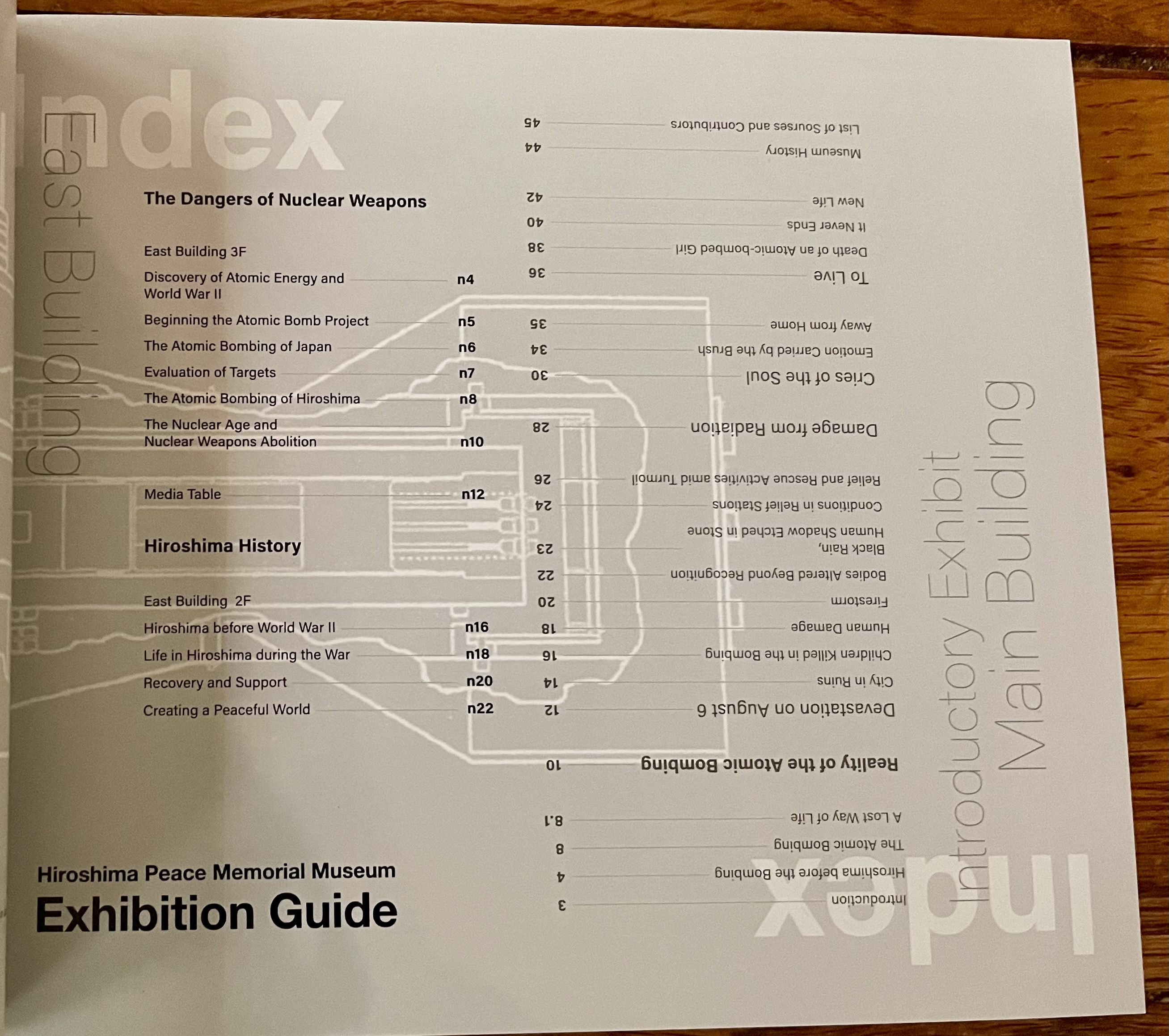
Hiroshima Peace Memorial Museum Exhibition Guide. No author and no publishing information given. I think this is about 68 pages.

There are two sections to this, which are actually printed reversed (as you might gather from the index: apologies for the lousy picture, but I couldn’t get this to sit flat easily). One covers “The Reality of the Atomic Bombing” and “Damage From Radiation” along with introductory material (“Hiroshima Before the Bombing”, “The Atomic Bombing”, “A Lost Way of Life”). The other covers “The Dangers of Nuclear Weapons” and “Hiroshima History”.

This was a gift from my beloved and indulgent sister, who was able to tour Japan recently and brought this back for me.

Obit watch: August 2, 2024.

Friday, August 2nd, 2024

Major General Joe Engle (USAF – ret.), astronaut. He passed away on July 10th, but the obituary didn’t run until yesterday (and if it was reported elsewhere previously, I missed it). He was 91.

Mr. Engle was the last surviving X-15 pilot.

He flew 16 X-15 missions.

He earned his astronaut wings on June 29, 1965, when he took the X-15 to an altitude of 280,600 feet, or 53 miles, at 3,431 m.p.h.

He was selected for Apollo, and scheduled to fly on Apollo 17. But he was replaced on that mission by Harrison Schmitt, and moved to Apollo 18. Apollo 18, of course, was cancelled.

In 1981, Mr. Engle, by then an Air Force colonel, went back to space as the commander of the second flight of the shuttle Columbia with the pilot Richard Truly. They demonstrated that the Columbia could be reused, but they had to return three days early because of a fuel cell failure. (Mr. Truly died in February.)
Four years later, Mr. Engle was the commander of the shuttle Discovery, which deployed three communications satellites and fixed an existing one.
He retired from the Air Force in 1986 and was promoted to major general, having flown more than 180 types of aircraft and logged more than 14,000 flight hours.

Quote of the day:

“If you lie down and let someone put a water-soaked bale of hay on your head and try to lift it,” he said, “that’s the feeling you have when gravity is pulling.”

NASA tribute page.

Quote of the day 2:

“I never met an airplane I didn’t like. Some of them are less relaxing and less enjoyable and less fun to fly, and some of them are a lot more work to fly than others, but they’ve all got their own characteristics, they’ve all got their own personality, and I really, really enjoy any new airplane, any airplane.”

Obit watch: August 1, 2024.

Thursday, August 1st, 2024

Greenspoint Mall in Houston.

At one point, it was the largest mall in Houston until the Galleria mall surpassed it with multiple expansions in the late 1980s and early 2000s.

That was the mall for my family for a long time. We saw “Star Wars” at the theater there, and I spent a lot of time as a teen in that mall. But Willowbrook Mall opened up closer to our house, and that became the mall of choice (unless there was some compelling reason to go to Greenspoint).

After we all moved away, the mall and the area around it went into decline. Crime got so bad, the mall was nicknamed “Gunspoint Mall” by locals.

Part of the area’s expansive campus will be transformed into a new apartment complex called Summit at Renaissance Park, developed by the Zieben Group. It will replace a vacant Sears Auto Center.

I’m sorry. Did someone say “Sears Auto Center”?

(I thought about putting a language warning on this, but: it’s Ron White. If you need a language warning on Ron White, well, welcome to our universe, I hope you enjoy your stay here.)

(And both Lawrence and I would be firmly in the “fark Sears Auto Center” camp, if Sears Auto Center still existed.)

I haven’t watched all of this yet, but here’s a “Dead Malls” YouTube video on Greenspoint:

This one’s for Mike the Musicologist: Richard Crawford.

“He was a pioneer who shaped the scope of American music research,” Mark Clague, a musicologist and professor at Michigan who studied with Mr. Crawford, said in an interview. “It wasn’t about celebrating an unchanging canon, but about opening up the magic of musical experience.”
While studying at Michigan in the early 1960s, Mr. Crawford began examining a trove of papers that had been acquired by the school’s library concerning the 18th-century musician Andrew Law, who taught singing and compiled hymnals in Connecticut. The study of American music was a marginal subfield at the time; most scholars considered music history to be about the European classics. (The “American” part of the American Musicological Society, founded in 1934, referred to the nationality of its members, not their subject of inquiry.)
Whereas Mr. Crawford’s adviser, H. Wiley Hitchcock — also a major force in American music studies — had traveled to Europe for his doctoral research on Baroque opera, Mr. Crawford preferred not to uproot his young family.
So despite the potential career risk, he wrote his dissertation — and then a 1968 book — on Law, becoming one of the first scholars to dedicate his life’s work to music of the United States.

“Americanists set out, by turning our full attention to music in our own backyard, to prove the musicological worth of American studies,” he wrote in the journal American Music in 2005. The value was not in discovering an American Bach or expanding the classical canon, but instead shifting focus, as he once described it, “from Music with a capital M to music-making.” For Mr. Crawford, musical history was about process, not just product; performance, not just composition.
“They pointed not to beauty, not to excellence, not to the music that had survived, but to all the music whose existence in America could be documented,” he wrote of his generation of Americanists. “Only by reconstructing that totality could the life — the beating heart, we might say — of a forgotten or moribund tradition be glimpsed and a true image of historical ‘shape’ imagined.”
Thus, his magnum opus, the 2001 book “America’s Musical Life: A History,” presented not a parade of major composers and their masterworks but instead a rich musical tapestry, beginning with Native American songs and colonial psalms and continuing through African-American spirituals, Civil War anthems, Tin Pan Alley and Philip Glass. With clear, matter-of-fact prose, Mr. Crawford placed economic and artistic developments in popular, folk and classical music side by side.

Obit watch: July 30, 2024.

Tuesday, July 30th, 2024

15 years ago today, I posted my first obit, for the late legendary Reverend Ike.

Just sayin’. “15 years looking at obituaries and which coaches got fired.” I cannot tell a lie: that still makes me laugh my spleen out of my body. (As you know, Bob, the spleen is the most amusing body part, though not the most humerus.)

Francine Pascal, author. She did some screenwriting for soaps, but is best known as the creator of the “Sweet Valley High” book series and the spinoffs of that.

Ms. Pascal wrote the first 12 books in the series, then worked with a team of writers to keep a steady, rapid publication pace, often a book a month. She would draft a detailed outline, then hand it to a writer to flesh out while relying on what Ms. Pascal called her “bible” — a compendium of descriptions of the personalities, settings and dense web of relationships that defined life in Sweet Valley.

Edna O’Brien, author.

Roland Dumas, French foreign minister under François Mitterrand. This is the most French obit I’ve read recently.

A longtime confidant of François Mitterrand, the Socialist former president, Mr. Dumas was one of the most high-profile officials in France for two decades. His career stretched from the French Resistance to the summit of power, taking in epoch-making treaties, secretive negotiations with world leaders, numerous extramarital affairs, expensive art — works by Picasso, Braque and Chagall hung in his sumptuous apartment on the Île Saint-Louis in Paris — and a notorious pair of $2,700 made-to-measure Berluti shoes that featured in a 2001 corruption trial.
Mr. Dumas avoided jail, but his conviction, which was eventually overturned, ended his career. He had already been forced to resign from the presidency of the Constitutional Council, France’s highest appeals body. Christine Deviers-Joncour, a former lingerie model who had given him the shoes while they were having an affair, was not so lucky: She published a memoir called “The Whore of the Republic” (“La Putain de la République,” 1998) and spent five months in prison.

Mr. Mitterrand said of him, “I have two lawyers: Badinter for the law,” referring to Robert Badinter, the upright jurist who abolished the death penalty in France, “and Dumas for everything that’s twisted.”

But like Mr. Mitterrand, Mr. Dumas was skeptical of many aspects of European integration. He failed to foresee the rapid collapse of Soviet hegemony in Eastern Europe, believed in the fixed European relationships and borders established after World War II and, for much of his life, harbored hostility for Germany and Germans.
He traced this sentiment to what he often said was the pivotal event of his life: the firing-squad shooting of his father, a member of the Resistance, by the Germans on March 26, 1944, when Mr. Dumas was 21 and himself in the French underground.

He served as foreign minister until 1993. Two years later, Mr. Mitterrand appointed him to the Constitutional Council, the summit of a French political career.
In the meantime he had become involved with Ms. Deviers-Joncour, whom the state oil company, Elf-Aquitaine, hoping to curry favor with Mr. Dumas, had hired as a “lobbyist,” showering her with favors to the tune of nearly $9 million, including a luxurious Left Bank apartment. She used the money to give Mr. Dumas valuable ancient artifacts, expensive meals and the custom Berluti shoes, among other things.
Mr. Dumas later suggested that he was unclear about the source of all this spending. That argument was eventually adopted by an appeals court, which threw out his six-month prison sentence in 2003, to the outrage of critics across the political spectrum, who saw France’s protective old-boy network in action.

Finally, William L. Calley Jr.

On the morning of March 16, 1968, Second Lieutenant Calley, a 24-year-old platoon leader who had been in Vietnam just three months, led about 100 men of Charlie Company into My Lai 4, an inland hamlet about halfway up the east coast of South Vietnam. The Americans moved in under ambiguous orders, suggesting to some that anyone found in the hamlet, even women and children, might be Vietcong enemies.
While they met no resistance, the Americans swept in shooting. Over the next few hours, horrors unfolded. Witnesses said victims were rousted from huts, herded into an irrigation ditch or the village center and shot.
Villagers who refused to come out were killed in their huts by hand grenades or bursts of gunfire. Others were shot as they emerged from hiding places. Infants and children were bayoneted and shot, and an unknown number of females were raped and shot. A military photographer took pictures.
Although Lieutenant Calley’s immediate superiors knew generally what had happened, the atrocity was covered up in military reports, which called it a successful search-and-destroy mission. It took nearly a year and a half — and persistent efforts by a few soldiers and an independent investigative journalist, Seymour M. Hersh, who later won a Pulitzer Prize for his disclosures — for investigations to grind forward and the story to reach a stunned world.

On Sept. 6, 1969, he was charged with the mass murder of civilians at My Lai. He was one of 25 people charged in the case, including two generals accused of misconduct. But charges against the generals were dropped, as were those against 10 other officers and seven enlisted men accused of murder or suppression of evidence. Six men were court-martialed, but all except Lieutenant Calley were acquitted, among them Capt. Ernest Medina, the company commander.
Lieutenant Calley’s trial, in Fort Benning, Ga., opened in November 1970. He was accused of personally killing 102 civilians. Many soldiers refused to testify. But eight witnesses, in often shockingly graphic testimony, said the lieutenant had herded sobbing, cowering villagers into a ditch and the hamlet center and shot them in bunches, and had ordered his troops to kill as well.
The number of victims at My Lai was never fixed precisely; the Army did not count the bodies. The official American estimate was 347, but a Vietnamese memorial at the site lists 504 names, with ages ranging from 1 to 82.
Lieutenant Calley, in three days of testimony, expressed no remorse and insisted that he had only followed orders by Captain Medina to kill all the villagers, quoting him as saying that everyone in the village was “the enemy.” The captain denied saying that, insisting that he had meant his order to apply only to enemy soldiers.
In March 1971, Lieutenant Calley was convicted of the premeditated murder of “not less than” 22 Vietnamese and sentenced to life in prison. Americans, long divided over Vietnam, were overwhelmingly outraged, calling him a scapegoat for a long chain of command that had gone unpunished. Many blamed the war itself, or said the lieutenant was only doing his duty.

Days after the sentencing, President Richard M. Nixon spared the lieutenant from prison, allowing him to remain in his bachelor apartment at Fort Benning pending appeals. In an ensuing roller-coaster of legal maneuvers, the fort’s commanding general reduced the life term to 20 years, and Secretary of the Army Howard Callaway cut it to 10 years, saying that Mr. Calley would be paroled after only one-third of that term.
In 1974, a federal judge in Georgia, J. Robert Elliott, overturned the conviction, saying Mr. Calley had been denied a fair trial because of prejudicial publicity. The Army appealed, and Mr. Calley was confined to barracks at Fort Leavenworth, Kan., for three months. He was then released on bail and never returned to custody.
In 1975, a federal appeals court in New Orleans reversed Judge Elliott and reinstated the conviction. And in 1976, the United States Supreme Court refused to review the case, letting the conviction stand and closing a bitter chapter of national history. By then, Mr. Calley had qualified for parole. His life term had been whittled down to slightly more than three years of house arrest and barracks confinement, which had ended in 1974.

WP (archived).

Obit watch: July 24, 2024.

Wednesday, July 24th, 2024

John Mayall, massively influential British bluesman. NYT (archived).

Though he played piano, organ, guitar and harmonica and sang lead vocals in his own bands with a high, reedy tenor, Mr. Mayall earned his reputation as “the godfather of British blues” not for his own playing or singing but for recruiting and polishing the talents of one gifted young lead guitarist after another.
In his most fertile period, between 1965 and 1969, those budding stars included Eric Clapton, who left to form the band Cream and eventually became a hugely successful solo artist; Peter Green, who left to found Fleetwood Mac; and Mick Taylor, who was snatched from the Mayall band by the Rolling Stones.
A more complete list of the alumni of Mr. Mayall’s band of that era, known as the Bluesbreakers, reads like a Who’s Who of British pop royalty. The drummer Mick Fleetwood and the bassist John McVie were also founding members of Fleetwood Mac. The bassist Jack Bruce joined Mr. Clapton in Cream. The bassist Andy Fraser was an original member of Free. Aynsley Dunbar would go on to play drums for Frank Zappa, Journey and Jefferson Starship.

As you know, Bob, music – especially music of this period – is outside of my area of competence, so I am going to defer to valued commenter pigpen51 for additional comment on Mr. Mayall and his legacy.

Also outside of my area of competence (Hello, pigpen51! Really, I should give you posting privileges here.): Duke Fakir, of the Four Tops.

His family said in a statement that the cause was heart failure.

“Heart failure,” MacAdoo said in an almost sorrowful tone.
“Heart seizure,” Haere said automatically.
“What’s the difference?”
‘Everyone dies of heart failure.”

–Ross Thomas, Missionary Stew

Lewis H. Lapham, of “Harper’s Magazine” and “Lapham’s Quarterly”.

This might just be me, and I may very well be speaking ill of the dead. But when I see someone described as a “scholarly patrician”, I mentally translate that to: someone who thinks they are better and smarter than you are, therefore they know better than you how to run your life, and believe the government should enforce their point of view on you.

Finally, one I’ve been holding for a couple of days and want to get in: Robert L. Allen, “writer, activist and academic”. I knew of Mr. Allen because he wrote the book on “The Port Chicago Mutiny“, which was proceeded by the Port Chicago explosion.

There were a large number of black soldiers stationed at the Port Chicago Naval Magazine, loading and unloading ammunition. Safety procedures may not have been what they should have been. On July 17, 1944, the E.A. Bryan exploded during the loading process. It was a massive explosion which destroyed everything within 1,000 feet, including another ship. 320 people died, many of them black sailors.

White officers were given leave to recover, but Black sailors were soon ordered to continue their dangerous work loading munitions at a nearby port. They did not know why the ships had exploded — a cause has never been determined — and 258 refused to keep working, leading an admiral to threaten to execute them by firing squad, Mr. Allen said.

Of the 258 men, 208 returned to work, but they were still court-martialed for disobeying orders. The 50 others, in a summary court-martial, were convicted of conspiracy to commit mutiny and sentenced to eight to 15 years of confinement.

Interestingly, Mr. Allen’s death apparently prompted the Navy to exonerate all the sailors last week.

“The secretary of the Navy called to offer condolences,” Ms. Carter said in an interview, referring to Carlos Del Toro. “And he said, ‘I’m going to do more than that — I’m going to exonerate these sailors.’”

I haven’t read Mr. Allen’s book, though I kind of want to. I know about the book and the incident from a long piece John Marr wrote in the late and very much missed “Murder Can Be Fun” zine (issue #11).

Sunday is my gun book day…

Sunday, July 21st, 2024

…and given the breaking news today, I suspect it’s going to be a manic Monday. (Also, I have to go to the eye doctor tomorrow.) So how about a little distraction?

(more…)

Obit watch: July 18, 2024.

Thursday, July 18th, 2024

Robert Pearson, hair stylist turned…barbecue chef.

He was pretty successful as a stylist, working with Vidal Sassoon and Paul Mitchell, as well as setting up a chain of salons in Bloomingdale’s.

By the end of the 1970s, Mr. Pearson was growing tired of the stylist’s life, in particular the long trips around the country to train stylists and speak at industry conventions. He did enjoy visits to one city, though: Lubbock, where he first encountered Texas-style barbecue.

He took up Texas-style barbecue seriously.

He purchased a $13,000 custom-made pit from Texas. He bought mesquite wood at $800 a cord, which he blended with local green oak (at just $110 a cord); after much experimentation, he found that a one-to-four ratio created the right balance of smoke from the mesquite and moisture from the oak to fuel the six- to 18-hour fires he needed to cook his meats.
Mr. Pearson was a purist: He insisted on wood, and only wood, as fuel. He cooked low and very, very slow. He eschewed rubs and sauces, letting flavor emerge from the meat and smoke. He specialized in brisket, the lodestar of Texas barbecue, but also offered half chickens, pork shoulder and the occasional exotic fare, like alligator, elk loin and rattlesnake.

His first location was in Connecticut, just off of I-95. Later on, he moved it to Queens.

After establishing himself in Queens, Mr. Pearson tried to open an outlet in Manhattan, which he supplied with food cooked in Queens. But he found that the cooked meat lost its zing during the drive across the East River, and in any case the space caught fire a few days after opening.
In the late 1990s, he stepped back from his restaurant, not long before it lost its lease under pressure from neighbors who, despite loving his food, were less enamored with its constant, thick smoke.

While many young pit masters looked to Mr. Pearson as a mentor, few chose to follow his near-religious devotion to an austere interpretation of Texas barbecue, and in particular his aversion to sauce.
Conceding to consumer tastes, he did offer a quartet of sauces as an accompaniment: mild, medium, “madness” and “mean,” which he said, with some disdain, was a further concession to “macho” diners who insisted that real barbecue had to be wet and spicy. Mean, made with a pile of Szechuan peppercorns, gave them what they wanted, and more.
“When I’m making that sauce at the store, I’ve got to make sure it’s very quiet, and nobody else is around,” he told Newsday. “It’s very volatile. Mean is not really meant for human consumption.”

Peter Buxtun, one of the people responsible for exposing the Tuskegee Study.

For the benefit of my younger readers:

Officially known as the Tuskegee Study of Untreated Syphilis in the Negro Male, the research began in 1932 with the recruiting of about 400 poor, undereducated Black men in Macon County, Ala., whose seat is Tuskegee. All had been found to have syphilis.
The infected men were deceptively told that they had “bad blood,” not a sexually communicable disease that could lead to blindness, heart injury and death. The researchers wanted to use them as human guinea pigs, without their informed consent, to study the ravages of syphilis.
Even after penicillin was found in the 1940s to be an effective cure for syphilis, the men were not offered treatment. In one sample of 92 deceased men from the study, 30 percent were found to have died of syphilis complications.

But in the early 1970s, after Mr. Buxtun had left the health service for law school, he turned his files over to reporters for The Associated Press. An article by Jean Heller, an A.P. investigative reporter, ran on front pages around the country, including in The New York Times on July 26, 1972.
“All hell broke loose,” said Susan M. Reverby, the author of “Examining Tuskegee: The Infamous Syphilis Study and Its Legacy.”

Hearings called by Senator Edward M. Kennedy of Massachusetts, at which Mr. Buxtun testified, led to the termination of the study. A class-action lawsuit on behalf of survivors and descendants was settled for $10 million. In 1997, President Bill Clinton invited surviving Tuskegee subjects to the White House, where he offered a formal apology and called the government’s actions over four decades “shameful” and “clearly racist.”

I like this quote:

Dr. Reverby, who got to know Mr. Buxtun, described him as a political libertarian and National Rifle Association member who was angry that the health agency where he worked, tracing people with sexually transmitted diseases, was denying treatment to the Alabama men.
“He thought it was outrageous and wrong,” she said, adding, “He was really a strong-willed, irascible guy.”

And speaking of holidays…

Friday, July 12th, 2024

…happy 45th anniversary of Disco Demolition Night!

For those of my readers who may be unfamiliar with what is (in my humble opinion) one of the three great events in sports history, here’s a “game story” from SABR.

Among those taking to the field was 21-year-old aspiring actor Michael Clarke Duncan; during the melee, Duncan slid into third base, had a silver belt buckle stolen, and went home with a bat from the dugout.

You know, I’m not sure I would consider a bat to be a good trade for a silver belt buckle. Also, how do you steal a belt buckle? Unless you’re Apollo Robbins

Here’s a 25th anniversary documentary that I don’t think I’ve linked to before:

And a more recent 45th anniversary compilation:

Finally, Steve Dahl’s “Do You Think I’m Disco?”:

As someone with no musical talent at all, I will leave it to my loyal readers to judge the quality of this song.