Archive for the ‘History’ Category

Obit watch and random notes: December 28, 2012.

Friday, December 28th, 2012

For the record, your General Norman Schwarzkopf obits: NYT. LAT. WP.

I saw this a few days ago and intended to make note of it, but the holidays interfered. Donnie Andrews has also died.

Andrews was a legendary Baltimore stick-up man and all-around crook, who reformed later in life. Omar Little (of “The Wire”) was based on Andrews:

Andrews appeared on screen as one of Omar’s crew, and died in a shootout scene in which Omar leaps from a four-story building and escapes. Andrews said that really happened to him — but he had jumped from the sixth story.

The NYT would like for you to be concerned about the poor show ponies, who are frequently drugged to make them easier to handle. What makes this interesting, to me, is that yesterday the NYT ran an article praising Tattler’s Jet and his trainer; Tattler’s Jet was running his 460th and final harness race, in spite of an inflamed hoof. So. Running a horse for 14 years and 460 races, good; sedating show horses, bad.

Random notes: December 7, 2012.

Friday, December 7th, 2012

Happy Pearl Harbor Day. On this date, as always, I will pause for a moment of silence to remember the Japanese-American graduate of Texas A&M who, on December 7, 1941, bombed Pearl Bailey.

Jim Letten, the chief federal prosecutor in New Orleans, has resigned over the comments scandal in his office. For those who weren’t following the story: two of the prosecutors in his office, including his top assistant, were exposed as the authors of pseudonymous comments about active cases on nola.com.

The exposure of Ms. Mann, months after Mr. Letten’s avowals that Mr. Perricone had acted alone, raised doubts about the effectiveness of an internal investigation by the Justice Department. The revelations could also jeopardize hard-fought convictions — including those last year of police officers involved in post-Katrina killings on the Danziger Bridge — as well as continuing inquiries like a bribery investigation that appears to be steadily encircling C. Ray Nagin, the former mayor.

Oh, isn’t that special? The Danzinger Bridge convictions might get tossed because a couple of prosecutors couldn’t behave themselves online. Thanks, guys.

Please to remember…

Monday, November 5th, 2012

….the Fifth of November
Gunpowder, treason, and plot.
I see no reason
why gunpowder treason
should ever be forgot.

Happy Guy Fawkes Day, everybody!

My great and good friend Chris sent along the following, which seems fitting:

Things I did not know (a continuing series of infinite length).

Friday, October 26th, 2012

Jacques Barzun lived in San Antonio?

And speaking of grits…

Tuesday, September 25th, 2012

the breakfast kind, that is, we learn by way of Mr. Henson and the Waco Tribune Herald that there’s an auction this weekend that includes some of Bonnie and Clyde’s guns.

We don’t have that kind of money to throw around, but we are intrigued by the event. The Waco paper’s writing is a bit sloppy; when they refer to “a fine Colt Fitzgerald revolver”, we’re pretty sure they mean a Fitz Special. But we’d really like to know how one of those wound up in Clyde Barrow’s hands; our understanding is that the Fitz Specials were all custom orders for law enforcement, and it is hard to imagine J.H. FitzGerald building one for Barrow. We wonder if there’s a Colt factory letter on that gun…

Apropos of nothing in particular…

Monday, September 17th, 2012

There was a time in my life when I was listening to the original cast recording of “Evita” (or, at least, certain tracks off of it) pretty much every day. I’d forgotten how much I liked some of those songs (and, for that matter, how good Mandy Patinkin is) until now. Especially “And The Money Kept Rolling In (And Out)“.

And the money kept rolling out in all directions
To the poor, to the weak, to the destitute of all complexions
Now cynics claim a little of the cash has gone astray
But that’s not the point my friends
When the money keeps rolling out you don’t keep books
You can tell you’ve done well by the happy grateful looks
Accountants only slow things down, figures get in the way
Never been a lady loved as much as Eva Peron

This guy’s no Patinkin, but he’s pretty good, and this is the best video I could find on YouTube. (There is one video that claims to be Patinkin performing the song, but it is almost unbearably poor quality.)

Actually, I take back the “apropos of nothing in particular”, because what got me going down this path was the “Stuff You Missed in History Class” podcast, and especially the “Why did it take more than 20 years to bury Eva Peron?” episode. There is a comment in the liner notes to that cast recording that the story of Eva’s body is almost as fascinating as the story of her life, and I’ve agitated for Rice and Weber to do a musical about the saga of Eva Peron’s body.

Hillsborough.

Thursday, September 13th, 2012

This was covered some on FARK yesterday, but I kind of feel like it is important enough to mention here.

On April 15, 1989, at the Hillsborough Stadium (located in Sheffield), 96 people were crushed to death. The initial inquiry on the deaths basically blamed the fans for what happened; that was a controversial verdict.

The British government agreed to a new inquiry in December of 2009. The results of that inquiry were issued yesterday.

Prime Minister David Cameron formally apologized on Wednesday to the victims’ families, saying their “appalling deaths” were compounded by an attempt by the police, investigators and the news media to depict the victims as hooligans and to blame them for the disaster.

More:

Quoting from the new report, Mr. Cameron said: “The Liverpool fans were not the cause of the disaster. The panel has quite simply found no evidence in support of allegations of exceptional levels of drunkenness, ticketlessness or violence among Liverpool fans, no evidence that fans had conspired to arrive late at the stadium, and no evidence that they stole from the dead and dying.”

And further:

The report also concluded that 116 witness statements presented by the police to previous inquiries had been amended by the police “to remove or alter comments unfavorable to the police,” and that police officers conducted computer checks on those who had died in an attempt “to impugn the reputations of the deceased.” In addition, the report said the coroner measured blood-alcohol levels in all who died, including children, only to discover — a fact withheld from previous inquiries — that the levels of alcohol consumption were “unremarkable and not exceptional for a social or leisure occasion.”

Additionally, the report suggests that at least some of the people who died may have lived, if they had been given prompt medical treatment:

The report said autopsy findings showed there were 41 victims who did not have the traumatic asphyxia that caused most of the deaths, and Dr. Bill Kirkup, a physician on the panel, said they might have survived if they been taken swiftly to a hospital.

DEFCON 20 notes: Day 1.

Saturday, July 28th, 2012

If you asked people to explain DEFCON, what would they say? Some might say: for those who understand, no explanation is necessary, for those who don’t, no explanation is possible.

Others might say that DEFCON is a mystery, wrapped in a riddle, inside…
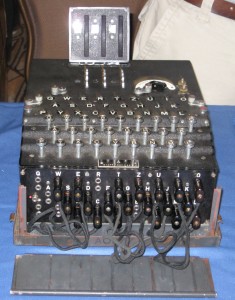
...an Enigma machine

(Not only did the National Cryptologic Museum bring that, they also were handing out (while supplies lasted) two really cool booklets: “The Cryptographic Mathematics of Enigma” and “Solving the Enigma: History of the Cryptanalytic Bombe”. The inside covers of both books claim they are available for free by sending a request: email me for the address, or try crypto_museum [at] nsa.gov.)

(I also got a kick out of the “NSA careers” cards they were handing out, mostly because it was the first buisness card I’ve ever seen with an embedded microfiber screen cleaner.)

Today’s schedule:

“Making Sense of Static – New Tools for Hacking GPS”: Pretty much what I expected from the description, but still a very good panel. The presenters have been doing a lot of work with systems that use GPS tracking, and they’ve run up against the limits of affordable off-the-shelf GPS hardware. There are all kinds of things you can’t do with retail GPS:

  • Experimenting with spoofing and jamming attacks is hard because you don’t have low-level hardware access to see what’s going on.
  • Implementing methods for dealing with poor signal environments, such as “urban canyons”, is also difficult.
  • You also don’t have access to the newer systems, such as GLONASS, Galileo, or Compass.
  • And it is hard to experiment with advanced positioning techniques.

Much of the presentation was devoted to a detailed account of exactly how GPS calculates positions on Earth, and what some of the limitations of those calculations are. If I were to attempt to summarize this, I’d be doing from memory and likely get much of it wrong, so instead I’ll point to the Wikipedia entry which covers the same material (including the use of Gold codes to distinguish each GPS satellite).

All of this led up to two products:

  • libswiftnav, which is a lightweight, fast, and portable set of tools for building a GPS receiver. The nice thing about libswiftnav, according to the authors, is that it will run on microcontrollers and other relatively wimpy hardware.
  • Piksi, a hardware implementation that uses libswiftnav and overcomes a lot of the limitations outlined previously: it can do highly accurate positioning, very fast updating, and supports other positioning systems.

The presenters have stated that their presentation should be available at the Swift-Nav site as soon as they have a chance to upload it.

I missed the “Not So Super Notes, How Well Does US Dollar Note Security Prevent Counterfeiting?” session simply because the clock got away from me. If I can find the presentation online, I will link to it.

I wasn’t able to get into the “How to Hack VMware vCenter Server in 60 Seconds” session for reasons of it being held in a room way too small for everyone who wanted to get in. This seems to be a version of the presentation from another conference. I’ve only given it a quick skim, but it looks very interesting indeed.

Bypassing Endpoint Security for $20 or Less” wasn’t quite what I had expected, but it paid off. The basic idea behind this panel was that there’s an increasing emphasis on keeping people from walking out of the office with sensitive data on USB mass storage devices; some companies use software that allows only known and approved devices to connect over USB.

So how do you know if a device is known and approved? Much of the presentation dealt with specifics of how USB, and especially USB mass storage, works. The short answer is that everything depends on “endpoints” (which are sort of “virtual wires” for USB connections) and “descriptors” (which provide information about the device). USB devices identify themselves through a combination VID/PID as part of the protocol, so if you can spoof the VID/PID, you can pretend to be an already authorized device.

Which is what the presenter’s hardware does, for less than $20. I haven’t found the presentation online, but the presenter swears the hardware schematics etc. will be available on github under “usb-impersonator” as soon as he gets around to updating the repository (which he promises will be real soon now).

Edited to add 7/28: Two points in this presentation that I wanted to mention but forgot to last night.

  1. Windows doesn’t see anything but the first LUN on USB mass storage devices. So if you want to hide something on a flash drive from a Windows user, partitioning the drive is a good way of doing that.
  2. If you run modprobe usbmon (this may require running as root) and then fire up Wireshark, wonder of wonders, you get a whole bunch of USB bus devices available as Wireshark interfaces. This is something I want to play with more when I have time: I’ll probably post some Wireshark capture files showing what happens when a device is inserted.

Edited to add: Added link to Phil Polestra’s blog entry, which contains links to the slides and the code, 8/1/2012.

The last presentation I went to was “Safes and Containers – Insecurity Design Excellence”. This is one that’s already gotten a fair amount of attention: a friend of mine emailed me a link to this Forbes article by one of the presenters that neatly recaps the whole thing (including their videos).

Basically, many popular gun safes, especially ones made by the Stack-On corporation, are insecure and can be opened with paper clips, drinking straws, pieces of brass purchased at a hardware store,..or by just simply lifting up the safe and dropping it a few inches.

Why is this? The presenters argue that the people who make these safes don’t come from a culture that says to itself “Okay, I’ve built this safe. Now how can I bypass the mechanism and get in?” Quoting: “Engineers know how to make things work, but not how to break them.” Many of these safes are imported from China and are made as cheaply as possible, which complicates things even more.

There’s also an attitude of “my product meets the standards, so up yours”. The California Department of Justice has standards for gun safes, and these products all meet those standards. However, the CDOJ standards do not involve any kind of realistic tests of the product, such as turning it over to a five-year-old and telling him there’s candy inside.

My one issue with this presentation is that the authors seem to view gun safes as the most important part of protecting your kids from guns; thus they believe safes need to be stronger. I can agree with this, but as I see it, safes should be a last resort, not the primary means of protection. I grew up in a house with guns, and I was never tempted to mess with any of them because my parents raised me properly (and because I knew I’d be beaten bloody if I did mess with them). Age-appropriate training (such as the NRA’s “Eddie the Eagle” program) combined with appropriate physical security (what was that gun safe doing where a three-year old had physical access to it, anyway?), combined with safes that actually do what they’re supposed to do, constitutes a layered defense, and one that works better than just relying on cheaply made Chinese junk.

And so to bed. I’m tired, and stuff hasn’t been working right all night. Project e just shut itself down in the middle of this post, the Kindle’s battery was deeply discharged and I had to wait for it, and dinner was not that great. (More about that later on.)

“History can be well written only in a free country.”

Monday, July 16th, 2012

(Quote attributed to Voltaire.)

A while back, there was a meme going around the gun blogs, asking “Why do you carry?” Answers to that generally fell into a couple of categories: “to protect myself/my family”, “because I can”, “because f–k you, that’s why”.

A kind of related question that I haven’t seen talked about is “why do you own guns in the first place?” Many of the answers are the same: self defense, because we don’t like people telling us what we can and can’t do, and so on. But one answer I haven’t really seen people talk much about is “history”.

Since I got back from the S&W Collector’s Association convention in Boise, I’ve been thinking about history and guns, both together and separate. There were a lot of intersections in Boise with areas of my own personal history, and there are some other things are just simply curious or interesting.

I believe an argument can be made that weapons are actually one of the cheapest ways to establish a connection to history for the common man. You can collect cars, for example, but it takes a millionaire’s pocket to collect anything historically significant. If you’re lucky, you might see a vintage warbird at an air show two or three times a year, but good luck touching one, let alone sitting in the cockpit. And flying one, again, requires a millionaire’s budget.

But I think there’s more going on than just the money element.

(more…)

Battleship!

Thursday, July 5th, 2012

I believe I’ve mentioned in the past that I’m a big fan of museums. Especially little museums, and especially military museums. I’ve had a lot of fun visiting official Navy museums, like the one at the Naval War College in Newport and the Submarine Force Museum in Groton. (However, I am not biased; I’ve been to the Air Force Museum at Wright-Patterson AFB twice, and loved that both times.)

It isn’t just the official museums I like. I want to get back over to the Nimitz Museum in Fredericksburg soon. (I know, it is now the “National Museum of the Pacific War”, but I still think of it as the Nimitz Museum.) It isn’t even just the military ones; there’s a whole host of little museums in Houston, for example, that I’d like to visit.

(We visited the San Jacinto Monument a lot when I was a child, but I don’t remember ever touring the battleship Texas. Odd that. I also never got to eat at the San Jacinto Inn during the glory days of that establishment. Not that I’m bitter or anything.)

The purpose of this long digression is to point out an article in today’s LAT (I know, I know, but they come in waves, and the Cudahy articles were actually yesterday; I just didn’t have time to blog them) tied to the battleship Iowa docking in San Pedro.

The basic point of the article is that warship museums may or may not work out. Why? It depends on the location: thank you, Captain Obvious!

In San Diego, the aircraft carrier Midway has topped 1-million visitors per year. Another carrier, the Intrepid, is a must-see museum in Manhattan, especially with the recent arrival of the space shuttle Enterprise.

I’d suggest both of those are very special cases; San Diego has a strong naval presence, so I’d expect a warship museum to work well there. And the Intrepid is, to my mind, an atypical warship museum, what with the space shuttle and the SR-71 and the glaven and the HEY NICE LADY!

Sorry.

On the other hand, I’m not exactly shocked that the battleship New Jersey in Camden, New Jersey has trouble attracting visitors.

“Don’t assume you know what the public wants,” said Midway marketing director Scott McGaugh when asked his advice for the Iowa. “Don’t build a museum just for History Channel buffs and retired military.”

I’d also note Chumlee and Rick have a full work schedule at the shop and can’t be running off to every warship in the country, and the Old Man is probably too grumpy to be a good docent.

Snark snark aborted snark.

Monday, May 7th, 2012

Prosecutors also showed a Taser allegedly used by Cpl. Jay Cicinelli in the beating of Thomas on a video screen visibly covered in blood.

You’d think that they could at least wipe off that video screen first. But this is California; they do things differently there.

I was going to make a snarky comment that this NYT article on what killed Vladimir Ilyich Lenin didn’t include my own favorite theory. Except that it does:

Dr. Lurie concurred on Friday, telling the conference that poison was in his opinion the most likely immediate cause of Lenin’s death. The most likely perpetrator? Stalin, who saw Lenin as his main obstacle to taking over the Soviet Union and wanted to get rid of him.
Communist Russia in the early 1920s, Dr. Lurie told the conference, was a place of “Mafia-like intrigue.”

Vladimir Ilyich Lenin, call your office, please.

Friday, January 13th, 2012

North Korea said on Thursday that it would place the body of Kim Jong-il on permanent display in a Pyongyang mausoleum and install his statues, portraits and memorial towers across the country.

Oh, wait, it looks like you’ve already called in:

Until Thursday, North Korea had not clarified what it would do with the body, although news reports in Russia and South Korea have said that a team of Russian specialists in charge of maintaining Lenin’s embalmed body was flown to Pyongyang, the North’s capital.

I wonder how you get a job as a Lenin maintainer. Is there an academic course of study you can follow? Is it a two-year or four-year program?

Like Steve McQueen.

Thursday, January 12th, 2012

Today’s NYT has an interesting article about an attempt to unearth and recreate the tunnel system used in Stalag Luft III.

In an effort to establish more clearly how the escape was accomplished — and, in a sense, to reclaim the narrative of the breakout — British-based engineers, battlefield archaeologists and historians traveled into the pine forest outside Zagan last summer to unearth the secrets buried there for a television documentary by Wildfire Television in London that was broadcast in late 2011 in Britain. They were accompanied by modern-day Royal Air Force pilots, as well as veterans of wartime bombing raids, now in their 80s, who helped build the tunnels at the encampment known as Stalag Luft III.

It turns out that the team was unable to excavate “Harry”, but they did manage to dig down to “George”. They also constructed a new tunnel called “Roger”, “but in a trench just beneath the surface; anything deeper was deemed too dangerous”. (The original tunnels ran 30 feet below the surface.)

I am looking forward to this documentary showing up on PBS. (At least, I’m hoping it will show up on PBS instead of The Hitler History Channel.) I think this is a review of it from the Telegraph. Here’s a link to an older NOVA documentary. For any of my younger readers who are unfamiliar with the story, here’s the Wikipedia entry to use as a starting point. The Great Escape is still in print and available from Amazon. And because I want to make things as easy for my readers as possible, here’s a link to the DVD.

I shouted out ‘Who killed the Kennedys?’

Tuesday, November 22nd, 2011

The City of Dallas would like for you to know that they are not responsible for the assassination of JFK.

Not only that, but they’re planning a big 50th anniversary event in 2013, and are raising money to restore Dealey Plaza.

Short shameful confession: I’ve lived in Texas for a long time, but I’ve never visited Dallas. One of these weekends, I’m going to take off, get a hotel room, and visit Dealey Plaza and the 6th Floor Museum.

(The Conspiracy Museum lost their lease a few years back. They were supposedly moving into a new space, but I can’t tell if they actually did.)

Anniversaries.

Monday, October 24th, 2011

A few people made note of the 10th anniversary of the iPod over the weekend.

That’s pretty nifty. But today is the 150th anniversary of the completion of the first transcontinental telegraph line, which is even more significant (in my humble opinion).

The article I linked above does a pretty good job of explaining the significance of the telegraph, especially by making an analogy with the Internet. It surprises me a little that the article doesn’t quote Tom Standage at all, however: his The Victorian Internet: The Remarkable Story of the Telegraph and the Nineteenth Century’s On-line Pioneers is basically a book-length examination of the early history of the telegraph, and draws heavily on the telegraph-Internet analogy.

If you haven’t already read it, I enthusiastically recommend Standage’s book. He’s a good writer, and the early history of the telegraph is a fascinating subject. (For example, how much do you know about Thomas Edison, other than the standard facts? Did you ever realize Edison was basically a hacker? He was able to build Menlo Park out of the money he got for banging on early telegraph machines.)