Archive for the ‘History’ Category

Obit watch: June 5, 2014.

Thursday, June 5th, 2014

Don Zimmer: NYT. ESPN.

Lady Mary Soames passed away last Saturday. Mrs. Soames was the last surviving child of Winston Churchill, and wrote extensively (and, by all the accounts I’ve seen, well) about her family.

And we are obligated to note the passing of Chester Nez, Navajo code talker.

Nez, a painter, earned a bachelor’s degree in fine arts from the University in Kansas in 2012.

On the road again…

Monday, June 2nd, 2014

Heading home. Travel day. In the meantime:

1. Go read this post by Tam. There are echos in it of something some less smart person wrote a couple of years ago.

2. I didn’t realize until the middle of last week that this year is the 50th anniversary of the .41 Magnum. (Ask me about my Model 57.)

3. I took a fair number of photos yesterday while running around with my aunt and uncle (who graciously drove the two hours each way from Cleveland to spend part of the day with me; thanks again, guys!). I’m waiting until I get back to do the post-processing and uploading, but I thought I’d throw one up here that I played with last night.

DSC_0005

I took this with the D40X and the 18-55 kit zoom. It was cropped and the exposure adjusted slightly using Shotwell on Project e. I’m actually pretty happy with the end product, though I may make a second pass over it once I’m in front of iPhoto.

Be careful what you promise.

Saturday, May 24th, 2014

I’ve been wanting to write about this for a couple of weeks now, but have had trouble finding a way into it.

Earlier this century, some researchers working with Boston College came up with what became “The Belfast Project”. The idea was simple; do an oral history of the conflict in Northern Ireland by interviewing people on both sides of the conflict.

This was probably a worthwhile idea. But could you convince these people to talk? Sure, if you promised them that what they said would remain confidential until they died.

In the end, “The Belfast Project” interviewed 46 people; 26 former IRA members, and 20 former members of the UVF. Since they were promised confidentiality, many of them spoke freely. Perhaps a bit too freely.

Because BC apparently didn’t think through all of the legal implications. The United States has a “mutual legal assistance treaty” with the United Kingdom of Great Britain and Northern Ireland. Law enforcement in UKOGBAI became aware of the existence of “The Belfast Project” and decided to subpoena some of the interviews. The US government, under the terms of the treaty, had to cooperate with the request. There was a long legal battle, which BC lost; they surrendered 11 interviews with former IRA members.

As a result of this, Gerry Adams, the former head of Sinn Féin, was arrested as part of the investigation into a 1972 murder. The last I heard, Adams was questioned and released, and so far has not been actually charged with the murder.

Of course, people are upset. Confidentiality was breached! And BC has promised to return the interviews to the participants.

That may be “too little, too late”. Because now the government of Northern Ireland is asking for everything: all the interviews in “The Belfast Project”.

I’m not a lawyer, but I wonder what BC’s chances are at this point. If they return the tapes and burn the transcripts now, after a subpoena has been filed, will they be destroying evidence? Could BC wind up facing obstruction of justice charges?

And it seems that there are a fair number of people, on and off the BC campus, who think BC did a crap job with the project:

“The question that is unanswered is, why was the process not followed with this project?” said Susan Michalczyk, assistant director of BC’s Arts and Sciences honors program and president of the university’s chapter of the American Association of University Professors. “There should have been direct faculty oversight. Academic freedom can only be maintained when people adhere to the policies that preserve ethical practices.”

And:

Many faculty remain stunned that a project with so many potential ethical and legal pitfalls could be run with so little supervision. Given the risks involved, the project might never have moved forward if other scholars had been given a chance to weigh in, many said.

I wanna see some history…

Monday, May 12th, 2014

…’cause now I got a reasonable economy!

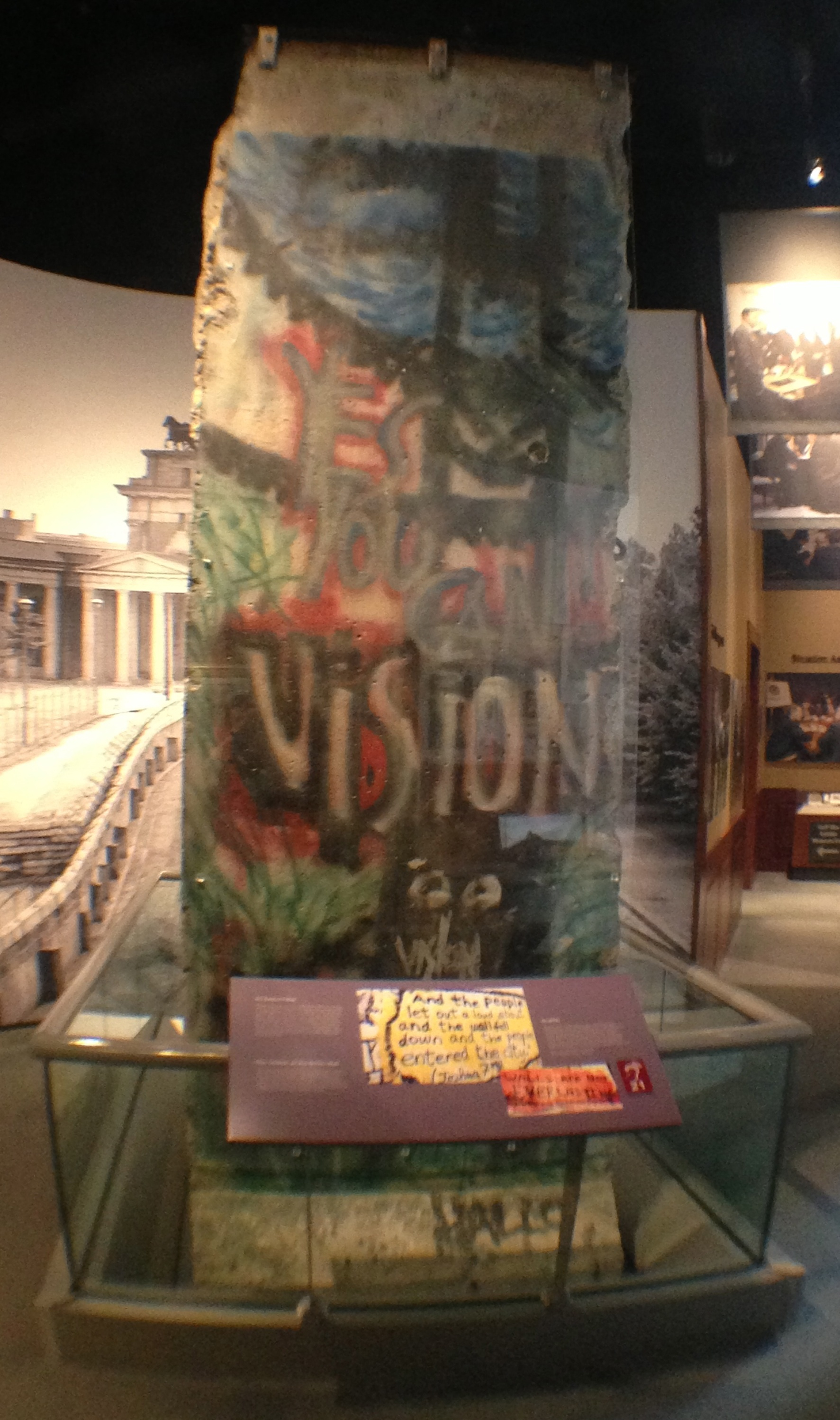
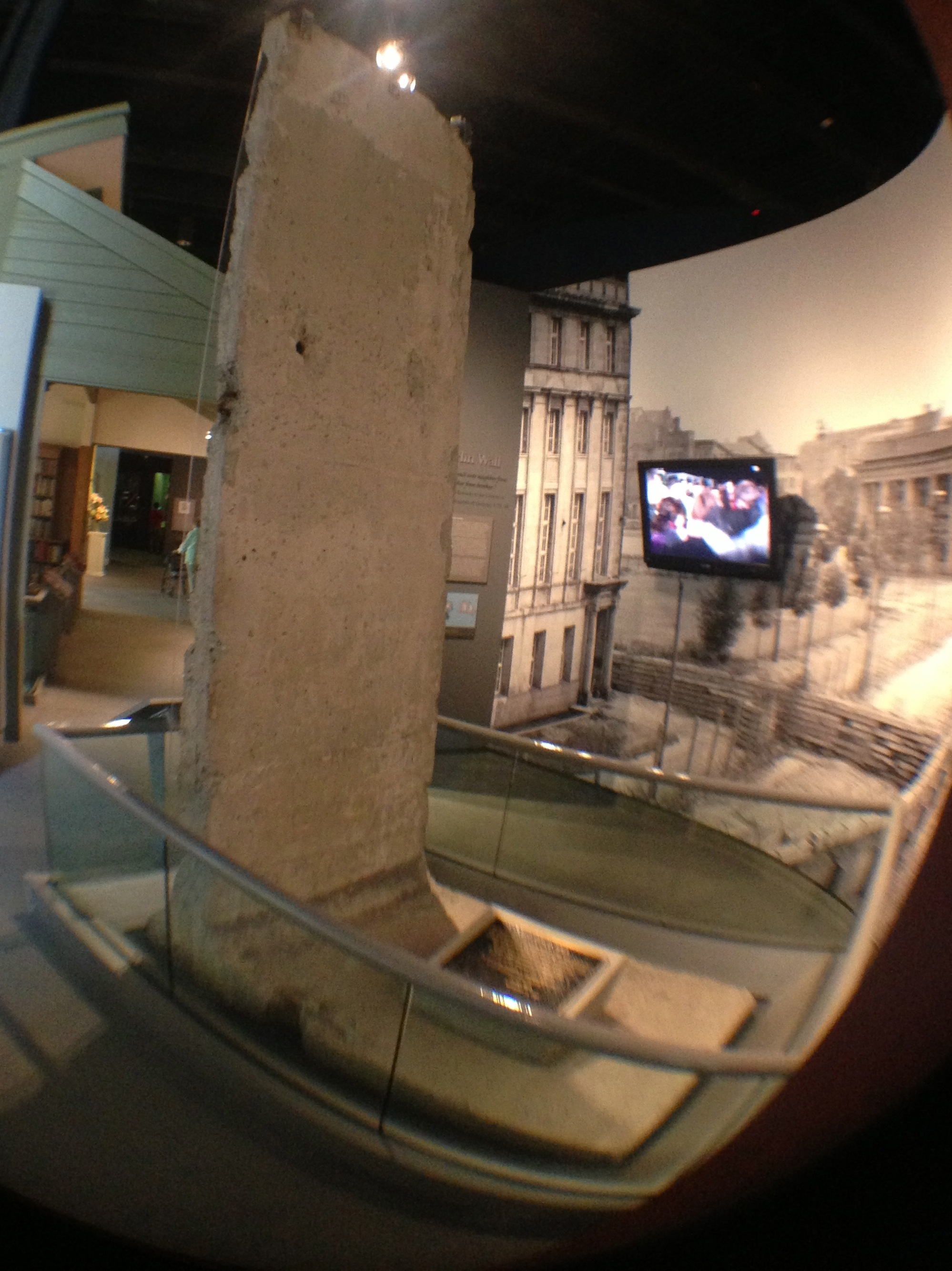
The Berlin Wall!

wall1

I don’t think these came out quite as well as I would have liked. I did get around to purchasing one of the Olloclip lens kits for the iPhone after my trip last year. But then I kept forgetting to take it with me when I went places. Yesterday was the first chance I’d actually had to take it out for a spin. It seems to work well, but the photos could have used a bit more light; I had the iPhone flash turned off.

(George Bush Presidential Library and Museum, College Station, Texas.)

(Subject line hat tip.)

And speaking of obits…

Friday, May 9th, 2014

I am sad that William Ash, a gentleman I was previously unfamiliar with, has died.

On the other hand, 96 years is a pretty good run, and his NYT obit is quite entertaining.

Before the war ended, he had attempted 13 escapes and made it outside the barbed wire a half-dozen times. He went under, over and through fences. He walked out in disguise. He tunneled through a latrine. He was always recaptured.

I suspect one reason he was always recaptured is that the Germans could hear him clanking as he walked from miles away.

Guy Lombardo and His Royal Canadian Navy.

Sunday, April 13th, 2014

I remember Guy Lombardo from when I was a wee lad. Every New Year’s Eve up until roughly 1976, there was Guy and his Royal Canadian Orchestra hosting their New Year’s Eve special. Sometimes I was able to stay up and watch at least part of it.

I associated Guy and the RCO with Lawrence Welk and Liberace and, for want of a better word, the kind of music my maternal grandmother and grandfather liked. But at the time, there were only three real television channels, I never really got into Dick Clark, and “Guy Lombardo and His Royal Canadian Orchestra” flowed trippingly off the tongue.

I hadn’t thought of Guy in years, until a few paragraphs in The Power Broker got me wondering about him. How did he end up hosting those specials? What else did he do, and where did he come from?

Wikipedia turned up one of those odd historical byways that I’m so fond of. In addition to being the leader of the Royal Canadians, Guy raced boats. Seriously raced boats. As in, he won the Gold Cup (which is the biggest prize in boat racing) in 1946.

From 1946 to 1949, he was the reigning US national champion. Before his retirement from the sport in the late 1950s, he had won every trophy in the field.

Before his retirement, he was planning to make a run at the world speed record on water. His retirement may have been prompted by the fact that the boat he was planning to use disintegrated during a test run.

(As a side note, that record isn’t for the timid. Wikipedia claims “an approximate fatality rate of 85% since 1940“, though it should also be noted that this statement is tagged “Citation needed.” No matter what the actual percentage is, looking over the history of attempts makes it very clear that this is an expensive way to kill yourself very fast if anything goes wrong.)

And what’s the relationship between Guy and Robert Moses that brought this up in the first place? Guy and his RCO were basically Robert Moses’ house band. Moses set them up at Jones Beach and gave them an incredibly sweet deal: Moses didn’t just pay Guy and RCO to play at the park, but also absorbed all the costs of running the venue, and allowed Guy and the RCO to keep most of the ticket money and advertising revenue. In return, not only did Guy and the RCO play at Jones Beach, but they also entertained at various other offical functions for Moses, and Moses used them to impress people he needed to impress. For example, if you had a small child and Moses needed your help with something…well, Guy entered the Jones Beach theater every night on one of his speedboats. Wouldn’t your kid love to ride along with Guy as he made his grand entrance in Tempo? Of course they would.

(There are a couple of good biographies that need to be written. I can’t find any evidence that there was ever one written of Guy and his brothers, and it sure seems there’s more to their story. I think you could also get a good book out of the story of Rosebud Yellow Robe.)

Quote of the day.

Friday, April 4th, 2014

As the crucial special session neared, the Times began to resemble a Democratic house organ.

–Robert Caro, The Power Broker: Robert Moses and the Fall of New York, page 198 in the paperback edition (Chapter 11, “The Majesty of the Law”, discussing the legal and legislative battles over Moses’ parks plan).

Obit watch: March 29, 2014.

Saturday, March 29th, 2014

Jeremiah A. Denton Jr., retired from the Navy as a rear admiral and a former US senator from Alabama.

He was also a war hero.

Over the next seven years and seven months, Commander Denton was held in various prison camps, including the notorious “Hanoi Hilton,” and endured beatings, starvation, torture and more than four years of solitary confinement, including periodic detentions in coffinlike boxes. He and other officers nevertheless maintained a chain of command and a measure of discipline among the prisoners.

And:

The North Vietnamese, who lost face, were even more outraged when they learned that Commander Denton, in the Japanese-taped interview broadcast on American television on May 17, 1966, had blinked out “T-O-R-T-U-R-E.” It was the first confirmation that American prisoners of war were being subjected to atrocities during the Vietnam War.
The commander was beaten all night.

Noted.

Saturday, March 15th, 2014

Gene Weingarten, the subject of previous posts here, has a short but nice appreciation of Joe McGinniss and Fatal Vision up at the WP site.

(Although this is dated March 11th, it only came to my attention today. There’s a note on it that says it originally came from Weingarten’s online chat.)

I am probably shooting a gigantic hole in my credibility as a true-crime buff. But, while I have read many of the “classics” of the genre (and some crap, too), I confess that I have not yet read Fatal Vision. Both Weingarten and Bill James say enough good things about it, however, that I think that will be next on my reading list. After, of course, I finish the true crime book I’m currently reading.

Edited to add: Discussion question for the huddled masses: was the Dreyfus affair really a “true crime” story? I would say “yes”: treason is, after all, a crime. Does the fact that Dreyfus was wrongly accused change that classification? Not in my mind: does the fact that O.J. was acquitted make the murders of Nicole Brown Simpson and Ronald Goldman any less a true crime story? Would it change my mind if it turned out there was no actual treason? I don’t think so; there was still a criminal accusation and trials, which to me qualifies it as a “true crime” story. Which raises the question: could you have a “true crime” story in which, not only is the accused innocent, but the crime itself never happened? For example, a murder charge where the alleged victim actually turns up alive and testifies for the defense? I am inclined to say “yes, and that’s a book I’d want to read”.

Howard Waldrop, call your office, please.

Wednesday, March 12th, 2014

By way of Popehat on the Twitter, NPR’s counterfactual series, “What If World War I Had Never Happened?

Do you think Sarajevo is full of assassins?” I can’t lie; this made me smile, as did “a very Austro-Hungarian problem” and “Is this how you greet visitors, by throwing bombs at them?”

(See also. Also, I have to admit to some curiosity; what kind of sandwich?)

Edited to add: Well. Well well well. Well.

Also, wouldn’t “Gavrilo Princip’s Sandwich” be a great name for a band?

This day in history.

Thursday, January 30th, 2014

Our great and good friend Borepatch has a post up about all the folks who died on January 30th, including Gandhi, Sir Everard Digby, and that guy who crossed the 47 Ronin.

Borepatch’s post, and an email from Chartwell Booksellers, reminded me: Winston Churchill died on January 24th, 1965, but his funeral was today er, on this date in 1965.

A couple of years ago, I read John Keegan’s Winston Churchill: A Life, and there was something in it that I found striking and moving:

Queen Elizabeth II attended his funeral.

I know that sounds like something you’d expect for Churchill, and I doubt there was any question about her going. But the royal family almost never attends the funeral of a commoner: they only go to funerals of other members of the royal family. I have this mental image of Elizabeth arguing with her people: “I’m going. I don’t care about tradition. He won the war, you…” Well, I doubt Elizabeth would say “assholes” but she might think it. I know it is fashionable to sniff at England and wonder what they need with the royal family, but it does seem like Elizabeth II is the class act of the bunch.

(And he got a state funeral, too. According to Keegan, the last commoner to get one of those was the Duke Of Wellington. In 1852.)

While I was working on this post, I found that the BBC has a nice archive devoted to remembering Churchill. I haven’t had time to go through it all yet, but I’m bookmarking it here.

Leadership Secrets of Non-Fictional (?) Characters (part 10 in a series).

Wednesday, January 29th, 2014

I’m currently reading Richard Miles’s Carthage Must Be Destroyed: The Rise and Fall of an Ancient Civilization (a Christmas gift from my beloved and indulgent sister).

One thing I’ve noticed is that Carthage suffered from a severe shortage of names. You would not believe the number of Hamilcars, Hannos, Hasdrubals, and Hannibals in the pages of this book.

(I owned a Hamilcar once. Couldn’t keep a clutch in it.)

But let’s talk for a moment about the Hannibal, Hamilcar Barca’s son, of “crossing the Alps” fame.

Miles makes a good point: what we know about Carthage mostly comes from the works of Roman historians, who (N.S. Sherlock) had their own set of biases and assumptions, and those should be taken into consideration. (That’s the reason for the question mark in the title.) But there’s an interesting quote from Livy, by way of Miles:

Reckless in courting danger, he showed superb tactical ability once it was upon him. Indefatigable both physically and mentally, he could endure with equal ease excessive heat or cold; he ate and drank not to flatter his appetites but only so much as would sustain his body strength; waking and sleeping he made no distinction between night and day; what time his duties left him he gave to sleep, nor did he seek it on a soft bed or in silence, for he was often to be seen, wrapped in an army cloak, asleep on the ground amid common soldiers on sentry or picket duties. His clothing in no way distinguished him from other young men of his age; but his accoutrements and horses were eye-catching. Mounted or unmounted he was unequaled as a fighting man, always the first to attack, always the last to leave the field.

So. Shared the hardships of his men, never asked them to do anything he wasn’t willing to do himself, first to fight, last to retreat. Where have we heard this before?

Oh, yeah: pretty much every great military commander in history shares those characteristics. I just find it kind of interesting to see how far back this goes…

Mao mix.

Thursday, December 26th, 2013

Mao Mao Mao, Mao Mao Mao, Mao Mao Mao Mao Mao Mao.

(Sorry. But when was I going to get another chance to do this?)

Random notes: December 10, 2013.

Tuesday, December 10th, 2013

One bright and lovely morning in September, on the first day of school, three traffic lanes that went from the streets of Fort Lee, New Jersey, to the George Washington bridge were suddenly shut down:

Cars backed up, the town turned into a parking lot, half-hour bridge commutes stretched into four hours, buses and children were late for school, and emergency workers could not respond quickly to the day’s events, which included a missing toddler, a cardiac arrest and a car driving into a building.

The lanes were ostensibly closed for a “traffic study”:

But the workers testified that the Port Authority already collected data on how many cars traveled in each lane, so such a traffic study would have been unnecessary.
The director of the bridge, Robert Durando, testified that in 35 years at the Port Authority, he had never heard of lanes being closed down for a traffic study.

The lanes were shut down for a total of four days. The Port Authority controls the bridge, and gave the order to shut down the lanes. And the members of the Port Authority are appointed by Chris Christie.

The mayor of Fort Lee, a Democrat, complained in a letter in September that the lane closings were “punitive” — Mr. Christie, a Republican, was leaning heavily on Democratic mayors to endorse him for re-election so he could present himself as a presidential candidate with bipartisan appeal, but the mayor was not going along.

So now the New Jersey legislature is holding hearings, and it sounds like there’s very little paperwork documenting exactly why the Port Authority decided to hold a traffic study on one of the busiest days of the year. It also sounds like there’s a lot of…obfuscation, shall we say?

On the one hand, I want to give this the “NYT covers a Republican politician” discount. On the other hand, there seems to be no dispute that three access lanes to the busiest bridge in the United States were closed for four days, and not for emergency repairs. That to me is simply inexcusable; in a case like this, I would support individuals taking it upon themselves to reopen the “closed” lanes, as well as the liberal application of tar and feathers.

Speaking of tar and feathers, here are some excerpts from yesterday’s testimony in the Kelly Thomas trial that are designed to enrage you:

“That would not be good proper police procedure,” [John A. ] Wilson [testifying as a “use of force expert” – DB], a 26-year FBI veteran, said when asked hypothetically about a suspect being hit on the head. Such a blow “is going to cause serious bodily injuries.”

Prosecutors maintain that Thomas was struck repeatedly in the face with the front of [Jay] Cicinelli’s Taser and that the injuries contributed to his death. Audio from the night captures Cicinelli saying he hit Thomas 20 times in the face with his stun gun.

Wilson also testified that when the video captures [Manuel] Ramos putting on latex gloves and threatening to punch Thomas, it was a show of force by Ramos: “It indicates there’s going to be contact made, or blood or some body fluid may be exposed as a result of a violent contact.”

In the video, Ramos puts on the gloves and tells Thomas, “See these fists? They’re getting ready to [expletive] you up.”

Wilson said officers should have stopped hitting Thomas after he started complaining that he couldn’t breathe and a pool of blood started forming on the concrete.

Morning coverage of the Spaccia conviction:

Spaccia probably faces a sentence similar to the 10 years to 12 years in prison that her former boss, Robert Rizzo, is expected to receive, prosecutors said. Rizzo pleaded no contest to 69 corruption charges in October.

I promised more coverage of the LA County Sheriff’s Department indictments, but I’d be doing it anyway. There is a lot of “Wow” going on here.

The indictments allege two assaults on inmates and three on people who visited the jail. They also include claims that deputies wrote false reports to justify using force and conducted illegal arrests and searches of jail visitors.
A sergeant who supervised deputies in the visiting area of Men’s Central Jail was accused of encouraging violence and reprimanding employees “for not using force on visitors … if the visitors had supposedly ‘disrespected'” jail deputies, according to an indictment.

Remember, these aren’t inmates (not that it would be any better if they were): these are visitors. But wait, it gets better:

In one case, prosecutors say, an Austrian consul official trying to visit an Austrian inmate was arrested and handcuffed even though she had committed no crime and would have been immune from prosecution, the indictment said.

There’s even more. A crooked jailer smuggled a cell phone in for an inmate who was an FBI informant.

After the discovery, sheriff’s officials moved the inmate — identified only as “AB” in the indictment — and changed his name. They then altered the department’s internal inmate database to falsely say he had been released, prosecutors allege. Deputies continued to isolate the inmate even after federal authorities had told sheriff’s officials that a judge had ordered the inmate’s appearance before a grand jury, the indictment states.

Can you say, “obstruction of justice”? I knew you could. But it gets even better:

Stephen Leavins, a lieutenant in the unit that handles allegations of criminal misconduct against sheriff’s employees, was accused of directing two sergeants to confront an FBI agent working on the investigation outside her home. The sergeants — Scott Craig and Maricella Long — falsely told the agent that a warrant was being prepared for her arrest, prosecutors said in court records.

They tried to intimidate an FBI agent? Does LACSD make it a practice to hire and promote deputies who are dumber than a bag of hair?

For a while now, I’ve felt like the HouChron is trying to become more like BuzzFeed; if you look at their website, there’s a huge emphasis on slideshows and listicles. I generally don’t like linking to that crap (though the slide shows of fair food are often interesting) but here’s an exception: historical photos of Bonnie and Clyde. The HouChron isn’t kidding around with the “graphic photos” warning, either; there are a couple of photos of Bonnie and Clyde after the shootout. (There’s also some nice photos of a couple of their guns, if you’re into that sort of thing.)

(Yeah, it is tied to the mini-series, which I didn’t watch, but the photos are still interesting on their own.)

Edited to add: Grammar question. “A FBI agent” or “An FBI agent”? “A FBI informant” or “An FBI informant”?

Historical oddities (part 1 of, yes, yet another ongoing series).

Saturday, December 7th, 2013

Discovered while Wiki-wandering: Charles Nelson Reilly was a survivor of the 1944 Hartford circus fire.