Archive for the ‘History’ Category

Brief historical note, suitable for use in schools.

Wednesday, October 4th, 2023

30 years ago yesterday and today, a group of UN soldiers (including US Special Operations troops, and units from Malaysia and Pakistan) went out on a mission to capture high-ranking members of the Somali National Alliance (SMA) in Mogadishu.

Things went bad. Then they went very bad. When it was all over, 18 US soldiers had been killed, and another 73 were wounded. One Malaysian Army soldier and one Pakistani soldier were also killed.

Battle of Mogadishu from Wikipedia.

Medal of Honor citations for Master Sergeant Gary Ivan Gordon and Sergeant First Class Randall David Shughart, killed in action during the battle.

Also killed:

  • Staff Sergeant Daniel Darrell Busch.
  • Sergeant First Class Earl Robert Fillmore, Jr.
  • Master Sergeant Timothy Lynn Martin.
  • Sergeant First Class Matthew Loren Rierson.
  • Corporal James E. Smith.
  • Specialist James M. Cavaco.
  • Sergeant James Casey Joyce.
  • Corporal Richard W. Kowalewski, Jr.
  • Sergeant Dominick M. Pilla.
  • Sergeant Lorenzo M. Ruiz.
  • Staff Sergeant William David Cleveland, Jr.
  • Staff Sergeant Thomas J. Field.
  • CW4 Raymond Alex Frank.
  • CW3 Clifton P. Wolcott.
  • CW3 Donovan Lee Briley.
  • Sergeant Cornell Lemont Houston, Sr.
  • Private First Class James Henry Martin, Jr.
  • Lance Corporal Mat Aznan Awang (Malaysian Army, posthumously promoted to Corporal).

I have been unable to find a name for the Pakistani soldier who was killed.

Black Hawk Down is still a heck of a book, in my opinion. The movie’s pretty good, too, but I’m not going to stake my life on it being 100% accurate. (Though I do believe the movie makers tried very hard.)

“Folly and Redemption: Thirty Years After Black Hawk Down” from The American Conservative.

Obit watch: September 15, 2023.

Friday, September 15th, 2023

Éva Fahidi, Holocaust survivor.

Ms. Fahidi, part of a Hungarian Jewish family that had converted to Catholicism, was rounded up in 1944 along with the rest of her family and taken to the Auschwitz-Birkenau concentration and extermination complex in occupied Poland. She was 18.
She was apparently saved from the gas chamber by being of an age and fitness level to qualify for a forced-labor camp. Her other family members were sent to their deaths. Josef Mengele, the Nazi death camp doctor, presided over the selection process.

After the war ended in 1945, Ms. Fahidi (who was also known as Éva Fahidi-Pusztai from an early marriage) kept her experiences largely to herself for more than a half-century. Then, in 2003, on the anniversary of that day on the ramp when she last saw her family members, she visited the Birkenau site and was disappointed to find it more like a tourist attraction than like anything she remembered.
She committed herself to telling her story and to helping younger generations understand what had gone on at the camp and in the Holocaust in general. Over the next 20 years she spoke to countless schoolchildren and worked with young volunteers who collected Holocaust remembrances from survivors. She appeared at anniversary observances marking the liberation of Auschwitz and other occasions and spoke to legislative bodies. And she bore witness, including attending the 2015 war crimes trial in Germany of Oskar Gröning, who at 93 was accused of having been one of the guards working that ramp at Auschwitz and was one of the last complicit Germans to face trial.

Lauch Faircloth, former Senator from North Carolina.

But it was as a member and later as chairman of the appropriations subcommittee on the District of Columbia that Mr. Faircloth made national headlines on a collision course with Mr. Barry, a former leader of the Student Nonviolent Coordinating Committee who had been a popular elected official in Washington, in various capacities, since the establishment of limited home rule in the capital in 1973.

The mayor admitted that the city government was “unworkable” and asked Congress to take over some city functions. Instead, with Mr. Faircloth as point man, a new Republican congressional majority put some city operations into receivership and created a financial control board to take over day-to-day spending and financial planning, with the power to overrule the mayor.
Over the next two years, Mr. Faircloth granted the city some concessions: more money than requested for public schools and repairs to decaying buildings. But Mr. Barry and the control board battled constantly over policy and budgetary issues.
A settlement was reached in 1997, when the Clinton administration and Senator Faircloth agreed to rescue the city but stripped Mr. Barry of power over most city agencies, handing it to the control board. The mayor, who retained authority over parks and recreation, libraries and tourism, called the arrangement “a rape of democracy.”

He dismissed Mr. Barry’s criticism. “I’ve heard so many meaningless statements from Marion Barry that one more doesn’t matter,” he said. “It’s airy persiflage.”

Lisa Lyon, bodybuilder and Robert Mapplethorpe photo subject.

Lawrence emailed an obit for Jean Boht, British actress, with the note that he wasn’t aware there was a British remake of “The Golden Girls”. I wasn’t either, but if we can remake British shows in the US, why can’t the Brits remake our stuff?

(I was aware that there was an attempt at a US “Fawlty Towers” remake. I wasn’t aware, until I went to look it up, that there were actually three attempts, including the Harvey Korman/Betty White one, and another with John Larroquette.)

IMDB.

Obit watch: September 11, 2023.

Monday, September 11th, 2023

Mangosuthu Buthelezi. I went back and forth about noting this, as I’m pretty far from being an expert in South African politics in the 1990s. What pushed me into it was that Lawrence posted a good obit at his site, which I encourage you to read.

Charlie Robison, noted Texas country musician. All the “local” obits I’ve found pull from the same AP obit.

Random gun crankery, with a public service announcement.

Thursday, September 7th, 2023

The Civilian Marksmanship Program (CMP) has opened up round 4 of 1911 pistol purchases. (Previously.)

Even better: with some limitations, you can purchase a second 1911, even if you’ve bought one from the CMP previously. That’s a new twist. There was formerly a lifetime limit of one 1911 per customer.

This might be your last chance to own a chunk of history. I, personally, won’t be buying one this time as I’m not eligible. (I technically got my 1911 this year, which disqualifies me.) But I’d really like to see some of my friends purchase 1911s from CMP, and if you need help navigating the process, I’ll be happy to try to help out.

Orders are being accepted through September 30th, so you’ve got some time.

Hattip: McThag.

Where do we get such men?

Wednesday, September 6th, 2023

This is a Bell AH-1 “Cobra” helicopter.

It was commonly used as an attack helicopter during the Vietnam war. I would like for you to observe that it has two seats: one for the pilot and one for the co-pilot. It has no more seating inside. It is only designed to carry two people, plus armament and ammo. This will become significant in a little bit.

On Monday, Capt. Larry L. Taylor (United States Army – ret.) was awarded the Medal of Honor for actions on June 18, 1968.

(more…)

Obit watch: September 4, 2023.

Monday, September 4th, 2023

Somebody out there is listening to me.

NYT obit for Marilyn Lovell (archived).

On Christmas Day 1968, while Mr. Lovell was on the Apollo 8 mission, the first manned spaceflight to orbit the moon, Ms. Lovell answered her door to find a representative from Neiman Marcus carrying a large box with moon-themed décor. In it was a mink coat and a note The New York Times would later describe as “the most romantic card in the universe”: “To Marilyn from the Man in the Moon.” Ms. Lovell did her household chores that day in pajamas and her new mink.
On that mission, Mr. Lovell named a triangle-shaped mountain on the lunar surface Mount Marilyn. It would later serve as a landmark for astronauts, and in 2017, after campaigning by Mr. Lovell, the name was officially recognized by the International Astronomical Union.

When Ms. Lovell’s 12-year-old daughter, Susan, became hysterical on seeing a priest at their door, Ms. Lovell found a way to soothe her. “Do you really think the best astronaut either one of us knows is going to forget something as simple as how to turn his spaceship around and fly it home?” she asked her daughter, according to Mr. Lovell’s memoir.
Reporters with notebooks, microphones and television cameras filled up the Lovell family lawn and driveway. She fielded a call from President Richard M. Nixon: “I just wanted you to know, Marilyn, that your president and the entire nation are watching your husband’s progress with concern,” he said. “Everything is being done to bring Jim home.”

When parachutes were seen on TV billowing out from the spaceship, guiding it safely to the ocean surface, a couple of famous astronauts in Ms. Lovell’s living room, Mr. Armstrong and Buzz Aldrin, opened champagne. President Nixon called with a new message: “I wanted to know if you’d care to accompany me to Hawaii to pick up your husband.”
She replied, “Mr. President, I’d love to.”

NYT obit for Douglas Lenat (archived).

Running across dozens of computers, Eurisko could discover possibilities that Dr. Lenat — and other humans — had not. But it needed help from human judgment. Machines could not be truly intelligent, he realized, unless they too had common sense.
The project was called Cyc. He set out to define the fundamental but largely unspoken laws that outline how the world works, including everything from “you can’t be in two places at the same time” to “when drinking a cup of coffee, you hold the open end up.” He knew it could take decades — perhaps centuries — to complete the project. But he was determined to try.
In recent years, the Cyc project — and the rule-based approach to A.I. research it represented — has fallen out of favor among leading A.I. researchers. Rather than defining intelligence rule by rule, line of code by line of code, the giants of the tech industry are now focused on systems that learn skills by analyzing massive amounts of digital data. This is how they build popular chatbots like ChatGPT.
Many leading researchers now believe that this kind of sweeping data analysis will eventually reproduce common sense and reasoning. But as today’s computers struggle with even simple tasks and play fast and loose with the truth, others believe that the industry can learn from Dr. Lenat and his never-ending struggle to build common sense by hand.

My favorite Dr. Lenat story is partially in the article: the Traveller Trillion Credit Squadron story.

In brief: Game Designers Workshop used to (still may) run a contest where you had a trillion “credits” to design the best possible fleet, according to the rulebook. The contestants were pitted against each other until one fleet won. Dr. Lenet fed the rules into Eurisko and iterated until it came up with what seemed to him to be an optimal strategy. He entered the 1981 tournament with his Eurisko designed fleet…and won.

The next year, GDW changed the rules. Dr. Lenet fed the revised rules into Eurisko, entered the tournament again…and won.

What the NYT obit doesn’t say: The third year, GDW told Dr. Lenet that if he entered the tournament with one of his weird computer designed fleets, they’d just cancel it completely. According to the Traveller wiki, he agreed to accept “the title ‘Grand Admiral’ as consolation.

Steve Harwell, former lead singer of Smashmouth. THR. Pitchfork.

Not much to say about this, really. 56 is awfully young, but all the stories go out of the way to mention his issues. And I was never a big fan of the band, with the possible exception of “Walkin’ on the Sun”.

Gayle Hunnicutt. Other credits include “Mister Roberts” (the TV series), “Get Smart”, and “Marlowe” (the 1969 movie with James Garner). (Hattip: Lawrence.)

Obit watch: September 1, 2023.

Friday, September 1st, 2023

Gil Brandt, one of the men who built the Dallas Cowboys.

Mr. Brandt joined the Cowboys in 1960, before their first season, and worked beside Tom Landry, the taciturn head coach, and Tex Schramm, the innovative president and general manager, to make them a perennial winner and a two-time Super Bowl champion. In time, the Cowboys became known as “America’s Team.”
As the team’s vice president of player personnel, Mr. Brandt was known for expanding his scouting beyond major-conference schools. He drafted future stars like the wide receiver Bob Hayes, the defensive tackle Jethro Pugh, the offensive lineman Rayfield Wright and the linebacker Thomas (Hollywood) Henderson, who all played at historically Black colleges and universities.
Mr. Hayes, Mr. Wright, and the quarterbacks Roger Staubach and Troy Aikman are among the nine players whose drafting Mr. Brandt oversaw who were later elected to the Hall of Fame.

At Mr. Schramm’s suggestion, Mr. Brandt began using a massive IBM computer in 1962 to meticulously evaluate prospects. He assigned numerical values to many personality traits, including character and competitiveness, and to many physical qualities like quickness and strength; stored them on punch cards; and loaded them into the computer.
The result was a database that enabled the Cowboys to sift through information quickly and comprehensively, weigh the talents of prospects and make recommendations to Mr. Landry and Mr. Schramm. This gave the team a competitive edge.

By the late 1980s, however, the Cowboys’ success was waning. In 1989, after Jerry Jones bought the team, he fired Mr. Landry and Mr. Brandt. Mr. Schramm resigned.

Mohamed al-Fayed. I’m not sure how many people remember that name.

The patriarch of a family that rose from humble origins to fabled riches, Mr. Fayed controlled far-flung enterprises in oil, shipping, banking and real estate, including the palatial Ritz Hotel in Paris and, for 25 years, the storied London retail emporium Harrods. Forbes estimated his net worth at $2 billion this year, ranking his wealth as 1,516th in the world.

Mr. Fayed lived and worked mostly in Britain, where for a half-century he was a quintessential outsider, scorned by the establishment in a society still embedded with old-boy networks. He clashed repeatedly with the government and business rivals over his property acquisitions and attempts to influence members of Parliament. He campaigned noisily for British citizenship, but his applications were repeatedly denied.

He’s probably better remembered as the father of Emad “Dodi” al-Fayed, who was killed with Princess Dianna and Henri Paul.

As rumors and conspiracy theories swirled, Mr. Fayed declared that the two had been murdered by “people who did not want Diana and Dodi to be together.” He said they had been engaged to marry and maintained that they had called him an hour before the crash to tell him that she was pregnant. Buckingham Palace and the princess’s family denounced his remarks as malicious fantasy.
The deaths inspired waves of books, articles and investigations of conspiracy theories, as well as a period of soul-searching among Britons, who resented the royal family’s standoffish behavior and were caught up in displays of mass grief. In 2006, the British police ruled the crash an accident.
And in 2008, a British coroner’s jury rejected all conspiracy theories involving the royal family, British intelligence services and others. It attributed the deaths to “gross negligence” by the driver and the pursuing paparazzi. It also said a French pathologist had found that Diana was not pregnant.
Mr. Fayed called the verdict biased, but he and his lawyers did not pursue the matter further. “I’ve had enough,” he told Britain’s ITV News. “I’m leaving this to God to get my revenge.”

YouTube videos you might enjoy.

Wednesday, August 23rd, 2023

I have several favorite bookstores.

One of those is Chartwell Booksellers in New York, which I have never visited but have done business with by mail. Chartwell is a bookshop specializing in Winston Churchill books and related items.

They turned 40 on April 11th of this year, and have been celebrating by doing a series of readings. The first one was John Lithgow reading from William Manchester’s The Last Lion.

I thought some folks might get a kick out of the most recent reading: Bryan Cranston reads from Churchill: A Biography by Roy Jenkins.

They are less than halfway through the series (the Cranston video is #19 out of a planned 40), so it might be worth subscribing to their YouTube channel so you can see what comes next.

Here’s something else I thought was interesting. I was tipped off to it by the second edition of Holstory, R.E.D. Nichols and John Witty’s book about the history of holsters in the 20th Century. I’ve written about that book previously (in both editions) so I won’t repeat myself here.

This is legendary holster designer Chic Gaylord’s appearance on “What’s My Line?” on May 1, 1960.

I’ve set the video to start with Mr. Gaylord’s appearance, but it won’t hurt you to watch the whole thing. The guest before him was Gloria Bale, a very cute trapeze artist. (If she was 17 at the time, she’d be 80 today, so there’s a chance she’s still alive. Miss Bale, if you’re out there somewhere, I hope you had a wonderful life.) And the mystery guest is Laurence Harvey.

This is a nice flashback to a time when guns were less demonized then they are today (well, NYC possibly excepted). I really like Dorothy Kilgallen’s “Ooooo, I’d like one of those.” My only complaint is that they don’t show Mr. Gaylord with any of his products, but I’m sure there were practical and legal reasons why they couldn’t do that.

Random gun crankery bookmark.

Friday, August 18th, 2023

I wanted to quickly bookmark this article from the American Handgunner website, even though it is basically an advertisement for an upcoming Rock Island Auctions event.

It provides a useful introduction to a couple of this blog’s ongoing obsessions:

  • The Smith and Wesson Registered Magnum
  • Ed McGivern

Short random gun crankery, with a patriotic and historical bent.

Saturday, August 12th, 2023

One of the guns that is currently high on my want list is a Smith and Wesson Model 53.

The Model 53 is a weird gun. It was designed and chambered to shoot the .22 Jet cartridge, which is a .357 Magnum necked down to take a .222 bullet. This was a relic of the time when people were experimenting with odd .22 caliber wildcat cartridges in revolvers.

I’ll probably write some more about the Jet when I get mine, but for now I’ll just say the .22 Jet and the Model 53 were not a complete success. Fortunately, the Model 53 can also bet set up to fire .22 LR: either by swapping out the .22 Jet cylinder for a .22 LR cylinder (it was fairly common for the guns to ship with both) or by using special inserts in the .22 Jet cylinder.

The 53 shipped with 4″, 6″, and 8 3/8″ barrels. I’m pretty set on getting one with a 8 3/8″ barrel, as that seems ideal for varmint hunting.

I’ve actually just found a really nice Model 53 with an 8 3/8″ barrel and both .22 LR and .22 Jet cylinders…that I won’t be buying.

Why?

Three reasons:

1) The estimated auction price is between $60,000 and $90,000.

2) It is really really really nice. Too nice to shoot.

3) (related to #2 above): it was Elvis’s gun.

Elvis’ Guns: The Bicentennial Smith & Wesson” from Rock Island Auction.

Elvis Presley loved guns. He loved buying them, shooting them, gifting them, and showing them off. As his fame grew, threats came and he regularly went armed as well as arming the men who surrounded him. At the time of his death at the age of 42, Elvis, the King of Rock and Roll, reportedly owned 37 firearms and a machine gun.

RIA lot number 1504: Elvis Presley’s Exhibition Quality S&W Model 53 Revolver.

I saw this gun, up close and personal like, at the 2022 S&WCA Collector’s Association Symposium. it is a beautiful gun, and if any of my readers have a spare $90,000 I encourage you to submit a bid. Better photos than I can take are in the RIA listing.

Found objects.

Wednesday, August 9th, 2023

One thing you can say about travel: it is good for blog content.

Some things I found while I was on the road. Why don’t we start off with my “You can call me Jimmy Lileks” mode.

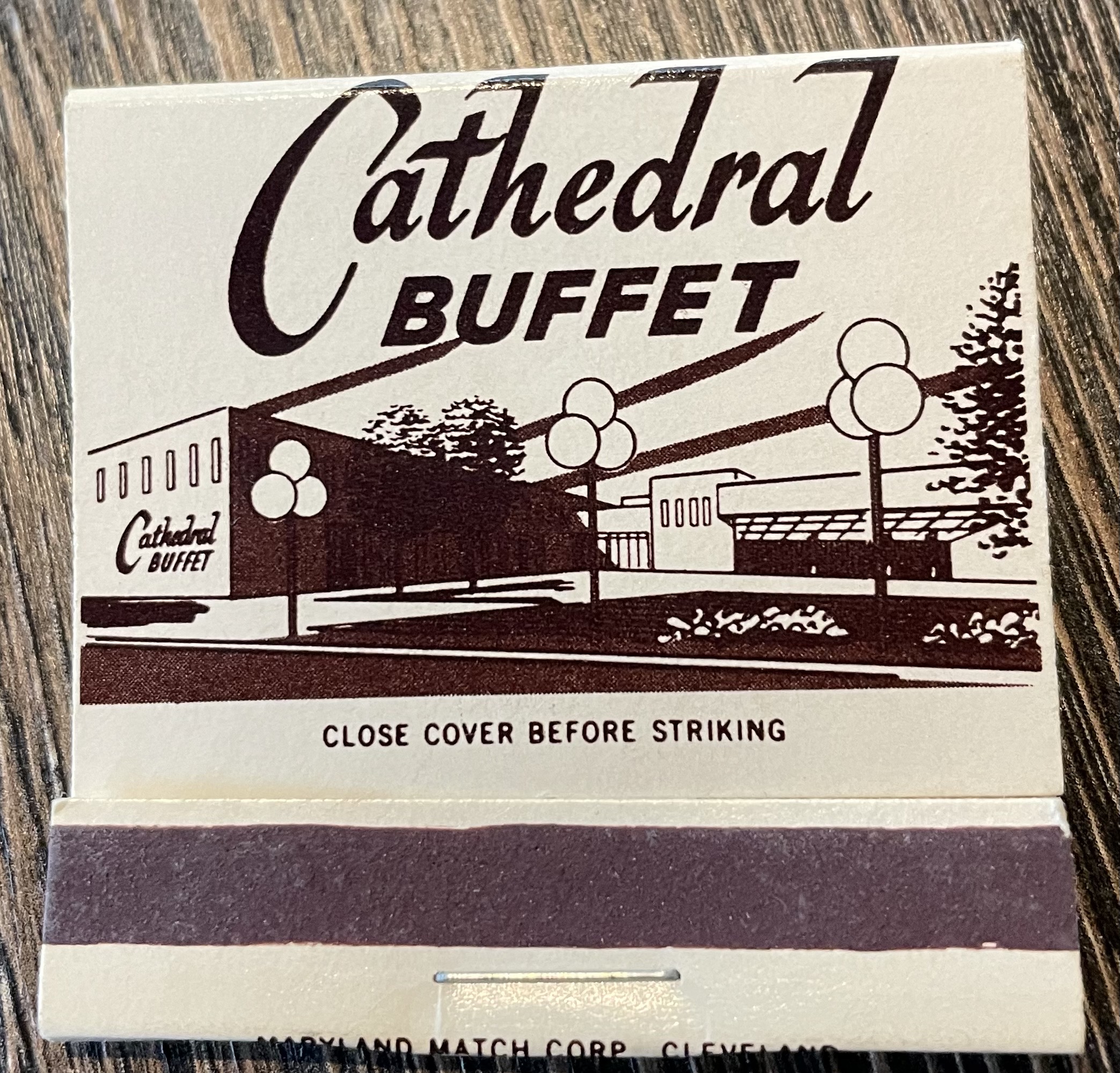
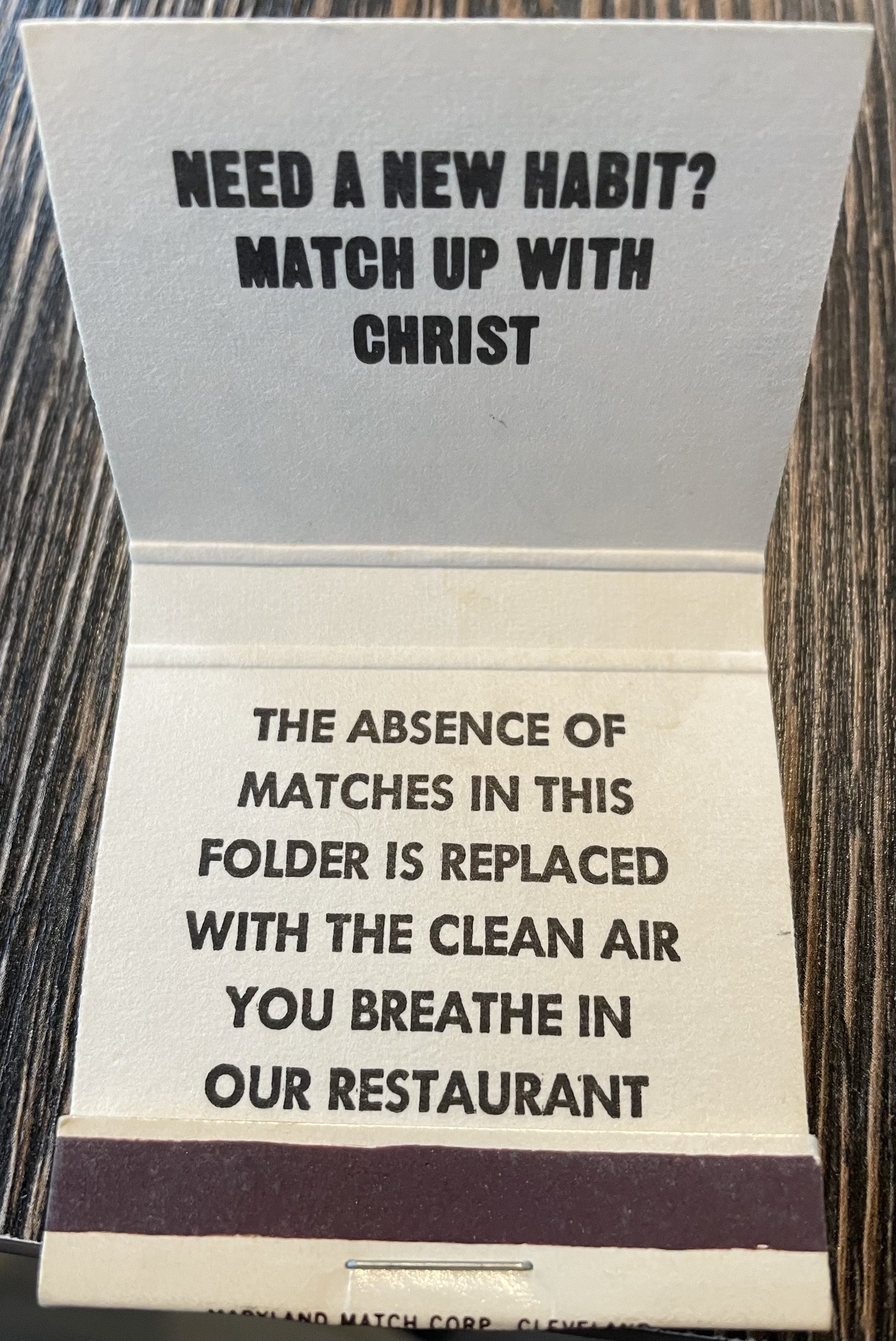
My family sort of has a tradition of accumulating matchbooks. There were a lot of matchbooks where I was, many for restaurants that have gone out of business.

The significance of the “Cathedral Buffet” explained here.

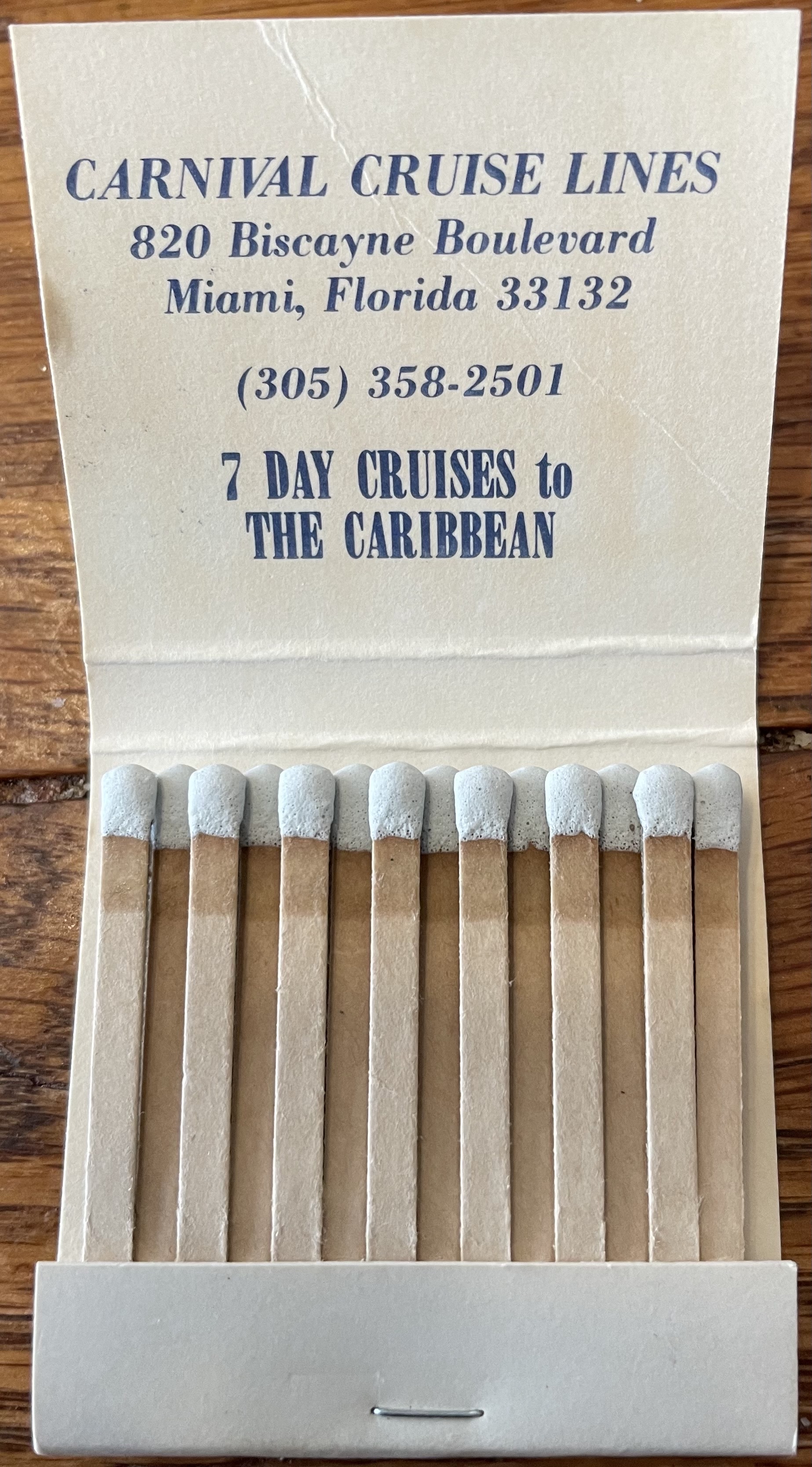
I like ships. I like maritime history. I picked this out because I was curious about the history of the SS Mardi Gras.

Turns out, the SS Mardi Gras was the very first Carnival Cruise Lines ship.

RMS Empress of Canada was an ocean liner built in 1961 by Vickers-Armstrongs, Walker-on-Tyne, England, for Canadian Pacific Steamships Ltd. The liner sailed in the trans-Atlantic trade between Liverpool and Canada.

Ted Arison bought the ship in 1972, renamed it, and it went out for its first Carnival cruise on March 11, 1972. It sailed for Carnival until 1993, bounced around various other cruise lines, and was finally broken up for scrap in 2003.

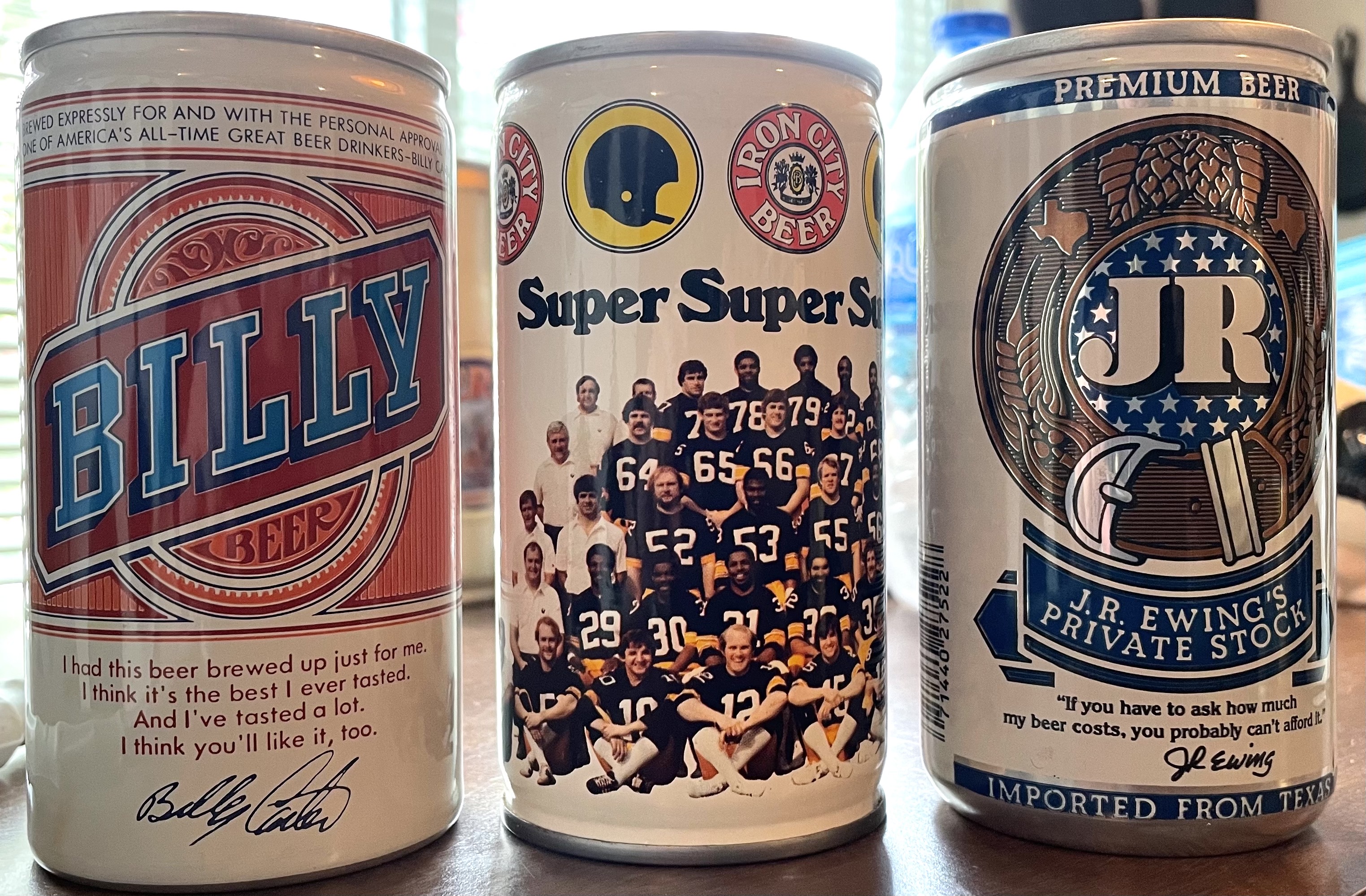
I remember Billy Beer, even though I wasn’t of drinking age at the time. But I do not have any recollection of “J.R. Ewing’s Private Stock”. (It should come as no surprise to the Texas contingent among my readers that “Private Stock” was produced at the Pearl Brewery.)

Just for fun.

Also, just for fun, regional variations among snack flavors:

The Old Bay flavored cheese curls (there are also potato chips) are a little weird, but not that surprising to me. I recently bought some Old Bay flavored goldfish for the Saturday Dining Conspiracy’s collection of odd snacks.

“Roast Pork Sandwich” does seem a little odd to me.

Someone asked me what the difference between “tomato pie” and “deep dish pizza with no meat or cheese” was. This led me to look up “tomato pie”, and I wish I had not.

What time is it, kids?

Tuesday, July 25th, 2023

Not Howdy Doody time.

I promised I wasn’t going to do any more gun books until “Day of the .45, part 2.” went up. Now that I have posted it, I have a large stack to go through, including more than one Samworth, so I’m going to start trying to knock some of those off.

First, some ground rules:

I’m going be posting some newer books, ones that are readily available on Amazon or from the usual suspects. For those, I will be posting Amazon affiliate links, and I will be posting commentary if I’ve read the book, but I won’t be posting cover photos or a lot of bibliographic detail. The Amazon links should give you enough information to order the book, or to find it from some other vendor, if you’re really interested, and photos of readily available contemporary books will just make these posts longer.

One of my side projects that I won’t be documenting in a lot of detail here: I’ve decided that I want to try to accumulate a complete set of Gun Digest. I’ve found that GD frequently has interesting articles on either gun or gun book history, and I think it would be useful to have them around for reference. I probably won’t be documenting those here, though I may mention them in passing.

My self-imposed limits for this project are: I’m buying them used, in very good to excellent condition, and I’m trying not to pay more than $10 for each one. So far, I have the 1998 edition (which has a very good article on the Winchester Model 52) and the 2005 edition (nice article on the guns of Roy Chapman Andrews). The 2010 edition (with the profile of E.C. Crossman) is on the way, as is another Samworth book by Crossman.

With those ground rules set:

(more…)

Obit watch: July 24, 2023.

Monday, July 24th, 2023

Richard Barancik has passed away at 98.

The Monuments Men and Women were composed of about 350 people — among them museum directors, curators, scholars, historians and artists — whose missions included steering Allied bombers away from cultural targets in Europe; overseeing repairs when damages occurred; and tracking down millions of objects plundered by the Nazis and returning them to the institutions, and the countries, they came from.

Mr. Barancik was the last surviving member of this group.

Mr. Barancik (pronounced ba-RAN-sick) was one of four members of what was formally called the Monuments, Fine Arts and Archives Section to receive the Congressional Gold Medal in 2015 in Washington for their “heroic role in the preservation, protection, restitution of monuments, works of art and artifacts of cultural importance.”
On the day of the ceremony, Mr. Barancik told The Los Angeles Times: “The Americans cared about the cultural traditions of Europe. We did everything we could to salvage what the Nazis had done. It’s the best we could do.”

Mike Reynolds.

At first, the murder of Mr. Reynolds’s daughter, Kimber, seemed like just one more statistic. An 18-year-old college student home in Fresno on summer break, she was attacked one night in June 1992 by two men on motorcycles who tried to grab her purse.
When she resisted, one of the men, Joseph Michael Davis, shot her in the head, in front of dozens of witnesses. She was rushed to a hospital and died 26 hours later.

One of the murderers was killed in a shootout with police.

His accomplice, Douglas Walker, was arrested and reached a plea deal for a nine-year sentence with parole after four and a half, despite having a previous felony conviction. Mr. Reynolds decided that there should be a law to keep people like him locked up.

His efforts stalled out at first. Then Polly Klass was murdered.

Almost overnight, public outrage over Polly’s murder turned into support for Mr. Reynolds’s campaign. Calls came in to his Fresno headquarters in such volume that they overloaded the city’s 1-800 system. Within weeks, he had the signatures he needed.
The bill also found a new life in the Legislature, as state and national politicians, facing election in the fall of 1994, raced to appear tough on crime. Senator Dianne Feinstein, a Democrat, and her Republican opponent that year, Representative Michael Huffington, both endorsed the bill.
This time it sailed through both chambers of the Legislature, and Governor Wilson signed it into law in March. That fall, the accompanying ballot initiative passed with overwhelming support. In the years that followed, two dozen states, inspired by California, enacted their own three-strikes laws.

Tiny violin watch:

The law had, and continues to have, its detractors. Critics claimed it would overcrowd the prisons, drive up the cost of incarceration and clog the courts, as criminals facing life in prison would be less likely to reach a plea agreement.
It was also derided as unfair: Even a felony as minor as stealing a slice of pizza could result in a 25-year sentence, a situation that befell one man, Jerry Dewayne Williams. Though a judge later reduced Mr. Williams’s sentence, critics used his case as an example of the law’s unfairness.

More about Jerry DeWayne Williams.

An initiative to soften the three-strikes law failed in 2004, but a nearly identical initiative in 2012 succeeded. Both proposals mitigated the sentencing rules if the third felony was a nonviolent one. Mr. Reynolds strongly opposed them.

Happy Bastille Day, everyone!

Friday, July 14th, 2023

Don’t have much to say, but didn’t want to let the holiday pass without notice.

If you live in Austin, the French Legation is having their celebration tomorrow.

Obit watch: July 10, 2023.

Monday, July 10th, 2023

The sports department of the New York Times.

The shuttering of the sports desk, which has more than 35 journalists and editors, is a major shift for The Times. The department’s coverage of games, athletes and team owners, and its Sports of the Times column in particular, were once a pillar of American sports journalism. The section covered the major moments and personalities of the last century of American sports, including Muhammad Ali, the birth of free agency, George Steinbrenner, the Williams sisters, Tiger Woods, steroids in baseball and the deadly effects of concussions in the National Football League.

The paper of record plans to shift sports coverage to The Athletic, which it purchased last year.

As a business, The Athletic has yet to turn a profit. It reported a loss of $7.8 million in the first quarter of this year. But the number of paying subscribers has grown to more than three million as of March 2023, from just over one million when it was acquired.

Evva Hanes, popularizer of Moravian cookies.

Mrs. Hanes, the youngest of seven, grew up watching her mother, Bertha Foltz, make and sell hundreds of the thin cookies to supplement what little money the family’s small dairy farm brought in. Other Moravian women sold cookies, too, adhering to a recipe with molasses and warm winter spices, like clove and ginger, that were popular around Christmas.
Mrs. Foltz began baking a crispy vanilla-scented version as a way to differentiate herself and extend the selling season. By age 8, Evva could bake them on her own. By 20, she had taken over her mother’s business and slowly begun to expand it, selling the original sugar crisps as well as the traditional ginger version but eventually other flavors, too, like lemon and black walnut.

I feel a little guilty about saying this, but now I kind of want to order a tin of Moravian cookies.

Roy Herron, Tennessee state legislator. He was injured in a jet ski accident on July 1st, and passed away on Sunday.

I’ve written previously about both the Dutch resistance and about the NYT‘s “Overlooked No More” obits. In that vein: Hannie Schaft.

In June 1944, Schaft and a fellow resistance fighter, Jan Bonekamp (with whom she was rumored to have had a romantic relationship), targeted a high-ranking police officer for assassination. As the officer was getting on his bicycle to go to work, Schaft shot him in the back, causing him to fall off the bike. Bonekamp finished the killing but was injured doing so. He died shortly after. Schaft managed to escape on her own bike, which was how she got around doing her resistance work.
Schaft was also involved in killing or wounding a baker who was known for betraying people, a hairdresser who worked for the Nazis’ intelligence agency, and another Nazi police officer.
Before confronting her targets, Schaft put on makeup — including lipstick and mascara — and styled her hair, Jackson said. In one of the few direct quotations that have been attributed to Schaft, she explained her reasoning to Truus Oversteegen: “I’ll die clean and beautiful.”