Archive for the ‘Books’ Category

Obit watch: August 23, 2017.

Wednesday, August 23rd, 2017

Leo Hershkowitz is another one of those people I hadn’t heard of until the NYT published his obituary. And he’s also another one of those people I would have liked to have coffee with, though our politics might not have been in alignment.

Mr. Hershkowitz was a historian and an archivist. Over the years, he rescued a lot of municipal documents that were just going to be thrown away:

Among the treasures he discovered were the city’s financial records for the funeral of Abraham Lincoln — held at City Hall on April 19, 1865 — including the undertaker’s bill for $1,000 and another bill, for $20, from James Ayliffe of Trinity Church for composing a funeral dirge and playing the church’s chimes…
And, from bundles of papers earmarked for disposal by the city comptroller’s office, he saved coroner’s records from the late 18th and early 19th centuries that recorded infanticides, suicides, drownings — and the killing of Alexander Hamilton by Aaron Burr in a duel across the Hudson in Weehawken, N.J.

He also wrote a book called Tweed’s New York: Another Look in which he argued:

Rather than portraying him as corrupt, Professor Hershkowitz determined that Tweed had been the victim of illicit machinations at his embezzlement trial; that he had shown more vision about the city’s growth than some reformers; and that he had been prosecuted to deflect attention from Republican corruption in Washington. Indeed, he said, the trial prosecutors arranged with Gov. Samuel J. Tilden of New York to handpick a judge who was prejudiced against Tweed.

(As the Times notes, the thesis that Boss Tweed was framed by evil Republicans trying to cover up their own corruption was not met with universal approval by other historians.)

He was 92.

And by the way, paper of record, where’s your damn Brian Aldiss obit?

TMQ Watch: August 22, 2017.

Tuesday, August 22nd, 2017

“The Year Without A Tuesday Morning Quarterback” was one of Rankin-Bass’s lesser holiday specials.

Then a year ago this time, I took a year off to complete my next book.

Oh. Is that what it was? (By the way, Gregg Easterbrook has a new book coming out.)

But now, he’s back. And so is the editorial “we”. Not to be confused with the editorial wee, though we plan to purchase one or more of those really nice Toto smart toilets when we win the lottery.

Welcome back to TMQ Watch. After the jump, this week’s TMQ…

(more…)

Obit watch take 2.

Monday, August 21st, 2017

Noted British science fiction author and SF historian Brian Aldiss has passed away.

Aldis was one of Britain’s most respected science-fiction writers, author and editor of more than 100 books, including novels, non-fiction and poetry. His 1969 short story Supertoys Last All Summer Long inspired Steven Spielberg’s 2001 film AI: Artificial Intelligence.

Oddly, we were just discussing Mr. Aldiss at dinner Saturday night, though I don’t think any of us were aware of his passing: the discussion was more about his book Trillion Year Spree (a mammoth history of SF) and the possibility of it being updated.

(Hattip: Pat Cadigan on the Twitter.)

You know what the problem with fiction is?

Friday, August 18th, 2017

It has to be believable.

22 years ago, four people were beaten to death in a hotel in Huzhou, Zhejiang Province, China. The police believe that two men committed the crime: they had checked into the hotel intending to rob other occupants and were caught by another guest. They apparently beat that guest to death, along with the hotel owners and the owner’s grandson.

This became a cold case until earlier this year, when the police were able to do more sophisticated DNA analysis. They eventually narrowed the pool of suspects down to two men, a Mr. Wang and Liu Yongbiao. Both have been arrested, and Mr. Liu has apparently confessed.

The twist? Mr. Liu went on to become a moderately successful Chinese mystery writer.

In the preface to his 2010 novel “The Guilty Secret,” the Chinese author Liu Yongbiao expressed his desire to write a suspense-filled detective story about an alluring female writer who dodges arrest despite committing a string of murders.
“I came up with the idea after reading some detective novels and watching crime shows and movies,” Mr. Liu wrote at the time. “The working title is: ‘The Beautiful Writer Who Killed.’”

(As far as I can tell, “The Guilty Secret” is not available in a US edition.)

You put that into a novel these days, people will just roll their eyes and say, “Yeah. Right.”

Late night thoughts.

Wednesday, August 16th, 2017

I was talking with a friend a couple of weeks ago, and she said something that triggered a mental connection. And then some other stuff happened that triggered some more connections. This is another one of these posts where I was thinking out loud when I wrote this, please forgive me if it goes astray.

I didn’t live back in the old days – 30s – 60s – but my impression (based on what I’ve read) is that, as a child, you were valued somewhat based on physical skills. That is, you were expected to be able to run, hit, and catch reasonably well. (Ruark talks about this a little in The Old Man and the Boy.) If you couldn’t, you were looked down upon by your peers. If you were actually physically incapable (lost a leg or an arm) you may have been looked upon with some pity rather than condescension, but there was still a feeling that the non-physically skilled were somehow inferior. It seems like that lasted well into the 1970s and possibly even into the late 80s.

(Question: what were the expectations for girls? I don’t have a good answer, not ever having been a girl.)

At some point, this changed. Physical skill, while still valued, began to be supplanted by other skills, specifically video games. If you couldn’t run, hit, or field well, being good at rescuing the princess from another castle or whatever the frack Sonic did could still gain you some level of respect. I don’t know exactly when this change started: I feel like it was after I went off to college, but before things changed again.

I still see parents getting their kids into sports, but soccer seems to be the thing now. And that seems to me to be less about the sport – there’s not that much talent required, just run and kick ball – and more about tiring the little s–ts out for a while so Mommy and Daddy can get stuff done. (There are other exceptions, such as Little League and youth football, but I have the impression that those sports are driven by parental nostalgia. “I loved Little League when I was a kid! Surely my kid will love it, too!”)

The third change was the growth of the Internet. Once that became commonplace and everywhere, it didn’t matter if you could run, hit, field, or what you were good at. If you had some kind of specific area of interest – something you were good at, something you were obsessed with – the Internet enabled you to find people just like you. Nobody knew you were a dog, or an awkward teenage boy. We accept you, one of us, one of us.

I used to think that was a good thing. I still do: I think it’s great that those awkward teenagers can find people who are just like them. I think the Internet has done a wonderful job helping people who are shut-in or disabled or just socially awkward interact with others. I think it’s incredibly empowering, and a good antidote to bullying and ostracism.

But recent events have me wondering: have we also built a bunch of individual echo chambers? Now that everyone can find people just like them, have we devalued social interaction and the ability to get along with other, different people? Are we raising generations of otaku?

I don’t want to seem like a cranky old man longing for a return to the good old days. There were bullies and thugs and cheaters and generally not nice people back then, there are now, and there always will be. “There were no formerly heroic times, and there was no formerly pure generation.”

But could this be part of the reason why we have LARP Nazis?

Brief book note.

Monday, August 14th, 2017

This is not a review or an endorsement, since I only picked this up yesterday and haven’t read it yet. But I do want to put in a quick plug for it: it was published last year by Texas Tech University Press and I am afraid it has already fallen into obscurity. I didn’t know anything about it until I stumbled on a copy at Half-Price Books.

Shooting for the Record: Adolph Toepperwein, Tom Frye, and Sharpshooting’s Forgotten Controversy is a book about Topperwein, Frye, exhibition shooting, and the world record controversy.

Back in the old days, the various gun companies paid “exhibition shooters” to travel around the country and put on shooting demonstrations with their products. Adolf “Ad” Topperwein was a shooter for Winchester (along with his wife, known as “Plinky”). At one point, Mr. Topperwein held the world record for aerial shooting: “…more than 72,000 hand thrown blocks 2½ inches in diameter, and missing only nine“.

Then Tom Frye came along. Mr. Frye was an exhibition shooter for Remington, and was a little younger than Mr. Topperwein. In 1959, he used the then newly introduced Remington Nylon 66 rifle to shoot 100,010 wooden blocks over a 14-day period, hitting 100,004 of them and breaking Mr. Topperwein’s record. However, Mr. Topperwein apparently felt that Mr. Frye’s setup wasn’t entirely fair: specifically, the distance Mr. Frye was shooting at was too short, and Mr. Frye’s throwers were using a different technique that made it easier for him to hit. (Also, the Nylon 66 was much lighter, and thus easier to hold for long periods, than the Winchester rifles that Mr. Topperwein used.)

As I said, I haven’t read the whole book yet, but I did get through the author’s preface. One of the things that interested him about the Frye/Topperwein controversy was that Mr. Frye may have actually been using “performance enhancing drugs” in his record attempt, predating Barry Bonds by about 40 years.

This book pushes a couple of my hot buttons. In the past couple of years, I’ve become more interested in the 20th Century exhibition shooters, like the Topperwins and Frye and Herb Parsons and others. (There’s a pretty good DVD, “Fast and Fancy Shooters“, that has vintage footage of some of these people at work. Link goes to Amazon, but I was able to find it cheaper on eBay when I bought it.)

In addition, I have my own personal reasons for being interested in Mr. Frye: one of these days Real Soon Now, I’m going to finish the long post I started a while back about my Nylon 66, Tom Frye, and childhood nostalgia.

In general, out of my group of shooting friends, I think I’m the most interested in shooting history of the bunch. I expect this to be a swell addition to my library, and I encourage anyone who has a set of buttons like mine to pick up a copy.

On a semi-related side note, you know who else is interested in firearms history? Karl of KR Training, official firearms trainer of Whipped Cream Difficulties. I bring this up here because he’s been working on a series of “Historical Handgun” courses: the first one was a 1/2 day course he ran this past weekend, and he has a full day class coming up in September. For personal reasons, I can’t attend, but I’m looking forward to the two-day version of the class he plans to run sometime in 2018.

In the meantime, though, he’s got some blog entries up: an after action report on the 1/2 day class, discussion of the FBI’s qualification course circa 1945, and even a couple of book reviews. I encourage my readers to give Karl’s blog some affection, even if you do live too far away to enroll in his classes.

(I think it’d be kind of fun, though, if Karl could develop this into a sort of standard curriculum and share it with instructors in other regions. It might be fun to have people all over the country running these classes and showing how it was done in the old days. Heck, maybe we could make this a thing, like cowboy action shooting and the zoot shooters: combat matches with “appropriate” guns from different eras. This could be a whole bunch of fun.)

News/!News

Friday, July 21st, 2017

Probably news, at least to some people: Texas A&M has a large science fiction archive.

Possibly news to more people: this includes George R.R. Martin’s stuff.

Probably not news, if you think about it: this includes a lot of “Game of Thrones” related stuff.

And there is plenty of other Martin stuff, including manuscripts for the Wild Card moasic novels he continues to edit and drafts of various “Max Headroom” scripts.

Quote that pushed me into posting this:

But also, there are swords.

(Much like, “And then the murders began“, “But also, there are swords” makes anything better.)

Obit watch: July 20, 2017.

Thursday, July 20th, 2017

I’ve been going back and forth on this one for a few days, and finally decided it was worth noting here.

Jean-Jacques Susini passed away on July 3rd. To borrow the paper of record’s description of him, Mr. Susini was “a fiery leader of a right-wing terrorist group that opposed Algerian independence from France who was twice condemned to death in absentia for plots to assassinate President Charles de Gaulle of France”.

More:

He was arrested and tried for helping to organize the so-called Week of the Barricades, which turned to bloody rioting. He fled to southern France during a court recess and later to Spain, where he joined the Secret Army Organization, an underground band of right-ring military and civilian extremists that used terrorism tactics to fight against Algerian independence.

…

Independence finally came to Algeria in 1962, but Mr. Susini was nonetheless involved in plotting to kill de Gaulle later that year and again in 1964. Details of the first attempt — in which de Gaulle’s Citroën was raked by machine gun fire outside Paris but he was unharmed — were used by the novelist Frederick Forsyth to open his 1971 thriller, “The Day of the Jackal.” The film adapted from the novel two years later opened the same way, with de Gaulle and his motorcade attacked by gunmen.

I know this is probably a sign of real geekdom, but I’m still fascinated by the struggle over Algerian independence and would love to find a good history. Wolves in the City: The Death of French Algeria sounds interesting, but it’s pricey.

James Byron Haakenson was killed sometime around August 5, 1976, though his death was not announced until yesterday.

Mr. Haakenson was one of John Wayne Gacy’s victims. His body was unidentified until DNA test results came back earlier this week.

There are six Gacy victims that still have not been identified.

More book stuff.

Monday, July 17th, 2017

I’m a sucker for those “collector’s” reprints of various firearms related books, like the stuff in the Palladium Press Firearms Classics Library. I’m not a total sucker: Half-Price Books gets these in every once in a while, and while I’m generally not willing to pay their marked price ($30-$35), if there’s a sale or a coupon, I’m there.

I know they generally don’t have a lot of value to book collectors, but that’s fine: I think they look nice on the shelves. Plus, to take one example, I think I paid $15 for Ordnance Went Up Front. Amazon has a Kindle edition for $9, but I’d rather pay the extra few dollars for a nice physical copy. And there’s a lot of that stuff that doesn’t have a Kindle edition.

This is a different publisher, and a little more expensive, but there’s a catch:

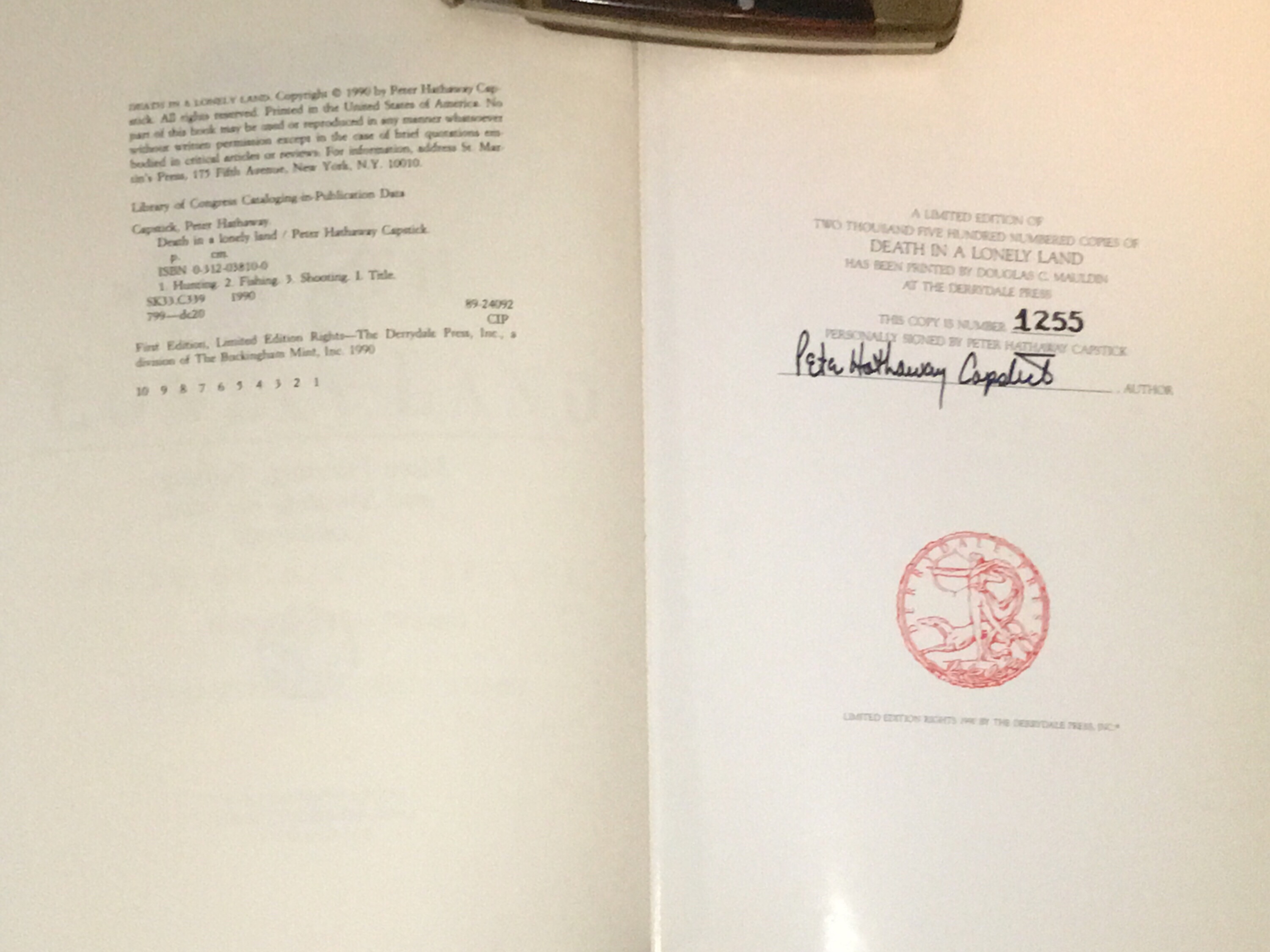
Capstick, Peter Hathaway. Death In a Lonely Land: More Hunting, Fishing, and Shooting on Five Continents. Derrydale Press, 1990.

Yes, it’s a reprint. A “limited” edition reprint of 2,500 numbered copies, which makes it almost certainly worthless to collectors and anybody who doesn’t have the word “sucker” stamped on their forehead.

(looks in mirror)

Well, I’ll be darned. Where did that come from?

But I digress.

I don’t remember exactly how I first came into possession of Death in the Long Grass: I want to say I was a teenager (or pre-teen?) visiting my maternal grandmother, we went by a bookstore on one of our rare ventures out of the house, either I talked her into buying it for her grandchild or I had some pocket money of my own, and…

…I was already kind of gun-crazy at the time, but that book was a revelation to me. It wasn’t just that the whole “let’s go hunting elephants in Africa” thing appealed to me as I was straining the bounds of my existence: it was also that the guy could write. The young me found him sometimes screamingly funny. The old me still does. I think sometimes I even try a little too hard to emulate Capstick’s prose style, the end result being something like if you left my prose next to a complete collection of Capstick books and a gallon of milk for a week in a non-working refrigerator outside in a Texas July.

Point being, I didn’t just want to hunt lions and tigers and buffalo like Capstick, I wanted to write like him as well. At least back in those days. These days, I’m working on developing my own style, but Capstick is still an influence.

This was $75, marked down by 50% because of the coupon. It was still a little more than I would usually have paid, but this book has one great advantage that my other Capstick books don’t:

Capstick died in 1996 of complications from, of all things, heart bypass surgery. I never met him – I don’t think he did a lot of book tours, and I don’t move in Safari Club circles – so this is the only signed Capstick in my library right now. It was worth it to me, and to that small boy inside me.

Recent aquisitions.

Saturday, July 15th, 2017

I’ve been a little off my feed recently (for reasons that are not open to discussion), but I’m starting to feel a little better. And Half-Price Books sent out another batch of coupons: I wasn’t able to use them Monday or Wednesday because reasons, but I have picked up a few mildly interesting things the rest of the week that I figured I’d share:

I have one more book on hold waiting for tomorrow’s 50% off coupon, and that may be the subject of a separate post. It combines one of my interests – African hunting – with childhood nostalgia and one of my favorite writers. No, not Ruark: the other guy.

Bookity bookity bookity bookmark!

Tuesday, June 6th, 2017

By way of @newsycombinator:

A whole big bunch of free NASA e-books in various formats, including Kindle and PDF.

A few titles that pique my interest:

  • Unlimited Horizons: Design and Development of the U-2
  • X-15: Extending the Frontiers of Flight
  • Breaking the Mishap Chain: Human Factors Lessons Learned from Aerospace Accidents and Incidents in Research, Flight Test, and Development

I’ll admit some of these are a little geeky even by my standards. It takes either a professional or a special kind of person to want to read a history of pressure suit design, or one of the Langley wind tunnel. But guess what: I am that person, and I bet some of my readers are, too.

Besides, who doesn’t love the X-15 and the U-2?

(No, really, who doesn’t? Raise your hands. No, I’m not noting your IP address…)

Obit watch: June 5, 2017.

Monday, June 5th, 2017

Jimmy Piersall, noted center fielder for the Boston Red Sox.

Piersall was an outstanding center fielder, a solid hitter and a two-time All-Star, playing in the major leagues for 17 seasons.

However, he was better known for off-field reasons:

The Red Sox demoted Piersall to the minors in June 1952, hoping he could gain control of his emotions, but his antics continued, and he entered a mental hospital in Massachusetts a month later. He remained hospitalized for six weeks, undergoing shock treatment and counseling for a nervous breakdown.

He returned to the Red Sox, and later wrote a book about his illness and recovery, Fear Strikes Out.

“Mr. Piersall’s courageous description of his struggles with manic depression, now called bipolar disorder, helped bring the disease and its treatments out of the shadows,” Dr. Barron H. Lerner, professor of medicine and population health at the New York University Langone Medical Center, wrote in The New York Times in 2015. “It was really a big deal 60 years ago.”

The book was also famously adapted as a movie, with Anthony Perkins playing Mr. Piersall.

“I hated the movie,” Piersall wrote in his 1985 memoir. Perkins, he said, gave a fine performance but looked foolish trying to play baseball. He maintained that the movie included events that had never happened, and that he had never blamed his father for his breakdown.

(The 1985 memoir is The Truth Hurts.)

And hey, I haven’t brought this up in a while!

Piersall later had broadcasting jobs with the Texas Rangers beginning in 1974 (doing color and play-by-play for televised games) and with the Chicago White Sox from 1977 to 1981, and was teamed with Harry Caray. He ultimately was fired after excessive on-air criticism of team management.

Yes, Jimmy Piersall does indeed show up in Mike Shropshire’s Seasons in Hell. As I recall, at one point he threatens to beat the crap out of Shropshire: they later made up when the team was sold and the new owner hired Mr. Piersall as a salesman and doubled his salery.

Books in brief.

Friday, May 26th, 2017

My head is in kind of a weird place right now when it comes to reading.

I have a large stack of unread gun and hunting related books, including the PO Ackley biography and Ordnance Went Up Front, both on the basis of Hognose recommendations. (You know, I really miss Hognose.)

But I’m also trying to avoid burnout, so my rule is: one gun or hunting related book, then one book on a different subject. But then I get into a mode where what I have on hand isn’t something I’m in the mood to read, so I get stuck not reading anything except the Internet, causing my blood pressure to spike. Fortunately, I found a couple of books a week ago at Half-Price that I kind of enjoyed. (Also, fortunately, Half-Price is having a 20% off sale this weekend…)

I’m not sire why I didn’t read Papillon when I was young and impressionable. It was apparently a huge bestseller, so it should have shown up at garage sales (like a lot of other books I read at that age), or I should have seen it at the library. I can’t explain.

When I did finally get around to it, though, I had trouble putting it down. Henri Charrière is a great storyteller, and is well served by his translators. (June Wilson and Walter Michaels in the edition I read. Fact I did not know until I was looking at Wikipedia: the original English translation was by Patrick O’Brian. Yeah, “Master and Commander” O’Brian: before he became famous for those books, he was a well-regarded French translator.) And, let’s face it: Papillon is a really compelling adventure story about one man’s life in some of the worst prisons in the world and his drive to escape. This is exactly the kind of thing that should have appealed to me as a small boy.

And it still appeals to me today. Except for the Internet and some nagging little details that I found while I was looking up things on Wikipedia. It turns out that Papillon is maybe “10 percent true”, in the sense that these things actually happened to Charrière. The general consensus of opinion seems to be that Charrière incorporated things that he witnessed, but didn’t happen to him directly (the sharks and the little girl is a commonly cited example) and possibly elements from other works (specifically Rene Belbenoit’s Dry Guillotine).

I still want to see the movie, and read Charrière’s sequel, Banco (which either hasn’t attracted the same level of revisionist scholarship, or else sticks closer to Charrière’s actual post-prison exploits). But it is kind of depressing to discover that this grand adventure story is also, mostly, untrue.

I’ve written before about my fascination with the rabies virus, so you would expect Rabid: A Cultural History of the World’s Most Diabolical Virus to push my buttons as well. And it did. I could have done with a little less “this is how the ancient Greeks and Romans treated rabies” and “rabies in popular culture” (especially the attempts to tie rabies and zombies together). But the chapters on things like Pasteur’s rabies research, contemporary treatment (turns out the Milwaukee protocol is more controversial than I thought) and rabies eradication on Bali (which also turns out to be more controversial and political than you’d expect) kept me hooked. And Rabid has the advantage of being an “economical” book: long enough to get everything in, but short enough to get through is an evening or a plane trip. Recommended.

Obit watch: May 23, 2017.

Tuesday, May 23rd, 2017

Anne Dick, Philip K. Dick’s third wife. (Hattip: Lawrence.)

Roger Moore.

(Edited to add: NYT obit, which was not up when I posted earlier.)

Followup: apparently, and contrary to the NYT report which I relied on, G.I. Joe had two daddies.

As a connoisseur of disaster…

Friday, April 28th, 2017

…I am enjoying reading about Fyre Festival so, so much.

It’s the feral dogs that really make a good music festival.

That reminds me. (adds Rabid: A Cultural History of the World’s Most Diabolical Virus to his Amazon wish list.)

William N. Finley IV’s Twitter feed: Finley was boots on the ground at Fyre Festival and is quoted in many pf the stories I’ve seen.

Questions, so many questions: could Ja Rule and Kendall Jenner be prosecuted for fraud? Would this have been a justified use of a MOAB? And is it true that United Airlines was an official Fyre Festival sponsor?