Archive for the ‘Books’ Category

More adventures in hoplobibliophila.

Sunday, October 3rd, 2021

The Smith and Wesson Collector’s Association Symposium has wrapped up.

I thought I’d stay over a day, relax, and kick around a bit. Unfortunately, a lot of the places I’d like to kick around are closed on Sundays. But my loss is your gain. At least if you like gun books.

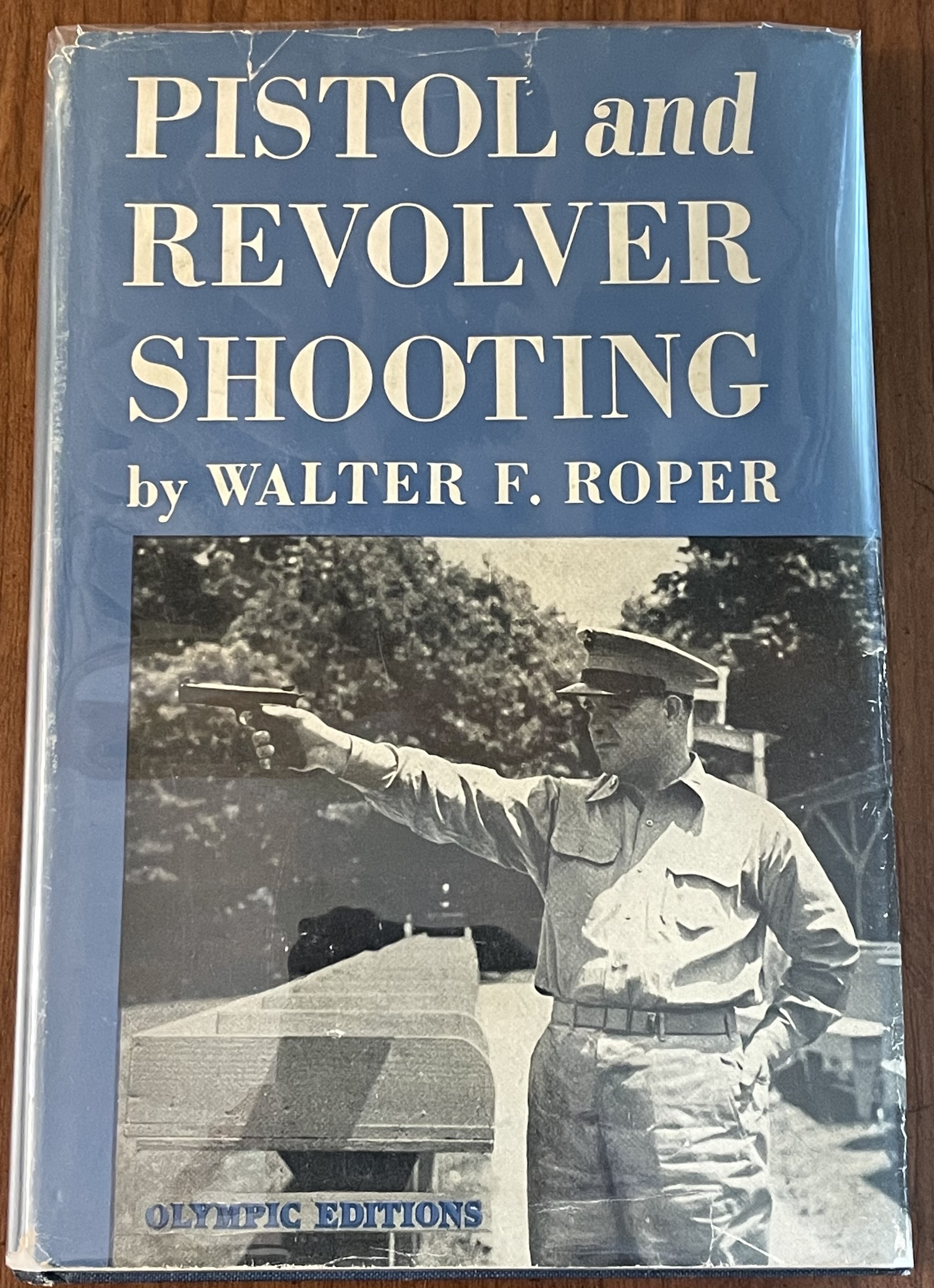
Pistol and Revolver Shooting by Walter F. Roper. The colophon lists it as Macmillan, 1945, and “First Printing”, but the “Olympic Edition” on the cover makes me wonder. Maybe first printing in this edition?

Mr. Roper was a prominent gun guy and gun experimenter: here’s a short article by John Taffin from Guns magazine about him. Purchased for $40 from a fellow collector at the Symposium.

I would have sworn great and good FotB (and official firearms trainer of WCD) Karl Rehn of KR Training had reviewed this book on his blog. But if he did, I can’t find the review now.

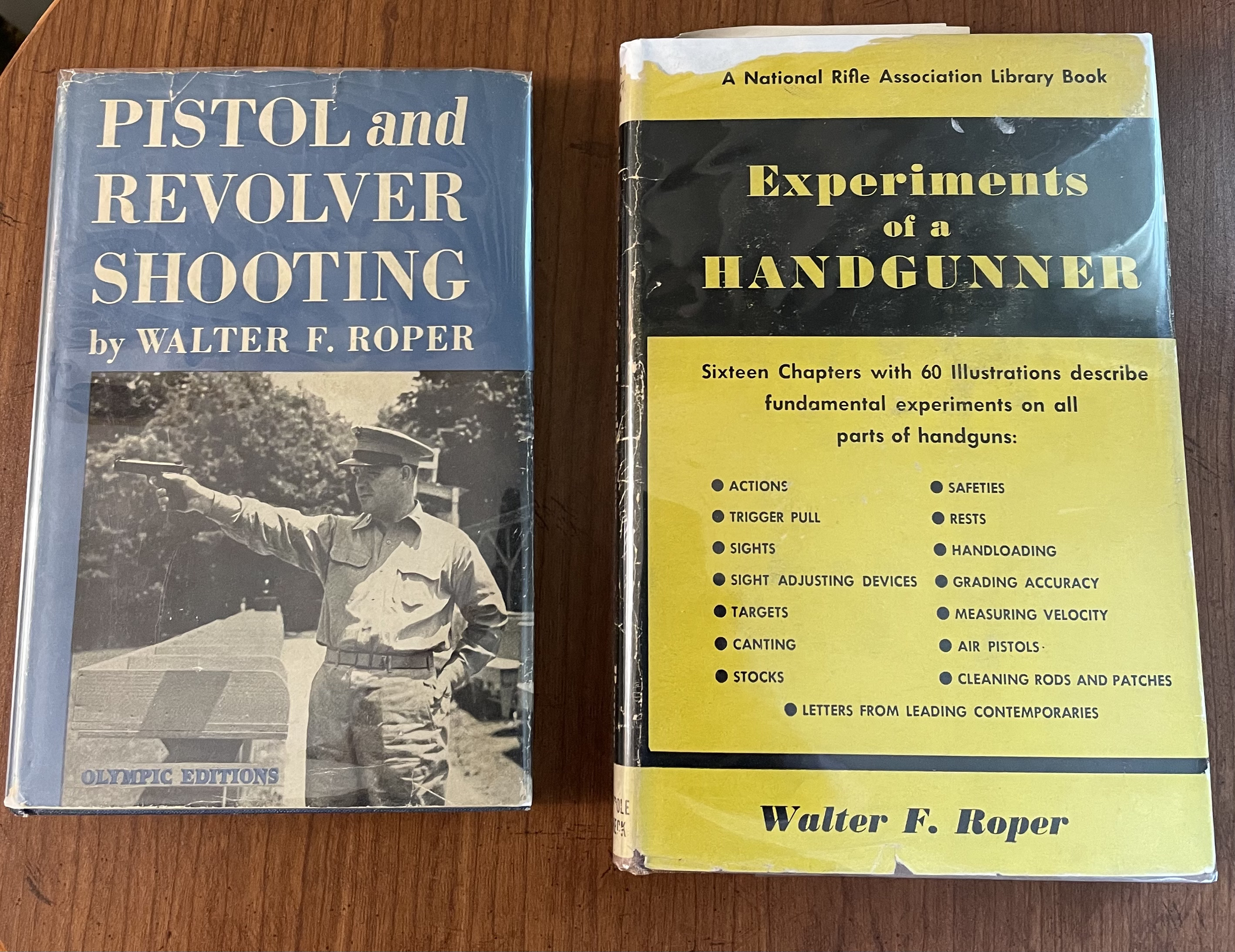
Two of a perfect pair:

(Previously on Experiments of a Handgunner.)

I do have a copy of what I believe is Mr. Roper’s only other book, Smith and Wesson Hand Guns (with Roy McHenry) but I didn’t bring it on the road with me, and my copy is a reprint anyway.

Not exactly a gun book, but worth noting, in my humble opinion:

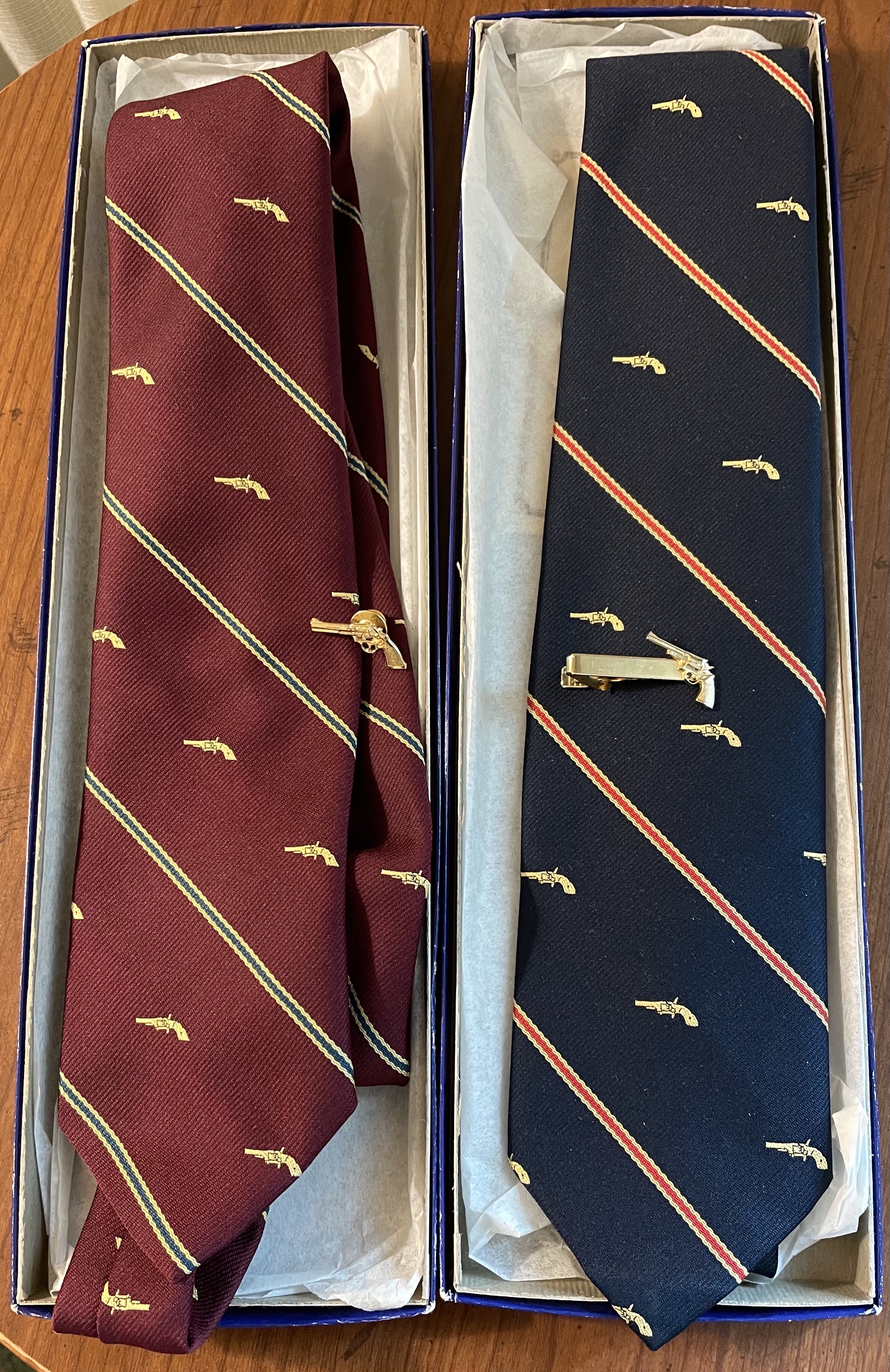
Smith and Wesson ties, tie bar, and tie pin. The tie bar and pin were purchased from one collector, the ties were purchased from another. I think they add that subtle touch of class when I’m wearing a suit. And I paid $25 for both ties (and another $10 for the bar and pin).

There was another very classy S&W tie in the auction on Saturday: sadly, it got bid beyond what I was willing to pay early, and I did not get a photo of it. You’ll have to trust me when I say this tie was about as subtle as a sledgehammer.

Final totally unrelated side note: of course there’s an Internet Movie Firearms Database entry for “Johnny Dangerously”. Just in case you were wondering what the “.88 Magnum” actually was.

Random gun crankery, some filler.

Thursday, September 9th, 2021

Two things that I have absolutely no use for but find oddly appealing. Both of these are kind of old, but I just discovered them in the past couple of days:

1. Lone Wolf shows them as “low stock”, but they do apparently still have 9×18 Makarov barrels for the Glock 42.

I actually learned about this by way of Lucky Gunner’s ammo tests, which I am familiar with, but was reviewing to find data about a specific caliber. I don’t know what advantage this would give me over .380 (ballistically, I think very little), and if I wanted something in 9×18, why wouldn’t I just go out and get a surplus gun? But the idea is just weird enough to turn my crank a little bit. And it is threaded for a suppressor

2. Speaking of guns in .380 Auto…the Cimarron 1862 Pocket Navy. This is a newly manufactured gun, designed to emulate the look and feel of a 1862 Colt Pocket Navy, but set up as a cartridge-fired gun (instead of a black powder one), and chambered in .380 Auto.

Again, I have no use for this, and why would I carry one over my Glock 42? But it is another one of those things that’s so freaking weird, it turns the crank again. If I saw one turn up used at a good price, it would be tempting.

In other news, I am back from my vacation, as of Tuesday. The original plan was to attend the NRA Annual Meeting in Houston…but that was not to be. So instead, Mike the Musicologist and I spent a few days bumming around looking at gun shops, some in the area around Abilene.

I’ll probably write more about our adventures later, but since this is “random gun crankery”, I’ll mention Caroline Colt Company, which is a nice shop with a lot of quality guns, and a surprisingly good (for the times we are in) selection of ammo.

Thanks to great and good FotB (and official firearms trainer of WCD) Karl for introducing me to the work of the Snub Gun Study Group. As a confirmed snubby guy, I like this idea and wish to subscribe to their newsletter.

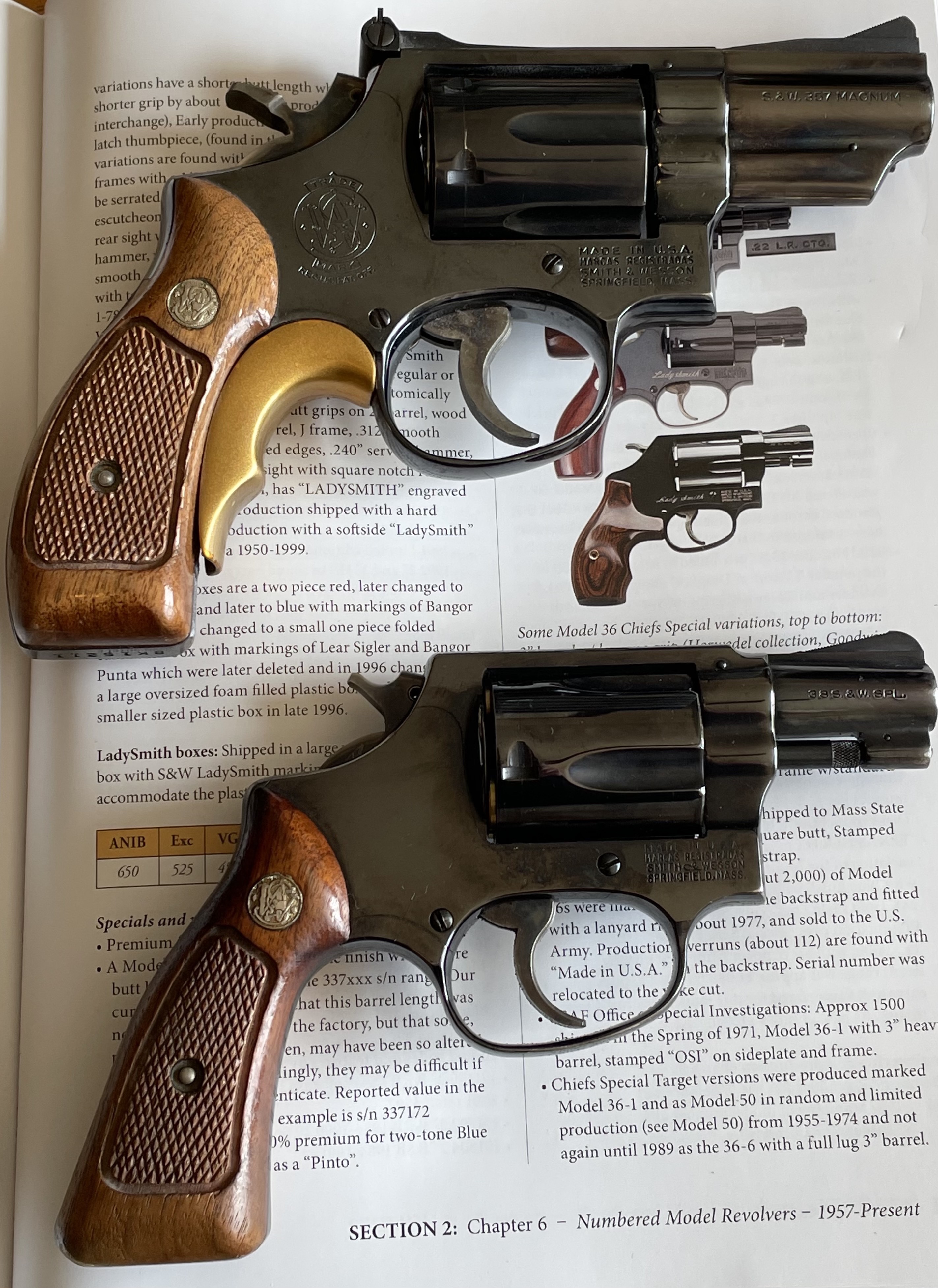
My snubbies. Let me show them to you.
Top: S&W 19-3 in .357 Magnum with Tyler T-grip.
Bottom: S&W Model 36 (no dash?) fitted with an Apex Tactical spring kit

(And yes, I consider the 2 1/2″ Model 19 to be a snub gun. As I recall, so did Ed Lovette in his book, The Snubby Revolver. No Amazon link because this was an old Paladin Press volume and prices are through the roof.)

In a rare combination of Smith and Wesson crankery and movie crankery, you can buy Indiana Jones’s S&W. On GunBroker. The “buy it now” price, though, is $5,000,000.00. Which is also the minimum bid. Just for comparison, the gun that killed Billy the Kid went for $6,030,312 not too long ago. (Hattip: The Firearm Blog.)

Lawrence sent over a note earlier this morning: David Chipman’s nomination to head BATFE is being withdrawn. I’d like to believe this is a good thing: maybe it is, but I’m worried the Biden administration is going to nominate someone who is even worse.


Obit watch: September 2, 2021.

Thursday, September 2nd, 2021

My sincere thanks to Alan Simpson for sending over a tribute from the Libertarian Futurist Society to L. Neil Smith.

In 2016, Smith received the Special Prometheus Award for Lifetime Achievement for his many contributions to liberty and libertarian sf. (Only four authors have received this prestigious lifetime award, including Poul Anderson, F. Paul Wilson and Vernor Vinge.)

Although not as widely recognized by mainstream critics for his social conscience and passion for justice and liberty during his lifetime as this principled and idealistic author deserved, Smith regularly incorporated such themes into both his fiction and nonfiction.
For instance, a dramatic exposure of the evils of anti-Semitism and the Holocaust was at the moral center of The Mitzvah, Smith’s novel (cowritten with Aaron Zelman) about a Catholic priest, influenced by socialist ideas of the 1960s, who discovers that the German immigrant parents who raised him actually adopted him and that his true parents were a Jewish couple murdered in the Holocaust.
Smith, a longtime libertarian activist, also wrote two non-fiction books, Lever Action and Down with Power, that expressed his libertarian views, and founded, and regularly contributed essays to, The Libertarian Enterprise, an anarcho-capitalist journal.

Carolyn Shoemaker, comet hunter.

“Carolyn Shoemaker is one of the most revered and respected astronomers in history,” Jennifer Wiseman, a senior scientist overseeing the Hubble Space Telescope, said in a phone interview. “Her discoveries, her tenacious care in how she did her work — those things have created a legacy and a reputation that has inspired people who have come into the field after her.”

In spite of feeling nervous around scientific instruments as simple as a calculator, she offered to help her husband, the revered planetary geologist Eugene Shoemaker, with a project gathering data on comets and asteroids.
Dr. Shoemaker believed that collisions with Earth by comets had been responsible for transporting to the planet water and other elements necessary for life, meaning that humans “may truly be made of comet ‘stuff,’” Ms. Shoemaker wrote in her essay. Dr. Shoemaker also worried that a comet hitting Earth could threaten human civilization. Yet relatively little scientific attention had been paid to the frequency and effects of cometary collision with planets.
As the dark phase of the lunar cycle began, making it easier to see faint objects in outer space, the Shoemakers would travel to an observatory on Palomar Mountain near San Diego. To locate previously unknown comets and asteroids, they aimed to photograph as much of the night sky as possible. The chirping of birds signaled bedtime.In the afternoons, Dr. Shoemaker would take the film they had used the previous night and develop it in a darkroom, then turn over the negatives to Ms. Shoemaker. Using a stereoscope, she would compare exposures of the same block of sky at different times. If anything moved against the relatively fixed background of stars, it would appear to float in the viewing device’s eyepiece.
Ms. Shoemaker was charged with discerning what was the grain of the film (and perhaps dust on it) and what was an actual image of light emitted by an object hurtling through space. “With time,” she wrote, “I saw fainter and fainter objects.”
It took a few years before she found her first new comet, in 1983. By 1994, in addition to hundreds of asteroids, she had discovered 32 comets, a number considered by the United States Geological Survey and others to represent the world record at the time.

Eugene and Carolyn Shoemaker are the “Shoemaker” in “Shoemaker-Levy 9”.

One comet, known as Shoemaker-Levy 9 (named in part for their associate David Levy), had stood out from the rest. Rather than making a lonely journey through the cosmic vacuum, Shoemaker-Levy 9 was on a collision course with Jupiter. By detecting the comet shortly before impact, Ms. Shoemaker gave scientists an opportunity to examine whether or not comets slamming into planets represented major astronomical events — and to test the hypotheses of her husband’s work.
The result had all the drama the Shoemakers might have imagined: whirling fire balls, a plume of hot gas as tall as 360 Mount Everests and a series of huge wounds that appeared in Jupiter’s atmosphere. Amateur astronomers could witness much of it with store-bought telescopes.
Anticipation of Shoemaker-Levy 9 and the spectacular show it produced made the front page of The New York Times and the cover of Time magazine, which called the Shoemakers “a husband-and-wife scientific duo who spend their evenings scanning the skies for heavenly intruders.” The couple and Mr. Levy were featured in a Person of the Week segment of the nightly ABC News broadcast and met with President Bill Clinton and Vice President Al Gore.

Today, professional astronomers use remotely controlled telescopes and digital detection software. They tend not to pull all-nighters in remote mountain regions, guiding telescopes across the night sky and developing film in their own darkrooms, as the Shoemakers did. Yet scientists still depend on methods that Ms. Shoemaker perfected.
“She and her colleagues set the stage for how to identify what we would call minor bodies in our solar system, such as comets and asteroids,” Dr. Wiseman said. “We still use the technique of looking for the relatively fast transverse motions of comets and asteroids in our own solar system as compared to the slower or more fixed position of stars.”

Obit watch: August 31, 2021.

Tuesday, August 31st, 2021

I am seeing reports (from Lawrence and in other places) that the great libertarian SF writer L. Neil Smith has died.

However, I have been unable to find a source for this that I am willing to give credibility, links, or page views to. I’ll either update or post a new obit if this changes.

Obit watch: August 26, 2021.

Thursday, August 26th, 2021

David Roberts, noted climber and climbing writer.

Michael Nader, actor. He was “Dex Dexter” in “Dynasty”, and “Dimitri Marick” on “All My Children”, among other credits.

Once again, pushing the boundaries of an obit, but: if you would prefer to read about Dorothy Parker’s tombstone in the NYT instead of the NYPost, well, here you go.

Obit watch: August 24, 2021.

Tuesday, August 24th, 2021

Bill Clotworthy. You almost certainly never heard of him, but you’ve seen his work.

Or, perhaps more accurately, you haven’t seen his work.

Mr. Clotworthy was a long time “standards and practices executive” – in other words, a network censor – for NBC. His nickname was “Doctor No”.

Censors are “hard working, dedicated professionals trying to make television acceptable to a large and culturally diverse audience and, not incidentally, to keep the FCC and the U.S. Congress off the backs of their employers,” he wrote.

In a 2002 interview, Clotworthy described one SNL sketch that never made it to air:
It revolved around “a bunch of guys in a fraternity house trying to light farts,” he recalled. “You didn’t see anything, but you heard the voiceover and then there was this big explosion, and Joe Piscopo was dressed as Smokey the Bear, and he came out and said that should be a lesson to everyone — don’t fart with fire.”
He said he was OK with it but was overruled by his boss.

After his retirement, Clotworthy became a prolific author and lecturer who traveled the U.S. to conduct research for his books on George Washington and first ladies and for his guidebooks to presidential homes, libraries and notable sites. He was an enthusiastic genealogist for more than 50 years.

Those sound really cool. Amazon doesn’t list them, but there is a Kindle edition of Saturday Night Live: Equal Opportunity Offender: The Uncensored Censor.

Stretching the definition of an obit here, but: there was an unveiling ceremony for Dorothy Parker’s tombstone on Monday.

The story of Dorothy Parker’s ashes is almost as weird as the story of Evita’s body. After her death, her ashes sat in a crematory for six years, then in a filing cabinet in the former office of her (retired) lawyer. In 1988, her ashes were turned over to the NAACP (“In her will, she bequeathed her estate to Martin Luther King Jr., and upon King’s death, to the NAACP.“)

The NACCP set up a memorial outside their headquarters in Baltimore. But when they moved in 2020, the organization returned the ashes to her family, who reburied them in Woodlawn Cemetery.

The New York Distilling Company in Williamsburg issued a commemorative gin to pay for the headstone.
Along with the gin, mourners left red roses near Parker’s grave, which lies next to those of her parents and grandparents.
The family plot is in a section of the 400-acre cemetery that includes the graves of writers such as Herman Melville and E.L. Doctorow — as well as a man dubbed “The Father of Mixology,’’ 19th century New York City bartender Jerry Thomas.

Brian Travers, founding member of UB40. Brain tumor got him at 62.

Marilyn Eastman, “Helen Cooper” in “Night of the Living Dead”.

Random gun crankery, some filler.

Thursday, August 19th, 2021

Apologies for the slowdown in posting. I’ve been working on my paper for the 2022 MLA convention on “Sexual Politics in ‘Hobgoblins‘”.

(Lawrence pointed out an interesting fact: “Road Rash” in “Hobgoblins” is the same actor who played “Maynard” in “Pulp Fiction”.)

Anyway, a couple of interesting gun politics stories by way of the NYT:

San Francisco’s district attorney on Wednesday sued three online retailers for selling “ghost guns,” untraceable firearms that can be made from do-it-yourself kits, part of an intensifying nationwide effort to stem the flood of deadly homemade weapons into American cities.
In a civil complaint filed in California Superior Court, District Attorney Chesa Boudin accused the companies — G.S. Performance, BlackHawk Manufacturing Group and MDX Corporation — of marketing a range of products in the state that furnish buyers with parts and accessories that can be quickly assembled into a functional firearm.

Note the phrasing: “…parts and accessories that can be quickly assembled into a functional firearm”, not firearms themselves. I am not familiar with California law, so I don’t know what the status of 80% parts kits is there, nor do I know if any regulations against same would pass constitutional muster.

But it feels like this is one of those things that doesn’t matter, much like Remington and Sandy Hook: they might be able to beat the case legally, but the criminal DA of San Francisco can make it expensive enough to cripple or even bankrupt the vendors.

A new state law in Missouri that prevents local law enforcement from working with federal agents on gun cases is already hampering joint drug and weapons investigations, the Justice Department said in a court document filed Wednesday that was obtained by The New York Times.

Great and good FotB (and official firearms trainer of WCD) Karl put up a long – and, I think, fascinating – review on his blog of a vintage (1981) firearms/self defense guide from South Africa. I don’t recommend you follow the advice (and Karl does an excellent job of pointing out where it deviates from evolved practice today) but it is an interesting slice of history from a place only a few of us are familiar with.

Noted: the Smith and Wesson M&P 12. I’m kind of happy to see S&W back in the shotgun market, but I’m not wild about this particular gun.

Obit watch: August 16, 2021.

Monday, August 16th, 2021

Michael Thomas, author. (“Green Monday”.)

Nanci Griffith, noted folk singer.

While Ms. Griffith often wrote political and confessional material, her best-loved songs were closely observed tales of small-town life, sometimes with painful details in the lyrics, but typically sung with a deceptive prettiness. Her song “Love at the Five and Dime,” for example, tracks a couple’s romance from its teenage origins when “Rita was 16 years/Hazel eyes and chestnut hair/She made the Woolworth counter shine” through old age, when “Eddie traveled with the barroom bands/till arthritis took his hands/Now he sells insurance on the side.”
The song was a country hit in 1986 — but for Kathy Mattea, not for Ms. Griffith. Similarly, while Ms. Griffith was the first person to record “From a Distance,” written by Julie Gold, the song was later a smash hit for Bette Midler.
Ms. Griffith sometimes affected a folkie casualness toward mainstream success. She told Rolling Stone in 1993 that she didn’t mind that Ms. Mattea had the hit version of “Love at the Five and Dime”: “It feels great that Kathy has to sing that for the rest of her life and I don’t.”

Ms. Griffith was a living link not just to earlier songwriters, but also to the music of Ireland (she played with the Chieftains) and Texas (she toured with the surviving members of Buddy Holly’s band, the Crickets).

Donald Kagan, historian. I never met him, but he sounds like someone whose books I want to read.

Professor Kagan was considered among the country’s leading historians. His four-volume account of the Peloponnesian War, from 431 B.C. to 404 B.C., was hailed by the critic George Steiner as “the foremost work of history produced in North America in the 20th century.”
He was equally renowned for his classroom style, in which he peppered nuanced readings of ancient texts with references to his beloved New York Yankees and inventive, sometimes comic exercises in class participation, like having students form a hoplite phalanx to demonstrate how Greek soldiers marched into combat.
A strong believer in the timeless virtues of Western civilization and the need for countries to project power in a lawless world, Professor Kagan was often categorized as a conservative. He more or less agreed: He called himself a “Harry Truman Democrat,” but by the late 1960s he had come to believe that the Democratic Party, and much of the academic world, had drifted too far to the left.
He was hard to pin down, though. He disliked Richard Nixon and, more recently, Donald Trump, but he was a fan of Reagan, whose commitment to a strong military and willingness to confront the Soviet Union seemed to him to embody the Greeks’ “mental and intellectual toughness in confronting the human condition.”

Professor Kagan fell in love with Cornell, especially the collegiality of its faculty. But in 1969, when armed Black students took over an administration building, demanding the creation of an Africana studies center and amnesty for fellow students who had been disciplined for an earlier protest, the university’s decision to negotiate with them struck him as a capitulation to violence. Months later he decamped for Yale. The crisis at Cornell was, he later said, the worst experience in his life.
Though he at first admired Kingman Brewster, Yale’s president, for his stand against campus radicalism, in 1974 Professor Kagan publicly criticized him after the university canceled a speech by William Shockley, a Stanford physicist and Nobel Prize winner who believed that Black people were genetically inferior. Professor Kagan strongly disagreed with Shockley’s views, but he believed the university should be exposing students to challenging points of view.
In response to that criticism, Mr. Brewster asked the historian C. Vann Woodward to write a report about campus speech, and later adopted many of its proposals that lined up with Professor Kagan’s views.

Professor Kagan’s passion for ancient Greece informed another of his great loves: sports. He liked to say that one root of his contrarian nature was that as a child in 1930s Brooklyn, he was a Yankees fan in a sea of Dodgers caps. Among his greatest moments, he said, was the year Yale asked him to serve as acting athletic director, a job he relished even as he continued to teach history.
He saw baseball as a Homeric allegory, one in which a hero — the batter — ventures from home and must overcome unforeseen challenges in order to return. That view set up one of his most celebrated articles: a withering review in The Public Interest of the columnist George Will’s book “Men at Work: The Craft of Baseball” (1990).
“This is the fantasy of a smart, skinny kid who desperately wants to believe that brains count more than the speed, power and reckless courage of the big guys who can play,” Professor Kagan wrote.

I’m hoping to win a Rory Award.

Thursday, August 12th, 2021

For the most gratuitous use of the word “Belgium” in a serious post.

“Work and Play In Belgium”, a 1950 propaganda film (in color!) from the “Belgian Government Information Center of New York City”.

Bonus: at least part of this is set…in Bruges.

Obit watch: August 9, 2021.

Monday, August 9th, 2021

It was a busy weekend, and I’ve got a backlog. I hope I don’t miss anybody.

Markie Post. THR. Variety.

Damn. Said it before, I’ll say it again: “Night Court” was a swell show, and she was part of what made it swell.

Trevor Moore, comedian (“The Whitest Kids U Know”).

Jane Withers, actress.

In her first major movie role, in 20th Century Fox’s “Bright Eyes” (1934), the 8-year-old Jane played a spoiled rich kid who wanted a machine gun for Christmas and took a ghoulish delight in sending her dolls to the hospital. She was the antidote to the movie’s star, Shirley Temple, the always cheerful, always obedient, always smiling orphan.

She did other movie and TV work, including “Giant”, and played “Josephine the Plumber” in the Comet commercials.

Bobby Bowden, football coach.

“When I was at Alabama the bumper stickers read ‘Beat Auburn,’ he recalled in “The Bowden Way” (2001), his book on leadership written with his son Steve. “When I was at West Virginia they read ‘Beat Pitt.’ When I came to F.S.U., the bumper stickers read ‘Beat Anybody.’”
Bowden’s Seminoles beat most everybody. He coached Florida State to national championships in 1993 and 1999 and his teams finished in the top five of the Associated Press rankings every season from 1987 to 2000. The Seminoles were unbeaten in bowl games from 1982 to 1995.

He was, for a period of time, the coach with the most wins in college football. I phrase it that way, though, because this was after the NCAA vacated 111 of Joe Paterno’s victories over the Penn State scandal:

But in January 2015, as part of a settlement in a lawsuit brought by Pennsylvania officials, the N.C.A.A. agreed to restore Paterno’s victories, returning him to the No. 1 spot.

Coach Bowden now ranks second, with 377 career wins.

Paul Cotton, of Poco.

Mr. Cotton joined Poco, replacing the founding member Jim Messina in 1970, just in time to appear on the group’s third studio album, “From the Inside” (1971). Produced by Steve Cropper, the guitarist with the Memphis R&B combo Booker T. & the MGs, the project signaled a new artistic direction for the band, maybe nowhere so much as on the three songs written by Mr. Cotton.
Rooted more in rock and soul than in the country and bluegrass that had hitherto been the group’s primary influences, Mr. Cotton’s sinewy, blues-inflected guitar work and brooding baritone vocals on songs like the ballad “Bad Weather” greatly expanded Poco’s emotional and stylistic palette.

Herbert Schlosser, TV executive. Among other accomplishments: “Saturday Night Live” and “Laugh-In”.

Jon Lindbergh. Yes, he was Charles Lindbergh’s son, but he led an interesting life of his own.

He didn’t go into aviation like his father: instead, he became a pioneer of undersea research.

After college, he did postgraduate work at the University of California San Diego and spent three years as a Navy frogman, working with the Underwater Demolition Team. He appeared as an extra in the television series “Sea Hunt” and had bit parts in a few movies, including “Underwater Warrior” (1958).
He also worked as a commercial deep-sea diver and participated in several diving experiments. They included a 1964 project in the Bahamas called “Man-in-Sea” in which a submersible decompression chamber devised by Edwin Link allowed divers to stay deeper under water for longer periods.
As part of that project, Mr. Lindbergh and Robert Sténuit, a Belgian engineer, set a record by staying in a submersible dwelling for 49 hours at a depth of 432 feet, breathing a mixture of helium and oxygen that allowed them to swim outside the dwelling without harm despite the enormous pressure of the water above. Mr. Sténuit wrote an account of the experiment in the April 1965 issue of National Geographic.
Mr. Lindbergh was also involved in the development and testing of the Navy’s Alvin deep-ocean submersible, which he used during the recovery of the hydrogen bomb in the Mediterranean. An American bomber had hit a refueling tanker in midair and dropped four hydrogen bombs, two of which released plutonium into the atmosphere, though no warheads detonated.
He later helped install Seattle’s water treatment system in icy waters as deep as 600 feet. Finding that he liked the area, he bought a secluded Georgian-style home on Bainbridge Island in the mid-1960s and raised his family there. He later farmed salmon in Puget Sound and in Chile as part of an emerging aquaculture industry and sold the fish to airlines and restaurants.

Charles Lindbergh lived long enough to see Jon flourish in his career and was relieved that his son had not followed him into aviation. “He removed any burden of his own career from his son’s shoulders,” Mr. Berg wrote in his biography, by telling Jon that much of what had first attracted him to aviation in the 1920s no longer existed.
“Thirty years ago, piloting an airplane was an art,” Charles Lindbergh told his son, but it no longer seemed like an adventure.
Rather than become a flyer, Charles Lindbergh added, “I think I would follow your footprints to the oceans, with confidence that chance and imagination would combine to justify the course I set.”

Nach Waxman. He founded Kitchen Arts and Letters, a Manhattan bookstore specializing in food related books.

In one instance, Mr. Waxman counseled Citibank on its banquet menu for the Venezuelan finance minister; in another, he found Indigenous recipes from New Guinea for the American Museum of Natural History’s dining room during an exhibition on rain forests.
“He could make helpful recommendations, obtain the very cookbook you needed, search for out-of-print editions and discuss the authors,” said Florence Fabricant, a food and wine writer for The New York Times.
Mr. Waxman once said that about two-thirds of his customers were culinary careerists purchasing professional tools. “Knives are one tool,” he told The Times in 1998. “Books are another.”

“It’s really the professional business that’s the gratifying business,” Mr. Waxman told The Times in 1995. “People who are expanding their skills and the scope of their work. I will tell you, when the lease was up a few years ago, I gave serious thought to moving the store to a second floor somewhere just to make it a place for motivated people, not casual drop-ins. The people who come here have a language in common.
“Just sitting and selling books is boring,” he said. “It’s making change and putting books in bags. What’s fun is helping people solve their problems.”

Quote of the day.

Wednesday, July 28th, 2021

Reading is an honor and a gift from a warrior or historian who—a decade or a thousand decades ago—set aside time to write. He distilled a lifetime of campaigning in order to have a “conversation” with you. We have been fighting on this planet for ten thousand years; it would be idiotic and unethical to not take advantage of such accumulated experiences. If you haven’t read hundreds of books, you are functionally illiterate, and you will be incompetent, because your personal experiences alone aren’t broad enough to sustain you. Any commander who claims he is “too busy to read” is going to fill body bags with his troops as he learns the hard way. The consequences of incompetence in battle are final. History teaches that we face nothing new under the sun. The Commandant of the Marine Corps maintains a list of required reading for every rank. All Marines read a common set; in addition, sergeants read some books, and colonels read others. Even generals are assigned a new set of books that they must consume. At no rank is a Marine excused from studying. When I talked to any group of Marines, I knew from their ranks what books they had read. During planning and before going into battle, I could cite specific examples of how others had solved similar challenges. This provided my lads with a mental model as we adapted to our specific mission.
Reading shed light on the dark path ahead. By traveling into the past, I enhance my grasp of the present…

Call Sign Chaos, Jim Mattis and Bing West

(Obviously, I like this quote. Gen. Mattis was speaking more in the context of history, especially military history. But I think this can be extended way out: the more I think about it, the more I think that all books – history, science, biography, books about farming, even fiction – are a honor and a gift from someone who sat down to have a “conversation” with you, and it is worth your time and effort, even if you are not a combat Marine, to “take advantage of such accumulated experiences”.

Of course, some of those people who are trying to have a conversation with you are the kind of person who would be called a “bore” in social circles. There’s no obligation to read, or to finish, everything: just to keep an open mind.)

Bonus quote of the day, from the same source:

“What is a Marine doing here?” Ambassador Wendy Chamberlin asked when I entered her office.
“Madam Ambassador,” I said, “I’m taking a few thousand of my best friends to Afghanistan to kill some people.” She smiled and said, “I think I can help you.” Never before had I personally experienced a diplomat’s impact so directly.

Obit watch: July 23, 2021.

Friday, July 23rd, 2021

Lawrence sent over an obit for Joe McKinney. He was a San Antonio based horror writer who won two Bram Stoker awards.

McKinney, who also worked as a San Antonio Police Department sergeant, frequently set his work in the Alamo City and incorporated elements of police procedural into his novels and short stories. He died in his sleep on Tuesday, according to multiple online posts by friends, and is survived by a wife and two daughters.

As an author, McKinney was known for brisk, action-oriented prose. His first novel, Dead City, came out in 2006, amid a wave of zombie pop culture, and it’s been cited in academic papers as a canonical work in modern zombie fiction. The book, which follows a San Antonio patrol cop as he tries to survive an undead apocalypse, spun into a four-novel series for Pinnacle Books.

He was 52.

The Cleveland Indians.

Obit watch: July 19, 2021.

Monday, July 19th, 2021

William F. Nolan, SF writer. His most famous work (co-authored with George Clayton Johnson) was Logan’s Run, basis for the movie of the same name.

[Ray] Bradbury introduced Nolan to the man who would become his best friend for 10 years, until his untimely death: Charles Beaumont. Nolan, Johnson, Beaumont, Richard Matheson, Chad Oliver, Charles E. Fritch, Kris Neville, John Tomerlin, Mari Wolf and several others eventually comprised “The Group,” which met to discuss stories. Nolan would shortly thereafter flourish as a writer and later a screenwriter, primarily for director Dan Curtis.

(Hattip: Lawrence.)

Kurt Westergaard, cartoonist.

He gained global notoriety in 2005 for his controversial depiction of the Prophet Muhammad in Jyllands-Posten, which published 12 editorial cartoons of the principal figure of Islam under the headline, “The Face of Mohammed.”
Westergaard was behind the most controversial of the cartoons published by the paper, showing the prophet wearing a turban shaped like a bomb, according to the BBC. The cartoon intended to make a point about self-censorship and criticism of Islam.

He was 86, and died in his sleep.

Obit watch: July 12, 2021.

Monday, July 12th, 2021

Edwin Edwards, former governor of Louisiana.

In January 2011, Mr. Edwards was released from a federal prison in Oakdale, La., after serving more than eight years of a 10-year sentence for bribery and extortion by rigging Louisiana’s riverboat casino licensing process during his last term in office.
Six months later he married. And in the fall, he rode in an open convertible through cheering crowds waving Edwards-for-governor signs at an election-day barbecue. “As you know, they sent me to prison for life,” he told them. “But I came back with a wife.”
Before Mr. Edwards, no one had ever been elected to more than two terms as governor of Louisiana. Indeed, the state constitution prohibits more than two consecutive terms. But from 1972 to 1996, with a couple of four-year furloughs to stoke up his improbable comebacks, Mr. Edwards was the undisputed king of Baton Rouge, a Scripture-quoting, nonsmoking teetotaler who once considered life as a preacher.

Henry Parham. He served in the 320th Barrage Balloon Battalion during D-Day.

Recognizing Mr. Parham’s service in remarks on the floor of the House of Representatives in June 2019, when the 75th anniversary of D-Day was commemorated, his congressman, Mike Doyle, Democrat of Pennsylvania, said, “He is believed to be the last surviving African American combat veteran from D-Day.”

His battalion hoisted large balloons to heights of up to 2,000 feet over Omaha and Utah beaches between D-Day and August 1944, carrying out the mission during the night hours so the balloons would not be spotted by incoming German planes. The balloons were tethered to the ground by cables fitted with small packets of explosive charges. German planes that became entangled in them were likely to be severely damaged or downed.
Mr. Parham’s section of the balloon battalion had reached Omaha Beach in the hours after the arrival of the first waves of infantrymen. (The other section was assigned to Utah Beach.) When the balloonists stepped off small boats, they witnessed a scene of carnage. The American forces, raked by German fire from high ground, had taken heavy casualties.
“We landed in water up to our necks,” Mr. Parham once told The Pittsburgh Post-Gazette. “Once we got there we were walking over dead Germans and Americans on the beach. Bullets were falling all around us.”
Mr. Parham told CNN in 2019: “I prayed to the Good Lord to save me. I did my duty. I did what I was supposed to do as an American.”

He was 99.

Thomas Cleary, noted translator and writer.

His books included “The Inner Teachings of Taoism” (1986), “Book of Serenity: One Hundred Zen Dialogues” (1991), “The Essential Koran: The Heart of Islam” (1993) and “The Counsels of Cormac: The Ancient Irish Guide to Leadership” (2004). Among the most popular was his version of “The Art of War” (1988), written by the Chinese military strategist Sun Tzu more than 2,000 years ago.

William Smith, prolific actor. He has 274 credits in IMDB, including the good “Hawaii 5-0”, “Rich Man, Poor Man”, “Darker Than Amber”, “Any Which Way You Can”, and “Kolchak: The Night Stalker”.

Happy Gavrilo Princip Day!

Monday, June 28th, 2021

Let us pause for a moment of silence in memory of FotB and valued commenter guffaw, who originated Gavrilo Princip Day.

“The Guns of August” is a long (almost 1:40) documentary adapted from Barbara Tuchman’s book.

Shameful confession: I greatly admire Barbara Tuchman. I loved The Proud Tower. I think Practicing History is an excellent collection of essays. I read A Distant Mirror: The Calamitous 14th Century a long time ago, but it was at the right time for me, and I’m fond of that book.

I have never been able to read The Guns of August. I have tried three times and just cannot get through it. I think it may be a matter of just too many people to keep track of…

Bonus: I may be pushing things a little bit, but here you go: “The Russian Civil War in Siberia” from “The Great War” channel.

It isn’t exactly WWI, but I believe (and I think Mike Duncan will agree with me) that the 1917 Revolution and the Russian Civil War were consequences of a lot of things, including WWI, so I’m including this here.

Bonus #2: This is an aspect of history I’m interested in, but I have not had a chance to sit down and watch this video yet. “Blood and Oil: The Middle East in World War I”. Looking at the description and comments, it may be somewhat biased: I would take this with some salt.

Note for myself: The T. E. Lawrence Society.