More:
Archive for the ‘Art’ Category
Art, damn it, art! watch (#36 in a series)
Thursday, May 9th, 2013Note from the art beat.
Wednesday, April 17th, 2013Hillel Nahmad owns the Helly Nahmad Gallery in Manhattan. The Nahmad family is kind of a big deal in the art sales world.
The Helly Nahmed Gallery was raided by the FBI yesterday. Hillel Nahmed is charged with…
Mr. Nahmed is also charged with “defrauding an unnamed person by selling him a painting for $300,000 when it was worth only $50,000.”
Also indicted: “Alimzhan Tokhtakhounov, 64, whom prosecutors describe as the leader of a Russian organized-crime gang.”
In addition to the new charges against him in this case,
More:
The United States attempted to extradite Mr. Tokhtakhounov from Italy, but the extradition order was overturned by the Italian courts, and Mr. Tokhtakhounov has never been tried on that charge.
Art, damn it, art! roundup: April 11, 2013.
Thursday, April 11th, 2013Three things in one blog post:
1. Julie Taymor and the producers of “Spider-Man: Turn Off the Dark” have settled their lawsuits. As you might expect, “terms of the settlement were not released”. However, according to the NYT:
The paper of record goes on to suggest that the producers will use their new-found artistic freedom to transform the show into “an arena-style special-effects extravaganza that might fit well in Las Vegas, one of the places that the producers are considering for a future ‘Spider-Man’ run”. In addition, there’s some discussion about “reductions and adjustments in royalties and payments that are factored into the weekly expenses”, which the producers hope will reduce those expenses and allow the show to – eventually – make a profit.
2. In 2001, the American Museum of Folk Art opened a new building near the Museum of Modern Art.
But things did not quite go as planned.
MoMA bought the building. Now they plan to demolish it and put up a new building that better fits the MoMA aesthetic. (Also, “The former folk museum is also set back farther than MoMA’s other properties, and the floors would not line up.”)
3. Architect Paolo Soleri has passed away.
Arcosanti never got larger than about 100 permanent residents, according to the LAT, which also asserts Soleri’s work has been influential in the “green architecture” movement. Personally, I think this
Random notes: March 28, 2013.
Thursday, March 28th, 2013Lawrence threw me a nice backlink yesterday, pointing out that Bloomberg’s tobacco proposals will just put money in the pockets of organized crime.
But surely there’s hope for NYC? Surely they’ve learned and will elect someone unlike Bloomberg?
Nope. The NYT profiles Joseph J. Lhota, deputy mayor under Rudy Giuliani and censorious asshat.
Hahahhahaha. Bloomberg, champion of free speech. Unless it is about guns. Or tobacco. Or soda. Or food.
Obit watch: James Herbert, noted British horror novelist.
Random notes: March 6, 2013.
Wednesday, March 6th, 2013My two favorite tributes to the late Hugo Chavez: here and here.
Both the NYT and the LAT are reporting arrests and confessions in the Bolshoi acid attack. (Previously.)
The NYT says one of the men has confessed: the LAT says both men and Dmitrichenko have confessed.
Roy Brown Jr. has died. Mr. Brown was a car designer for Ford. This was one of his designs:

Come all without, come all within. you’ll not see nothing like Mighty Quinn’s.
(Sorry.)
The things you learn wandering the Internet.
Wednesday, February 20th, 2013A comment over here led me to the official website (are there many unofficial ones?) of Ern Malley, who I had never heard of previously.
Malley was an Australian poet who died at the age of 25 of Graves disease. His sister discovered his poetry in his personal effects, and sent it to Max Harris, the editor of a literary magazine called “Angry Penguins” (really, I am not making that up) for evaluation. Harris loved the poetry, and published it in the magazine, and in a book called “The Darkening Ecliptic”.
And none of what I’ve told you about Malley was true. He was actually the creation of two other poets, Harold Stewart and James McAuley:
So they created Malley and his poetry (they claimed all the poems were written “in one grand burst on a wet afternoon in their barracks”) and sent it to Harris in an attempt to puncture what they saw as the pretense of modernist poetry. Hilarity ensued…
…until Harris and “Angry Penguins” became the subject of an obscenity trial over the Malley poems. (Harris ended up being fined 5 pounds and had to pick up the garbage.)
Lawrence would probably enjoy this story, as it reminds me a lot of the “Social Text” affair. As for myself, I think “the black swan of trespass on alien waters” is a neat turn of phrase.
Art, damn it, art! watch (#35 in a series)
Monday, January 28th, 2013W.C. Fields supposedly said “It is morally wrong to allow a sucker to keep their money.”
I was reminded of that reading this NYT article:
Some examples of questionable practice:
- “chandelier bidding”: “At major auctions the first bids announced for a piece are typically fictional — numbers pulled from the air by the auctioneer to jump-start bidding.” (It’s called “chandelier bidding” because the auctioneer isn’t pointing at an actual bid, but at the light fixtures.)
- “Collectors can find themselves being bid up by someone who, in exchange for agreeing in advance to pay a set amount for a work, is promised a cut of anything that exceeds that price.”
- NYC has a law that requires galleries to post prices. “None of 10 galleries visited at random this month had posted prices, though a few smaller ones produced price lists when asked.”
Art, damn it, art! watch (#34 in a series)
Tuesday, January 15th, 2013Once upon a time, a man named Colonel Michael Friedsam, president of the B. Altman retail store chain, died.
The late Col. Friedsam left his extensive art collection to the Brooklyn Museum. Sounds great, doesn’t it? But there’s a catch. Actually, several catches.
Catch one: Col. Friedsam died in 1931. Over the years, the Brooklyn Museum has discovered…well…
This leads us directly to catch number two: the museum is paying to store stuff it doesn’t particularly want.
Of course, there are rules and standards on how museums are supposed to store art, so they can’t just shove stuff “willy-nilly into a closet”, as the NYT describes it.
So why don’t they just get rid of the stuff they don’t want? Surely, they can find a buyer, even for the fakes? I’d give them $5 for that Louis XI portrait.
Ah, but that’s catch number three: Col. Friedsam’s will requires that the museum get permission from the executors of his estate before they “deaccession” items. And the last executor died in 1962. The museum is working with the courts on this problem, but:
Left unclear in the article: why it took 80 years for the museum to figure out it was stuck with a bunch of crap. Or, alternatively, why there’s a crap crisis now.
Art, damn it, art! watch (#33 in a series).
Friday, December 14th, 2012Atlanta has this thing called “Living Walls”, which the NYT describes as “an annual gathering of street artists from around the world who paint on walls and buildings”.
Some of these paintings are in “blighted” areas; the theory seems to be that these paintings will make things look a little nicer.
The punchline?
But this had nothing to do with “artistic value”, according to the DoT: rather, they claim that the artist didn’t have the proper permits for public art. (Other “Living Walls” paintings are on private property; the NYT doesn’t make this clear, but it looks like the alligator mural was painted along the side of a road.)
And:
“an allegory about the brutality of capitalism”. By the way, “Living Walls” sponsors include “a prominent law firm, the Museum of Design Atlanta and the W Hotel”.
“…with the eyes wide open”
Thursday, December 6th, 2012Something about the state cemetery that I didn’t realize until I went there; many of the monuments are, for want of a better work, architecturally interesting.
There are quite a few standard flat tombstones (especially in the section for the Confederate dead) but it seems like many people have the attitude of “This is the state cemetery; let’s make it interesting.”
I wish the focus had come out a little better on this one. I think it works, but in retrospect, it would have been better if i had taken another shot with a smaller aperture to get better depth of field.
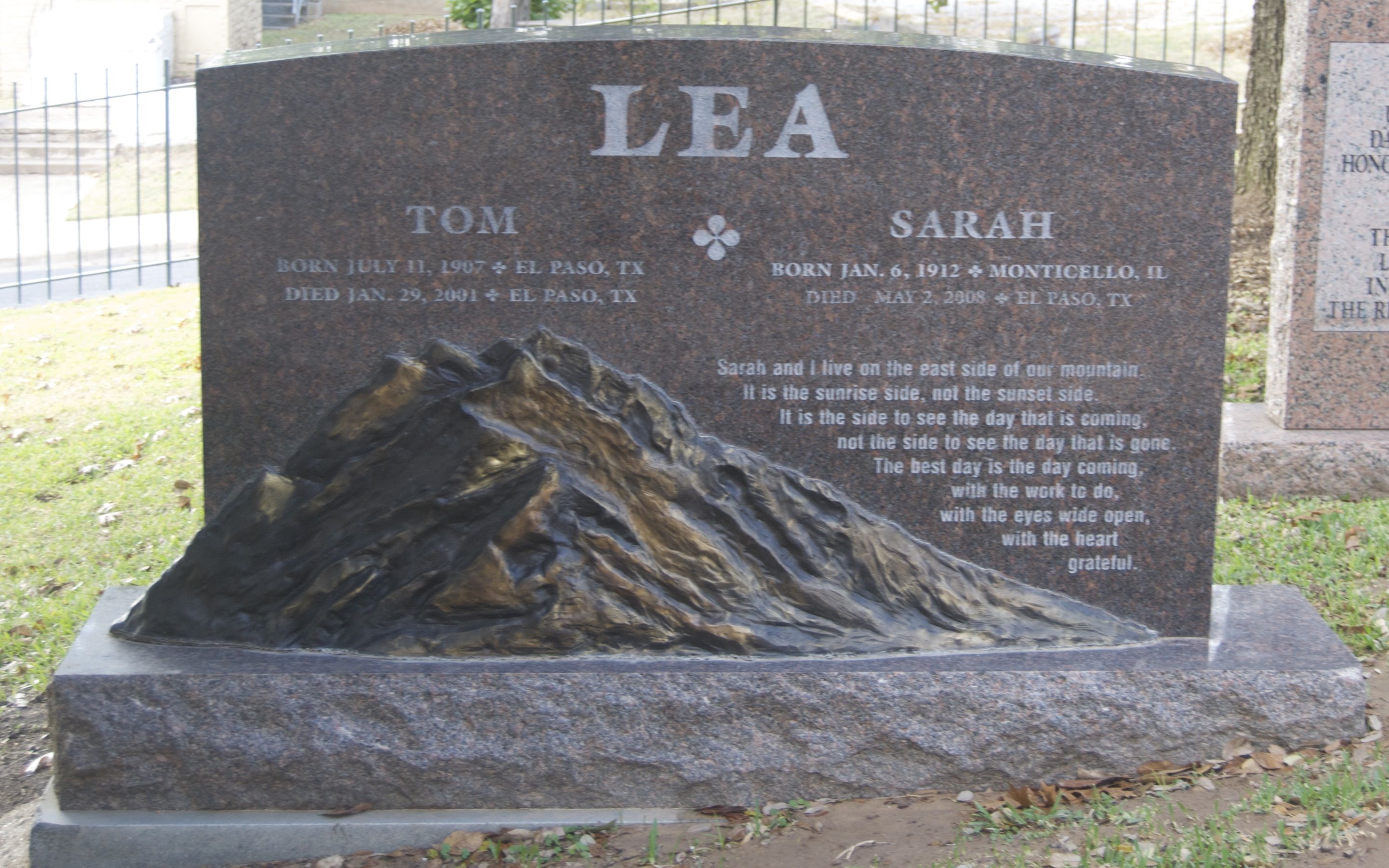
(And call me a sentimental old fool, but I like the inscription.)
(Tom Lea Institute. The Tom Lea Collection at the University of Texas.)
Art, damn it, art! watch (#32 in a series).
Monday, October 22nd, 2012Once upon a time, there was an art gallery in New York City called Knoedler & Company.
Knoedler & Company made more than a fair amount of money selling art. As a matter of fact, they made a lot of money selling art supplied by one dealer, Glafira Rosales.
But there are some problems. Ms. Rosales’s “collection of works attributed to Modernist masters has no documented provenance and is the subject of an F.B.I. investigation.” One of the works that passed through her hands, a Mark Rothko painting, was sold by Knoedler for $8.3 million dollars, and has now been declared a fake.
Knoedler stopped selling works from Rosales in 2009, and immediately started losing money. They closed in 2011.
Morning random notes: September 4, 2012.
Tuesday, September 4th, 2012Would you pay $18 for a 40-minute vinyl record of previously unreleased Charles Manson songs?
Yeah, I wouldn’t, either.
I want to come back to this later and elaborate on the idea some, but I’m getting more than a little tired of the mass media being coy in their reporting. (See also: Russian punk bands.)
This kind of bothers me, too, but I’m not sure I can articulate why.
Headline in the NYT:
First paragraph:
Matt’s death is tragic, but a 21-year-old man who has been accepted to grad school is not a child.
(Gee, doesn’t NYC have strict gun control laws?)
I don’t think I ever saw anything Michael Clarke Duncan was in, and I wouldn’t say I was a big fan of his work. But 54 is just too young. (NYT. LAT. A/V Club.)
The Frank Lloyd Wright archive is moving to New York City. This sounds like a very good thing:
(Well, a very good thing for everyone except Mike the Musicologist, who hates NYC.)
Headline from something called “The Root”, linked from the WP site:
Random notes, September 3, 2012.
Monday, September 3rd, 2012Workers of the world, unite! Dyslexics of the world, untie!
Oh, yes. Garden and Gun. I remember them. I was considering subscribing: that is, until they refused ads from the NRA. Now they can die in a fire, as far as I am concerned.
In other news, the NYT wants you to know that you should be careful buying art online.
My big question for the day: now that Reverend Moon is dead, how long will the Washington Times be around? I’ve gotten the distinct impression that it has survived that long purely because he wanted it that way, and his successors are not as wild about the paper as he was.
Mike Nesbitt has resigned as offensive coordinator at the University of Houston. That would be two days after the season opener, which they lost 30-13 to Texas State.
I’ve been kind of tied up the past couple of days and haven’t had a chance to blog the Austin Police Department acting as agent provocateurs to Occupy Austin story. I don’t really know what to make of it, so instead I’ll refer you to the Statesman story above, and the coverage from Grits for Breakfast here. (The other problem I have with this story is that much of the coverage comes from sources I don’t read and don’t trust.)
Speaking of Grits, he also has an interesting followup on the Texas Highway Patrol Association and other similar scam organizations.
Obit watch: August 7, 2012.
Tuesday, August 7th, 2012Noted art critic Robert Hughes.
A/V Club obit for Marvin Hamlisch. I expect fuller obits in the daily papers tomorrow. (I did not know, until I read it in one of the current obits, that Hamlisch was an EGOT recipient, and one of only two people to receive a Pulitzer Prize in addition to the Emmy, Grammy, Oscar, and Tony awards. Richard Rodgers was the other one.)
The NYT is also reporting the passing of noted film critic Judith Crist.
Art, damn it, art! watch (#31 in a series)
Tuesday, July 24th, 2012This story has gotten a fair amount of attention elsewhere, but I want to highlight one aspect of it.
Ileana Sonnabend was a noted NYC art dealer who passed away in 2007. Her children inherited her art collection, which was valued at $1 billion. So far, her heirs have paid $471 million in estate taxes on the collection, selling off a large part of it to do so.
One of the pieces in the collection is a Robert Rauschenberg piece called “Canyon”.
The IRS values “Canyon” at $65 million, and wants the family to pay $29.2 million in tax.
But doesn’t the fact that the work can’t be sold make it of zero value anyway? Sort of by definition? And is Ms. Barron confusing aesthetic value with market value?