Archive for the ‘Movies’ Category

Typecasting?

Sunday, June 30th, 2013

Last night after the SDC, we went over to the home of our anonymous friends to watch movies. (Hi, anonymous friends! Thanks for hosting! Especially since you were a bit tired! Hope you enjoy the Shaq Soda!)

We wanted to honor the late great Richard Matheson, and ended up watching “Nightmare at 20,000 Feet” and “Little Girl Lost“. (Speaking of “Nightmare”, yeah Shatner, yeah Matheson, but how many of you realize that was directed by Richard “Superman” Donner?)

Anyway, I don’t have a lot to say about these episodes: they are classics, and I was kind of distracted (for reasons I’ll probably talk about in the near future). But I bring this up because Lawrence’s original desire was to watch “Trilogy of Terror“. I don’t remember seeing this, or even hearing much about it, when it first aired, but apparently it is one of those things – like those TZ episodes – that people really really remember from their childhood. Especially the last segment, with Karen Black fighting off the evil doll: I get the impression that was nightmare fuel for a lot of kids in the 1970s.

It is odd what sticks with you. As I said, I don’t recall “Trilogy”, and my parents weren’t big on letting me watch “scary” stuff (though I do remember watching part of the first “Godfather” on TV with my dad, and that had big violence warnings all over it). There’s one episode of what I think was “Night Gallery” that sticks out for me: I only remember part of it, but it also involved an evil doll that killed the kindly (?) grandfather by setting the house on fire.

(I wonder what would have happened if my parents had let me watch this crap when I was a kid. Would I have grown up to be a rich and famous science fiction writer with groupies and a cocaine habit? Maybe my parents had the right idea.)

Anyway, my point (and I do have one) is that “Trilogy” isn’t on NetFlix. But you can watch the entire movie for free on YouTube.

You can also get a “special edition” DVD of “Trilogy of Terror” from Amazon: it looks like the “special edition” includes commentary by William F. Nolan (a noted writer himself, who did two of the three screenplays that make up “Trilogy”) and Karen Black, along with a “featurette” about Matheson.

(Already ordered it, Lawrence.)

(Obligatory reference to The Voluptuous Horror of Karen Black here.)

(Did you know Karen Black blames this movie for “forcing her to accept many roles in B-grade horror films”? Yeah, neither did I.)

(You can also watch “Trilogy of Terror II” on YouTube, but I don’t have a strong opinion about whether you should. One the one hand, it has the same creepy Zuni fetish doll from the first movie, plus rats. On the other hand, it lacks Karen Black and Richard Matheson. You make the call.)

Random notes: June 25, 2013.

Tuesday, June 25th, 2013

The NYT, LAT, and WP have not yet published obits for Richard Matheson. However, the A/V Club has a very nice tribute.

I feel kind of blocked when it comes to paying tribute to Mr. Matheson. The one thing I can say is: whenever I was trying to think of “who wrote this story?” – the box with the button, the family fleeing their home planet, the girl who falls into the fourth dimension – at least seven times out of every ten, the story I was trying to think of was written by Richard Matheson. It is impossible to overstate the depth of his influence on the genre.

In other news, I’m sure some of my readers remember the 2003 documentary Capturing the Friedmans about the child abuse convictions of Arnold and Jesse Friedman. Since the documentary was released, there’s been a lot of back and forth about the guilt or innocence of the Friedmans, leading up to an investigation by the Nassau County district attorney.

…it concluded, “By any impartial analysis, the reinvestigation process prompted by Jesse Friedman, his advocates and the Second Circuit, has only increased confidence in the integrity of Jesse Friedman’s guilty plea and adjudication as a sex offender.”

More, and I apologize for the length of this quote:

The report centered on four points raised in the film and by the appeals court: that the case may have been tainted by repeated police interviews that pushed children toward confessions; that children may have been hypnotized to recover memories not based on fact; that the case was distorted by a “moral panic” that created false accusations and a predisposition toward conviction; and that Jesse Friedman’s guilty plea may have been unlawfully coerced by the police, prosecutors and a hostile judge.

The review rejected them all. It said that though some interviews late in the case may have been flawed, the rapid pace and early flow of accusations from children in the classes indicated that the allegations arose from spontaneous accounts, not from investigators pushing children toward accusations. It said the first child interviewed reported improper behavior, 12 children leveled accusations of illegal sexual behavior at Arnold Friedman in the investigation’s first two weeks and, five weeks into the investigation, 13 boys described criminal behavior by Jesse Friedman.

It said, that despite one student’s account in “Capturing the Friedmans” of making allegations after being hypnotized, any use of group therapy or hypnosis came after all the indictments were filed. It disputed the one account of hypnosis in the film.

Additionally, the report points out that Jessie Friedman had “competent legal representation, weighed his options intelligently and pleaded guilty after determining it was ‘the optimal strategy’ in light of the available choices.

Mr. Friedman’s lawyer, Ron Kuby, and the film’s director, Andrew Jarecki, reacted with disappointment and anger, saying the report was a biased whitewash by the office that originally botched the case.

About that: the investigation was overseen by a “four-member independent advisory panel” that included Barry Scheck of Innocence Project fame.

The report was prefaced by a four-page statement by the panel. It said its job was about process more than findings. It did not reinvestigate the case itself, and it was not given access to key documents like grand jury records and interview reports.

Still, it commended the investigation, and said that if the evidence had pointed toward exoneration, “we have no doubt the Review Team was prepared to recommend without reservation that Friedman’s conviction be overturned.”

The statement, signed by all four members, said it was not the role of the panel to make an ultimate judgment about Jesse Friedman’s guilt, but added: “We do have an obligation to express a view as to whether we believe the conclusions expressed in the Review Team’s report are reasonable and supported by the evidence it cites. We think they are.”

Historical note, suitable for use in schools.

Friday, June 21st, 2013

A thread on FARK led me to the 1931 movie The Viking, which I was previously unfamiliar with. (This should not be confused with the 1928 movie The Viking.)

The Viking is somewhat interesting because it was the first talkie shot in Canada, because it was one of the earliest films shot in a documentary style (inspired by Nanook of the North) and because of how it was shot:

Much of the film takes place aboard the ship or on the ice floes of the Grand Banks of the North Atlantic, making for a difficult production.

The basic story of The Viking is your classic “young man runs away and joins up with seal hunters to prove himself worthy of his girlfriend’s love”:

Luke spots a seal herd, and, in a scene sure to be difficult viewing for modern-day audiences, dozens of hunters take to the ice floes to track the seals and slaughter them. During the chaos of the hunt, Jed attempts to shoot Luke, but snow blindness prevents him from hitting his target.

But other than the location aspects, and the seal hunting, why is The Viking interesting? After it premiered, the producer, Varick Frisell, decided “What this movie needs is more footage of ice floes.” So he and some film crew members went out to get pickup shots of the ice floes while their ship (the real ship named Viking) was hunting seals. The Viking (the ship) got stuck in the ice…

….and, on March 15, 1931, the good ship The Viking exploded, killing Frisell, his dog, and 26 other members of the crew.

Ice-breaking seal boats routinely carried explosives onboard to crack up the ice; authorities speculated that the explosion was likely due to an accident in the powder room.

As far as I know, and have been able to determine, this is the largest number of people killed in a single accident during the making of a film. I’m a little surprised I’d never heard this story before today.

TCM page on The Viking. Wikipedia. Entry on The Viking from the Canadian Film Encyclopedia.

Said it before. Say it again.

Thursday, May 30th, 2013

If you’re going to scam, make it worth your while. Seven figures in front of the decimal point is a good start.

Don’t lose your job as a police officer for something stupid, like trying to scam free movie tickets.

(Especially at the Regal Westgate Stadium 11. But, as I’ve said before, I’m an Alamo Drafthouse snob.)

Random notes: May 29, 2013.

Wednesday, May 29th, 2013

The NYT is absolutely indignant that the ceremonial throwing out of the first pitch at baseball games has evolved from a…

…honor was extended only a few times a season to a rarefied group that included presidents, mayors and military veterans. These days, it is regarded as a marketing opportunity, a sweetener in sponsorship deals between baseball teams and groups that want a piece of the spotlight.

In other news, water is wet and fire is hot. More:

The rite, now carried out nightly, is handed to actors and reality television stars, sponsors’ representatives and contest winners, and people dressed as animals as well as actual animals.

A capuchin monkey carried the ball out for a San Diego Padres game in September. Twice in the last two seasons, the Los Angeles Dodgers have welcomed to the mound Hello Kitty, or, rather, a person dressed as Hello Kitty.

Sometimes, there are ceremonial second, third, fourth and fifth pitches. The day after making his major league debut this month, John Gast, a promising pitcher for the St. Louis Cardinals, crouched up and down to catch five pitches. The honorees that day were Edward Jones, a financial planning company; the National Geospatial-Intelligence Agency; the Washington University School of Medicine; a local radio station; and the Cystic Fibrosis Foundation.

Question left unanswered by the paper of record: do the ceremonial second, third, fourth, and fifth pitches cost less for the sponsors than the first pitch?

Also in the NYT: Antoni Krauze, a Polish film director, is working on a feature film called “Smolensk” about the 2010 plane crash that killed the Polish president and 95 other people. But “some leading Polish actors have refused to participate”, and the NYT sees this, and other events, as reflecting deep divisions in Poland over the crash.

The range of conspiracy theories is dizzying. So-called truthers accuse the Kremlin of pumping artificial fog over the runway, planting explosives on the plane and doctoring and then sewing victims’ bodies back together in fake autopsies. Some even contend that the Kremlin murdered Kaczynski because he had traveled to Georgia in 2008 to support that country in its war with Russia.

Cahiers du Cinéma: Alphaville.

Sunday, May 19th, 2013

Last night’s movie was Alphaville.

Lawrence has said he’s not sure he wants to write a review of it, so I guess the duty of commentary falls to me. The problem is, I’m not sure what to say about it. I get the idea that Jean-Luc Godard is an important director, and Alphaville is an important film in the history of the French New Wave.

And the movie does have some things going for it:

  • The women are beautiful, especially Anna Karina.
  • “Hey, we don’t have a budget, so let’s use a Ford Mustang as an interstellar spacecraft, and Paris at night to represent an alien city.” Sounds good to me.
  • Godard does do a lot with little money in this movie.
  • It is shortish: 1:39.
  • I am not sure, but I believe this may be the first pop culture example of the “destroy the computer by setting it up with a logical contradiction” trope. TVTropes is not helpful in this regard, but Alphaville does predate Star Trek.
  • At least Godard had the good taste to give Lemmy Caution a 1911.
  • Wow. What great staircases.

Beyond those things, though…wow, this is one hot pretentious mess. Alphaville is the kind of movie that is great to be able to say you have seen, but not all that great to actually sit through.

(I have a feeling this is going to make it much harder to talk Lawrence and everyone else into seeing Made in U.S.A.. Indeed, Lawrence commented as I was leaving last night that next week, we need to watch “something where stuff blows up”.)


(And no great shock here, but my guess was right: you can buy Alphaville buttons online. However:

  1. Lawrence isn’t a button person.
  2. $6.25 seems steep to me, especially given that…
  3. …most of the things I’ve ordered from Zazzle have been disappointing, especially t-shirts.

Maybe if there’s a button maker at Worldcon I’ll get some done. Goddard won’t mind me infringing his copyright, will he? If he does, it isn’t like he has any room to complain.)

Just one more thing…

Wednesday, May 15th, 2013

As long as we’re talking about Lawrence’s review of General Idi Amin Dada, I have a question that’s bugging me, and I know I have some aviation buffs in my audience.

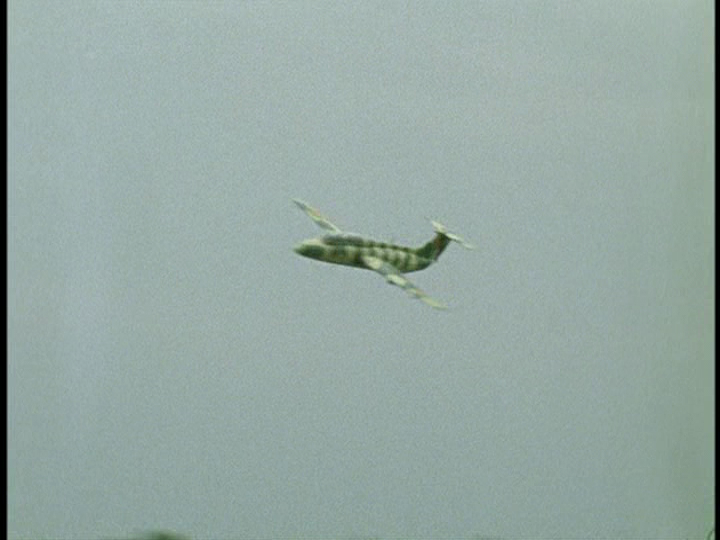
What are these planes? I apologize for the pictures: they are actually screen snapshots from the DVD, and I tried to get ones that showed the best possible angles. Click to embiggen.

vlcsnap-2013-05-15-17h01m58s204

vlcsnap-2013-05-15-17h03m36s240

vlcsnap-2013-05-15-17h07m18s150

Lawrence suggested they might be MiGs, and I know the Ugandan Air Force had MiG-15s and MiG-17s. But both the 15 and 17 have a really blunt open nose, while these planes have a more rounded one. I don’t think these are Fouga Magisters either, because they lack the V-tail. I believe these are some sort of two seat jet trainer, and they may be French. But I can’t tell, and it really bugs me that I can’t figure it out. Maybe if I’m lucky Tam will see this. For some reason, I’ve also got in my head that the good and great Brian Dunbar knows his planes. And, of course, there’s RoadRich…

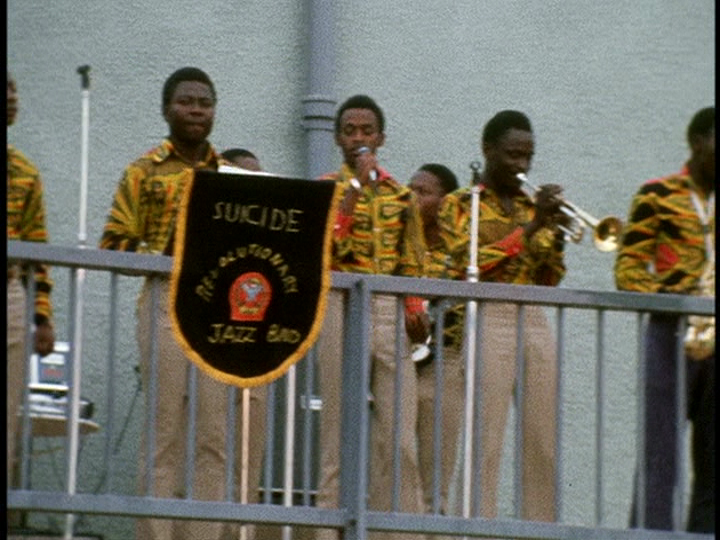
Okay. I lied. One more “one more thing”, just because this amuses me, and I’m pretty sure it amused Lawrence as well.

The Suicide Revolutionary Jazz Band

(Okay, one last thing. It irritates the fire out of me that Apple disabled screen captures from DVD Player in the Grab utility. And they don’t just throw up a “You can’t do this” popup: Grab lets you do the capture, but the resulting file is just a checkerboard grey and white pattern. Fortunately, VLC will a) playback DVDs, and b) even has a built-in “Snapshot” menu option. Hurray open source.)

Linkey linkey.

Wednesday, May 15th, 2013

Lawrence has put up a review of Barbet Schroeder’s classic documentary, General Idi Amin Dada: A Self-Portrait, which we watched at his house the other night.

Don’t have much to add to what he says, and I agree with him pretty much 100%, so I encourage you to wander over there and read his review.

Bacon numbers of note: Idi Amin – Bacon number of 3, if you include TV shows. Otherwise, the Oracle of Bacon says Amin can’t be linked to Bacon, which I find hard to swallow. (I checked using both “Idi Amin” and “Idi Amin Dada”.)

Fidel Castro, on the other hand, has a Bacon number of 2. Castro is linked to Bacon through Detective Munch and something called “Marilyn Monroe: Murder on Fifth Helena Drive” which is scheduled for release sometime in 2013.

Cahiers du Cinéma: I watched Gatsby so you don’t have to.

Monday, May 13th, 2013

Yes, I finally went to see it. Yes, I even sprang for the 3-D version. I run a full service blog here.

tl,dr: Wait for it on cable.

Notes:

      • This is a highly personal reaction, influenced by a lot of things. In particular, I think I have a weakness for 1920’s era flapper outfits. But Elizabeth Debicki as Jordan Baker and Carey Mulligan as Daisy Buchanan are both just…wow. I don’t know how I can put it without lapsing into the vulgar. Perhaps I should just say I would be delighted to take either one (or both) of them out for a cheeseburger and the amusing house red. Indeed, one of the reasons I wanted to post this is so I could link to photos of both young ladies. Ms. Debicki:

        and Ms. Mulligan:

      • Tobey Maguire did not work for me as Nick Carraway. I felt that he exhibited a limited emotional range: either vaguely petulant or slightly baffled. When he did try to express happiness or friendship, he seemed stiff.
      • Jay Z’s music was…well, let me be polite and say simply “not memorable”.
      • The 3-D does not add much to the movie. There are a few neat tricks (the closing credits in particular are kind of trippy in a geometric sort of way), but I don’t believe you’ll miss anything if you stick with 2-D.
      • There were more than a few CG shots in the movie that were so poorly done and so obviously CG that they took me out of the movie. Luckily, all I had to do was wait for Ms. Debicki or Ms. Mulligan to come back on screen…
      • Other than the bad CG, though, there is a lot of lush and beautiful photography in the movie. It is pretty to look at…
      • …but ultimately empty. I think the biggest failure of the movie isn’t in conveying Gatsby’s obsession with Daisy; that comes across just fine. The point that I think Baz Luhrmann missed (along with Craig Pearce, the other credited screenwriter) is that Daisy is an unworthy vessel for Gatsby’s affection. Tom and Daisy are empty, shallow, vain people. Gatsby’s death isn’t the tragedy; the true tragedy is that he brings about his own end through his pursuit of Daisy, and that Daisy isn’t worth it. Luhrmann fails to develop Daisy in such a way that we’re able to see this. Towards the end of the movie, Maguire in his voiceover quotes the classic line about Tom and Daisy being “careless people“, but reading the words isn’t the same as demonstrating this to us.

I’m glad I went: it was, after all, a nice afternoon out at a nice theater. But I can’t recommend purchasing a ticket until The Great Gatsby comes to cable or the discount theater nearest you.

Obit watch: May 8, 2013.

Wednesday, May 8th, 2013

Ray Harryhausen. NYT. LAT. A/V Club appreciation. Lawrence. Popehat.

Week of Gatsby: Day 1.

Monday, May 6th, 2013

In honor of the forthcoming movie, I am declaring this week the “Week of Gatsby” on WCD. Mostly for my own personal amusement.

Today’s entry: The Great Gastby for NES, a browser based game in which you wander around Gatsby’s party, throwing your hat at various targets and searching for the titular character.

(Yes, I am planning to see the movie. Yes, in 3D. “Argo” was the last thing I saw in a theater, and I figure I could use the diversion. Even if it is a pile of crap.)

(And, yes, as it happens, I do like the book. A short defense of it is here.)

Obit watch: May 1, 2013.

Wednesday, May 1st, 2013

Deanna Durbin, movie star of the 1930s and 1940s. NYT.

Ms. Durbin had remained determinedly out of public view since 1949, when she retired to a village in France with her third husband.

More:

Ms. Durbin, who gave almost no interviews after she left Hollywood, did send reporters a letter in 1958 that read in part: “I was a typical 13-year-old American girl. The character I was forced into had little or nothing in common with myself — or with other youth of my generation, for that matter. I could never believe that my contemporaries were my fans. They may have been impressed with my ‘success.’ but my fans were the parents, many of whom could not cope with their own youngsters. They sort of adopted me as their ‘perfect’ daughter.”

High speed low drag tactical stuff.

Monday, April 8th, 2013

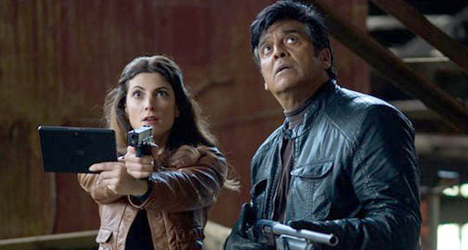
So Lawrence and I watched the latest SyFy channel disaster, “Chupacabra vs. the Alamo” Saturday night at the home of our friends who shall remain anonymous. (Thank you, anonymous friends!)

I’m hoping Lawrence will write a review so I don’t have to, but there’s one thing I did want to highlight.

Have any of you tactical operators given any thought to how you’re going to perform your tactical operations with an iPad (or other tablet) in one hand?

Are iPad operations something that’s covered in training these days? (Karl, I sense a great need.)

Obit watch: April 8, 2013.

Monday, April 8th, 2013

It hasn’t been a good few days for the movies.

Noted documentary filmmaker Les Blank passed away on Sunday. NYT. LAT. Edited to add: A/V Club (they were late in getting their obit up).

My favorite Les Blank story:

Perhaps his best-known films concern Mr. Herzog, the German director of films like “Aguirre, the Wrath of God” and “Stroszek.” To encourage his student and friend Errol Morris to finish his long-talked-about film on pet cemeteries, Mr. Herzog had said that when it was done he would eat his shoes. The impetus worked: Mr. Morris finished the film (“Gates of Heaven”) in 1978, and Mr. Herzog kept his promise, boiling his leather desert boots in duck fat (and stuffing them with garlic) at Chez Panisse, the celebrated restaurant in Berkeley, and consuming them — partly, anyway — onstage at a local theater. Mr. Blank turned it into a comic, and rather touching, 20-minute film about what artists do for the sake of art, appropriately titled “Werner Herzog Eats His Shoe” (1979).

Blank’s most famous film is another one involving Herzog: “Burden of Dreams” about Herzog and the making of “Fitzcarraldo”.

Margaret Thatcher: LAT. NYT. Battleswarm. I apologize if I seem to be giving her short shrift: my feeling is that everyone who doesn’t live under a rock is aware of her passing, and I am just linking to the obits here for the historical record.

Roger Ebert.

Friday, April 5th, 2013

Thinking about what I wanted to write, I came to the realization that I’ve already written much of what I wanted to say: he was a huge influence on how I think about movies (for which I am grateful), his views on what is and is not art were questionable, and many of the political views he expressed later in his life were appalling. (Roger should have spent more time reading Mencken.)

Chicago Sun-Times. NYT. LAT.

A/V Club. Onion. There are several posts at Jimbo’s site, but this one in particular seems to be worth highlighting.

This whole thing is kind of odd, taken in the light of Roger’s April 2nd blog post, where he talks about launching a Kickstarter campaign to bring back “At the Movies”, relaunching RogerEbert.com, and various other projects. I wonder how things went downhill that fast.

And I also wonder what’s going to happen to RogerEbert.com. My understanding is that Ebert et al planned to move the site to their own servers, and off the Sun-Times site. That’s fine. But I went to the site for the first time in weeks yesterday and realized that I wasn’t all that interested any longer; only one of the current reviews was written by Ebert. Many of the others were written by Richard Roper (who I only tolerated because he was on the same show as Ebert), Ignatiy Vishnevetsky, Jim Emerson, and other reviewers who I don’t find interesting. I’m hoping the site stays up as an archive of Ebert’s writing (and it’d be nice if it also archived “At the Movies”), but it isn’t a place I’m going to go for movie criticism any longer.

That’s a little mean, but it is also the truth. Let’s end on an upbeat note. Or two.

They don’t make them like that any more. (Actually, they do, but only for the SyFy channel.)

I couldn’t find their “Worst Movies of 1992” show online, but here’s their original review of “Shining Through”, which was their pick for worst movie that year (this clip does include the strudel scene):

Someone’s done an IMDB list of all of Siskel and Ebert’s worst movies of the year, just in case you’re interested. A Google search will turn up clips from some, but not all, of those episodes.