Archive for the ‘Law’ Category

Quintana update.

Friday, February 10th, 2012

The final charge (criminal mischief) against former APD officer Leonardo Quintana was dropped Thursday.

As you may recall, Mr. Quintana was acquitted by juries on three other charges; he was also fired by the APD and reinstated by arbitrators several times before his most recent termination (which seems to have stuck).

Stuff. And things.

Wednesday, February 8th, 2012

Obit watch: noted British SF author John Christopher.

Here’s the latest I’ve been able to find in the HouChron on the Rangers/FBI/Harris County DA. It doesn’t add a whole lot to what was reported yesterday, alas.

Paul Farhi in the WP writes about press coverage of the Lance Armstrong probe, including his own paper’s coverage.

Weer’d beat me to this one, but: carry your damn guns, people.

Break 1-9, good buddy…

Tuesday, February 7th, 2012

There isn’t a whole lot known at this point, but various news sources are reporting that the Texas Rangers and FBI are questioning staff members at the Harris County DA’s office.

Both the HouChron and KTRK are reporting that the questioning allegedly involves the DA’s investigation into the grand jury, and not the BAT vans that the grand jury was investigating.

More on this when we know more.

Eye the Jury.

Friday, February 3rd, 2012

More 185th Grand Jury stuff:

Lykos and her defenders were claiming they didn’t do anything out of the ordinary; they were just Googling folks, which, after all, anyone can do.

Not quite. It seems that the Harris County DA’s investigator also used something called Accurint. Accurint is not a publicly accessible system; it is a service that the county pays for, and which requires that you certify a “permissible use” before obtaining information. Defense attorney Mark Bennett has more about Accurint over at his blog, “Defending People”, which I commend to your attention.

And, of course, The Hon. Murray Newman is on the case as well.

Quis custodiet ipsos custodes? and other random notes for February 2, 2012.

Thursday, February 2nd, 2012

Obit watch: Angelo Dundee, Muhammad Ali’s corner man.

Mike Kelley, L.A. based visual artist. There’s also a well-done appreciation of his work at the A/V Club website.

And I’m a little late on this, but wanted to note it anyway: Ian Abercrombie.

In other news, the fun never stops with the Harris County District Attorney’s office. I missed the actual report (I can’t get Houston’s Channel 13 in Austin), but BlogHouston and The Hon. Murray Newman have links. In brief, DA Lykos basically admitted that, yes, she ordered investigators in her office to “research” (as she puts it; other people use the word “investigate”) members of the 185th Grand Jury, as well as the special prosecutors and the judges involved with the grand jury.

I don’t think I am overstating things to suggest that the HCDA’s office is starting to look positively Nixonian.

Update: Leonardo Quintana

Thursday, February 2nd, 2012

Do you remember Leonardo Quintana? The APD officer who was fired multiple times by APD, and reinstated multiple times by an arbitrator, before APD finally managed to make a charge stick? Last time we touched base with former officer Quintana, he’d just been acquitted on domestic assault charges.

Yesterday, he was acquitted on two more charges: another domestic assault charge in an unrelated incident, and criminal trespass.

According to the Statesman, there’s still one more criminal mischief charge pending against Quintana. We’ll try to keep you updated on the disposition of that charge.

Rogue grand jury update.

Tuesday, January 31st, 2012

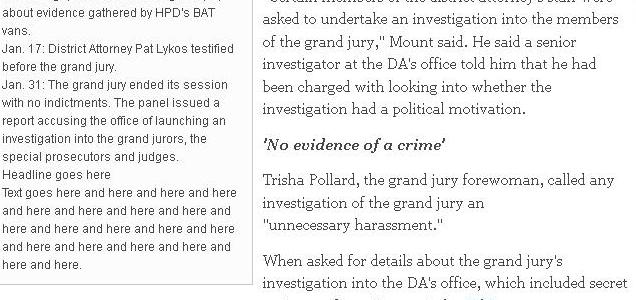
The 185th Grand Jury – that would be the one investigating the Harris County DA’s office – ended their term today. (Previously: here, here, here, here, and here.)

And?

No indictments. But the grand jury is not pleased with the DA’s office:

[Grand jury foreman Trisha] Pollard signed off on a one-page report blasting the DA’s office for “unexpected resistance” and accusing the office of launching an investigation into the grand jurors, the special prosecutors and judges.
The grand jury also harshly criticized Rachel Palmer, a prosecutor who invoked her fifth amendment right to refuse to testify.
“The stain upon the HCDAO will remain regardless of any media statements issued or press conferences issued by anyone,” according to the statement.

The current Chron article is a bit short; I expect a longer version later today. Murray Newman had a good piece up this morning with his predictions; I would expect commentary from him once he’s had a chance to read and digest the grand jury report.

Edited to add: The Hon. Mr. Newman has the statement, and his thoughts, up over at his blog.

Edited to add 2/1: Longer story from the HouChron. Note the fine copy editing (which I hope will be fixed when you see it):

Today’s literary fraud update…

Thursday, January 26th, 2012

…comes to us by way of our great and good friend Earl Cooley III on Google+.

It starts with the arrest of Mitchell Gross on charges of wire fraud and money laundering. According to the indictment, Gross defrauded a woman he met online of $3 million.

Okay, so? Mitchell Gross is also known as “Mitchell Graham”; he published fantasy books with HarperCollins and mysteries with Tor and Forge.

And then this is where it really starts to get weird. Gross claims to be a championship fencer (there are some questions about that claim; it seems clear, at the very least, that he was not on the US Olympic fencing teams in 1984 and 1988). Gross also claimed to have been a practicing lawyer for twenty years, and that he quit practicing in order to go back to school and earn a doctorate in neuropsychology. (Gross was actually disbarred in 1990, and convicted of practicing law without a license in 1992.)

And then it gets weirder. Gross may have set up his own fake writing contest, complete with judging by Ben Bova, and used that to get published. (“Mr. Bova told us that he had indeed been hired as a contest judge–the only one, so far as he was aware. He was a bit surprised to discover that there was also only one finalist, but went ahead and did as he was asked–to read the manuscript and judge if it was fit to win.“)

The best roundup of this is at the Writer Beware blog. Be sure to read the comments, as people seem to be digging up more information on Mr. Gross. There’s also a lot of good stuff in the linked AJC article.

Speaking of traffic lights…

Thursday, January 26th, 2012

Battleswarm was doing a better job of covering the red-light camera issue in Houston than I was. However, I ran across an item (by way of Overlawyered) that I thought was worth sharing.

When the referendum outlawing the red light cameras was being litigated before District Court Judge Lynn N. Hughes, Judge Hughes blocked Francis and Randy Kubosh, the people behind the referendum, from participating in Houston’s lawsuit against American Traffic Solutions (ATS). The Kuboshs (and other people) were concerned that Houston was going to go into the tank for ATS, “especially after ATS and Houston’s lawyers sat together at the same table during oral arguments.”

Yeah. Well. The Fifth Circuit ruled on Tuesday that, no, Judge Hughes, you can’t do that.

“There is no federal authority nor state law prohibiting intervention of right in this type of case,” Chief Judge Edith H. Jones wrote for the appellate panel. “These intervenors are unique because they engineered the drive that led to a city charter amendment over the nearly unanimous, well funded, and longstanding opposition of the mayor and city council… They have raised substantial doubts about the city’s motives and conduct in its defense of the litigation with ATS. Without these intervenors’ participation, the city might well be inclined to settle the litigation on terms that preserve the adverse ruling on the charter amendment and thus preserve its flexibility to reinstate red light cameras in the future. This is no matter of simply defending city policy of one sort or another: it involves millions of dollars of revenue to city coffers during a period of considerable economic uncertainty.”

Meanwhile, the city settled with ATS for $4.8 million. Noted:

Hughes has close ties with ATS, having served on the bench for 25 years with Judge David Hittner, the father of ATS General Counsel George Hittner.

TMQ watch: January 24, 2012.

Tuesday, January 24th, 2012

Before we jump into this week’s TMQ, we thought we’d mention D.J. Gallo’s list of the worst college basketball blowouts in Division I history. “Long Island 179, Medgar Evers 62”. It took all of Long Island to defeat one guy? And “Texas 102, San Marcos Baptist 1”. “San Marcos Baptist Academy was — and is — a boarding school for teenagers.”

After the jump…

(more…)

I hope they get tongue prints.

Monday, January 23rd, 2012

LAT headline: “Gene Simmons look-alike robs stores in Sacramento“.

(First comment: “That’s Paul Stanley you morons.” How can you tell from that photo?)

Happy dance!

Monday, January 23rd, 2012

The Supreme Court has handed down their decision in the case of United States v. Jones, the case involving attaching GPS tracking devices to vehicles.

The court held that, yes, attaching a GPS tracking device to someone’s vehicle is a search under the Fourth Amendment, and yes, this does require a search warrant. The decision is here.

Even better: it was a 9-0 ruling. (Five of the justices signed on to the majority opinion; the other four wrote a separate concurring opinion.)

Here’s preliminary coverage from Wired‘s “Threat Level” blog. I haven’t had a chance to review the full ruling yet; I may have additional links or commentary later.

Edited to add: Correction. According to the WP, there were two concurring opinions; I missed one in my quick skim of the ruling. Alito, Ginsburg, Breyer, and Kagan signed on to one concurrence; Sotomayor wrote a second concurrence, and also signed on to the majority opinion.

Edited to add 2: Discussion at the Volokh Conspiracy. Part 1. Part 2. Part 3. Part 4. Still wading through this, but part 2 makes a good point; the Court did not actually rule per se that GPS tracking requires a warrant, but that it is a search under the Fourth Amendment. Not all searches require a warrant (see Terry v. Ohio or Chimel v. California) but, in general, the types of searches that the Court has held do not require a warrant involve “exigent circumstances” and are highly limited in scope. I find it hard to see the Court applying an “exigent circumstances” exception to GPS tracking in just about any case.

ETA3: And one of Volokh’s commenters makes a good point: the police apparently had a warrant, but botched the execution of it (“The warrant authorized installation in the District of Columbia and within 10 days, but agents installed the device on the 11th day and in Maryland.”) and then tried to argue that they didn’t need no stinking warrant anyway.

Obit watch: January 22, 2012.

Sunday, January 22nd, 2012

Joe Paterno is dead.

As opposed to last night, when he was apparently declared dead but actually wasn’t. (Good on Devon Edwards for standing up and taking responsibility, but I still feel sorry for him; especially since it sounds like they were taken in by a forged email and a dishonest source.)

Also among the dead: Philip Vannatter, LAPD detective. I know, you probably never heard of him. He led the Ron Goldman/Nicole Brown Simpson investigation and the Roman Polanski investigation, two of the LAPD’s biggest cases.

One colleague told The Times in 1994 that Vannatter was a bear of a man who, when he kicked in a door while arresting a robbery suspect once on the Westside, he knocked the door off the hinges. When Vannatter worked as a detective in Venice in the 1970s he would have contests with co-workers to see how long they could hold a sledgehammer outstretched in front of them with one arm.

Holy…goat? Maybe. Kind of. Sort of.

Sunday, January 22nd, 2012

The German Sport Guns folks are putting out some interesting stuff. I’ve been tempted for a while to pick up one of their .22LR MP-5 clones (Mike the Musicologist has been pushing me to do so as well); they’re nice looking guns, I think they’d be a lot of fun to shoot, and I often see them at the gun show for reasonable prices. But I can’t find any practical use for them (other than “they’d be fun to shoot”) and I’ve got enough .22LR guns already, thankyouverymuch.

I do also kind of like the idea of an AK-47 clone in .22LR, but it has less appeal to me than the MP-5 clones. I’d rather have a full-on AK-47. (And that is on my list, just haven’t gotten around to it yet.)

New at the SHOT show, we’ve got the Mexican drug dealer line of guns from GSG: gold-plated AK and MP-5 clones. Yeah. Not on the list, but lord love GSG for trying.

On the other hand, American Tactical Imports (GSG’s US importer) is also going to be importing GSG’s .22LR version of the StG 44. This could be interesting; .22LR is a lot easier to find than 7.92×33mm Kurz, and I do have a certain interest in the StG 44 after reading Pale Horse Coming (in which the Audie Murphy clone uses one to great effect against a guard tower).

Also, if I’m going to be honest with myself, the wooden crate “handmade by a Amish community in New York state” pushes a button, too.

(Hattip: The Firearm Blog on both of these.)

Edited to add: Something occurs to me. You know what ATI/GSG could probably rake in the cash with? A Thompson clone in .22LR, complete with drum magazine. Especially if they sold it (and the drum) at a price that doesn’t make you think it is made out of compressed unicorn tears and ambergris.

However, I’d be willing to bet that the current owners of Auto-Ordnance might not take too kindly to that without some sort of licensing deal. Which I think actually raises an interesting legal question; to what extent is the physical look and design of a firearm protected by law? GSG was, after all, sued by H&K (“you suck and we hate you”) for trade dress infringement, but how long does trade dress protection last? Forever? The Thompson is, after all, an 84 year old gun…
Today’s Bell update.

Friday, January 20th, 2012

More than half of the disability retirements awarded to police officers under former Bell City Administrator Robert Rizzo — including those given to three police chiefs — should not have been granted, and workers’ compensation settlements for 13 officers were “exceedingly large,” an investigation has concluded.

Former police chief Michael Chavez gets a pension of $117,942, and got a worker’s compensation settlement of $140,000. Former police chief Andreas Probst gets $160,649 a year on top of his $250,000 worker’s compensation settlement. Former police chief Dennis Tavernelli gets $169,027 a year on top of his $395,667 worker’s compensation settlement.

The advantage of a disability retirement is that only half of the pension is taxed; workers’ compensation settlements are tax free.

And:

The Times reported that in at least two instances, the city wrapped severance and unused vacation and sick time into the workers’ comp settlements, which experts said violated tax laws.

Question: if the city and the police chiefs knowingly violated state law in that fashion, could they be charged with tax evasion?