I’m fascinated by computer chess, so I would probably have posted this anyway. Interestingly, though, this article also features (and quotes) an unexpected appearance by a now very prominent science fiction and fantasy writer, who at the time had recently graduated from Northwestern University and was interested in both computers and chess.
I thought I’d go back to the early days, starting with the 1950s.
From 1953, and the Bell System, “The Transistor”, an early documentary about the transistor and its anticipated impact on society. (Remember, this was six years after the transistor was invented.)
Wrist radios! Portable televisions! Computers that can fit into “a good sized room”! The future!
Bonus video #1: “Genesis of the Transistor”. Also from the Bell System, but from 1965 this time: the origins and development of the device.
Bonus video #2: “The Incredible Machine”. Electronic circuit design, digital drawing with a pen, computer animation, computer music composition, speech synthesis…none of this stuff is extraordinary today. But it was in 1968.
We’re still in the “produced “under the personal supervision of Jack L. Warner”/Owen Crump era. But according to Wikipedia, the Bell System wasn’t all that happy with the first two Warner films, and actually approached Frank Capra about coming back. I gather he turned them down.
Film number seven in the series: “Thread of Life”, about DNA and related matters (heredity, genetics, all that stuff). This is from 1960, so it’s worth considering where we were at the time: it wasn’t until 1952 that DNA was established as the carrier of genetic information, and it wasn’t until 1953 that Crick and Watson published the double helix paper. Franklin and Gosling’s X-ray diffraction photo was from 1952.
This is literally within a couple of years of the beginnings of molecular biology, and the Bell System is trying to present these concepts to the general public.
What if – and I know this is a crazy thought – but what if someone like Elon Musk or Jeff Bezos produced a one hour video once a year to explain some scientific concept to the general public? Get some real hotshot director like Tarantino to direct, bring in subject matter experts who come across well on camera, hire a charismatic host…? I think you could do this without veering into the political arena, though I’m sure the temptation would be hard to resist for some.
Film number eight in the series: “About Time”. The people of Planet Q have a problem. They haven’t been into the concept of “time”, but they just got their first clock and want to know what time they should set it to. They are unhappy with the initial answer – “Set it anywhere you like.” which leads to a discussion of time, the nature of time, timekeeping, how do we really know what time it is anyway, and relativity theory.
Spoiler #1: the ultimate answer turns out to be…”Set it anywhere you’d like.” But there’s a catch: the people of Planet Q are looking for audiophiles who are interested in high quality cassette tapes.
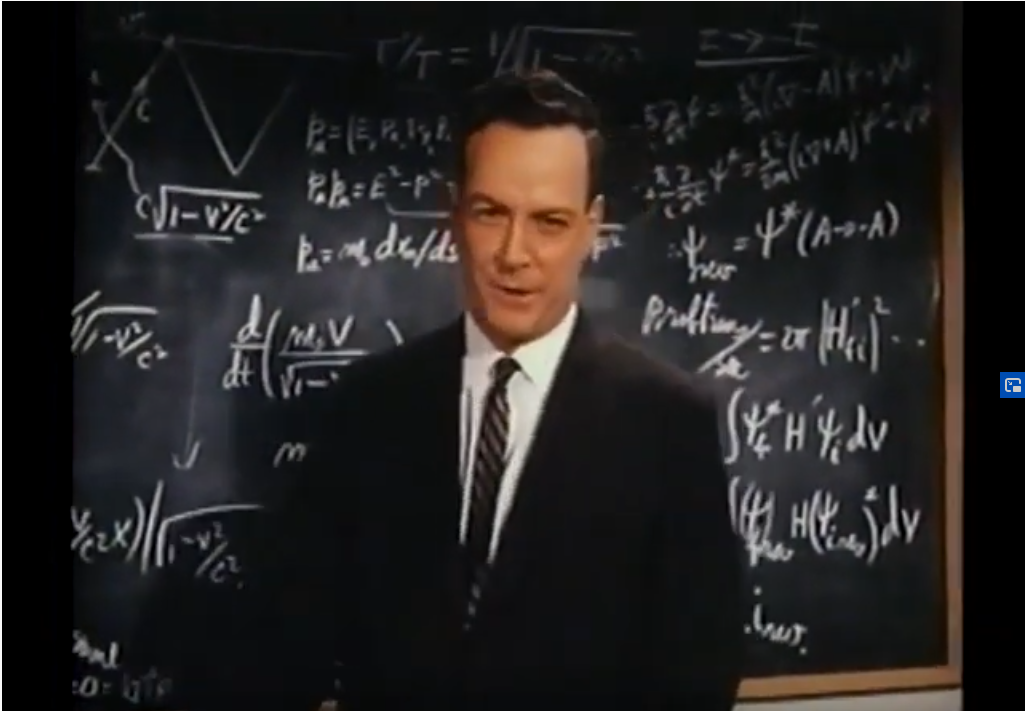
Spoiler #2: if you don’t want to watch the whole film, but are just interested in the guest appearance, Dr. Richard P. Feynman appears at about the 45 minute mark.
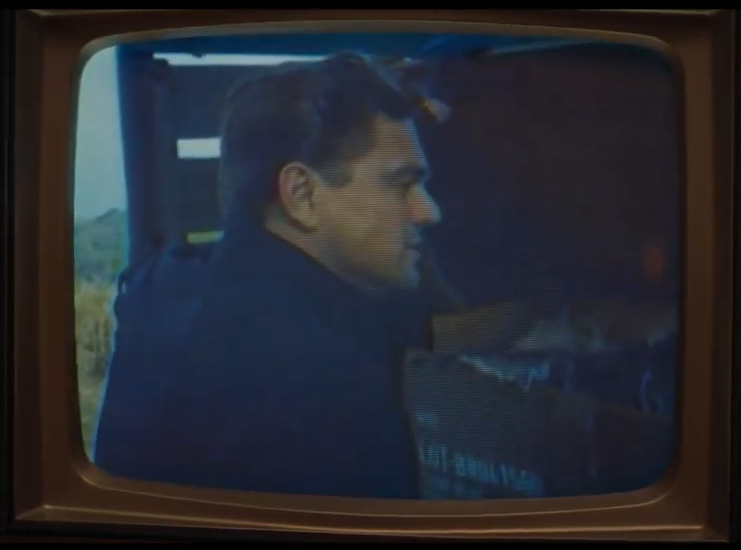
Is it just me, or is there a little bit of resemblance between Feynman and Leonardo DiCaprio?
Okay, that may not have been the best DiCaprio photo I could have picked, but I have reasons. I really think DiCaprio could pull off the Feynman role, if they ever make that film of his life.
But I digress. There was one more film in the series: “The Restless Sea”. Unlike the first eight, it was only 30 minutes long. It also wasn’t produced by Capra or Warner: this was actually a Disney production. Les Clark, one of the early Disney animators, directed, and Walt Disney appears as himself.
Unfortunately, I haven’t been able to find this one anywhere. Wikipedia’s page lists various public domain/DVD/VHS/laserdisc releases of the Bell System Science Series, but none of them seem to include “The Restless Sea”. I suspect this is locked away in the Disney vault, possibly on the same shelf as “Song of the South”.
Next week: I want to continue the “Science Sunday” theme, but I don’t have any good ideas right now. Suggestions from the gallery are very welcome.
The third and fourth films in the series were co-written by Frank Capra and Jonathan Latimer. Mr. Latimer was fairly famous as a crime novelist as well as a screenwriter. (He also wrote the screenplays for “The Glass Key” and “The Big Clock”, among other credits.) I haven’t read any of Latimer’s work, but I have heard the name come up before. According to Wikipedia, he wrote a book called Solomon’s Vineyard in 1941: it was so racy that it wasn’t published in the US until 1950, and was heavily censored at that time.
The third film in the series was “The Strange Case of the Cosmic Rays”.
The fourth film in the series: “The Unchained Goddess”, about weather. Capra produced this one, and wrote the screenplay with Latimer, but did not direct: Richard Carlson did that job.
Apparently, the television ratings for these next two films were disappointing. Capra wasn’t happy either: I gather that he felt the Bell System was interfering too much with his creative vision. He was replaced after “The Unchained Goddess” and went back to directing Hollywood films. His first one after “The Unchained Goddess” was “A Hole In the Head”, with Frank Sinatra and Edward G. Robinson. You may remember that as the movie that introduced “High Hopes”.
But what happened with the Bell System Science Series? Next week: “Produced under the personal supervision of Jack L. Warner”.
I thought today I’d reach back for some rocket geekery.
First up: “The Space Age: Dr. Goddard to Project Gemini”. This is a 1965 film sponsored by the Metropolitan Life Company about the early days of rocketry. Includes some home movies of Dr. Goddard that I think are pretty neat.
Bonus video #1: “Report From Aerojet”, a promo video for Aerojet General, “a subsidiary of the General Tire and Rubber Corporation”.
Bonus video #2: “All Systems Go”, a 1963 NASA promo film about Gemini.
We’ve heard from various organizations and individuals in this series. But do you know who we haven’t heard from until now?
The intelligence community.
Unless you’re as geeky as I am (or more) you’ve probably never heard of CORONA/DISCOVERER. CORONA was an early satellite reconnaissance program: DISCOVERER was the name of the disinformation program associated with it, which claimed to be a technology development program.
CORONA shot photos on film – actual, physical film. But how do you get the film back from space for development? CORONA would eject a capsule containing the film, which would re-enter the atmosphere…
Here’s a vintage video from Lockheed of “DISCOVERER”, which (of course) doesn’t discuss CORONA at all. But it does show the capsule retrieval process.
Bonus video #1: “Oceanography: Mining Minerals In The Ocean” from Martin Marietta. This is pretty much what it says on the tin: exploring deep undersea using early remote operated vehicles to find deposits of underwater mineral nodules.
I can’t tell when this video was made, so I’m not clear on whether it was pre or post the Project Azorian revelations. I’m guessing it was some time during the 1970s, because that music.
Bonus video #2: from 1964, “Undersea Pilot”, about the Reynolds Aluminum built deep sea vehicle Aluminaut. This doesn’t have quite as many intelligence implications as the other two videos, but Aluminaut did see some military use. (It is a well known fact that it was used in recovery operations after the 1966 Palomares B-52 crash. Some other books I’ve read on Navy deep sea operations in the 1960s and 1970s lead me to believe it was involved in other classified missions as well.)
I thought Aluminaut and Trieste and Alvin were incredibly cool, back when I was in the single digit age range. (I’m pretty sure I read about them in a How and Why Wonder Book, thought I don’t remember which one.)
To be fair, these are not random YouTube recommendations. This is something I ran across a few months ago, and that became part of a small project I’m working on. I want to bookmark these here for my own reference, but I also think some of my readers (especially those with children) may enjoy these. Admittedly, they are about an hour each, but that’s why this is Science Sunday. And how long are your children’s normal school classes?
Between 1956 and 1964, the Bell System (you remember the Bell System, don’t you?) produced nine specials about various aspects of science. These were broadcast on television in prime time, and the first couple got pretty good audience ratings.
Frank Capra (yes, thatFrank Capra) produced and wrote the first four, and directed the first three.
I haven’t done anything super geeky in a little while, so today’s the day.
“An Introduction to Digital Computers”, from the UNIVAC division of Sperry Rand sometime in the 1960s.
Bonus video #1: it seems only fair to give the other guys their turn. This is a compilation put together by the Computer History Archives Project of promotional videos for the IBM System/370.
Not just bombs – though what high explosives fan can resist the biggest booms of all – but atomic energy in general. The early power reactors. Atoms for peace. Project Plowshare.
I have personal reasons for this, but in my mind, it also ties in to something I call “The Future We Could Have Had”. A lot of folks have written about facets of that future, and someday I may do a longer blog post on the idea.
Today is not that day. But here are some vintage atomic videos to hold you.
First up, “First Reactor In Space…SNAP 10A”. SNAP 10A was an experimental reactor launched almost exactly 55 years ago (April 3, 1965) and was the first nuclear reactor in orbit.
Bonus video: “Power For Continent Seven”. Yes, there was a reactor at McMurdo Station (PM-3A) that operated for about 10 years.
Slight spoiler: if you read the Wikipedia entries, you’ll find that neither one of these projects was, shall we say, 100% successful.
Two of my favorite things written by Neal Stephenson:
Cryptonomicon, a book that seems scientifically designed to push the maximum number of my buttons.
“Mother Earth, Mother Board”, Stephenson’s long but fascinating essay about submarine cables. This was originally published in Wired almost 24 years ago, and (interestingly enough) is reprinted as part of the back matter to the Kindle edition of Cryptonomicon.
I mention these things because this came across my YouTube recommendations, and I thought it was worth running on a Sunday: “The Voice Beneath The Sea”, about laying a trans-Atlantic cable to link the US, Canada, and the UK. Brought to you by “The American Telephone and Telegraph Company Long Lines Department”.
Man, I miss the days of organizations like the “Long Lines Department” and people with names like “Wildman Whitehouse” (even if the latter was grotesquely incompetent).
Bonus video #1: This seems oddly appropriate in these days of Zoom and Skype and WebEx: “Face to Face”, a 1970s promo film from AT&T for the Picturephone.
This is weird, but: I have a really vivid memory of seeing a Picturephone demonstration on TV when I was very young. Specifically…on “Captain Kangaroo”. I kid you not. I guess there were a lot of five to seven year old kids in the target market for AT&T’s service. Or perhaps it was really targeted at all the stay-at-home moms who were watching the show with their small children?
Bonus video #2: “Tools of Telephony”, produced by Western Electric.
I have another video or two along the long lines line (see what I did there?) that I want to put up, but I’m waiting for it to get hot again: I’m hopeful that at least one of those videos will cool you down a bit.
Colby Cave, forward for the Edmonton Oilers. He was 25. According to the reports, he had emergency surgery on Monday and was placed in a medically induced coma.
I am seeing unconfirmed reports that John Horton Conway, noted mathematician, has passed on, but I don’t have any links or anything that I’d consider confirmation yet.
Some reactions have to be run at very low temperatures. This is one of them. If you mix this stuff together at room temperature your internal organs would be found in several time zones.
tl,dr; Remdesivir is one of the more promising drugs for coronavirus. It is also a king hell b—h to synthesize.
You could do a lot worse than browse through some of Mr. Bloom’s other articles if you’re bored, especially the ones about meth chemistry and fentanyl. We’ve all heard of fentanyl and some of us have probably heard of carfentanil. But have you ever heard of ohmefentanyl?
(I know some of these are a couple of years old. I only discovered Mr. Bloom and the ACSH site over the weekend, when Hacker News linked to his Remdesivir article.)
Sadly, the celebration this year is more than a little subdued, and not just because Pi Day falls on a Saturday.
I had actually planned to do Pi Day (observed) on Monday at work. I’d even ordered pies six days in advance. Unfortunately, that was overtaken by events.
In other news, stuff’s getting serious: Buzzard Day in Hinkley, Ohio, has been “postponed”. It is not clear to me if anybody has conveyed this message to the buzzards.
Also, by way of Mike the Musicologist: the High Caliber gun show this weekend in Conroe has been cancelled by the city. I checked the Premier and Saxet web sites, and don’t see anything there about those shows. But none of these organizations is really good about updating their websites, in my opinion.
(For the record, I don’t see any grand conspiracy here to run gun shows out of business. I think it’s just precautionary. But I’m open to evidence otherwise.)