I was armed to the teeth with a pitiful little Smith & Wesson’s seven-shooter, which carried a ball like a homeopathic pill, and it took the whole seven to make a dose for an adult. But I thought it was grand. It appeared to me to be a dangerous weapon. It only had one fault—you could not hit anything with it. One of our “conductors” practiced awhile on a cow with it, and as long as she stood still and behaved herself she was safe; but as soon as she went to moving about, and he got to shooting at other things, she came to grief.
–Mark Twain, Roughing It
According to Wikipedia, the source of all vaguely accurate (and a lot of inaccurate) information, the events of Roughing It took place between 1861 and 1867. So it is likely that Twain’s “pitiful little Smith & Wesson’s seven-shooter” was something very much like this:
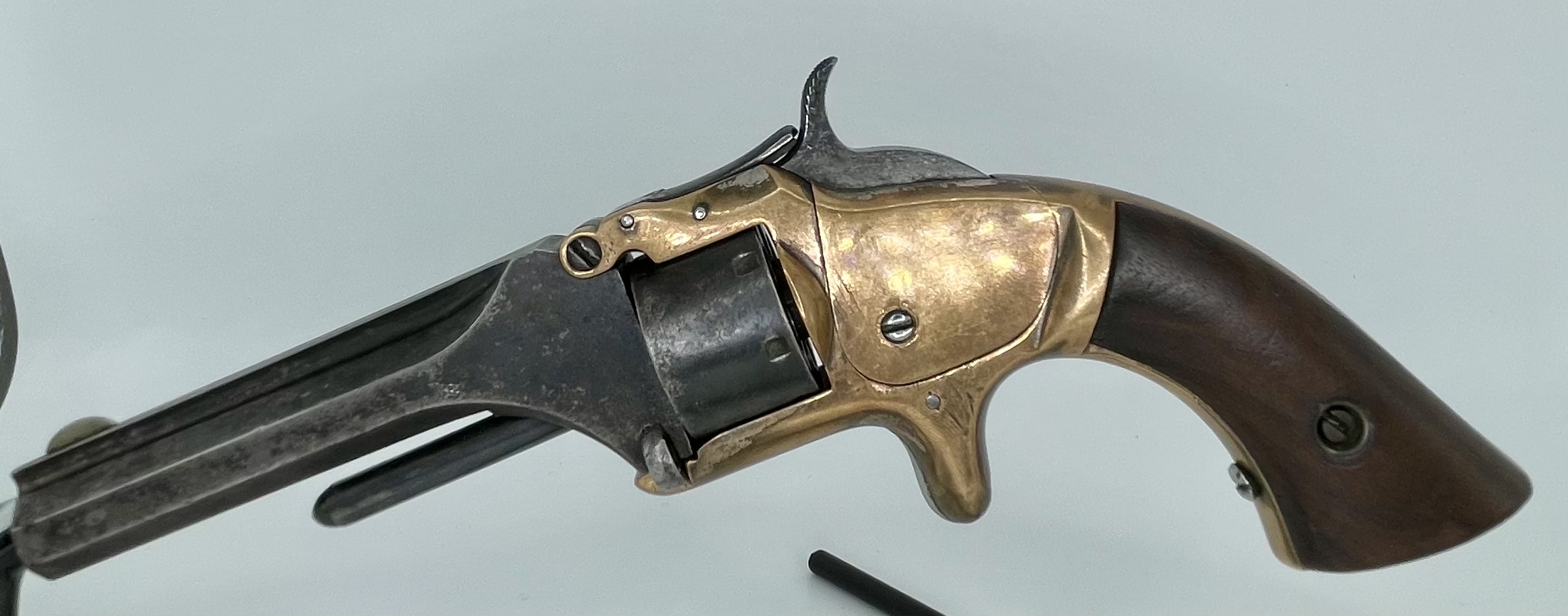
That’s a Smith and Wesson, Model 1, Second Issue.
I wanted to do a post on these, and I already had photos taken. I even did some of the writing previously in other (private) forums.
This morning’s “Wheelgunner” mailing from the Guns magazine folks links to an article, “The Model 1: Smith & Wesson’s little rimfire” by Holt Bodinson, which goes into more detail about the Model 1. So I can save myself some effort by just linking to that. Aren’t I S-M-R-T smart?
The Model 1 pioneered two things. The first was the rimfire cartridge:
The second was the “bored-through cylinder”:
This is where Smith and Wesson history began. (To be technical, S&W history really began with the Model 1, First Issue, First Type, or 1st 1st 1st as some people call it. These are not common: there were about 213 made. According to the Standard Catalog, the earliest known example sold at auction in 2020 for a little over $40,000.)
This is my first Model 1, Second Issue, serial number 22845:
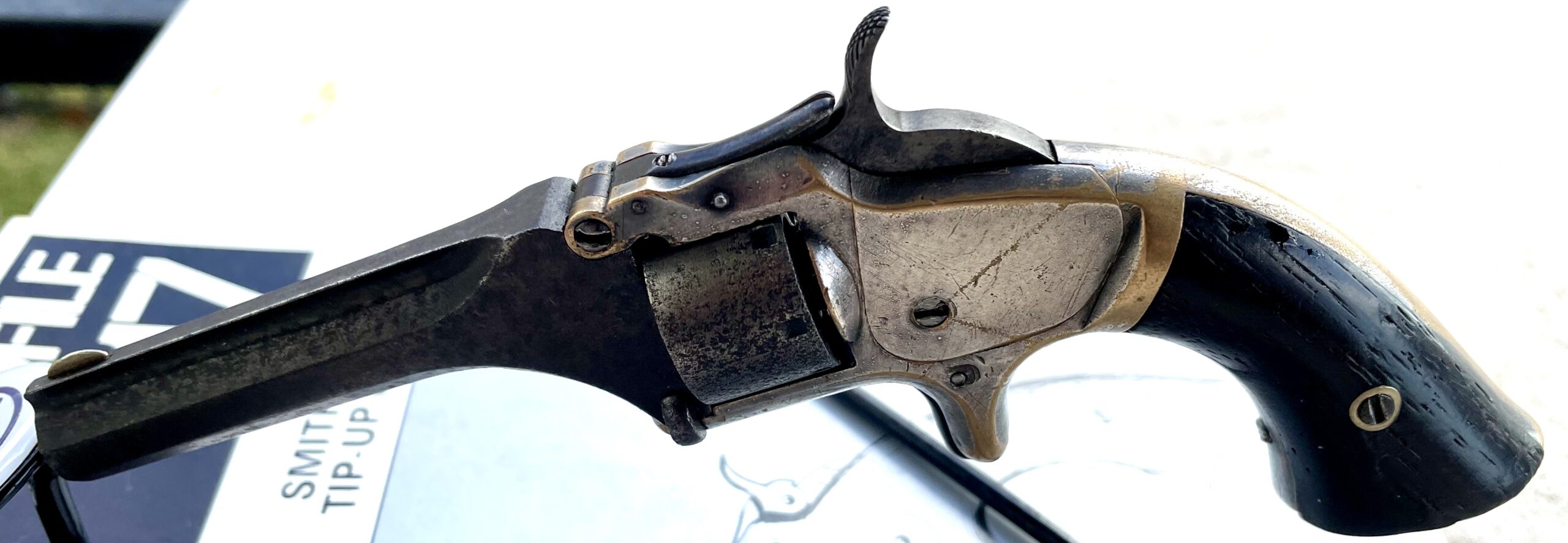
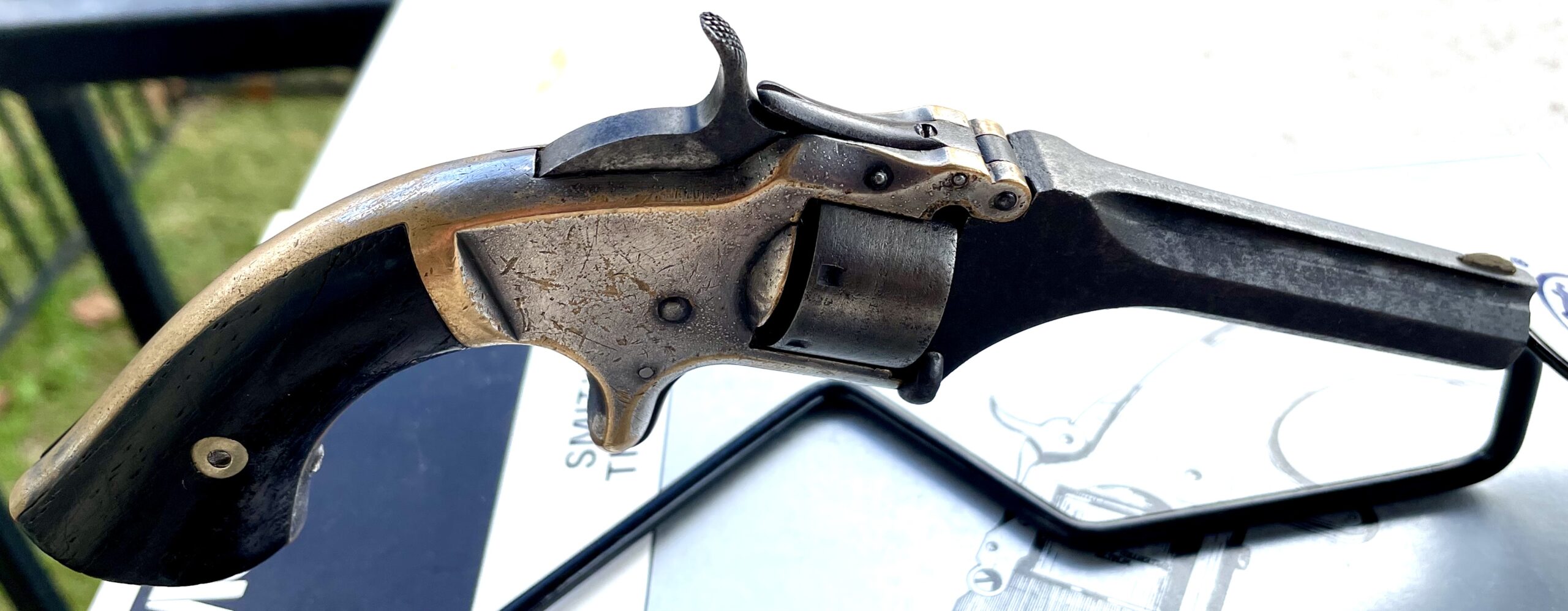
It is not in great shape. The cylinder has some pitting:
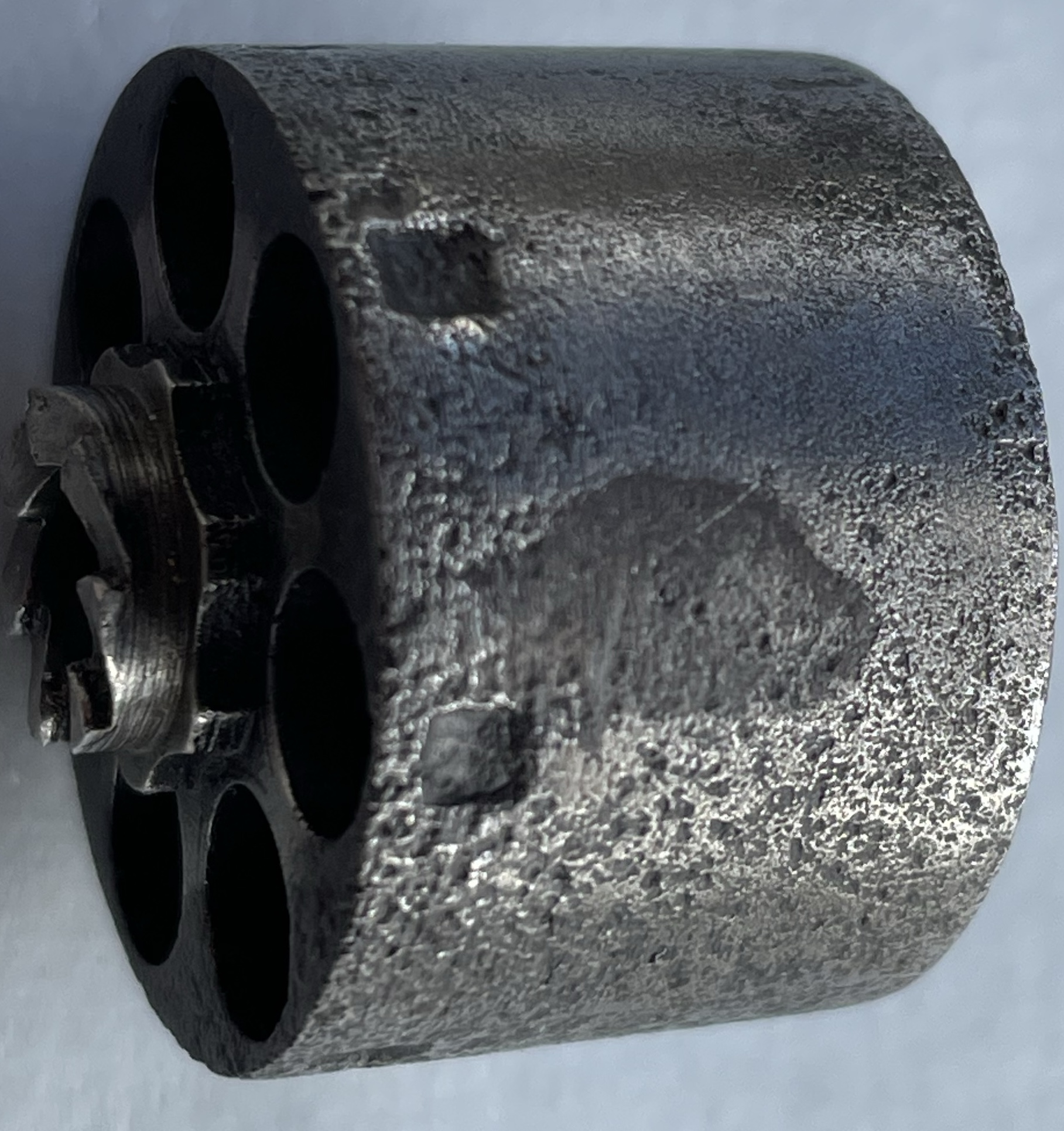
The ejector rod is missing, and the cylinder hand (the part that holds the cylinder in place while the gun is being fired) is broken. I’m seriously considering taking it to a semi-local gunsmith to see if it can be partially restored. I also did not pay a lot for this gun, and I knew the condition going in.
This was part of a three-gun set that came into my local gunshop. I bought the Model 1 first (right after the Glendale Symposium: I tell people we drove 2,500 miles round trip, and I ended up buying a gun five miles from home) and went back later for the other two guns and the accompanying case:
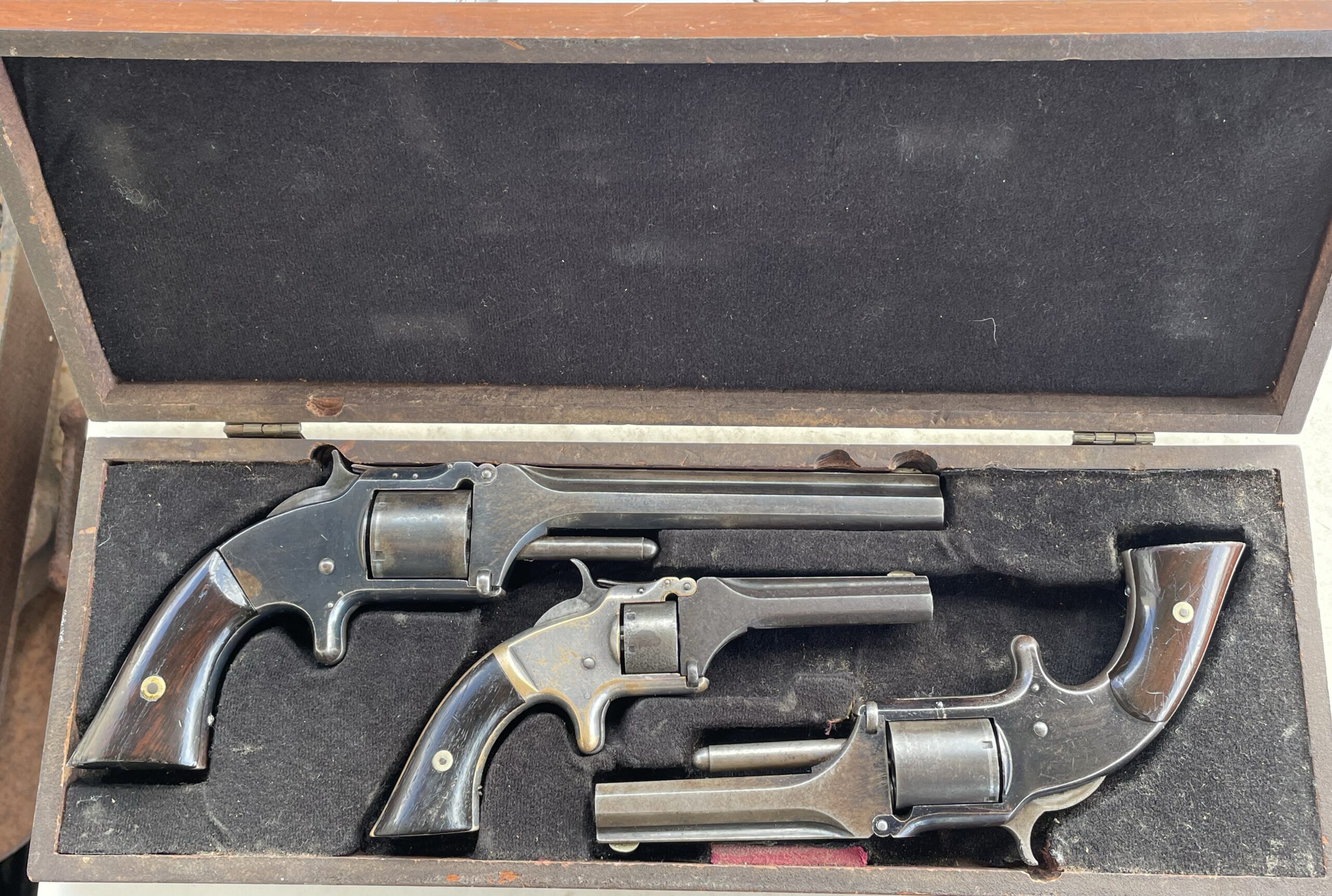
(The other two guns are a S&W Model 1 1/2 and a Model 2. More about those in future posts.)
I also have a shipping letter from the Smith and Wesson Historical Foundation on this gun, which is what makes it special to me. It shipped on December 25th, 1861. Yes, on Christmas Day. So many things in history can be explained by the words “There was a war on”.
I went in to my other local gun shop a couple of weeks ago, and this was in the display case:
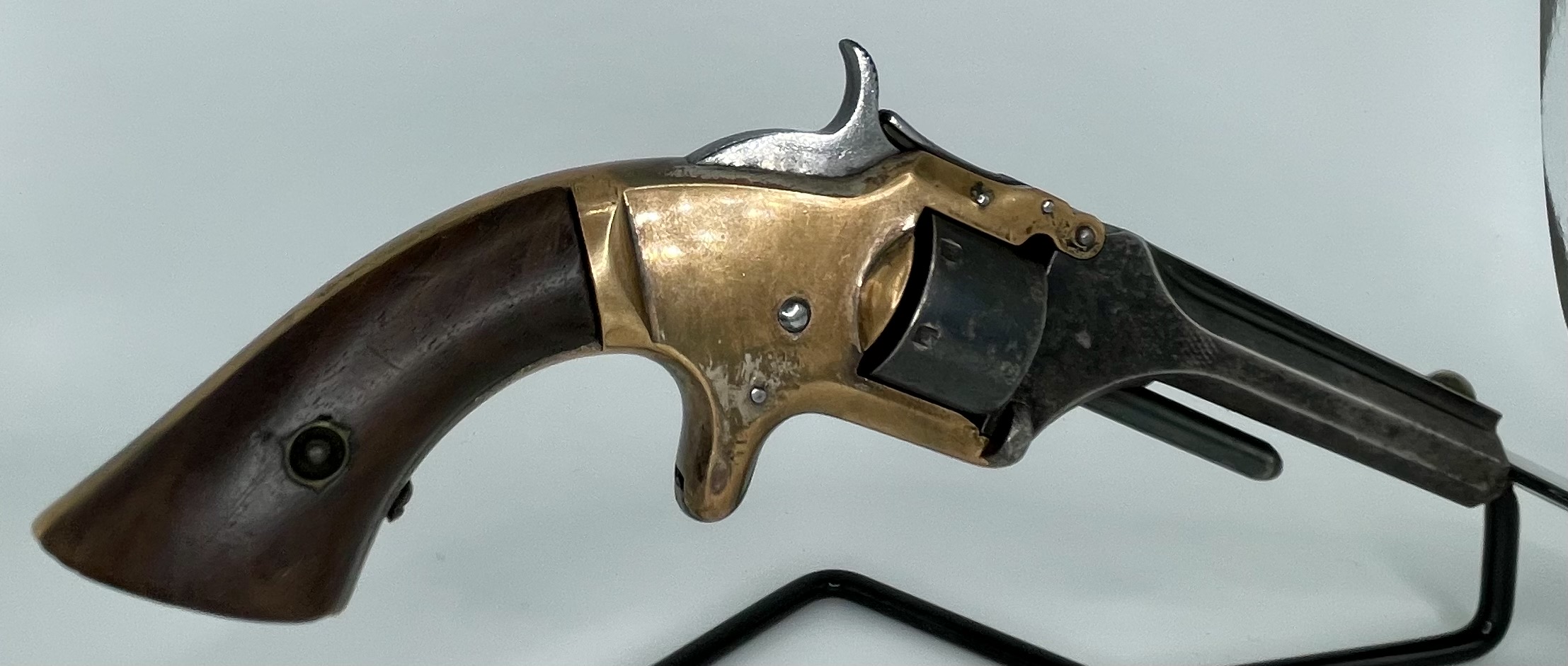
This is also a Model 1 Second Issue (as far as I know), serial number 98582. Of course, it followed me home. It is like these people know me or something.
It is also a much nicer Model 1: I did pay a little more for it, but it has the ejector rod, the cylinder isn’t badly pitted, and it locks up exactly as it should when I cock it. I haven’t fired it, and I’m not going to, because they don’t make black powder .22 short rimfire ammo these days.
(All of the resources I’ve read about the Model 1 strongly warn against trying to fire smokeless powder cartridges in it. Even .22 shorts. A CB cap might fit, but I’m not going to risk turning my gun into a hand grenade.)
I have sent off for a factory letter on this, but I don’t have that in hand yet. So I don’t know when it shipped, except sometime before 1868. (1868 is when S&W introduced the Model 1 Third Issue.)
This isn’t in bad shape at all, for a gun that’s, at a minimum, 158 years old and possibly older. It will be interesting to see what the history letter shows, and I’ll try to post an update here.
I feel like, if I can, I would like to get in another gun crankery post before America 250! (With purchase of any America of equal or greater value.) The question is: do I want to do:
Or do I want to post about the major who was a lady suffragette?
I have an Iver Johnson Safety Automatic, as it was sometimes called, in .32 Smith and Wesson long. It has the Owl Head grips, and functions perfectly, but the barrel is rusted out on the inside.
I am sad about that, but I think that the fact that the guns used black powder and was likely not cleaned very well is to blame. I know that the gun is not very valuable, with the grips probably be worth more than the rest of the gun itself, but it came from my dad, and so it will just sit in my gun safe until I pass it on to my grandson.
[…] gears a bit…I’ve found out some interesting information about this old Smith and Wesson. I have not received the actual history letter yet, and I want to wait on that before I post. […]